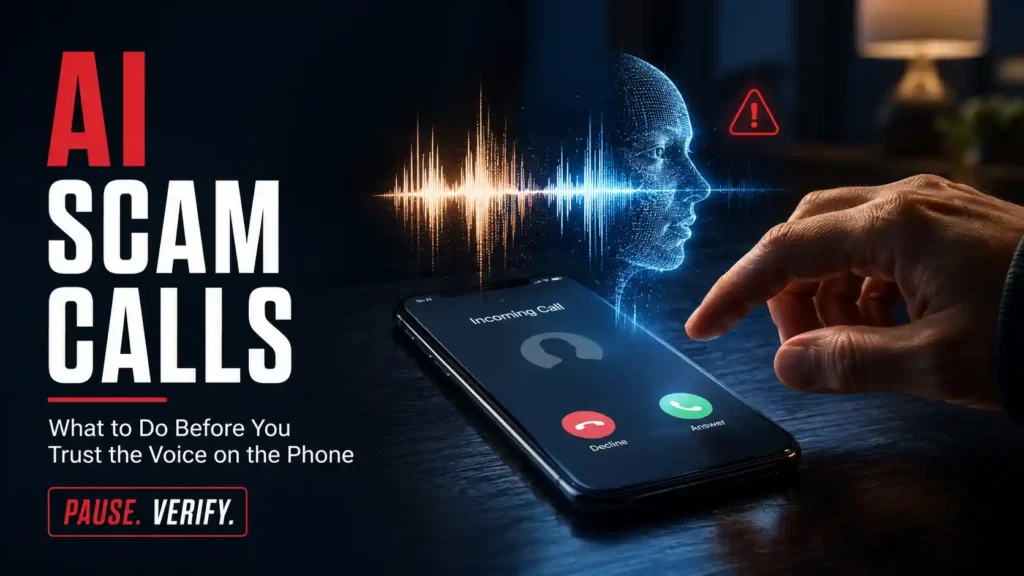
AI scam calls can turn an ordinary phone call into a convincing emergency within seconds. You answer, hear your son crying and immediately recognize his voice. He says he has been arrested after an accident. Before you can ask what happened, a supposed lawyer takes the phone and tells you that thousands of dollars must be sent before the court closes.
Everything inside you says, “Help him now.”
That reaction is exactly what the scammer needs.
The voice may sound authentic. The caller may know your son’s name, where he works and what he calls you. Your screen may even display his real number. None of those details prove that he is actually on the phone.
Artificial intelligence can imitate voices. Caller ID can be manipulated. Personal information can be collected from social media, data breaches and compromised accounts. A familiar voice is now a reason to listen—but it is no longer sufficient proof of identity.
The safest response is not to become an expert at detecting synthetic audio. It is to follow a verification process that works even when the voice sounds completely real.
What Are AI Scam Calls?
AI scam calls are fraudulent phone calls that use artificial intelligence to make an impersonation attempt more believable.
The technology may be used to:
- Clone the voice of someone you know
- Generate realistic speech from written text
- Change a criminal’s voice during a live call
- Create a fake crying or distressed voice
- Translate speech while preserving a copied voice
- Produce convincing automated robocalls
The impersonated person could be:
- Your child
- Your spouse
- Your parent
- Your friend
- Your employer
- A senior executive
- A bank employee
- A police officer
- A lawyer
- A doctor
- A government representative
- A celebrity
The criminal uses the trusted voice to persuade you to send money, reveal confidential information, approve account access or follow dangerous instructions.
How AI Scam Calls Are Created
A scammer first needs audio of the person they want to imitate. That audio may be collected from:
- Public social media videos
- Podcasts
- Online interviews
- Livestreams
- Webinars
- Business presentations
- Video-sharing platforms
- Public voicemail greetings
- A previous phone conversation
The criminal may combine the voice sample with personal information about the target and intended victim.
For example, social media might reveal that:
- You have a daughter studying in another city
- Your parents live alone
- Your employer is travelling
- Your family recently experienced a medical problem
- Your company is working with a new supplier
- You call a relative by a particular nickname
A hacked email or messaging account can reveal even more convincing details.
The scammer then creates an urgent story in which the impersonated person supposedly needs immediate help. The story is constructed to make you respond emotionally before checking whether it is true.
Why AI Scam Calls Are So Convincing
These calls do not succeed because the technology is perfect. They succeed because the voice arrives inside a carefully designed situation.
The scammer combines several forms of pressure:
Familiarity
You hear a voice you already trust.
Fear
The caller describes an arrest, accident, account breach or another emergency.
Urgency
You are told that waiting could cause serious harm.
Secrecy
You are instructed not to speak to anyone else.
Authority
A supposed lawyer, officer, doctor or executive reinforces the story.
Payment Pressure
You receive precise instructions for sending money before you can verify the caller.
The voice opens the door. Psychological pressure pushes you through it.
What to Do Before You Trust a Voice on the Phone
The following steps are designed to protect you whether the suspicious voice belongs to a stranger, an artificial intelligence system or a real person using a stolen account.
1. Pause Before You Answer the Request
The first thing you need to do is nothing.
Do not:
- Send money
- Read out a security code
- Confirm account information
- Click a link
- Install an application
- Approve a login
- Transfer the call to another department
- Follow instructions to move your savings
Take one slow breath and separate the caller’s identity from the caller’s request.
Ask yourself:
- What am I being asked to do?
- Why must it happen immediately?
- What would I do if I did not recognize the voice?
- Can I verify this request without the caller’s help?
You do not need proof of a scam before pausing. An unexpected high-risk request is enough reason to stop.
2. Do Not Trust Caller ID
A familiar name or phone number on your screen can make the call feel legitimate before you hear a single word.
However, caller ID information can be manipulated. A fraudulent call may appear to come from:
- A family member
- Your bank
- A local police department
- A government office
- Your employer
- A known business
A criminal may also contact you through a compromised phone or messaging account.
Treat the displayed number as unverified information. It tells you what appeared on your screen, not who is actually speaking.
3. Listen to the Request, Not Just the Voice
A convincing voice can distract you from an absurd or highly unusual demand.
Focus on what the caller wants.
Be suspicious if you are asked to:
- Send money to an unfamiliar person
- Buy gift cards
- Transfer cryptocurrency
- Move money into a “safe account”
- Share a password or PIN
- Read out a one-time code
- Approve remote access to your phone or computer
- Keep the request secret
- Ignore normal workplace procedures
- Remain on the line while completing a payment
Ask whether the real person would normally make that request in that way.
If your daughter would never ask you to pay a lawyer with gift cards, the request does not become sensible because the voice resembles hers.
4. Ask for Your Family Safe Word
A family safe word is a private word or phrase used to verify identity during an emergency.
Ask:
“What is our emergency word?”
Do not say the word yourself. Do not provide the first letter or offer possible answers.
If the caller changes the subject, claims to have forgotten it or becomes angry, end the call.
Choose a safe word that is:
- Easy for trusted relatives to remember
- Difficult for a stranger to guess
- Unrelated to information posted online
- Not based on a pet, school or birthday
- Replaced if it may have been exposed
A safe word is helpful, but it should not be your only test. A criminal who has accessed private messages might discover it. Always combine it with an independent callback.
5. Ask an Unexpected Personal Question
Voice-cloning technology may reproduce someone’s speech without reproducing that person’s private memories.
Ask about a recent experience that is not available publicly.
For example:
- “What did we discuss during our last private call?”
- “Where did we agree to meet next weekend?”
- “What did you ask me to keep for you?”
- “What joke did you make yesterday?”
- “Who did we agree I should contact during an emergency?”
Avoid basic questions involving:
- Birthdays
- Addresses
- School names
- Pet names
- Employers
- Favourite sports teams
- Information visible on social media
A scammer may ignore the question, repeat the emergency, claim the signal is poor or hand the call to a supposed authority figure.
A correct answer is useful but still not conclusive. Verify the caller separately.
6. End the Call Yourself
Do not remain connected while trying to verify the story.
The scammer may continue speaking, intensify the threat or tell you that ending the call will make the situation worse. That constant pressure makes clear thinking difficult.
Say:
“I am ending this call and verifying the situation independently. I will not send money or disclose information during an incoming call.”
Then hang up.
You are not being rude. You are protecting yourself.
A genuine family member, employer or institution should understand the need for secure verification.
7. Call the Person Using a Number You Already Know
Contact the real person through a trusted number saved before the suspicious call.
Do not:
- Press redial
- Call a number supplied by the caller
- Use a link sent during the conversation
- Trust contact details in a follow-up message
- Ask the suspicious caller where you should call
If the person does not answer, try:
- A second known number
- Their established messaging account
- Their spouse
- A close friend
- Their workplace
- Their school
- Someone likely to be physically near them
Failure to reach the person immediately does not prove the emergency is real.
8. Verify the Story With a Separate Organisation
If the caller claims to represent a bank, hospital, police department, court or government agency, locate that organisation’s official contact information yourself.
Call and ask whether:
- The person is there
- The case or reference number exists
- The employee works for the organisation
- The requested payment method is legitimate
- The described procedure is real
Do not trust an official-looking website or contact number sent by the caller. Search independently, use the number printed on an existing bank card or access the organisation through its established application.
9. Involve Another Trusted Person
Scammers often demand secrecy because a second opinion can expose the lie.
Before sending money or disclosing information, contact someone you trust and explain:
- Who called
- What they claimed
- What they asked you to do
- How they wanted to be paid
- Why they said the matter was urgent
Another person may notice contradictions that fear prevented you from seeing.
Create a family rule that emergency payments require confirmation from at least two people whenever possible.
10. Verify the Payment Recipient
Even if the emergency appears real, confirm where the money is going.
Ask:
- Does the recipient’s name match the supposed organisation?
- Has this account been used before?
- Why is the money going to an individual?
- Why did the payment information suddenly change?
- Does the organisation accept this payment method?
- Can the payment be reversed?
- Can I pay the organisation directly?
Do not assume that a lawyer, police officer or doctor would request payment through an unrelated account.
A request for gift cards, cryptocurrency or cash delivered to a stranger should make you stop immediately.
11. Refuse to Reveal One-Time Security Codes
A caller may claim that a code is needed to verify your identity, cancel a transaction or secure your account.
The code may actually allow the criminal to:
- Reset your password
- Enter your email account
- Approve a bank transfer
- Add a new payment recipient
- Take control of your phone number
- Bypass multi-factor authentication
Never read a one-time code to someone who called you.
A message that says “Do not share this code” means exactly that—even if the caller claims to work for the company that sent it.
12. Refuse Remote Access Requests
A fake technical-support agent, bank employee or fraud investigator may tell you to install an application that allows them to see or control your device.
Do not install:
- Screen-sharing software
- Remote desktop tools
- Unfamiliar security applications
- Files sent through text or email
- Browser extensions requested during the call
Remote access can allow a criminal to view passwords, intercept codes, transfer money and alter what appears on your screen.
If you genuinely need technical assistance, contact the company through a trusted channel after ending the call.
13. Follow Established Workplace Procedures
AI scam calls can be particularly costly when criminals impersonate executives.
The caller may claim that:
- A confidential acquisition requires immediate payment
- A supplier has changed bank accounts
- Gift cards are needed for clients
- An invoice must be paid before a deadline
- Normal approval rules should be skipped
- Only you can be trusted with the transaction
Do not allow authority or secrecy to override financial controls.
Before approving a business request:
- Call the executive through a known number.
- Obtain written confirmation through an authorised channel.
- Confirm new banking details with the supplier independently.
- Require a second approver.
- Document the request.
- Follow the same process regardless of the caller’s seniority.
A real executive should support controls that protect the company.
A Simple Verification Formula: PAUSE–HANG UP–CALL BACK
You do not need a complicated audio-analysis tool during an emergency. Remember these three actions.
PAUSE
Do not comply with the request while fear controls the conversation.
HANG UP
End the incoming call. Do not let the caller supervise your verification.
CALL BACK
Contact the person or organisation through a number you already trust.
If you remember only one thing from this article, remember this formula.
Warning Signs That an AI Scam Call May Be Happening
A suspicious voice call may contain several of the following signs:
- The emergency begins immediately.
- The caller pressures you to act within minutes.
- You are told not to contact anyone else.
- The story contains few verifiable details.
- The caller refuses personal questions.
- The caller cannot provide the family safe word.
- The voice repeats phrases or pauses strangely.
- Someone else quickly takes over the call.
- You are prevented from calling back.
- The payment must go to an unfamiliar recipient.
- You are asked for gift cards or cryptocurrency.
- You are told to move money for protection.
- You are asked for a password or security code.
- The request violates normal family or workplace procedures.
- The caller becomes aggressive when you insist on verification.
Do not wait for every sign to appear. One unexpected high-risk request is enough reason to verify.
Exact Scripts to Use During an AI Scam Call
Prepared words can help you resist emotional pressure.
If the Voice Sounds Like Your Child or Grandchild
“I want to help you, but I will verify your identity through our normal contact method first. I will call you back.”
If a Supposed Lawyer Takes the Phone
“Give me your full name, organisation and case number. I will find the official number and verify the case independently.”
If the Caller Claims to Be Your Bank
“I do not discuss account security during incoming calls. I will contact the bank using the number on my card.”
If You Are Told to Move Money
“I will not transfer money to protect it. I will visit or contact my bank directly.”
If Your Supposed Boss Requests a Payment
“I cannot approve financial changes through a voice call. I will follow our established verification and approval process.”
If the Caller Requests a Security Code
“I never share passwords or one-time codes.”
If the Caller Demands Secrecy
“I do not make confidential emergency payments without independent confirmation.”
You do not need to argue. State your rule and end the call.
Common AI Scam Call Scenarios
Family Emergency Calls
A familiar voice claims to have been arrested, injured or stranded. A supposed lawyer or officer then requests immediate payment.
Your response: Call the family member independently and verify the official’s identity through the organisation’s published number.
Virtual Kidnapping Calls
You hear screaming or a familiar voice pleading for help. Another caller demands payment and warns you not to contact anyone.
Your response: Do not reveal information about the person. Quietly contact them through another device and notify emergency services.
Bank Impersonation Calls
A caller claims that criminals are stealing your money and tells you to transfer it to another account.
Your response: Do not move the money. End the call and contact your bank through a verified number.
Executive Impersonation Calls
A cloned executive orders an urgent transfer or confidential purchase.
Your response: Apply established approval procedures and verify through a separate communication channel.
Government and Police Impersonation
A realistic voice claims you owe money, face arrest or must pay a fine immediately.
Your response: Do not pay during the call. Contact the relevant agency independently.
Technical-Support Calls
A caller claims your device or account has been compromised and requests remote access.
Your response: Refuse access, end the call and contact the company through official support.
How to Prepare Your Family Before an AI Scam Call
Preparation protects you when emotion makes careful thinking difficult.
Choose a Family Safe Word
Every trusted family member should know it. Do not send it casually through an unsecured group message.
Create a Two-Person Payment Rule
No one sends emergency money without informing and consulting another trusted person.
List Trusted Contact Methods
Record the numbers of close relatives, schools, workplaces and other important contacts.
Discuss Realistic Scenarios
Explain what family members should do if someone claims that:
- A relative has been arrested
- A child has been kidnapped
- A family member lost a phone
- A lawyer needs immediate payment
- A bank account is under attack
Protect Public Information
Review social media privacy and reduce public exposure of:
- Family relationships
- Phone numbers
- Travel plans
- School information
- Workplace details
- Daily routines
- Clear voice recordings of children
You may not be able to remove every voice sample, but you can make personal research more difficult.
Secure Email and Messaging Accounts
Use unique passwords, multi-factor authentication and login alerts.
A criminal who accesses your private messages can learn enough about your family to make an AI-generated call far more convincing.
What to Do If You Receive an AI Scam Call
If you suspect that a call used a cloned or generated voice:
- End the call.
- Confirm the real person’s safety.
- Preserve any voicemail or audio message.
- Screenshot texts, account details and payment instructions.
- Record the time, number and story used.
- Warn the person being impersonated.
- Alert other possible targets.
- Notify your bank if financial details were discussed.
- Secure any exposed accounts.
- Report the incident through the appropriate fraud channels.
- Block the suspicious number after preserving the evidence.
Do not repeatedly call the criminal or reveal your family’s entire verification process.
What to Do If You Already Trusted the Voice
If you sent money or disclosed information, act immediately.
Contact Your Financial Provider
Explain that the transaction was caused by an impersonation scam.
Ask whether the payment can be:
- Cancelled
- Recalled
- Frozen
- Reversed
- Flagged as fraudulent
Give the provider all available recipient and transaction details.
Contact the Payment Service
If you used a wire service, payment application, cryptocurrency platform or gift card, contact that provider through an official support channel.
Keep receipts, card numbers, transaction IDs and wallet addresses.
Change Exposed Passwords
Change the affected password immediately and replace it anywhere else you reused it.
Also:
- Sign out of all sessions
- Remove unfamiliar devices
- Enable stronger authentication
- Review recovery information
- Check for new payment recipients
- Examine recent account activity
Preserve the Evidence
Keep original copies of:
- Call logs
- Audio messages
- Voicemails
- Text messages
- Emails
- Payment receipts
- Account information
- Usernames
- Screenshots
- A written timeline
Do not edit the original audio.
Report the Fraud
Notify the affected financial providers, platforms, relevant reporting services and local law enforcement.
Fast reporting may help interrupt the movement of stolen funds, although recovery cannot be guaranteed.
Watch for Recovery Scams
After losing money, you may be contacted by someone claiming they can recover it for an upfront fee.
The person may know details about the original attack because your information was shared or sold.
Do not pay an unverified investigator, hacker or recovery service.
Frequently Asked Questions About AI Scam Calls
Can AI make a caller sound exactly like someone I know?
AI can create a highly convincing imitation of a person’s voice, including aspects of accent, pitch, rhythm and emotional delivery. The quality varies, but recognition alone is not reliable proof.
How much audio is needed to copy a voice?
The amount depends on the technology and audio quality. Short, clear recordings may produce recognizable results, while additional clean audio may improve the imitation.
Can an AI voice respond during a live conversation?
Yes. Some attacks use fixed recordings, while others use real-time generation or voice conversion that allows the criminal to answer questions.
Is a strange pause proof that the voice is fake?
No. Unusual pauses can raise suspicion, but poor reception or emotional stress can affect a genuine caller. A smooth voice can also be artificial.
Can an AI scam call come from a familiar number?
Yes. Caller ID can be manipulated, and trusted accounts or devices may be compromised.
What if the caller answers my private question correctly?
Continue verifying. The answer may have come from stolen messages, public information or earlier social engineering.
Should I call the number back?
Use a number that you already knew and trusted before the suspicious call. Do not simply redial or use contact information supplied during the interaction.
What is the safest way to confirm a family emergency?
End the call, contact the family member directly through a known method and confirm the story with another trusted person or relevant organisation.
Should I use an AI voice-detection application?
A detection tool may offer additional information, but it should not replace an independent callback and verification. Detection systems can make mistakes.
What is the clearest sign of an AI scam call?
An unexpected request for money, account access or sensitive information—especially when combined with urgency, secrecy or resistance to verification—is the clearest practical warning.
Final Word: The Voice Is a Claim, Not Proof
You do not need to determine exactly how an AI scam call was created before protecting yourself.
The voice may be cloned. It may be prerecorded. The caller may be using real-time voice conversion. The criminal may simply be a skilled impersonator.
Your response remains the same:
- Pause.
- Refuse the immediate request.
- End the call.
- Contact the person independently.
- Verify the story with a second source.
- Protect passwords and security codes.
- Follow established payment procedures.
- Involve another trusted person.
A voice can sound familiar and still be fake. A caller can know private information and still be a criminal. A phone number can look correct and still be manipulated.
Before you trust the voice on the phone, verify the person behind it.


Pingback: AI Grandparent Scam: The One Question That Could Stop a Costly Mistake - SafeGuard Press
Pingback: How to Identify a Scammer on the Phone: 21 Red Flags and a 60-Second Verification Test - SafeGuard Press