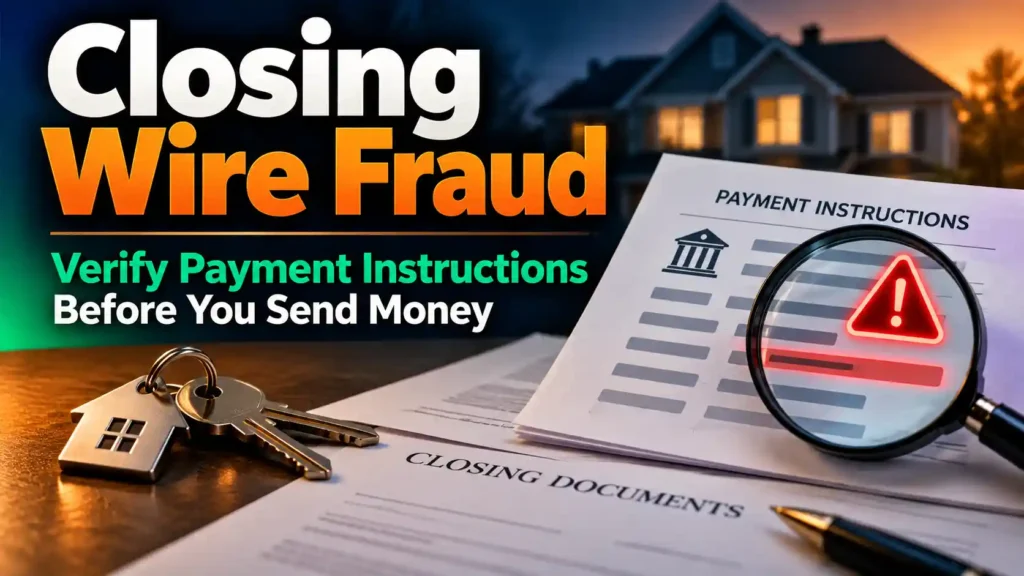
Before sending closing funds, call the person responsible for receiving them using a phone number you obtained independently. Read the recipient name and account details aloud. If you cannot confirm them, do not send the wire.
That one call matters even when the instructions look completely genuine.
Imagine that your home purchase is nearly complete. An email arrives with your property address, the correct closing date and the amount you expect to pay. It appears to come from someone on your closing team. The message says to use the attached bank instructions instead of the earlier ones.
You have arranged the move. You do not want to delay closing. So you send the money.
Later, the legitimate closing professional says it never arrived.
This is closing wire fraud: a criminal redirects money from a real property transaction into an account they control. The property may be genuine. The professionals may be genuine. The payment destination is the part that has been changed.
This guide shows you how to verify instructions before transferring money, what to say during the verification call and what to do immediately if you may have sent funds to the wrong account.
What Is Closing Wire Fraud?
Closing wire fraud happens when someone deceives a buyer, seller or other participant into sending property transaction funds to an unauthorized account.
For a homebuyer, the targeted money is often a down payment or closing costs. A seller’s proceeds or funds intended to pay off an existing mortgage can also be redirected.
The criminal might impersonate a real estate agent, attorney, title company, escrow officer or lender. They may send a message from a slightly altered email address. In some cases, an actual account involved in the transaction may be compromised, allowing the criminal to see details and send a message at the right moment.
You may also see this described as real estate wire fraud, mortgage closing fraud or closing payment fraud. The name matters less than the question you must answer before paying:
Has the intended recipient independently confirmed this exact account?
The Five-Minute Check Before You Send Closing Funds
Do this even if you have received no obvious warning signs.
- Find a phone number you already trust. Use one from your established closing paperwork, a contact you verified earlier or the professional’s independently located business details. Do not use a number supplied only in the message containing the payment instructions.
- Call the professional responsible for receiving the funds. Your agent may be able to help, but confirm the account with the party handling the actual closing payment.
- Read back the complete instructions. Confirm the recipient’s name, bank, account number and any other required details.
- Ask whether anything changed. If there are earlier instructions, find out whether they remain valid.
- Check what you entered at the bank. A correctly verified document will not protect you if you mistype an account number during the transfer.
If the right person is unavailable, wait until you can reach them. Do not treat an email reply saying “yes, it is correct” as an independent check.
What exactly should you say?
Use this script:
“I am about to send closing funds for the property at [address]. I am calling on the number I already have for your office to verify the payment instructions. Please confirm the full recipient name, bank and account details. Have any of those details changed?”
After the professional answers, read the details on your instructions back to them. Ask how and when they will confirm receipt.
If you are passed to another person, establish that person’s role through the office you called. Do not let an unexpected caller take over the verification.
Why a Convincing Email Is Not Enough
A fraudulent message does not have to look sloppy.
It might include your full name, the address of the property, the exact amount due and the date of closing. It may use the correct logo and professional signature. It could arrive in an existing email thread.
Those details show that the sender knows about the transaction. They do not prove the sender is authorized to change where the money goes.
A criminal may have copied information from previous messages, imitated an address or accessed an account involved in the closing. That is why checking spelling and logos alone cannot settle the question.
For a closer look at suspicious sender addresses, links and requests, read how to tell if an email is from a scammer. Apply the phone verification above even if the email passes those checks.
Warning Signs in Real Estate Wire Instructions
Any unexpected payment instruction deserves verification. These details make the need especially urgent:
- The bank account changes shortly before closing.
- The message says earlier instructions were “incorrect” or “cancelled.”
- You are told to switch from an agreed payment method to a wire.
- The account holder’s name does not match the recipient you expected.
- The sender supplies a new number and insists you call it for confirmation.
- The message says the closing will fail unless you act immediately.
- Someone asks you to keep the change from another member of the closing team.
- The sender discourages you from visiting the office or calling your established contact.
A legitimate transaction can sometimes require a correction. These signs do not prove that a person is dishonest. They tell you where to stop and verify.
There may also be no visible warning signs at all. Make the independent call every time.
A Last-Minute Change to the Bank Account: What Should You Do?
Do not transfer the money using the new details yet.
Call the established professional who handles the funds. Ask whether the change was authorized, why it was made and what happened to the previous instructions. Have them confirm the full new account details aloud.
If the person cannot answer, ask to speak with the responsible colleague through the same verified office number. If the office is closed, wait. Do not let a deadline inside the suspicious message dictate how you handle a major transfer.
You can say:
“I will send the funds after I verify the changed account through our established contact. Please let the closing team know that I am checking the instructions.”
This is a reasonable step. A genuine closing professional should understand why a buyer will not wire a large sum based only on a changed email.
Set Up Your Protection Before Closing Day
You can make the verification easier long before payment is due.
Save the right contact details
Ask who will issue the final payment instructions and who can confirm them by phone. Save that person’s name, role and office number from an independently verified source.
If your agent, attorney and title or escrow company are all involved, clarify which one actually receives the funds.
Ask how instructions will arrive
Will you receive them through an established portal, in person or by another agreed method? What should you do if an email arrives instead? Knowing the normal process makes an unexpected change easier to challenge.
A secure portal can help, but do not assume a link in an email takes you to the genuine portal. Open it using an address or method you already know.
Discuss changes in advance
Ask:
“If the payment details ever change, who will call me, and how can I verify the new instructions?”
Write down the answer. The important point is to establish the process before someone pressures you with an urgent update.
Allow time for a problem
Do not leave the transfer until the last possible minute. You may need to reach the closing team or your bank to resolve a mismatch. A sensible verification delay is better than a rushed payment to an account nobody has confirmed.
Can a Real Email Thread Contain Fake Instructions?
Yes. Being in the correct conversation is not enough.
If a criminal gains access to an account used in the transaction, they may be able to read earlier messages and send a new one in context. A lookalike address can also be missed when people are busy preparing to close.
This is why “the email sounded like my agent” is weak evidence. The test is whether you contacted the intended recipient through a route the new message did not give you.
If the professional says they never sent the instructions, stop engaging with the suspicious sender. Preserve the message and tell the closing team what you received.
Will Your Bank Catch a Wrong Recipient Name?
Do not rely on it.
Banks’ transfer screens and checks can differ. A form may allow you to enter the name of the intended closing company while the account number points somewhere else. A warning or mismatch should be taken seriously, but the absence of one is not proof that the destination is correct.
Confirm the name and number with the intended recipient. Then compare them carefully with what you enter at your bank. If anything differs, stop and ask your bank and closing professional to explain it before you submit the payment.
The same rule applies if someone suggests sending a small “test wire.” A test payment to a fraudulent account does not make a later, larger payment safe.
I Already Sent the Wire. What Do I Do First?
Call the sending bank’s fraud department now—whether the transfer says “pending,” “sent” or “completed.” Do not spend time trying to determine on your own whether the money has reached the receiving account.
Tell the bank:
“I sent a wire for a real estate closing and believe the payment instructions were fraudulent. Please check its status immediately and attempt to stop or recall it. What information do you need from me right now?”
Have the amount, transfer time, recipient account details and transaction reference ready. Ask for a case number and record whom you spoke with.
If your regular branch is closed, look for the bank’s established fraud or wire support channel. Do not call a “recovery number” supplied by the person who sent the suspicious instructions.
A stop or recall attempt may be possible, but success is not guaranteed. Make the call anyway, immediately.
Next, alert the real closing professional
Use the number you trusted before the suspicious message arrived. Tell the closing professional where you sent the funds, when you sent them and why you believe the instructions were false.
Ask them to preserve their communications and check whether anyone else in the transaction received altered instructions. Do not quietly send a second payment to keep the closing on schedule. First establish what happened and verify any new request.
Report the suspected fraud
Follow the reporting route for the place where the transaction occurred. In the United States, internet-enabled financial crime can be reported through the FBI’s Internet Crime Complaint Center. Your bank may also ask you for a report number or additional documents.
The bank call comes first. Reporting is important, but it should not delay the attempt to stop or recall the transfer.
Preserve the original evidence
Save the payment instructions, email conversation, any text messages, transfer confirmation and closing documents. Record the time of each call and the names or case numbers you receive.
Do not alter or delete the original messages. If the sequence is confusing, write a separate timeline while the events are fresh in your mind.
What If You Clicked the Message but Did Not Send Money?
Your next step depends on what you did after clicking.
If you only viewed a page and entered nothing, stop using that page and alert the genuine closing team to the suspicious message.
If you entered an email password, banking credentials or a security code, secure the affected account through its official app or website. Contact the provider, review recent activity and tell the closing team that communications may have been exposed.
If you downloaded a file or shared identity documents, preserve the message and seek appropriate help for the affected device or accounts. For a step-by-step assessment based on what you clicked, shared or paid, read how to know if you are scammed.
Do not assume that “no wire sent” means there is no problem. A stolen email login could let a criminal interfere with later instructions.
What If You Discover the Fraud the Next Day?
Contact the bank immediately anyway. Tell it when you learned of the suspected fraud and ask what recovery actions are still available. Then notify the genuine closing professional and make the relevant report.
Do not assume the funds can be automatically reversed. Do not assume there is no point in calling. The status of the money and the available response can vary.
Keep the bank’s case number and follow up through its official channels. Be especially cautious if someone later contacts you claiming that the money has been found and can be released for a fee. A person who knows the details of your loss is not necessarily a legitimate investigator.
Buyers Are Not the Only People at Risk
A buyer is the most obvious target because they may be sending a down payment and closing costs. But a property sale can involve other large payments.
A seller expects to receive the sale proceeds. An existing mortgage may need to be paid off. A criminal may attempt to redirect either payment by impersonating someone authorized to change the account details.
If you are selling, ask the closing professional in advance where proceeds will go, how the mortgage payoff will be handled and how changes are verified. If you receive notice of a new account that you did not request, call through established contacts immediately.
The same principle protects every participant: no account change should be accepted solely because it appears in an email.
Closing Wire Fraud: Frequently Asked Questions
What is the safest way to verify closing wire instructions?
Call the person responsible for receiving the funds using a phone number obtained independently. Confirm the recipient name, bank and account details aloud before authorizing payment.
Can closing wire instructions change legitimately?
Yes. A change is possible, but it must be verified through your established contact route. Do not rely on the message announcing the change as proof.
Is the email safe if it came from my actual agent’s address?
Not necessarily. A real account may have been compromised. Confirm the payment destination with the professional responsible for receiving the funds.
What if the message knows my exact closing amount?
Correct transaction details make a message more convincing, but they do not prove that the account belongs to your closing professional. Make the independent call.
Can I verify instructions by replying to the email?
No. A reply stays within the same channel that may be compromised or impersonated. Call a number you trusted before the payment request arrived.
Should I call the number printed on the wire instructions?
Use it only if you have independently established that the number belongs to the intended recipient. A fraudulent document can include a fraudulent verification number.
Are last-minute bank changes always scams?
No, but they are a strong reason to pause. Verify the full new instructions directly before sending money.
Will a small test transfer prove the account is safe?
No. It proves only that money can reach that account. Verify who controls the account before sending any amount.
Can the bank reverse a real estate wire?
The bank may be able to attempt to stop or recall a transfer. Recovery depends on the circumstances and cannot be guaranteed. Contact the sending bank’s fraud department immediately.
What if my transfer still shows as pending?
Call the bank immediately. Do not wait for its status to change. Tell the fraud team you suspect the destination is fraudulent and ask it to act.
What if the wire says completed?
Call the bank immediately as well. Ask it to attempt a recall and tell you what details it needs. Then alert the genuine closing professional and report the fraud.
Should I send a replacement wire to avoid delaying closing?
Do not send another payment until you and the genuine closing professional have addressed the first transfer and independently verified any new instructions.
Verify the Destination, Then Send
Closing wire fraud succeeds when a believable message replaces a verified payment process. The property can be real. The closing can be real. The account in the final instruction can still be wrong.
Before sending money, use a phone number you obtained independently and confirm the complete recipient and account details. If they change, verify them again. If you have already sent a suspicious wire, call your bank’s fraud department immediately.