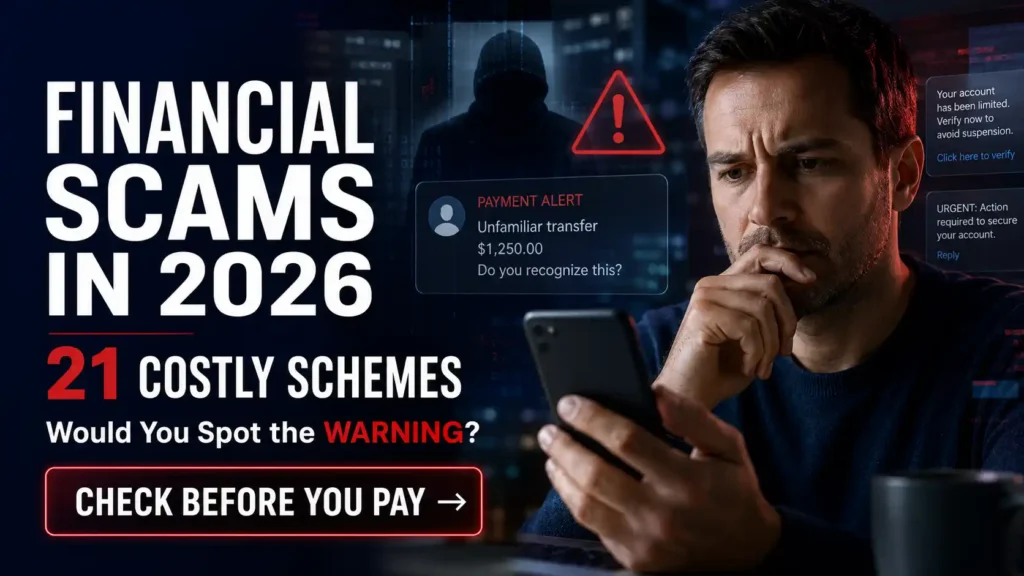
Your phone rings during an ordinary day. The caller sounds calm, professional and genuinely concerned.
They know your name. The number on your screen appears to belong to your bank. According to them, someone is emptying your account right now—and moving your savings is the only way to stop it.
Every minute you hesitate feels dangerous.
That pressure is exactly what the scammer wants.
Financial scams in 2026 are more convincing than the poorly written emails and unbelievable promises you may remember. Criminals can clone voices, copy legitimate websites, manipulate caller ID and create realistic banking alerts. They can also collect personal details from social media and use them to make a false story feel disturbingly accurate.
You do not have to be careless or unfamiliar with technology to lose money. You only need to believe the wrong person during one emotional moment.
This guide reveals 21 costly financial scams you could encounter in 2026. You will learn how each scheme works, which warning signs scammers hope you overlook and what you should do before money leaves your account.
Some of these scams may already look familiar. Others could surprise you—and recognising them now may save you from an expensive decision later.
What Are Financial Scams?
Financial scams are deceptive schemes created to steal your money, financial information, identity or access to your accounts.
A scammer may try to persuade you to:
- Transfer money into a supposedly secure account
- Reveal your banking password or security code
- Invest through a fraudulent platform
- Pay an invented debt, fine, tax or processing fee
- Deposit a fake check and return part of the money
- Install software that gives them access to your device
- Send cryptocurrency, gift cards, cash or gold
- Approve a transaction while believing you are stopping fraud
- Share enough personal information for them to access your accounts later
The first message may arrive through a phone call, email, text, social-media advertisement, messaging app, QR code, fake website or letter.
However, scammers do not always ask for money immediately. A patient criminal may spend days or weeks earning your trust before introducing an urgent financial problem or irresistible opportunity.
Once you accept the story, the payment request can feel reasonable.
Why Financial Scams Are More Convincing in 2026
Technology has made it faster and cheaper for scammers to look legitimate.
Artificial intelligence can produce persuasive messages without obvious spelling mistakes. Voice-cloning tools can imitate a relative, manager or bank employee. A fake website can copy the colours, logo and login page of a company you already trust.
Scammers may also research you before making contact. Information from public profiles, leaked databases and previous breaches could reveal:
- Your full name
- Your workplace
- Your relatives
- Your email address
- Your phone number
- Your date of birth
- Your bank or payment provider
- Places you recently visited
- Products you have purchased
- People you regularly communicate with
When a stranger knows several real facts about you, it becomes easier to believe the rest of their story.
But technology does not complete the scam by itself. The criminal still needs to influence your emotions.
Most financial scams target one or more of these feelings:
- Fear that your money is disappearing
- Urgency to prevent an arrest, penalty or account closure
- Hope of earning a life-changing return
- Relief at receiving an easy loan
- Shame about an alleged debt or private mistake
- Trust in someone who appears to hold authority
- Excitement about winning a valuable prize
- Compassion for someone facing an emergency
Feeling afraid, hopeful or excited does not make you foolish. It makes you human. The danger begins when someone uses that emotion to stop you from checking the facts.
How to Recognize a Financial Scam Quickly
You do not need to understand every new scam to protect yourself. You need a reliable process that works before you pay.
Remember this rule:
If someone creates an emergency and then controls exactly how you must solve it, stop.
A legitimate organisation should allow you to end the conversation, verify the claim independently and contact it through an official channel. A scammer will discourage that pause because time gives you an opportunity to notice the deception.
Be especially careful when someone unexpectedly tells you to pay with:
- Cryptocurrency
- A wire transfer
- Gift cards
- A payment app
- Cash delivered to a courier
- A cryptocurrency ATM
- Gold bars or precious metals
These payment methods are attractive to criminals because recovering the money can be difficult. If someone insists that only one unusual payment method will solve the problem, assume something is wrong until you independently prove otherwise.
21 Common Financial Scams to Avoid in 2026
Financial scams come with different stories, but most depend on the same ingredients: trust, emotional pressure and a payment that is difficult to reverse.
1. Bank Impersonation Scams
You receive a text or call claiming suspicious activity has been detected on your bank account.
The message may mention an unfamiliar purchase, attempted transfer or login from a new device. It might include your bank’s logo, a partial account number or the name of a real department.
Even the caller ID may display the correct bank name.
The supposed fraud specialist asks you to confirm your identity so they can stop the transaction. They may request:
- Your account number
- Your debit or credit card details
- Your online banking password
- Your PIN
- A one-time security code
- Approval of a notification sent to your banking app
The security code is especially important. The criminal may already possess your username and password and need that final code to enter your account.
If you receive an approval request inside your banking app, the caller may tell you that accepting it will cancel a fraudulent payment. In reality, you could be approving a new device, transfer or password change.
Never share a password, PIN or one-time code with someone who contacts you unexpectedly.
End the call and contact your bank through its official app, website or the number printed on your physical card. Do not use the telephone number contained in the suspicious message.
If the alert is genuine, your bank can still help you after you call back through a trusted channel.
2. “Move Your Money to Protect It” Scams
This scheme turns your fear of losing money into the reason you lose it.
A caller claims that criminals have compromised your account. They may pretend to be a bank investigator, police officer, security specialist or government official.
They could tell you:
- A dishonest employee is stealing from your account
- Your identity has been connected to money laundering
- Criminals are preparing to empty your savings
- Your bank account is part of a secret investigation
- Your money must be moved before it is frozen
- Your savings are no longer secure
The caller then introduces a solution: transfer your money to a “safe account,” “protected wallet” or “secure government account.”
The destination belongs to the scammer.
Some criminals keep you on the phone while you travel to your bank, withdraw cash, purchase cryptocurrency or buy gold. They may warn you not to speak with bank employees because those employees are supposedly involved in the crime.
That instruction is a major warning sign.
Your bank will not ask you to move savings into a stranger’s account to prevent fraud. A legitimate official will not send a courier to collect your cash or gold for safekeeping.
If anyone tells you to hide a transaction, lie about a withdrawal or keep an investigation secret from your family, end the conversation.
Contact your bank independently and discuss the situation with someone you trust before moving anything.
3. Fake Credit or Debit Card Fraud Alerts
An unexpected text asks whether you authorised a large purchase.
It may say:
Did you approve a $947 transaction? Reply YES or NO.
Replying “NO” feels like the safest response. However, it can confirm that your telephone number is active and begin the next stage of the scam.
A supposed security representative may call moments later. They offer to cancel the payment, but first they need to verify your card number, expiration date, security code or online banking credentials.
Another version contains a link to a fraud-resolution page. The page looks like your bank’s website and asks you to log in. The information you enter goes directly to the criminals.
Do not reply to the message or tap its link.
Instead, open your banking app manually and check your transaction history. If you remain concerned, contact your bank using the number on your card.
You should also enable notifications for:
- Card purchases
- Bank transfers
- New payees
- Password changes
- New device logins
- Cash withdrawals
- Contact-detail changes
Fast alerts give you a better chance of stopping unauthorised activity before the damage grows.
4. Payment-App Scams
Payment apps allow you to send money in seconds. Unfortunately, that speed can make fraudulent transactions difficult to stop.
A scammer may impersonate your bank and claim someone is transferring money from your account. To reverse the transaction, they tell you to send money to yourself through a payment app.
However, the username or phone number they provide belongs to the scammer.
You may also receive money from a stranger who says they sent it accidentally. They politely ask you to return it, sometimes to a different account.
The original transfer may have come from a stolen card or compromised bank account. If that payment is later reversed, the “refund” you sent could still be taken from your balance.
Payment-app scams also appear in:
- Online marketplace purchases
- Rental deposits
- Concert-ticket sales
- Pet advertisements
- Investment groups
- Romance scams
- Fake emergencies
- Hacked social-media accounts
Before sending money, confirm the recipient through a separate communication channel. Check every letter and number in the username because scammers may create accounts that differ from a real name by one character.
If a friend sends an urgent request, call that person using a telephone number you already know. Their account may have been hacked.
If an unexpected payment appears in your account, do not return it manually. Ask the payment provider to investigate and reverse it through the correct process.
5. Wire Transfer Scams
Wire transfers can move large amounts of money quickly. That makes them particularly dangerous when a scammer changes the payment destination.
You may receive false wiring instructions while:
- Buying a home
- Paying a contractor
- Purchasing a vehicle
- Settling a business invoice
- Paying a supplier
- Sending money to a relative
- Completing a legal transaction
The email may appear to come from your real-estate agent, lawyer, manager, supplier or closing representative.
Sometimes criminals gain access to a real email account and silently monitor conversations. They wait until a large payment is approaching and then send replacement banking instructions at the perfect moment.
Because the message comes from a genuine account, it may contain no spelling mistakes or obvious warning signs.
Before sending a wire transfer, call the intended recipient using a trusted number. Read the account information aloud and ask them to confirm every detail.
Treat any last-minute change in payment instructions as suspicious. Statements such as “our usual account is unavailable” or “send the money to this new account immediately” should trigger additional verification.
If you discover the fraud after sending the transfer, contact your bank immediately. Ask it to recall the payment and notify the receiving institution.
Do not wait until the next day. Criminals often move stolen funds through several accounts quickly, so every minute matters.
6. Fake Check and Overpayment Scams
Someone sends you a check and asks you to deposit it. The amount is larger than expected, so they tell you to keep your share and return the difference.
The story might involve:
- A remote job
- A mystery-shopping assignment
- An online sale
- A rental payment
- A prize
- A grant
- Payment for creative work
- Money for office equipment
- A refund
- A personal assistant position
After depositing the check, your banking app may show that the funds are available. You assume the check has cleared.
That assumption can cost you.
Your bank may make the money temporarily available while it continues verifying the check. A convincing counterfeit can take days or weeks to be discovered.
When the check is eventually rejected, the full deposit disappears from your account. The money you returned to the sender came from your real balance and may not be recoverable.
For example, you deposit a $4,000 check and send $1,500 to a supposed equipment supplier. When the check bounces, the $4,000 credit is removed—but the $1,500 you sent does not automatically return.
Never send money, buy gift cards or purchase cryptocurrency because someone paid you by check.
If a buyer sends more than the agreed amount, refuse the transaction. Ask them to cancel the original check and issue another one for the correct amount.
A genuine payer can correct the mistake without asking you to forward part of the money.
7. Gift Card Payment Scams
A caller claims you owe taxes, missed jury duty, have an unpaid utility bill or must pay a fee to prevent your account from being closed.
They tell you to buy gift cards and provide the numbers from the back.
The story may also sound positive. You supposedly won a prize, secured a job, qualified for a grant or received approval for a loan. You only need to pay a small processing charge first.
The scammer may stay on the phone while you visit different shops. They could tell you which cards to buy, how much money to load and what to say if a cashier becomes suspicious.
They may even instruct you to visit several stores so that one large purchase does not attract attention.
Once you reveal the card number and PIN, the scammer can drain the balance without holding the physical card.
No legitimate bank, government office, utility provider, employer or prize organiser requires gift cards as payment.
If someone demands gift cards, stop the conversation. Do not buy them, even if the caller threatens you with arrest, account closure or financial penalties.
If you already shared the numbers, contact the card issuer immediately. Keep the gift card and receipt, explain what happened and ask whether the remaining balance can be frozen.
You should also change any passwords or financial details you may have disclosed during the conversation.
8. Advance-Fee Loan Scams
When you urgently need money, a guaranteed loan can feel like the answer you have been waiting for.
A supposed lender contacts you by text, email, social media or messaging app. They promise quick approval regardless of your income, debt or credit history.
You may hear persuasive claims such as:
- “Bad credit is accepted.”
- “Your approval is guaranteed.”
- “No credit check is required.”
- “Receive your money within one hour.”
- “Pay one small fee to release the funds.”
The application process may look professional. You could receive loan documents, an approval number and access to a polished website. The representative may even know personal information from an application you completed elsewhere.
However, before releasing the loan, they demand an upfront payment. They might call it:
- An application fee
- Loan insurance
- A processing charge
- A security deposit
- A verification payment
- A credit-improvement fee
- A tax
- An account activation charge
After you pay, another problem appears. You must send an additional amount to resolve it. This continues until you refuse to pay or realise that the loan never existed.
A genuine lender may charge certain disclosed fees, but it will not guarantee approval before reviewing your financial situation and then pressure you to send money through gift cards, cryptocurrency or an unrelated personal account.
Before applying, verify the lender independently. Check its official contact information, physical address, registration details and complete loan terms. Do not rely on documents or links supplied by the person offering the loan.
If the lender focuses more heavily on collecting an upfront fee than assessing whether you can repay the money, walk away.
9. Debt Relief Scams
Debt can make every telephone call feel threatening. Scammers understand that stress and promise a fast escape.
A company may claim it can:
- Eliminate most of your debt
- Stop all collection calls immediately
- Reduce your balance by a guaranteed percentage
- Remove legitimate debts from your credit history
- Create a special government repayment plan
- Prevent legal action without reviewing your case
- Settle every account for “pennies on the dollar”
The representative may pressure you to stop communicating with your creditors and send monthly payments to the company instead.
While you wait for the promised settlement, your original accounts may continue accumulating interest and late fees. Missed payments can damage your credit, and creditors may continue collection efforts.
The company may also collect fees without providing meaningful assistance.
Be careful if a debt-relief provider guarantees a specific result before examining your accounts. No legitimate professional can promise that every creditor will accept a reduced payment.
You should receive a clear explanation of:
- Which services will be provided
- How much those services cost
- When fees will be collected
- How long the process may take
- What could happen if you stop paying creditors
- Whether interest and penalties will continue
- Which debts qualify for the program
Do not allow desperation to make the decision for you. Compare alternatives, speak directly with your creditors and get every promise in writing before paying.
10. Fake Debt Collection Scams
You receive a call about a debt you do not remember—or one you thought you had already paid.
The caller knows your full name, address or part of your identification number. They claim you owe money on an old loan, credit card, medical bill or online purchase.
Then the threats begin.
You may be told that:
- Police are coming to arrest you
- Your wages will be taken immediately
- Your bank account will be frozen today
- Your employer will be contacted
- Your relatives will be told about the debt
- A lawsuit has already been filed
- You must pay before the office closes
Fear can make it tempting to pay first and investigate later. That is the response the scammer is trying to produce.
Do not admit that you owe the debt, and do not provide personal or financial information during the initial call.
Ask for the collector’s:
- Full name
- Company name
- Business address
- Telephone number
- Name of the original creditor
- Exact amount supposedly owed
- Written details of the debt
A scammer may refuse, become aggressive or insist that written verification is unavailable.
Contact the original creditor independently and ask whether the account was transferred or sold to a collection company. Review your records and credit reports for matching information.
Even if the debt is genuine, you still have the right to verify who is collecting it before sending money. Never pay an unknown caller through cryptocurrency, gift cards or a payment app because they threatened you.
11. Credit Repair Scams
A low credit score can affect your ability to obtain housing, financing or affordable credit. That frustration creates an opening for companies promising instant results.
A credit repair scam may claim it can:
- Erase every negative item
- Create a completely new credit identity
- Add hundreds of points to your score within days
- Remove accurate late payments
- Delete legitimate bankruptcies
- Guarantee approval for any credit card
- Hide your real credit history from lenders
Some scammers tell you to use a different identification number when applying for credit. That number may belong to another person, including a child or someone who has died. Using it could pull you into identity theft or financial fraud.
Others repeatedly dispute accurate information to make it disappear temporarily. When the information is verified, it returns.
No company can legally remove accurate negative information simply because it is inconvenient. Genuine errors can be challenged, but you can start that process yourself without paying someone to invent a new identity.
Before hiring help, demand a written agreement explaining the work, cost, timeframe and cancellation terms. Reject anyone who requests a large upfront payment or guarantees a specific score increase.
You should also avoid sharing sensitive documents until you have confirmed who will receive them and how they will be protected.
If your credit report contains accounts you do not recognise, the problem may be identity theft rather than poor credit management. In that situation, focus on securing your identity and disputing the fraudulent accounts—not paying someone for a “credit sweep.”
12. Fake Investment Platform Scams
A convincing investment opportunity may begin with a social-media advertisement, private message, online group or unexpected conversation.
The person introduces you to a trading platform that appears professional. It displays live charts, account balances, customer support and impressive returns.
You deposit a small amount. Shortly afterward, your dashboard shows a profit.
The scammer may even allow you to withdraw a little money. That first successful withdrawal is designed to earn your trust and encourage a much larger deposit.
As your displayed balance grows, the person persuades you to:
- Invest your savings
- Borrow money
- Withdraw retirement funds
- Increase your credit limit
- Invite relatives
- Deposit before a special opportunity expires
- Pay through cryptocurrency
The profits on the screen may be completely fabricated. You are not watching a real investment grow; you are looking at numbers controlled by the scammer.
When you try to withdraw your full balance, the platform demands additional money for taxes, verification, liquidity, insurance or account upgrades.
Paying the new fee does not release your funds. It creates another excuse for collecting more money.
Before investing, verify the company and individual through independent channels. Do not use the registration documents, reviews or contact information they send you because those materials can be fabricated.
Search the exact website address, not just the company name. Scammers often copy a legitimate business and change one letter in the domain.
Be suspicious if someone guarantees returns, claims there is no risk or discourages you from discussing the opportunity with an independent financial professional.
Legitimate investments can lose value. Anyone promising reliable profits without meaningful risk is hiding something.
13. Cryptocurrency Investment Scams
Cryptocurrency transactions can be fast, international and difficult to reverse. Those features make digital assets useful to scammers.
The scheme may begin with an advertisement, investment group, online friendship or unsolicited message from someone who claims to be a successful trader.
They show screenshots of impressive returns and offer to teach you their strategy. The first deposit is usually small so that the decision feels manageable.
After the fake platform displays a profit, you are encouraged to invest more.
You may be told that:
- An exclusive trading signal is available
- A new token is about to increase in value
- Artificial intelligence automatically generates profits
- A celebrity secretly supports the project
- A limited number of investors can join
- Your returns are guaranteed
- You must act before the current price changes
The scammer may direct you to buy cryptocurrency through a legitimate exchange and transfer it into a wallet they control. Once you complete the transfer, the receiving platform may show the funds in your account—but that balance does not prove you own a real investment.
Another version begins with a fake account-security warning. Someone claims your savings are at risk and instructs you to deposit cash into a cryptocurrency ATM for protection.
No real security procedure requires you to convert your savings into cryptocurrency and send it to a stranger’s wallet.
Before transferring digital assets, slow down and confirm:
- Who controls the receiving wallet
- Whether the trading platform is genuine
- How withdrawals work
- Which fees apply
- Whether the person contacting you can be independently verified
- Whether the investment exists outside the website they provided
Never send additional cryptocurrency to unlock a frozen withdrawal. Requests for taxes, security deposits or verification fees usually mean the original investment was fraudulent.
14. Long-Term Cryptocurrency “Relationship” Scams
Some cryptocurrency scams move slowly because the criminal wants more than one payment.
A stranger contacts you through social media, a dating platform or messaging app. They may pretend the message was sent to the wrong person, then continue the conversation because you seem friendly.
Nothing feels threatening at first.
They ask about your interests, work and goals. They share photographs, discuss their daily routine and communicate frequently. Over time, they position themselves as a friend, romantic interest or trusted mentor.
Eventually, cryptocurrency enters the conversation.
The person claims that a relative, mentor or private trading group helps them earn consistent returns. They offer to show you how it works—not because they need your money, but because they supposedly care about your future.
You are directed to a fraudulent investment platform. Your first deposits appear to earn profits, and you may be allowed to withdraw a small amount.
That carefully planned success makes the opportunity feel real.
The scammer then encourages you to invest more. They may connect the decision to your shared future, financial freedom, retirement or family security.
When you attempt a large withdrawal, the account is frozen. The platform demands a tax, release charge or security payment.
By that point, you may struggle to accept that the relationship and investment were both fabricated. The emotional connection can keep you paying even after warning signs appear.
Protect yourself by treating unexpected investment advice from an online contact as dangerous, regardless of how long you have known them.
Reverse-search profile photographs, verify video calls carefully and refuse to invest through a platform introduced by someone you have never met in person. Even a live video is no longer absolute proof of identity because recorded footage, face filters and manipulated video can create convincing illusions.
Most importantly, do not let affection replace independent verification. Someone who genuinely cares about you will not pressure you to transfer savings, borrow money or keep an investment secret.
15. Ponzi and High-Yield Investment Schemes
A Ponzi scheme promises reliable returns but pays earlier participants using money collected from newer investors.
The organiser may present the opportunity as:
- A private investment fund
- A foreign-exchange trading program
- A cryptocurrency mining project
- A real-estate development
- A lending business
- An artificial-intelligence trading system
- An agricultural investment
- An exclusive wealth-building club
At first, everything may appear legitimate.
You receive regular account statements. Small withdrawal requests are processed quickly, and other investors enthusiastically describe the money they have earned.
Those early payments create confidence. You may invest more, encourage relatives to join or leave your supposed profits inside the program so they can continue growing.
The problem becomes visible when too many participants request their money at once or new deposits begin to slow down. Since the operation is not generating enough genuine profit to cover everyone’s balances, withdrawals are delayed and eventually stopped.
The organiser may blame:
- Banking problems
- A government audit
- Market instability
- A cyberattack
- A temporary liquidity shortage
- A major upgrade
- Too many withdrawal requests
- New regulatory requirements
You may be offered a bonus for keeping your money inside the program or recruiting additional investors. That is not reassurance. It may mean the scheme desperately needs new deposits to survive.
Do not assume an investment is safe because someone you trust received a payout. Your friend or relative may not realise that they are participating in a fraudulent operation.
Before investing, ask how the business generates its returns. If the explanation is confusing, secretive or dependent on constant recruitment, do not proceed.
Guaranteed profits, unusually consistent returns and pressure to reinvest your earnings are serious warning signs.
16. Pump-and-Dump Stock Scams
You are added to an online investment group where members share supposedly exclusive stock tips.
The administrators may claim to be experienced traders, financial educators or assistants working for a famous investor. Other group members post screenshots of profitable trades and praise the recommendations.
Some of those enthusiastic participants may be fake accounts controlled by the same people running the scam.
The group promotes a low-priced or lightly traded stock. You are told that:
- A major announcement is coming
- A large company is about to acquire it
- Insiders are quietly buying shares
- An artificial-intelligence system detected an opportunity
- The price is about to explode
- You must buy before the public finds out
As more people purchase the stock, its price rises. That movement appears to confirm the prediction and attracts additional buyers.
Meanwhile, the organisers sell the shares they purchased earlier at a lower price. Once they exit, the promotion stops and the price collapses.
You are left holding shares that may be worth far less than you paid.
A related scheme deliberately pushes a stock’s price down before criminals buy it cheaply. They may spread false negative information, frighten investors into selling and then profit when the price recovers.
Treat unsolicited stock tips as advertising, not independent advice. Do not invest simply because a price is moving quickly or because an online group appears successful.
Before buying, investigate:
- What the company actually does
- Whether it generates real revenue
- How easily the shares can be traded
- Why the person promoting it wants you to buy
- Whether the claims can be verified independently
- Whether the promoter owns the stock
- Whether you could afford to lose the entire investment
If the opportunity depends on buying immediately, you are not being given enough time to make an informed decision.
17. Mortgage and Foreclosure Relief Scams
When you are struggling to make mortgage payments, the possibility of losing your home can make any promise of help feel urgent.
A supposed housing specialist claims they can stop foreclosure, reduce your interest rate or negotiate a guaranteed loan modification.
They may tell you to:
- Pay a large fee before any work begins
- Stop contacting your mortgage provider
- Send your monthly payments to them
- Sign documents you do not fully understand
- Transfer the title of your home
- Give them permission to negotiate on your behalf
- Rent your own home from them temporarily
- Make payments into a new account
One dangerous version asks you to sign over ownership with the promise that you can buy the property back later. You may unknowingly surrender your home while remaining responsible for the original mortgage.
Another scammer may collect several monthly payments without ever contacting your lender. By the time you discover the deception, your arrears have increased and you have lost valuable time.
Do not stop paying or communicating with your mortgage provider because an unsolicited company tells you to do so.
Contact your lender directly using the information on your mortgage statement. Explain your situation and ask about available repayment, modification or hardship options.
Read every document before signing it. If the paperwork involves ownership, title transfer or power of attorney, have an independent legal professional review it.
A genuine housing adviser cannot guarantee that foreclosure will stop. The final decision depends on your circumstances and the organisation servicing your mortgage.
18. Government Grant and “Free Money” Scams
An unexpected message announces that you qualify for a government grant, hardship payment or financial assistance program.
You may be told that the money can be used for:
- Housing
- Education
- Medical bills
- Business expenses
- Home repairs
- Debt repayment
- Retirement
- Emergency costs
The offer may appear to come from an official department or someone you know. If a friend’s social-media account has been hacked, the scammer might use it to claim they already received their grant.
The message says you do not need to repay the money. You only need to cover a processing fee, delivery charge, insurance payment or tax.
After you pay, another fee appears.
The supposed agent may also request personal information to “confirm your eligibility,” including your identification number, bank details, date of birth and copies of identity documents.
This creates two risks: you can lose your money and expose enough information for identity theft.
Be suspicious if someone contacts you unexpectedly about a grant you never applied for. Real financial assistance programs do not choose recipients through random social-media messages.
Do not pay to receive free money. Search for the program independently and confirm its application process through its official website.
If the only evidence is a certificate, approval letter or screenshot supplied by the person contacting you, you have not verified anything. Those materials can be created in minutes.
19. Tax and Refund Scams
Tax scams often use fear, authority or the promise of unexpected money.
In one version, a caller claims you owe unpaid taxes and must settle the balance immediately. They may threaten arrest, deportation, licence cancellation, asset seizure or legal action.
They demand payment through cryptocurrency, gift cards, a wire transfer or a payment app.
In another version, you receive a message about a pending tax refund. The link leads to a fake website that asks for your banking information, identification number or login credentials.
Criminals may also file a fraudulent tax return using stolen personal information and claim the refund before you submit your real return.
Warning signs include:
- An unexpected demand for immediate payment
- Threats of arrest during the first contact
- A link asking you to claim a refund
- Pressure to pay through an unusual method
- A promise to obtain an impossibly large refund
- A tax preparer who refuses to sign your return
- A preparer who wants part of your refund deposited into their account
- Requests to invent income, expenses or dependants
Do not click a tax-refund link in an unexpected message. Access your tax account by entering the official website address yourself.
Choose your tax preparer carefully because you remain responsible for the information submitted in your name. Review the complete return before signing it and make sure any refund is directed to an account you control.
If your return is rejected because one has already been filed using your information, act quickly. Secure your financial accounts, preserve all notices and begin the identity-theft reporting process.
20. Lottery, Sweepstakes and Prize Scams
You receive exciting news: you have won money, a holiday, a vehicle or another valuable prize.
The message may contain your name, a reference number and an official-looking certificate. A representative congratulates you and explains that only one small step remains.
Before receiving the prize, you must pay:
- Taxes
- Customs charges
- Insurance
- Delivery fees
- Legal costs
- Account verification charges
- Processing expenses
If you pay once, the scammer invents another charge.
Some criminals send a counterfeit check that supposedly covers part of the prize. You deposit it, pay the required fees and later discover that the check is worthless.
Ask yourself one basic question: did you enter the competition?
You cannot win a lottery or sweepstakes you never entered. Even if you participated in a genuine contest, you should not have to pay a stranger through gift cards, cryptocurrency or a wire transfer to collect your winnings.
Do not provide bank details to receive an unexpected prize. Do not deposit a check and send part of the money elsewhere.
A real prize does not require you to risk your own money first.
21. Business Email Compromise and Invoice Scams
If you run a business, handle payments or work with suppliers, one believable email can create a devastating loss.
A criminal gains access to a business email account or creates an address that closely resembles it. They study real conversations, payment schedules and relationships before making a request.
You may receive a message that appears to come from:
- Your manager
- A company executive
- A supplier
- A client
- Your accountant
- A lawyer
- A payroll employee
- A real-estate professional
The email asks you to pay an invoice, update a supplier’s banking details, purchase gift cards or complete an urgent transfer.
Because the criminal understands the conversation, the request may include real names, correct invoice amounts and familiar writing patterns.
One version targets payroll. The scammer impersonates an employee and asks the payroll department to change the bank account receiving their salary.
Another version targets a home purchase. Fake wiring instructions are sent shortly before closing, redirecting the buyer’s deposit into a criminal account.
You should never approve a financial change based only on an email.
Verify new account details, payment destinations and urgent transfer requests through a separate channel. Call the person using a trusted telephone number or speak with them face to face.
Do not use the telephone number contained in the same email requesting the payment. If the criminal controls the account, they can include a number they also control.
Businesses should require two-person approval for large transfers and changes to supplier or payroll details. Employees responsible for payments should also know that a senior title does not eliminate the need for verification.
If you discover a fraudulent business transfer, contact the sending bank immediately. Request a recall, provide the receiving account information and preserve every email, invoice and transaction record.
The Warning Signs Most Financial Scams Share
Although the stories change, the pressure tactics remain remarkably predictable.
Understanding these shared warning signs helps you recognise unfamiliar scams without memorising every possible variation.
You Are Pressured to Act Immediately
The scammer says waiting will cause an arrest, missed investment, account closure, financial loss or additional penalty.
Urgency prevents you from thinking carefully. It also discourages you from asking someone else for an opinion.
When money is involved, treat extreme pressure as a reason to slow down—not speed up.
You Are Told to Keep the Situation Secret
The caller may claim that discussing the matter could compromise an investigation, cancel your prize or expose someone you care about.
Secrecy isolates you from people who might recognise the scam.
If someone insists that you cannot speak to your bank, relatives, lawyer or financial adviser, assume they are hiding the truth from you.
The Payment Method Is Difficult to Reverse
A demand for cryptocurrency, gift cards, cash, gold or a wire transfer should immediately raise your concern.
Legitimate organisations generally offer traceable payment methods and written documentation. Scammers prefer payments they can collect quickly and move before you react.
The Opportunity Is Guaranteed
Investments carry risk. Loans require assessment. Credit improvement takes time. Debt settlements depend on cooperation from creditors.
Anyone guaranteeing profits, approval or instant results before reviewing your circumstances is trying to sell certainty that does not exist.
You Must Pay Money to Receive Money
A prize, loan, grant, refund or investment withdrawal is supposedly waiting, but you must pay first.
The scammer may call the request a tax, deposit, activation charge or insurance fee. The label does not change what is happening.
If your money is already available, a stranger should not need an irreversible payment to release it.
The Story Changes After You Pay
Once you complete the first payment, a new problem appears.
The transfer failed. Another tax is required. Your account needs upgrading. A final certificate must be purchased.
There is no final fee. Each payment only proves that the scammer may be able to collect another one.
You Are Discouraged From Verifying the Claim
The person becomes impatient when you ask questions. They tell you not to call your bank, search online or speak with anyone else.
A genuine professional should welcome reasonable verification. A scammer needs you to trust the story before checking the facts.
How to Protect Your Money From Financial Scams
Recognising suspicious stories helps, but your everyday financial habits can stop criminals before they reach the payment stage.
Pause Before Every Unexpected Payment
Create a personal rule: never send money during the same unexpected call or message in which it was requested.
End the conversation and allow yourself time to investigate. Even a short pause can weaken the emotional pressure.
Verify Through a Separate Channel
If someone claims to represent your bank, employer or another organisation, contact that organisation independently.
Use a number from your card, statement, official application or a website address you entered yourself.
Do not use the link or telephone number supplied by the person making the request.
Protect Your Security Codes
Treat one-time security codes like passwords.
If someone asks you to read a code aloud, they may be attempting to enter your account or approve a transaction.
Read the complete message accompanying the code. It may clearly state that you should never share it.
Use Strong, Unique Passwords
A password reused across several websites creates a chain reaction. If one website is breached, criminals may try the same login details on your email, bank and payment accounts.
Use a different password for every important account and store them in a reputable password manager.
Your email account deserves especially strong protection because it may be used to reset your other passwords.
Enable Strong Account Verification
Turn on an additional verification method wherever possible. An authentication app or security key can provide stronger protection than text messages alone.
You should also review your recovery email addresses, telephone numbers and trusted devices. Remove anything you no longer recognise or use.
Activate Transaction Notifications
Set alerts for:
- Purchases
- Transfers
- Cash withdrawals
- Password changes
- New devices
- New recipients
- Contact-detail updates
- Large transactions
The sooner you see suspicious activity, the sooner you can contact your financial provider.
Limit the Information You Share Publicly
Details about your job, family, birthday and travel plans can make an impersonation scam more believable.
Review your social-media privacy settings. Remove unnecessary personal information and be careful with quizzes that request details commonly used in security questions.
Discuss Large Payments With Someone You Trust
Before moving savings, purchasing cryptocurrency or sending a large transfer, explain the situation to someone who is not emotionally involved.
A trusted person may notice pressure or inconsistencies that are difficult to see when you feel afraid or excited.
Asking for a second opinion is not weakness. It is one of the strongest financial protection habits you can develop.
What to Do Immediately If You Paid a Scammer
Discovering that you have been deceived can trigger panic, anger and embarrassment. Those emotions are understandable, but they can cost you valuable recovery time.
Do not spend the first few hours blaming yourself or arguing with the scammer. Focus on limiting the damage.
Stop All Further Payments
Do not send another payment, even if the scammer claims it will:
- Release your original money
- Complete a refund
- Pay a required tax
- Unlock your account
- Prevent legal action
- Cover a recovery fee
- Verify your identity
The original scammer may become more aggressive after you stop paying. They may threaten you, appeal to your emotions or promise that one final payment will fix everything.
Block the person once you have preserved the evidence.
Contact Your Bank or Payment Provider
Call the fraud department immediately. Explain that you authorised a payment because you were deceived.
Do not describe it vaguely as a mistake. Clearly state that it was a scam.
Provide:
- The transaction amount
- The date and time
- The receiving account
- The recipient’s name or username
- The payment method
- Copies of relevant messages
- A clear explanation of the deception
Ask whether the transaction can be stopped, recalled, reversed or disputed. Also ask whether the receiving account can be flagged before the money is moved.
A successful recovery is never guaranteed, but acting quickly gives you a better chance.
Respond According to the Payment Method
The next step depends on how the money was sent.
Bank Transfer
Contact your bank’s fraud team and request an immediate recall. Ask it to notify the receiving institution that the account may be involved in fraud.
If the transfer is still pending, your bank may be able to stop it.
Credit or Debit Card
Contact the card issuer, report the fraudulent transaction and ask about a dispute or chargeback.
If you shared the card details, request a replacement card. Review recent transactions for smaller charges that may have been used to test whether the card was active.
Payment App
Report the recipient and transaction inside the application. Then contact the payment provider’s fraud department.
If the app was connected to a bank account or card, notify that financial provider as well.
Wire Transfer
Contact the wire-transfer service immediately and ask whether the payment can be frozen or recalled.
Provide the transaction reference number and recipient information. Do not wait for the recipient to stop responding.
Gift Card
Call the number printed on the gift card or visit the issuer’s official website. Explain that the card was used in a scam and ask whether the remaining balance can be frozen.
Keep the physical card and receipt. Do not throw them away because they may help trace the transaction.
Cryptocurrency
Contact the exchange or wallet provider used to purchase or send the cryptocurrency. Provide the wallet address and transaction identification number.
Cryptocurrency transfers generally cannot be cancelled after confirmation, but reporting the receiving wallet may help identify or freeze funds when they reach a cooperating platform.
Do not pay anyone who promises to reverse the blockchain transaction. That promise is a common recovery scam.
Cash or Gold
If cash or precious metals were collected by a courier, write down everything you remember:
- The collection time
- The location
- The courier’s appearance
- Their vehicle
- Any telephone numbers used
- Nearby cameras
- Delivery instructions
- Packaging details
Report the incident immediately. Video footage can be overwritten quickly, so do not delay.
Secure Your Financial Accounts
If the scammer knows your account information, assume they may try to steal more.
Change your online banking password from a trusted device. Then secure your:
- Email account
- Payment apps
- Investment accounts
- Mobile telephone account
- Cloud-storage account
- Shopping accounts
- Social-media profiles
Use unique passwords and sign out of unfamiliar devices.
If you shared a security code, approved an unexpected notification or installed software at the scammer’s request, tell your bank exactly what happened.
Ask whether your account number should be changed or additional restrictions should be placed on transfers.
Contact Your Mobile Provider
If your telephone suddenly loses service, a criminal may have transferred your number to another SIM card.
Contact your mobile provider immediately and place a security PIN on the account. Ask whether any recent changes, replacement SIM cards or transfer requests were made.
Your phone number may be connected to password resets and security codes, so protecting it is part of protecting your money.
Remove Remote-Access Software
A fake security representative may ask you to install an application that allows them to view or control your screen.
Disconnect the affected device from the internet. Remove the remote-access program and run a complete security scan.
However, deleting the application may not remove every malicious file or account change. If the scammer had extensive control, consider having the device examined by a trusted professional.
Use a different, secure device to change important passwords. Start with your email account because access to your inbox could help the criminal reset other accounts.
Preserve Every Piece of Evidence
Do not immediately delete embarrassing messages. They may contain information that helps trace the scam.
Save:
- Emails
- Text messages
- Chat histories
- Telephone numbers
- Usernames
- Profile links
- Website addresses
- Payment receipts
- Wallet addresses
- Bank account details
- Voice messages
- Photographs
- Contracts
- Fake certificates
- Screenshots of account balances
Create a simple timeline explaining what happened from the first contact to the final payment. Include dates, amounts and the promises made.
This record can help your bank, payment provider, insurer or investigators understand the case quickly.
Report the Scam
Report the incident to the appropriate fraud-reporting service, your local police and any platform used by the criminal.
If the scam involved a business, professional licence or investment service, report it to the relevant regulator as well.
A report may not return your money immediately, but it creates an official record. It can also help connect your case with reports from other people targeted by the same operation.
Watch for Identity Theft
Money may not be the scammer’s only target.
If you shared identity documents, account numbers, tax information or login credentials, monitor for:
- New accounts you did not open
- Unfamiliar credit enquiries
- Password-reset messages
- Address changes
- Missing mail
- New telephone accounts
- Tax returns filed in your name
- Loans you did not request
- Purchases you did not make
Consider placing a fraud alert or security freeze on your credit files where those options are available.
You should also review your account statements frequently. Some criminals wait before using stolen information because they expect you to be alert immediately after the scam.
Beware of Financial Scam Recovery Services
Losing money can make you desperate to believe anyone who promises to recover it.
That is why scammers often target the same person twice.
A supposed investigator, lawyer, hacker, government agent or recovery specialist contacts you. They claim to know about the original fraud and say your money has been located.
They may even possess accurate details about your loss.
That does not prove they are legitimate. Your information may have been shared or sold by the original criminals.
The recovery scammer asks for:
- An investigation fee
- A legal payment
- A wallet activation charge
- A tax
- A security deposit
- A tracing fee
- A percentage paid in advance
They may show you a fake account containing your supposedly recovered funds. To withdraw the money, you must pay another fee.
Do not send money to recover money.
Be extremely careful with anyone who contacts you unexpectedly and promises a guaranteed recovery. Genuine professionals cannot guarantee that stolen funds will be found or returned.
You should also avoid people claiming they can hack a cryptocurrency wallet, reverse a completed digital-asset transfer or retrieve funds through secret connections.
Before hiring professional assistance, independently verify the person’s identity, business history, physical address and professional licence. Do not rely on reviews or documents they provide.
How to Build a Personal Financial Scam Protection Plan
You should not wait until an emergency call arrives to decide how you will respond.
A simple protection plan gives you rules to follow when fear makes clear thinking difficult.
Create a Mandatory Pause Rule
Decide that you will never make an unexpected financial decision immediately.
For example:
“I do not transfer money, reveal security codes or change payment details during an incoming call.”
This rule removes the burden of deciding whether the caller sounds convincing. You follow the same process every time.
Choose a Trusted Verification Person
Select one or two people you can contact before making an unusual or high-value payment.
They might be a relative, close friend, accountant or trusted colleague.
Explain that you want them to challenge the situation honestly. Their role is not simply to agree with you. It is to identify pressure, secrecy and inconsistencies.
Set Transfer and Withdrawal Limits
Lower daily limits can reduce the amount a criminal can move after entering your account.
Ask your bank what controls are available for:
- Transfers
- Cash withdrawals
- Card purchases
- New recipients
- International payments
- Cryptocurrency transactions
A limit will not stop every scam, but it can create additional time for verification.
Separate Your Savings From Daily Spending
Keeping all your money in one easily accessible account increases the potential damage of an account takeover.
Consider separating:
- Everyday spending
- Emergency savings
- Long-term savings
- Business funds
- Tax money
Use strong, unique credentials for each financial account. Avoid storing large balances in payment applications designed mainly for quick transactions.
Create a Family Verification Phrase
Voice cloning can make an emergency call sound like someone you love.
Choose a private phrase that family members can use to confirm their identity. Do not post it online or use information that strangers could guess.
If someone calls claiming to be a relative in trouble, ask the question and then contact that person through a telephone number you already know.
Do not trust the voice alone.
Review Your Accounts Every Week
You do not need to wait for a monthly statement.
Look for:
- Small unfamiliar charges
- New recipients
- Changed contact information
- Unexpected subscription payments
- Transfers between accounts
- Login attempts
- New linked devices
Criminals sometimes test an account with a small payment before attempting a larger transaction.
Protect Older Relatives Without Taking Away Their Independence
Older adults may be targeted because they have savings, retirement funds or a trusting communication style. However, treating someone as incapable can make them hide suspicious contact.
Speak respectfully and create shared safety rules.
You can agree that they will contact you before:
- Buying gift cards for someone
- Sending cryptocurrency
- Moving savings
- Paying an unknown caller
- allowing remote access to a device
- Sending money to an online romantic partner
- Making an unfamiliar investment
Where appropriate, account alerts can notify a trusted person about unusually large transactions without removing the account holder’s control.
Train Employees Who Handle Money
If you own or manage a business, financial security cannot depend on one employee recognising every fraudulent email.
Create written procedures for:
- Changing supplier details
- Approving large transfers
- Updating payroll accounts
- Purchasing gift cards
- Processing refunds
- Sharing financial documents
- Responding to executive requests
Require independent confirmation and two-person approval for sensitive changes.
Test the procedure regularly. A policy that employees forget or fear using will not protect the business.
Financial Scam Prevention Checklist
Before sending money or sharing financial information, ask yourself these questions:
- Did this person contact me unexpectedly?
- Am I being pressured to act immediately?
- Am I afraid of what will happen if I wait?
- Am I being promised guaranteed money or approval?
- Have I been told to keep the transaction secret?
- Am I being asked to lie to my bank or family?
- Does the payment involve cryptocurrency, gift cards, cash or a wire transfer?
- Am I paying money to receive money?
- Has the person refused to provide written information?
- Did they send the website or telephone number I am using to verify them?
- Have the payment instructions changed suddenly?
- Am I being asked to share a password or security code?
- Can I confirm the claim through a separate channel?
- Have I discussed the decision with someone I trust?
- Would the opportunity still make sense without the emotional pressure?
If one answer makes you uncomfortable, pause. If several warning signs appear together, do not proceed.
You may miss an opportunity by taking time to verify it. But a legitimate opportunity should survive reasonable questions. A scam depends on preventing you from asking them.
Final Thoughts on Avoiding Financial Scams in 2026
Financial scammers do not need to break into your account if they can persuade you to open the door.
They may use fear, trust, hope, embarrassment or affection. The story will change depending on what matters most to you, but the final objective remains the same: make you act before you verify.
Your strongest protection is not perfect technical knowledge. It is a repeatable habit.
Stop. End the conversation. Contact the organisation independently. Speak with someone you trust. Then decide.
If you have already lost money, act quickly and refuse to let shame keep you silent. Contact every financial provider involved, secure your accounts, preserve the evidence and watch for recovery scammers.
Being deceived does not define your intelligence. What matters now is how quickly you protect what remains and how confidently you recognise the next attempt.
Disclosure: This article may contain affiliate links. If you choose to use a provider through one of these links, we may earn a commission at no additional cost to you. These commissions help support the ongoing maintenance and operation of our website so we can continue providing helpful, up-to-date content.
Pingback: Can a Scammer Access My Bank Account With My Phone Number? What to Check Now - SafeGuard Press
Pingback: Scams Targeting Seniors: Warning Signs, Urgent Steps, and How Families Can Help - SafeGuard Press
Pingback: What to Say to a Scammer: Short Responses, When to Stay Silent, and What to Do Next - SafeGuard Press
Pingback: Online Scams: Common Types, How to Spot Them, and What to Do Next - SafeGuard Press
Pingback: Gift Card Scams: How to Spot Them and What to Do If You Sent a Code - SafeGuard Press