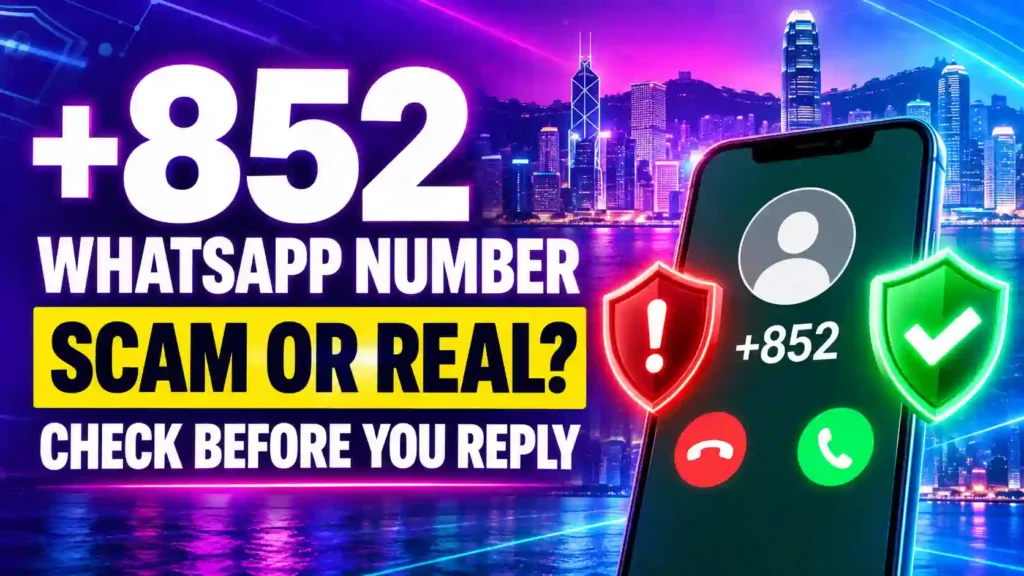
An unfamiliar WhatsApp number beginning with +852 sends you a message.
The sender may claim to be a recruiter, investment adviser, supplier, courier representative or someone who contacted you by mistake. They might offer an easy online job, ask you to join a cryptocurrency group or simply write, “Hello, do you remember me?”
You do not know anyone in Hong Kong, so you immediately wonder: Is the +852 WhatsApp number a scam?
The +852 country code genuinely belongs to Hong Kong. Therefore, a +852 number is not automatically fraudulent. However, the country code does not confirm who controls the account, where that person is physically located or whether their story is true.
Treat an unexpected +852 WhatsApp message cautiously—especially if the sender asks you to click a link, invest money, complete paid tasks, share personal information or provide a verification code.
| Question | Quick answer |
|---|---|
| Which country uses +852? | Hong Kong |
| Is every +852 WhatsApp number a scam? | No |
| Does +852 prove the sender is in Hong Kong? | No |
| Should you answer an unknown +852 message? | Only after verifying the sender |
| Can a legitimate Hong Kong number be used for fraud? | Yes |
| Should you click an unexpected link? | No |
| What should you do with a suspicious account? | Preserve evidence, block it and report it |
What Country Uses the +852 Code?
The +852 international calling code belongs to Hong Kong.
A Hong Kong telephone number displayed internationally may appear in a format such as:
+852 XXXX XXXX
Unlike many international numbers, the digits following +852 do not normally include a domestic trunk prefix that needs to be removed.
The + symbol tells a telephone network to use the appropriate international dialing prefix. Depending on the country and device, a Hong Kong number may sometimes be written as 00852 instead of +852.
Therefore:
+852indicates Hong Kong.00852can also represent Hong Kong.+853is not Hong Kong; it belongs to Macao.+86belongs to mainland China.
The International Telecommunication Union lists Hong Kong under country code +852.
Is +852 a Hong Kong or China Country Code?
+852 is assigned specifically to Hong Kong.
Mainland China uses +86. Macao uses +853.
Because Hong Kong has its own telephone numbering system, WhatsApp may display a Hong Kong account with the +852 prefix even if the account owner communicates with people in mainland China or elsewhere.
The prefix indicates the telephone numbering system—not the person’s nationality, current location or honesty.
Are +852 and 00852 the Same?
They can represent the same destination.
The plus sign substitutes for the international dialing prefix used in the country from which a call is made. In many places, that prefix is 00.
That means:
+852 XXXX XXXX00852 XXXX XXXX
may represent the same Hong Kong telephone number.
The formatting alone does not determine whether the number is legitimate.
Is a +852 WhatsApp Number Automatically a Scam?
No. Millions of legitimate residents, professionals and businesses use Hong Kong telephone numbers.
A genuine +852 WhatsApp account could belong to:
- A Hong Kong resident
- A customer or supplier
- A hotel or travel company
- A financial-services company
- A shipping or logistics business
- A university or student
- An international employer
- Someone responding to an enquiry you made
- A person who entered the wrong number
However, legitimate number formats are also used for fraudulent accounts.
A scammer may:
- Obtain a Hong Kong telephone number
- Take control of someone else’s account
- Impersonate a real Hong Kong company
- Use a business name without permission
- Copy an executive’s photograph
- Operate the account from another country
- Send messages to thousands of random numbers
The number can be real while the story is false.
Instead of asking only whether +852 is a scam code, ask:
Why is this person contacting me, and what do they want me to do?
The request reveals more than the country code.
Why Am I Receiving WhatsApp Messages From +852 Numbers?
Receiving an unexpected international message does not automatically mean your telephone has been hacked.
The sender may have obtained your number in several ways.
Your Number May Be Public
Your telephone number could appear on:
- A business website
- A social-media profile
- A professional directory
- An online marketplace
- A job website
- A public WhatsApp group
- A classified advertisement
- A résumé
- A property listing
- An old forum account
Scammers can collect publicly displayed numbers and add them to mass-messaging lists.
Your Information May Have Been Exposed
A data breach can expose telephone numbers, names, email addresses and other personal information.
A criminal may use these details to make a message appear personal.
Knowing your name, employer or city does not prove that the sender genuinely knows you.
The Sender May Be Testing Random Numbers
Some scammers send short messages to thousands of telephone numbers.
Examples include:
“Hello.”
“Are you available?”
“Can we talk?”
“Is this Mr. David?”
Anyone who replies confirms that the number is active and monitored.
Someone May Have Entered the Wrong Number
Typing one incorrect digit can send a WhatsApp message to a stranger.
A genuine wrong-number conversation should normally end after the mistake is explained.
Be careful when the stranger apologizes but continues asking personal questions. Wrong-number scams often use an apparent mistake to begin a relationship before introducing an investment or financial request.
You May Share a WhatsApp Group
Someone in a public or professional group may be able to see your number.
Check whether you share any groups with the sender. A shared group explains how they may have found you, but it does not prove that their request is safe.
Common +852 WhatsApp Scams
A +852 number can be used for different types of fraud. The following patterns are especially important when an unknown person contacts you without a clear reason.
The country code identifies a numbering region, not the sender’s honesty. These WhatsApp scammer warning signs explain what to check before you trust the message.
1. Fake Remote Job and Task Scams
The sender claims to be a recruiter representing a well-known company, online store, hotel platform or marketing agency.
The job sounds simple. You may be asked to:
- Like social-media posts
- Rate restaurants or hotels
- Review products
- Follow accounts
- Watch videos
- Complete online orders
- Optimize applications
- Perform “data entry”
- Increase product visibility
The promised income is surprisingly high.
At first, you may receive a small payment. That payment is bait designed to make the operation appear legitimate.
Later, the platform asks you to deposit your own money to:
- Unlock a premium task
- Correct a negative balance
- Complete a combined order
- Access a higher commission
- Withdraw your earnings
- Upgrade your account
A legitimate employer pays employees. It does not require workers to deposit money before receiving their wages.
2. Cryptocurrency and Investment Scams
An unknown person claims to have a reliable investment method.
The conversation may begin as a friendship or wrong-number message. After gaining your trust, the sender introduces:
- Cryptocurrency trading
- Foreign exchange
- Gold investments
- Property opportunities
- Artificial-intelligence trading
- Private investment groups
- Exclusive financial signals
They may show screenshots of large profits and successful withdrawals.
You are directed to an unfamiliar website or application. The dashboard displays rapid growth, encouraging you to deposit more.
When you attempt to withdraw, the platform demands another payment for:
- Tax
- Verification
- Insurance
- Account activation
- Security clearance
- Withdrawal authorization
The balance displayed on a website does not prove that real money exists.
Do not pay additional money to release supposed profits.
3. The Friendly Wrong-Number Scam
The message may say:
“Hello, is this Anna?”
You explain that the sender has the wrong person.
Instead of leaving, they continue:
“I’m sorry. You seem kind. Maybe we can still be friends.”
The stranger may present themselves as wealthy, successful or attractive. They discuss their daily life and gradually ask questions about your work, family and finances.
Eventually, the conversation moves toward investing or an emergency.
A real wrong number normally ends the conversation. Persistent friendliness can be a deliberate opening script.
4. Fake Supplier or Business-Payment Requests
A scammer impersonates a supplier, manager or company executive.
They claim that:
- Bank details have changed
- An invoice must be paid urgently
- A shipment is being held
- A confidential transaction must be completed
- The regular contact is unavailable
- Payment must be transferred to a new account
The profile picture and company name may be copied from a real business.
Never change payment instructions based solely on a WhatsApp message.
Contact the supplier or executive through a telephone number or email address you already trust.
5. Fake Bank or Account-Security Messages
The sender claims that:
- Your bank account has been compromised
- An unauthorized transaction is pending
- Your card will be blocked
- Your account requires verification
- Your money must be transferred for protection
They may ask you to:
- Click a link
- Enter banking credentials
- Share a one-time code
- Install an application
- Approve a login notification
- Transfer funds to a “safe account”
Banks do not protect your money by asking you to move it into an account controlled by a stranger.
End the conversation and contact your bank through its official application, website or telephone number.
6. Parcel and Customs Scams
You receive a message saying a package cannot be delivered.
The sender may claim that:
- Your address is incomplete
- Customs charges remain unpaid
- A delivery attempt failed
- The package will be returned
- A small redelivery fee is required
The message contains a link to a website that resembles a real courier company.
The page may request your:
- Full name
- Address
- Card information
- Banking credentials
- Password
- Identification number
If you are expecting a package, visit the courier’s official website manually. Do not use the link in the message.
7. Family or Friend Impersonation
The sender uses a familiar name or profile picture and says:
“This is my new number.”
They then create an emergency involving a bill, medical problem, lost telephone or urgent purchase.
Contact the real person through the number you already know.
A familiar photograph is not proof. Images can be copied from social media, and genuine accounts can be compromised.
8. WhatsApp Verification-Code Scams
The sender says a code was accidentally sent to your phone and asks you to forward it.
Never share the code.
The criminal may be attempting to register an account using your number, reset a password or gain access to an existing service.
A stranger does not need a code delivered to your device.
9. QR Code Scams
The person sends a QR code and tells you to scan it to:
- Receive payment
- Verify your identity
- Join a business platform
- Claim a prize
- Open a document
- Confirm a delivery
The code may lead to a fraudulent website, authorize a payment or connect your account to another device.
Do not scan an unexpected QR code from an unverified sender.
10. Romance and Friendship Scams
The stranger forms an emotional connection using frequent messages, attractive photographs and personal stories.
They may claim to be a:
- Business owner
- Doctor
- Engineer
- Investor
- Military officer
- Widowed parent
- International contractor
After trust develops, they introduce a financial emergency, investment opportunity or request for travel money.
The person in the photograph may be completely innocent. Reverse-search profile images and verify the identity through independent channels.
11. Loan and Advance-Fee Scams
The sender promises fast approval for a personal or business loan.
They may claim that bad credit does not matter and no meaningful checks are required.
Before the loan is released, you must pay for:
- Processing
- Insurance
- Tax
- Documentation
- Account activation
- Legal clearance
The loan never arrives, and additional fees continue appearing.
A lender offering guaranteed approval before reviewing your circumstances is not offering a genuine assessment.
Warning Signs of a +852 WhatsApp Scam
The country code alone proves nothing. Look for combinations of suspicious behavior.
Warning signs include:
- You did not expect the message.
- The sender will not explain how they obtained your number.
- They claim it was a wrong number but continue chatting.
- They ask personal questions immediately.
- They promise high income for easy work.
- They guarantee investment returns.
- They request cryptocurrency or gift cards.
- They ask you to pay before receiving money.
- They send an unfamiliar link or QR code.
- They request a password, PIN or verification code.
- They ask you to install an application.
- They want access to your screen or device.
- Their company cannot be independently verified.
- They use a free email address while claiming to represent a large business.
- Their name, number and profile photograph do not match.
- They create an urgent deadline.
- They tell you to keep the transaction secret.
- They discourage you from contacting your bank.
- They become hostile when you ask questions.
- They demand another payment to release your original funds.
WhatsApp itself identifies unsolicited requests for money, personal information, downloads, investments, loans and jobs as common features of suspicious messages.
How to Check a Suspicious +852 WhatsApp Number
No single check can confirm every account. Use several methods together.
Confirm the Country Code
Make sure the number actually begins with +852.
Do not confuse it with:
- +853 for Macao
- +86 for mainland China
- +855 for Cambodia
Examine the entire prefix rather than glancing at the first two digits.
Search the Complete Number
Place the full number inside quotation marks in a search engine.
For example:
“+852XXXXXXXX”
Look for reports involving the same:
- Name
- Message
- Job offer
- Website
- Investment platform
- Company
- Payment details
One anonymous accusation is not definitive. Several independent reports describing the same activity are more meaningful.
Check the Profile Picture
Reverse-search the profile photograph.
The image may belong to:
- A different person
- A company employee
- A public figure
- A model
- A social-media creator
- Another scam report
A stolen picture exposes a false identity, but remember that the innocent person shown in the photograph may have nothing to do with the scam.
Verify the Business Independently
If the sender claims to represent a company:
- Search for the company independently.
- Inspect the exact website address.
- Find its official contact information.
- Contact it through a verified channel.
- Ask whether the person works there.
- Confirm whether the job, invoice or offer is genuine.
Do not use contact information supplied by the stranger.
Check the Website Carefully
Look for:
- Misspelled domain names
- Recently created websites
- Copied company text
- Missing physical addresses
- Unverifiable licenses
- Guaranteed profits
- Pressure to deposit immediately
- Payment through cryptocurrency only
- No clear withdrawal policy
A polished website can still be fraudulent.
Examine the Sender’s Request
Ask yourself:
- Do they want money?
- Are they asking for personal information?
- Do they want me to click something?
- Are they requesting a code?
- Do they want me to install software?
- Are they creating artificial urgency?
- Are they preventing independent verification?
The request is often the strongest evidence.
Follow the WhatsApp Scammer List: Check a Suspicious Number, Profile or Message process before trusting the sender.
Should You Reply to an Unknown +852 Number?
Do not reply merely because you are curious.
Responding may confirm:
- Your number is active
- Someone reads the messages
- Your preferred language
- Your approximate time zone
- Your willingness to engage
If the message might be legitimate, investigate the person before sharing any information.
A genuine sender should be willing to provide a clear explanation that can be independently confirmed.
What to Do When a +852 Number Messages You
Use this order:
- Do not click links.
- Do not scan QR codes.
- Do not download files.
- Do not share verification codes.
- Do not reveal banking information.
- Do not send money.
- Screenshot the profile and message.
- Check the complete number.
- Verify the claimed identity separately.
- Block and report suspicious accounts.
Do not spend hours arguing with the sender or trying to expose them. Preserve what you need and end the communication.
How to Block and Report a +852 Number on WhatsApp
The interface may vary slightly depending on your device, but you can generally:
- Open the conversation.
- Tap the number or profile name.
- Scroll through the account information.
- Select Block or Report.
- Follow the instructions shown by WhatsApp.
Blocking stops that account from directly sending you messages, calls and status updates. Reporting provides relevant account and message information to WhatsApp for review.
Save screenshots and transaction details before deleting the conversation.
Can a +852 Number Hack Your WhatsApp?
Simply receiving or reading a message does not normally give the sender control of your account.
The danger increases if you:
- Share a verification code
- Enter credentials on a fake website
- Install an unknown application
- Approve an unfamiliar login
- Scan a malicious QR code
- Share your screen
- Grant remote access
- Download a dangerous file
Protect your account by using a strong device lock, reviewing connected devices and enabling additional account verification.
Also review your WhatsApp privacy settings to limit who can see your photograph, status, last-seen information and other profile details.
What to Do If You Clicked a Link
Your next action depends on what happened after you opened it.
If You Opened the Page but Entered Nothing
Close the website.
Do not approve notifications, install anything or return to the page. Check your downloads for unexpected files and run a security scan.
If You Entered a Password
Change the password immediately through the official application or website.
If you reused the same password elsewhere, change it on those accounts too.
Secure your email first because it may be used to reset other accounts.
If You Entered Card or Banking Information
Contact your bank immediately.
Explain that you entered financial information on a suspected fraudulent website. Ask whether the card or account should be frozen, replaced or monitored.
Review your recent transactions.
If You Installed an Application
Disconnect the device from the internet if you believe the application provides remote access.
Remove the suspicious software, run a security scan and change important passwords from a different trusted device.
Tell your bank if the sender could see your financial applications, passwords or one-time codes.
What to Do If You Sent Money
Act immediately.
Contact the bank, card issuer, payment application or cryptocurrency platform involved.
Provide:
- The amount
- Date and time
- Recipient’s details
- Transaction reference
- Account or wallet address
- Screenshots
- The WhatsApp number
- An explanation of the deception
Ask whether the transaction can be stopped, recalled, reversed or disputed.
Next:
- Stop every further payment.
- Secure your email and financial accounts.
- Change exposed passwords.
- Review connected devices.
- Preserve the complete conversation.
- Report the payment destination.
- Monitor for identity theft.
- Report the incident to the appropriate authorities.
Do not pay someone who contacts you unexpectedly and promises to recover the money. A supposed investigator, lawyer or hacker may be attempting a second scam.
Read Fund Recovery Scams: Warning Signs Before You Pay a Fake Investigator before trusting a recovery service.
Frequently Asked Questions
Which country uses the +852 code?
The +852 international calling code belongs to Hong Kong.
Is every +852 WhatsApp number a scam?
No. Legitimate Hong Kong residents and businesses use +852 numbers. Evaluate the sender’s identity, behavior and request.
Why is a Hong Kong number messaging me?
It may be a genuine enquiry, wrong number, business contact or scam attempt. Verify the sender before continuing.
Does +852 mean the sender is physically in Hong Kong?
No. It indicates that the account uses a number from Hong Kong’s telephone numbering system. The user may be elsewhere.
Is +852 China or Hong Kong?
+852 is assigned to Hong Kong. Mainland China uses +86.
Is +853 the same as +852?
No. +852 belongs to Hong Kong, while +853 belongs to Macao.
Is 00852 the same as +852?
It can be. In many countries, 00 is the international dialing prefix, so 00852 can represent a Hong Kong number.
Should I reply to a +852 WhatsApp message?
Reply only if you recognize the sender or can independently verify why they contacted you.
Why do +852 numbers offer online jobs?
Some may be legitimate, but fake recruiters also use international numbers to promote task scams and collect deposits or personal information.
Should I trust a WhatsApp Business account?
Not automatically. Verify the business through its official website and independently confirmed contact information.
Can a +852 number steal my WhatsApp account?
The number alone cannot take your account. The danger increases if you disclose your registration code, scan an unsafe QR code or approve an unauthorized login.
Can I search for the number online?
Yes. Search the complete number in quotation marks. Treat online reports as clues rather than final proof.
What if the sender knows my name?
Your information may be public, previously shared or exposed in a data breach. Knowing your name does not prove the sender is genuine.
What if the sender claims it is a wrong number?
A genuine sender normally apologizes and leaves. Be cautious if the stranger continues chatting or introduces an investment.
Should I return a missed call from +852?
Not unless you recognize the caller or receive a credible explanation for the call.
Can a scammer use a real Hong Kong number?
Yes. A valid number format does not prove that the person using it is trustworthy.
What if I already shared a verification code?
Secure the affected account immediately. Review connected devices, change relevant passwords and contact the service through its official support channel.
Can I block all +852 numbers?
WhatsApp generally allows you to block individual accounts and apply protections against unknown callers or high volumes of unknown messages. Blocking an entire country code may not be available as a standard option.
What if the sender threatens me?
Do not pay or continue arguing. Preserve the messages, block the account and report credible threats to the appropriate authorities.
What is the safest response to an unknown +852 message?
Do not click, pay or share information. Verify the sender independently, then block and report the account if the claim cannot be confirmed.
Final Verdict: Is a +852 WhatsApp Number a Scam?
The +852 country code is a genuine international prefix assigned to Hong Kong.
It is not automatically a scam code.
However, a real number format cannot verify the person behind a WhatsApp account. Treat the contact as suspicious when an unknown sender requests money, guarantees profits, offers unusually easy work, sends an unexpected link or asks for private information.
Remember:
The country code may be real while the identity, opportunity and emergency are completely fabricated.
Pause before replying. Investigate the number, verify the sender through a separate trusted channel and refuse any request you cannot independently confirm.
For a complete investigation process, read How to Identify a Scammer on WhatsApp Before You Reply or Send Money.