Imagine waking up tomorrow morning to discover that someone has opened a credit account in your name.
Or logged into one of your online accounts.
Or convinced your bank they were you.
Your first thought would probably be:
“How did they get my information?”
Most people imagine a sophisticated hacker breaking into a computer.
Sometimes that happens.
But more often, something much simpler is responsible.
You.
Not because you wanted to help criminals.
Not because you were careless.
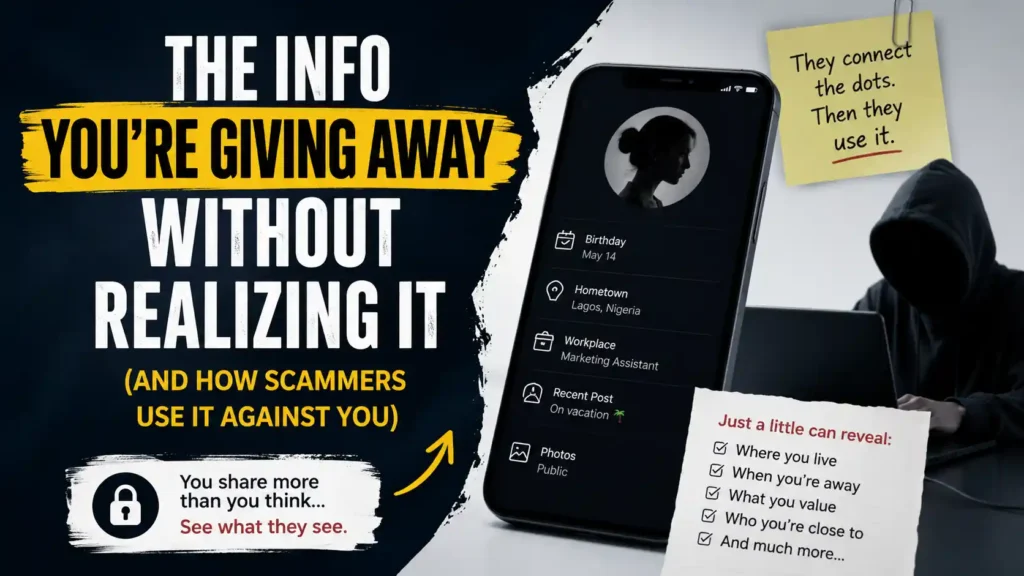
But because you’ve been leaving behind tiny pieces of information for years without realizing how valuable they are.
One social media post.
One online profile.
One shopping account.
One photo.
One online quiz.
One “About Me” page.
Individually, they don’t seem dangerous.
Together…
They become your identity.
And once enough pieces are available, scammers don’t need to steal your identity.
They simply rebuild it.
The good news?
Once you know where your identity is leaking, you can begin closing those leaks today.
Your Identity Isn’t Stolen Overnight
Many people think identity theft happens all at once.
It usually doesn’t.
Think of a bucket with tiny holes.
One hole won’t empty the bucket.
Neither will two.
But leave enough holes open…
Eventually the bucket runs dry.
Your personal information works the same way.
Scammers rarely collect everything in one attack.
Instead, they gather:
- your name
- your birthday
- your phone number
- your email address
- your workplace
- your family members
- your interests
- your location
One piece at a time.
By itself…
Each piece seems harmless.
Combined…
It becomes surprisingly powerful.
Leak #1: Your Social Media Profiles
Scroll through your Facebook or Instagram profile.
Without realizing it, you may have shared:
- Your birthday
- Your hometown
- Your children’s names
- Your pet’s name
- Your favorite vacation spots
- Your anniversary
- Where you work
- Where you live
Now imagine someone trying to answer your security questions.
They might not need to guess.
The answers may already be online.
Before posting personal milestones, ask yourself:
“Would I want a scammer to know this?”
Leak #2: Your Professional Profile
LinkedIn is one of the best networking tools available.
It’s also incredibly useful to scammers.
A typical profile reveals:
- Your employer
- Your position
- Your industry
- Your education
- Your colleagues
- Your work history
That information can be used to create highly convincing fake emails.
Imagine receiving this message.
Hi Sarah,
I’m from the Finance Department.
Could you quickly review the attached invoice before tomorrow’s meeting?
It feels believable because the scammer already knows where Sarah works.
That’s the danger of combining publicly available information.
Leak #3: Your Email Address
Your email address is more valuable than most people realize.
It’s the gateway to:
- Online banking
- Shopping accounts
- Social media
- Password resets
- Cloud storage
Scammers don’t always attack immediately.
Sometimes they simply collect email addresses until they have enough information to launch a convincing phishing campaign.
That’s why it’s worth thinking twice before posting your primary email address publicly.
Leak #4: The Photos You Share
Take another look at the last five photos you posted online.
Now ignore the people.
Look at the background.
Can you see:
- A parcel with your address?
- A boarding pass?
- Your driver’s licence?
- A work ID?
- Family names?
- School uniforms?
- Car registration plates?
- Computer screens?
Most people focus on the main subject.
Scammers often focus on everything else.
Modern phone cameras capture extraordinary detail.
Sometimes more detail than you intended.
Leak #5: Your Daily Routine
Many people post things like:
“Morning run.”
“At the office.”
“Weekend getaway.”
“Heading to the airport.”
These updates seem innocent.
But together they reveal patterns.
Someone observing your posts may learn:
- when you’re usually away
- when you’re at work
- when your house is empty
- when you’re travelling abroad
The safest memories are often the ones shared after you return home.
Leak #6: Your Online Shopping Habits
Every online purchase creates information.
Scammers love knowing:
- where you shop
- which delivery companies you use
- which payment services you prefer
Why?
Because fake messages become much more convincing.
If you regularly shop online, receiving a fake delivery notification feels completely normal.
That’s exactly what criminals are counting on.
The Information You Forgot You Shared
Here’s something many people never think about.
Five years ago…
You may have completed:
- personality quizzes
- competitions
- giveaways
- “Tell us about yourself” forms
- surveys
- loyalty programs
Most of them seemed harmless.
Some still are.
Others quietly collected information that helps build a surprisingly detailed picture of your life.
The internet has a long memory.
Sometimes longer than we realize.
One Question That Changes Everything
Before sharing anything online, ask yourself one simple question:
Could this information help someone pretend to be me… or gain my trust?
If the answer is even “maybe”…
Pause.
Think again.
That single question has prevented countless people from sharing more than they intended.
Your Identity Is Worth More Than You Think
Many people assume criminals only want money.
Money is the reward.
Information is the tool.
The more someone knows about you…
The easier it becomes to convince you they’re legitimate.
That’s why protecting your identity starts long before anyone tries to steal it.
It starts with the small decisions you make every day about what you share… and what you keep private.
Leak #7: Your Phone Number
Your phone number is no longer just a way for friends and family to contact you.
Today, it’s often connected to:
- Your bank accounts
- Two-factor authentication
- Shopping websites
- Messaging apps
- Password recovery
- Mobile payment services
That makes it one of the most valuable pieces of personal information you own.
The more places your phone number appears publicly, the easier it becomes for scammers to target you with convincing phone calls, text messages, and phishing attempts.
Think carefully before sharing it online unless it’s absolutely necessary.
Leak #8: Your Security Questions
Years ago, security questions were considered a smart way to protect online accounts.
Questions like:
- What’s your mother’s maiden name?
- What was the name of your first pet?
- What street did you grow up on?
- What’s your favorite teacher’s name?
The problem?
Many people unknowingly publish the answers themselves.
A birthday post from your mother.
An old family photo.
A childhood memory.
A “Throwback Thursday” picture.
A post celebrating your first dog.
Individually, these posts seem harmless.
To a scammer, they’re clues.
Whenever possible, treat security questions like passwords instead of trivia.
Choose answers that aren’t publicly available—and don’t have to be literally true.
Leak #9: Your Public Wi-Fi Habits
Free Wi-Fi is everywhere.
Coffee shops.
Hotels.
Airports.
Restaurants.
Shopping malls.
It’s convenient.
But convenience sometimes comes at a price.
If you’re connected to an unsecured network, avoid logging into:
- Online banking
- Investment accounts
- Shopping websites that store payment details
- Email accounts
If something can’t wait, consider using your mobile data instead.
A few extra megabytes are much cheaper than recovering from identity theft.
Leak #10: Data Breaches You Never Hear About
Here’s something many people don’t realize.
You can do everything right…
…and your information may still be exposed.
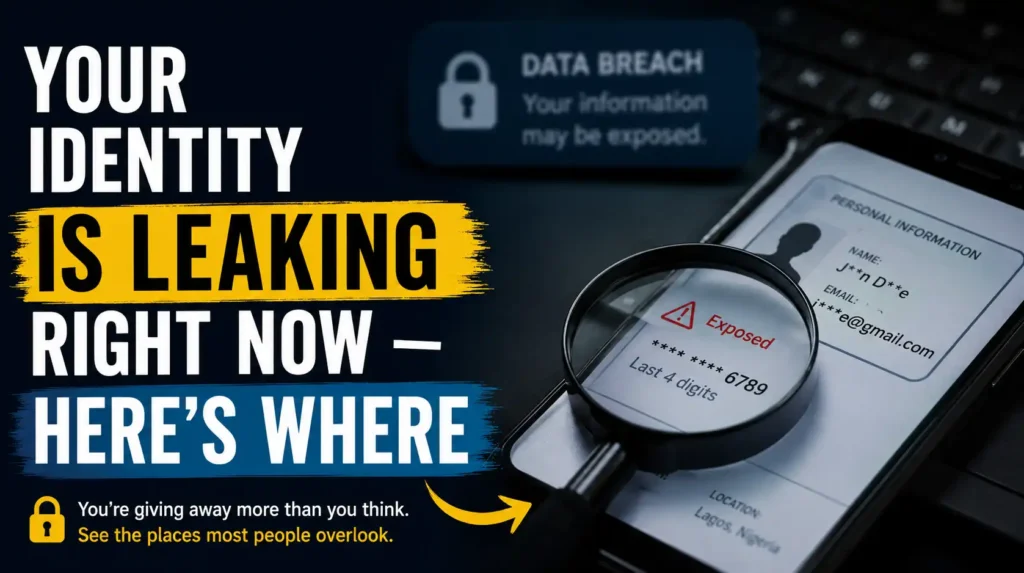
Companies occasionally experience data breaches that expose customer information.
That doesn’t automatically mean criminals have access to your accounts.
But it does mean your information may be circulating where you never expected it.
That’s why using a different password for every important account is so important.
If one website is compromised, unique passwords help prevent criminals from accessing your other accounts.
The Identity Leak Checklist
Take a few minutes today and answer these questions honestly.
☐ Is my birthday publicly visible?
☐ Can strangers see where I work?
☐ Is my phone number easy to find?
☐ Have I posted travel plans before leaving?
☐ Do my photos reveal personal information in the background?
☐ Do I reuse the same password on multiple websites?
☐ Have I reviewed my social media privacy settings recently?
☐ Would I be comfortable if a stranger read every public post I’ve ever made?
Every “No” is an opportunity to strengthen your privacy.
Every “Yes” is a reminder to review what you’re sharing.
You don’t have to disappear from the internet.
You simply have to become more intentional.
Privacy Isn’t About Having Something to Hide
Some people say,
“I don’t care who sees my information. I have nothing to hide.”
But privacy isn’t about hiding.
It’s about control.
You lock your front door.
Not because you’re doing something wrong.
But because you decide who enters your home.
Your personal information deserves the same respect.
You should decide:
- who knows it
- when they know it
- why they know it
The less unnecessary information you share, the fewer opportunities criminals have to misuse it.
The Most Dangerous Leak of All
After everything we’ve discussed, you might think the biggest leak is your birthday.
Or your phone number.
Or your address.
They’re all important.
But the biggest leak is something else.
Overconfidence.
Many victims believe:
“It would never happen to me.”
That’s exactly what scammers hope.
Because people who believe they’re immune often stop paying attention to the warning signs.
Stay confident.
But never become complacent.
What Would Someone Learn About You in 30 Minutes?
Here’s a challenge.
Pretend you’re a scammer.
Open a private browser window.
Search for yourself.
Look at:
- Your social media profiles
- Your LinkedIn page
- Old comments
- Public photos
- Business listings
- Online directories
How much could a complete stranger discover in just thirty minutes?
You may be surprised.
That exercise isn’t meant to scare you.
It’s meant to show you how small pieces of information can quickly become a detailed profile.
Once you see your online presence through a scammer’s eyes, you’ll begin making different decisions about what you share.
Final Thoughts
Your identity rarely leaks through one catastrophic mistake.
It leaks through dozens of small ones.
A public birthday.
A visible boarding pass.
A reused password.
An overshared vacation.
A photo with sensitive information in the background.
None of these seem dangerous on their own.
Together, they create opportunities that skilled scammers know how to exploit.
The good news is that every leak you close makes you a more difficult target.
You don’t need to disappear from the internet.
You simply need to become more aware of what you’re sharing and who might be watching.
The next time you’re about to post, comment, or upload a photo, pause for a moment and ask yourself one final question:
“Would I be comfortable if this became part of someone else’s plan to impersonate me?”
If the answer is no, you’ve just prevented another piece of your identity from leaking into the wrong hands.