Take a moment and think about this.
How much does a complete stranger know about you?
Probably not much…
Or so you think.
Now imagine someone knows:
- Your full name.
- The city where you live.
- Your birthday.
- Where you work.
- Your favorite football team.
- Your children’s names.
- Your email address.
- Your phone number.
- The bank you use.
- The last holiday you went on.
Would that concern you?
Most people would answer yes.
Here’s the surprising part:
You may have shared much of that information yourself.
Not because you’re careless.
Not because you wanted to.
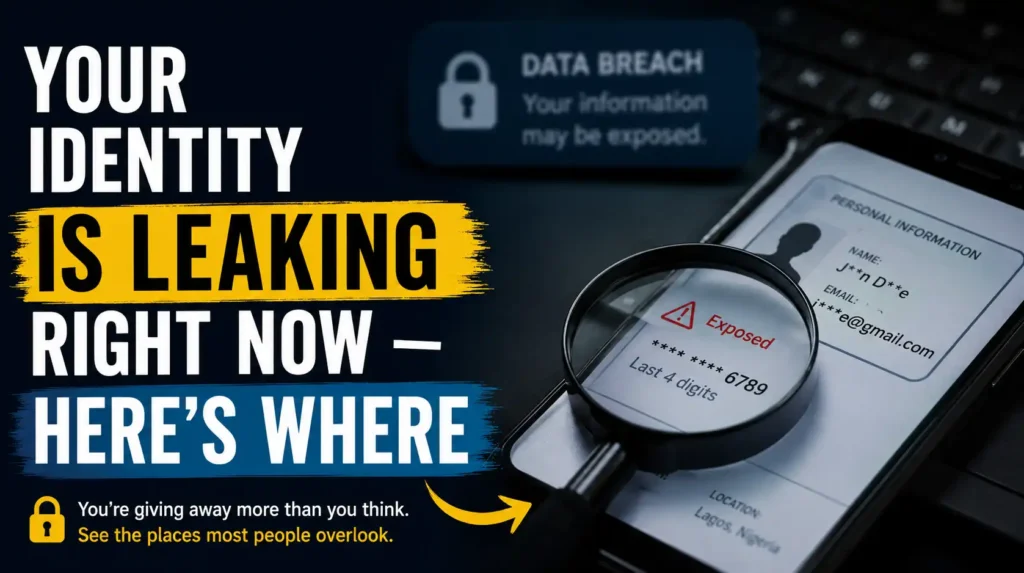
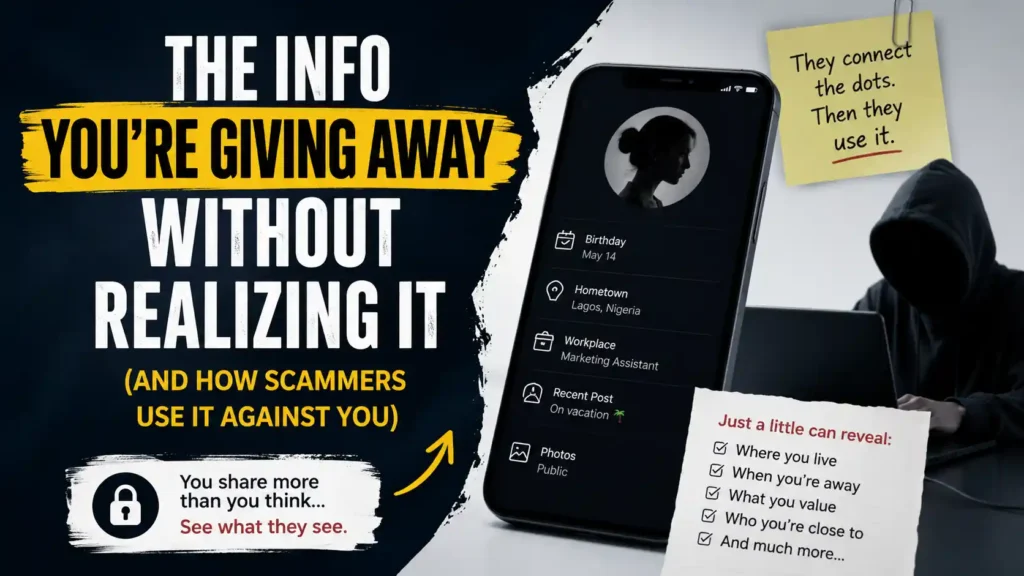
But because the internet has quietly turned everyday activities into tiny pieces of personal information that criminals can collect like puzzle pieces.
A Facebook post here.
An Instagram photo there.
A LinkedIn profile.
A shopping receipt.
A quiz.
A public comment.
Individually, these details seem harmless.
Together, they tell a story about you.
And to a scammer, that story is valuable.
In this guide, you’ll discover the information you may be giving away without realizing it, why scammers want it, and the simple habits that can help protect your privacy.
Information Is the New Currency
Many people believe scammers only want one thing:
Money.
That’s only partly true.
What they really want is information.
Why?
Because information helps them get your money.
Think about it.
If a stranger sends you an email saying:
“Hello.”
You’ll probably ignore it.
But what if the email says:
“Hi Issiak,
We noticed unusual activity on your account after your recent purchase.”
It suddenly feels personal.
More believable.
That’s because information creates trust.
The more a scammer knows about you…
…the easier it becomes to fool you.
The Digital Breadcrumb Effect
Imagine walking through a forest.
Every few steps, you drop a breadcrumb.
One breadcrumb doesn’t reveal much.
But after several miles…
Anyone can follow your trail.
Your online life works the same way.
Every time you:
- post a photo
- leave a review
- like a page
- enter a giveaway
- fill out a quiz
- comment on a post
- create an account
you may be leaving another breadcrumb.
Most people never notice.
Scammers do.
The 10 Pieces of Information You May Be Giving Away
None of these seem dangerous on their own.
The problem is what happens when they’re combined.
1. Your Date of Birth
Many people proudly display their birthday online.
Friends send congratulations.
Family members post old photos.
It feels harmless.
Unfortunately, your date of birth is often used as part of identity verification.
Combined with your name and address, it can help criminals answer security questions or make convincing impersonation attempts.
You don’t have to hide your birthday completely.
But think carefully before making the full date public.
2. Your Daily Routine
Do you always post:
“Off to work.”
“Gym time.”
“Vacation starts today.”
“Can’t wait to be away for two weeks.”
You’re sharing more than memories.
You’re revealing patterns.
Scammers—and even burglars—may learn:
- when you’re usually home
- when you’re away
- when you’re busy
- when you’re less likely to notice suspicious activity
It’s often safer to share travel photos after you’ve returned home.
3. Your Email Address
Every online account begins with an email address.
That’s why scammers constantly try to collect them.
An email address allows criminals to:
- send phishing emails
- attempt password resets
- target you with fake invoices
- impersonate companies you trust
Treat your email address like the front door to your digital life.
Don’t publish it publicly unless necessary.
4. Your Phone Number
Your phone number has become one of the most valuable pieces of personal information you own.
It may be connected to:
- banking verification codes
- social media accounts
- shopping websites
- messaging apps
- password recovery
Think twice before sharing it publicly.
The fewer people who have it, the fewer opportunities scammers have to misuse it.
5. Photos That Reveal Too Much
Have you ever posted a picture of:
- your airline boarding pass?
- your driver’s licence?
- your new credit card?
- your work ID?
- your house keys?
Many people do.
Without realizing the risks.
Modern smartphones capture extremely detailed images.
Sometimes criminals can zoom in and read information you never intended to share.
Before posting any photo, ask yourself:
Is there anything visible in the background that shouldn’t be?
Sometimes the biggest risk isn’t the subject of the picture.
It’s what’s behind it.
A Simple Rule That Can Protect You
Before posting anything online, ask yourself one question:
“Would I be comfortable if a scammer saw this?”
It’s a surprisingly effective filter.
If the answer is no…
Don’t post it.
Or remove the sensitive details first.
🛡️ Privacy Is One of Your Best Defenses
Most scams don’t begin with stolen money.
They begin with stolen information.
The less criminals know about you, the harder it becomes for them to impersonate trusted companies, guess security questions, or create convincing scams.
That’s why protecting your personal information isn’t about being secretive.
It’s about making yourself a much harder target.
6. Your LinkedIn Profile
LinkedIn is an excellent platform for networking and career growth.
Unfortunately, it’s also a valuable source of information for scammers.
A typical profile may reveal:
- Your full name
- Your current employer
- Previous employers
- Your job title
- Your work email
- Your education
- Your city
- The people you work with
To you, it’s a professional profile.
To a scammer, it’s a blueprint.
This information can be used to create convincing fake emails that appear to come from your boss, HR department, clients, or business partners.
That doesn’t mean you should delete your LinkedIn profile.
It means you should be aware of how much information you’re sharing publicly.
7. The Security Questions You Answer Without Thinking
Many websites ask questions like:
- What’s your mother’s maiden name?
- What’s the name of your first pet?
- What’s the name of the street where you grew up?
- What’s your favorite teacher’s name?
Years ago, these questions were considered secure.
Today, many of the answers can be found online.
Family photos.
Old Facebook posts.
Birthday messages.
School reunions.
Comments from relatives.
The more you share publicly, the easier these questions become to answer.
If possible, don’t answer security questions truthfully.
Instead, treat them like extra passwords by using unique answers that only you know.
8. Your Location
Many apps automatically attach your location to photos and posts.
Others encourage you to “check in.”
Think about what that reveals.
“I’m at the airport.”
“I’m at the beach.”
“We’re spending the weekend away.”
To friends, these updates seem harmless.
To criminals, they may signal that your home is currently empty.
If you enjoy sharing your travels, consider posting after you return instead of while you’re away.
9. The Quizzes You Love Taking
You’ve probably seen quizzes such as:
- Which movie character are you?
- What’s your hidden personality?
- Which city should you live in?
They’re entertaining.
But many quizzes also ask questions that resemble security questions.
Examples include:
- Your favorite food.
- Your first school.
- Your childhood nickname.
- Your favorite teacher.
- Your first car.
Individually, these answers seem harmless.
Collect enough of them, and someone may know far more about you than you realize.
Before participating, ask yourself:
Why does this quiz need this information?
10. The Photos in Your Background
Most people focus on what’s in front of the camera.
Scammers often look behind it.
Take another look at your recent photos.
Can you see:
- A package showing your address?
- A computer screen displaying personal information?
- Your passport on the table?
- A work ID badge?
- Family photos with names?
- Important documents?
Modern smartphone cameras capture remarkable detail.
What seems invisible to you may become obvious when someone zooms in.
Before posting, spend a few seconds checking the background.
Those few seconds may prevent you from revealing far more than intended.
Why Scammers Collect Small Pieces of Information
One piece of information rarely causes a problem.
Ten pieces can.
Imagine a scammer knows:
Your name.
Your birthday.
Where you work.
The bank you use.
Your phone number.
Your email address.
The city where you live.
Your favorite sports team.
The names of your children.
Now imagine they call you.
Would they sound more convincing?
Almost certainly.
That’s why modern scams often feel so personal.
The criminal isn’t guessing.
They’re using information that was already available.
The Privacy Check I Use Before Posting Anything
Before I post anything online, I ask myself three questions.
Could this help someone pretend to be me?
Could this answer one of my security questions?
Would I be comfortable if a scammer saved this information?
If the answer to any of those questions is “no,” I don’t post it—or I remove the sensitive details first.
It’s a simple habit, but it can make you a much harder target.
Information Isn’t Dangerous Until It’s Combined
One Facebook post isn’t dangerous.
Neither is one LinkedIn profile.
Or one Instagram photo.
Or one online review.
The danger comes when all those pieces are combined.
Think of your personal information like a jigsaw puzzle.
Each piece reveals only a tiny part of the picture.
But eventually…
The whole image becomes clear.
That’s exactly how many scammers operate.
They don’t steal everything at once.
They collect small pieces over time.
A Five-Minute Privacy Audit
Take five minutes today and review your online presence.
Ask yourself:
☐ Is my phone number publicly visible?
☐ Is my email address easy to find?
☐ Have I shared my full date of birth?
☐ Can strangers see where I work?
☐ Have I posted photos showing sensitive information?
☐ Do my social media accounts reveal my daily routine?
☐ Are my privacy settings up to date?
If you answered “yes” to several of these questions, don’t panic.
Simply start reducing the amount of information that’s publicly available.
Every small improvement makes you a more difficult target.
The More They Know, The Easier You Become to Fool
Scammers don’t need to know everything about you.
They only need to know enough.
Enough to earn your trust.
Enough to make their story believable.
Enough to convince you that they’re legitimate.
That’s why protecting your personal information isn’t about hiding from the world.
It’s about deciding what deserves to remain private.
Want to Stay One Step Ahead of Modern Scammers?
Protecting your personal information is only one part of staying safe online.
Final Thoughts
Every photo.
Every comment.
Every public profile.
Every online purchase.
Every social media post.
They all tell a small part of your story.
Individually, they may seem harmless.
Together, they can become exactly what a scammer needs to gain your trust.
The good news is that protecting yourself doesn’t require disappearing from the internet.
It simply requires becoming more intentional about what you share.
Before your next post…
Pause for a moment.
Ask yourself:
“Am I sharing something I wouldn’t want a scammer to know?”
That one question may protect far more than your privacy.
It could protect your money, your identity, and your peace of mind.