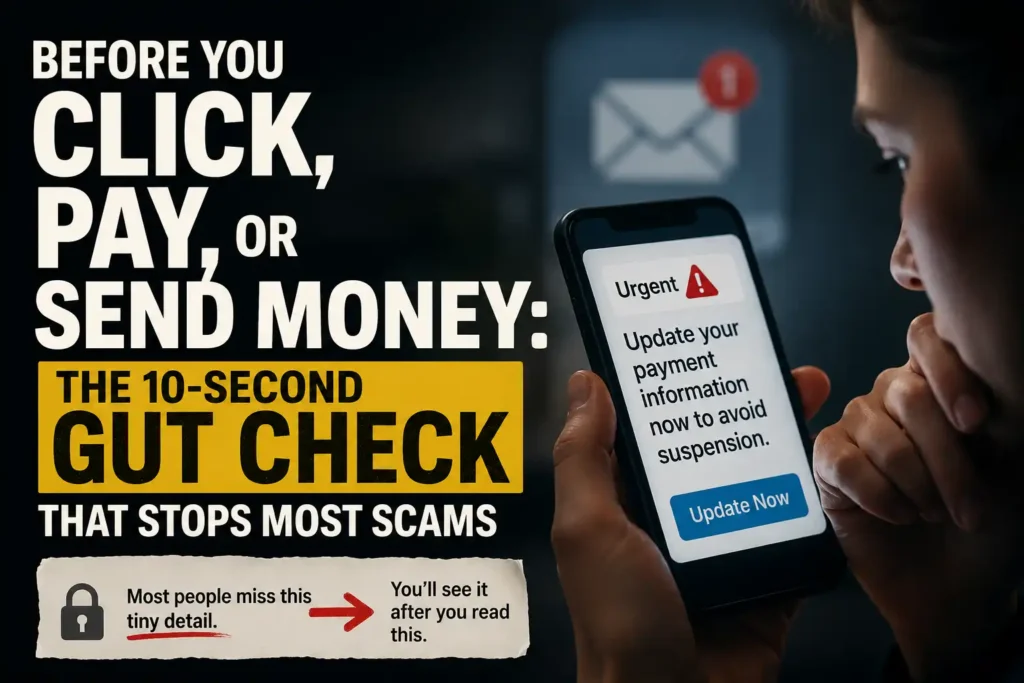
You’re about to click “Pay.”
Everything looks normal.
The email appears to come from your bank.
The online store has hundreds of five-star reviews.
The investment opportunity promises returns that seem almost impossible to ignore.
Your finger is hovering over the button.
Then…

Something doesn’t feel right.
It’s not something you can explain.
You don’t see any obvious spelling mistakes.
The website looks professional.
The person you’re talking to sounds confident.
But somewhere in the back of your mind, a quiet voice whispers:
“Wait.”
Most people ignore that voice.
Scammers hope you will.
Because almost every successful scam happens in the few seconds between feeling uncertain and taking action anyway.
That tiny window is where people lose money.
It’s where passwords get stolen.
It’s where identities are compromised.
It’s where years of savings disappear with a single click.
But what if you created one simple habit that interrupted almost every scam before it succeeded?
Not an expensive security program.
Not complicated technology.
Just ten seconds.
That’s all.
Ten intentional seconds before you:
- click a link
- make a payment
- reply to a message
- scan a QR code
- download an attachment
- share personal information
Those ten seconds won’t stop every scam.
But they can stop a surprising number of them.
Why Ten Seconds Can Change Everything
Scammers don’t usually defeat technology.
They defeat emotion.
Think about the last scam message you received.
It probably tried to make you feel something.
Fear.
Excitement.
Curiosity.
Urgency.
Hope.
Panic.
The moment emotions take over, logical thinking begins to disappear.
That’s exactly what scammers want.
The longer you think…
…the less likely you are to become their victim.
That’s why almost every scam includes pressure.
“Act now.”
“Limited time.”
“Final warning.”
“Only two left.”
“Your account will be suspended today.”
Urgency isn’t just part of the scam.
It’s the engine that makes the scam work.
The moment you interrupt that urgency, you’ve already taken away one of the scammer’s biggest advantages.
The G.U.T. Check
Whenever you’re about to click a link, send money, or share personal information, stop for just ten seconds and ask yourself three simple questions.
G — Is It Genuine?
Who am I really dealing with?
Not who they say they are.
Who have I independently verified them to be?
Could this email actually be from my bank?
Could this text message really be from the delivery company?
Is this online store genuinely connected to the brand it claims to represent?
Scammers depend on assumptions.
Verification destroys assumptions.
U — Is It Urgent ?
Pressure is one of the strongest warning signs of fraud.
Ask yourself:
Why must I do this immediately?
What happens if I wait ten minutes?
Or an hour?
Or until tomorrow morning?
Legitimate businesses understand that important decisions deserve careful thought.
Scammers don’t.
If someone becomes impatient because you want time to think, you’ve just learned something valuable about them.
T — Have I Thought It Through?
This may sound obvious.
It isn’t.
Many scam victims later say:
“I don’t know why I did it.”
The answer is simple.
They didn’t stop long enough to think.
Ask yourself:
Does this request actually make sense?
Would this company normally contact me this way?
Am I acting because I’ve verified the information…
…or because I’m afraid of what might happen if I don’t?
Those questions alone can stop many scams before they begin.
Imagine Two Different Outcomes
Let’s say two people receive exactly the same email.
It appears to come from PayPal.
The message says someone has logged into their account from another country.
There’s a large blue button.
Secure My Account
The first person clicks immediately.
They enter their username.
Their password.
Their verification code.
Within minutes, criminals access their account.
The second person pauses.
Just ten seconds.
They perform the G.U.T. Check.
Is it genuine?
“I’m not sure.”
Am I being rushed?
“Definitely.”
Have I thought this through?
“Not yet.”
Instead of clicking the email…
They open their browser.
They type paypal.com themselves.
They log in.
No unusual activity.
The email was fake.
The difference between these two people wasn’t intelligence.
It wasn’t education.
It wasn’t luck.
It was ten seconds.
Why Your Gut Feeling Matters More Than You Think
Have you ever heard someone say:
“Something just didn’t feel right.”
That sentence appears in thousands of scam stories.
Victims often noticed:
- the conversation felt strange
- the caller sounded rehearsed
- the website looked slightly different
- the offer seemed unusually generous
Yet they continued anyway.
Your intuition isn’t magic.
It’s your brain processing tiny details before you’ve consciously identified them.
Think of it as an early warning system.
It isn’t always correct.
But it’s almost always worth listening to.
If your instincts tell you to slow down…
Slow down.
Missing a bargain is inconvenient.
Losing your savings is far worse.
The Biggest Mistake People Make
People often believe scammers succeed because they’re brilliant hackers.
Most aren’t.
They’re skilled manipulators.
They understand human behavior.
They know how to create urgency.
They know how to build trust.
They know exactly when to pressure you.
The good news?
They can’t force you to act.
Only you can press the button.
Only you can send the payment.
Only you can share the password.
That’s why your greatest defense isn’t software.
It’s the small habit of pausing before you act.
Every scam has a moment when it can still be stopped.
Most of the time…
That moment lasts about ten seconds.
What Scammers Don’t Want You to Do
Imagine spending hours preparing the perfect scam.
You buy a convincing domain name.
You copy a trusted company’s website.
You create a professional-looking email.
You even practice what you’ll say on the phone.
Then your potential victim says:
“Give me ten seconds.”
Those ten seconds can destroy everything you’ve built.
Why?
Because scams depend on momentum.
The moment you interrupt that momentum, cracks begin to appear.
Suddenly you notice:
- The email address isn’t quite right.
- The website address contains an extra letter.
- The caller becomes impatient.
- The payment request no longer makes sense.
- The “limited-time offer” suddenly doesn’t feel so urgent.
Scammers don’t fear people who know every scam.
They fear people who refuse to be rushed.
The 10-Second Questions That Could Save You Thousands
Before every important online action, ask yourself these questions.
Not all of them.
Just enough to slow your thinking.
“Was I Expecting This?”
Unexpected emails.
Unexpected phone calls.
Unexpected text messages.
Unexpected invoices.
Unexpected refunds.
Unexpected prizes.
Scammers love the unexpected because surprise reduces careful thinking.
If you weren’t expecting it, verify it.
“Who Benefits If I Act Right Now?”
This is one of the simplest questions you’ll ever ask.
Yet it’s incredibly powerful.
If acting immediately mainly benefits the other person…
Slow down.
“What Happens If I Wait Ten Minutes?”
Ask yourself honestly.
If this is really my bank…
Will my account disappear because I waited ten minutes?
Probably not.
If this is really Amazon…
Will they refuse to help because I verified independently?
No.
Legitimate businesses understand caution.
Scammers don’t.
“Would I Tell Someone I Love to Do This?”
Imagine your spouse.
Your parents.
Your child.
Your closest friend.
Would you tell them:
“Don’t worry. Just click it.”
Or would you say:
“Let’s check first.”
Give yourself the same advice you’d give someone you care about.
Scammers Study Human Nature
Many people imagine scammers sitting behind computers trying to hack passwords.
In reality, they’re often studying something far more predictable:
People.
They know:
People hate missing opportunities.
People fear losing money.
People trust authority.
People avoid conflict.
People panic under pressure.
Every successful scam is built around one or more of those emotions.
That’s why the G.U.T. Check works.
It shifts your brain from emotion…
…back to logic.
Five Situations Where the G.U.T. Check Can Protect You
The beauty of this habit is that it isn’t limited to one type of scam.
You can use it almost anywhere.
An email claims your account has been suspended.
Pause.
Perform the G.U.T. Check.
Instead of clicking the link, visit the company’s website yourself.
Phone Calls
Someone claims they’re calling from your bank.
Pause.
End the call politely.
Call the official number listed on your bank card.
Online Shopping
A website offers unbelievable discounts.
Pause.
Search for independent reviews.
Check the website address.
Verify the business.
Investment Opportunities
Someone promises guaranteed returns.
Pause.
Ask difficult questions.
Research independently.
Remember:
Real investments involve risk.
Guaranteed profits should immediately raise suspicion.
Social Media
A friend shares an amazing opportunity.
Pause.
Even trusted accounts can be hacked.
Verify before responding.
Build the Habit Before You Need It
The best time to practice the G.U.T. Check isn’t during a scam.
It’s today.
Try it with ordinary situations.
When you receive a promotional email…
Pause.
When you’re shopping online…
Pause.
When someone asks for personal information…
Pause.
The more often you practice, the more automatic it becomes.
Eventually, those ten seconds won’t feel like extra work.
They’ll simply become part of how you use the internet.
One Habit Isn’t Enough—But It’s a Powerful Beginning
The G.U.T. Check won’t stop every scam.
Nothing will.
Criminals constantly develop new techniques.
AI-generated phishing emails.
Fake online stores.
QR-code scams.
Voice-cloning attacks.
Romance scams.
Investment fraud.
Identity theft.
The scams change.
The psychology doesn’t.
That’s why learning how scammers think is often more valuable than memorizing individual scams.
Once you understand the patterns, you’ll recognize them even when the story changes.
The Habit That Changed Everything
Years from now, you probably won’t remember every phishing email you’ve received.
You won’t remember every fake website.
You won’t remember every scam text message.
But you’ll remember one simple habit.
Pause.
Think.
Verify.
Those three actions may take only ten seconds.
Yet they can protect years of savings, countless hours of stress, and the personal information you’ve spent a lifetime building.
Want to Think Like a Scammer—So You Don’t Become Their Next Victim?
The G.U.T. Check is one practical habit.
But it’s only one part of protecting yourself.
Modern scammers are constantly adapting. They use phishing emails, fake websites, AI-generated messages, QR-code scams, romance scams, investment fraud, fake customer support, and identity theft to catch people off guard.
Your 10-Second Promise
Before you leave this page, make one promise to yourself.
From today onward, I will never click, pay, or send money without giving myself at least ten seconds to think.
Ten seconds.
No special software.
No technical expertise.
Just a simple pause that interrupts the scam before it has a chance to succeed.
Those ten seconds may not seem important today.
But one day, they could be the reason you keep your money, your identity, and your peace of mind.
Real-Life Scenarios: How the 10-Second G.U.T. Check Stops Scams
The easiest way to remember the G.U.T. Check is to see it in action.
Imagine yourself in these situations and ask the three questions before you act.
Scenario 1: The “Your Bank Account Has Been Locked” Text Message
You’re having lunch when your phone vibrates.
A text message appears:
URGENT: Your account has been temporarily locked due to suspicious activity. Verify your identity immediately to avoid account suspension.
A link follows.
Your first instinct is panic.
But instead of tapping the link, you pause for ten seconds.
G — Is it Genuine?
You haven’t confirmed the message came from your bank.
U — Am I Being Rushed?
Absolutely.
The message wants immediate action.
T — Have I Thought It Through?
Instead of clicking the link, you open your banking app directly.
Everything is normal.
The text message was fake.
Those ten seconds just protected your money.
Scenario 2: The Amazing Online Deal
You’ve been saving for a new laptop.
Normally it costs $1,200.
Today you find one selling for only $399.
The website says:
Only 2 Left! Sale Ends in 9 Minutes!
Excitement takes over.
Then you remember the G.U.T. Check.
G — Is it Genuine?
You’ve never heard of the website.
U — Am I Being Rushed?
Yes.
The countdown timer is pressuring you.
T — Have I Thought It Through?
You search for reviews.
You discover dozens of people saying they never received their orders.
You close the page.
You just avoided a fake online store.
Scenario 3: The Unexpected Phone Call
Your phone rings.
The caller claims to be from your bank’s fraud department.
They already know your name.
They even know the last four digits of your card.
Then they ask you to read the verification code that has just been sent to your phone.
Everything sounds convincing.
Until you pause.
G — Is it Genuine?
You haven’t confirmed who’s calling.
U — Am I Being Rushed?
Yes.
They’re insisting you act immediately.
T — Have I Thought It Through?
You hang up.
You call the official number printed on your bank card.
The bank confirms no one called you.
The verification code would have allowed criminals to access your account.
Ten seconds prevented a disaster.
Scenario 4: The Friend Who Needs Money
Late at night, a friend sends you a message.
“I’m stuck. Can you send me money quickly? I’ll pay you back tomorrow.”
You want to help.
But something feels unusual.
You perform the G.U.T. Check.
Then you call your friend.
They answer immediately.
Confused.
Their social media account had been hacked.
If you had acted emotionally instead of verifying first, your money would have gone directly to a scammer.
Why This Habit Becomes Stronger Over Time
The first few times you use the G.U.T. Check, it may feel unnatural.
That’s normal.
Eventually it becomes automatic.
Just like fastening your seatbelt.
Or checking your mirrors before driving.
You’ll begin pausing without even thinking about it.
And something interesting starts to happen.
You notice scams much earlier.
The fake urgency.
The strange wording.
The suspicious payment request.
The slightly misspelled website address.
The pressure to keep everything secret.
Instead of wondering whether something is a scam…
You’ll start recognizing the pattern almost immediately.
The One Sentence to Remember
If you forget everything else in this article, remember this:
Scammers win when you react. You win when you pause.
Those ten seconds may seem insignificant.
But they create something every scammer fears.
Time to think.
Time to verify.
Time to make a better decision.
Save This Rule Somewhere You’ll See It
Write it on a sticky note.
Save it as your phone wallpaper.
Print it and keep it near your computer.
Make it part of your daily routine.
Before I Click, Pay, or Send Money… I Stop for 10 Seconds.
It may become the most valuable online habit you ever develop.
Continue Your Scam-Proof Journey
The G.U.T. Check is one simple habit that can stop many scams before they begin.
But today’s scammers use far more than urgency. They rely on fake websites, phishing emails, QR-code scams, romance scams, AI-generated impersonation, investment fraud, fake customer support, and identity theft to catch people off guard.
Final Thought
You can’t stop scammers from sending emails.
You can’t stop fake websites from appearing.
You can’t stop criminals from inventing new tricks.
But you can control one thing.
Your next ten seconds.
Those ten seconds are where panic becomes patience.
Where pressure becomes perspective.
Where victims become prepared.
The next time you’re about to click a suspicious link, send money to someone you’ve never met, or respond to an unexpected message, remember the promise you made to yourself:
Pause. Think. Verify.
Because sometimes, the smallest habit makes the biggest difference.
If your G.U.T. tells you something isn’t right, stop. Verify first.
Pingback: 5 Small Habits That Make You a Hard Target - SafeGuard Press