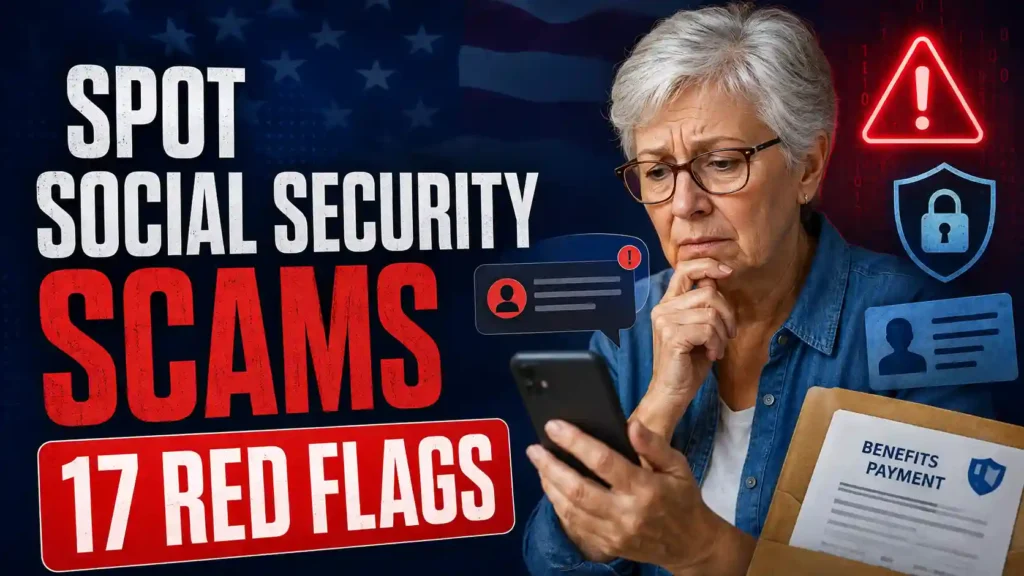
The message looks official. It includes your name, a government seal and a warning that something is wrong with your Social Security number.
Then your phone rings.
The caller claims your number was connected to a crime. Unless you cooperate immediately, your benefits could be suspended, your bank account could be frozen or an arrest warrant could be issued.
Your heart starts racing—and that reaction is exactly what the criminal wants.
To spot Social Security scams, watch for threats of arrest, claims that your Social Security number has been suspended, demands for immediate payment, requests for verification codes and instructions to keep the matter secret. Never trust caller ID, badges, case numbers or official-looking letters without independently verifying the claim.
Social Security scammers do not need you to believe every part of their story. They only need to frighten you long enough to make you click a link, reveal personal information, share a security code or move your money.
That is why learning how to spot Social Security scams can protect more than your next monthly payment. Your personal information could be used to open accounts, file fraudulent tax returns, obtain medical services, redirect benefits or build an entirely new identity in your name.
The names, documents and technology may change, but the manipulation usually follows the same pattern. Once you understand that pattern, these scams become much easier to recognize.
What Is a Social Security Scam?
A Social Security scam is an attempt to steal money, personal information or account access by impersonating Social Security, a government investigator, law enforcement or another trusted organization.
The criminal may contact you through:
- A telephone call
- A robocall
- A text message
- An email
- A social media message
- A video call
- A fake website
- A search advertisement
- A pop-up warning
- An official-looking letter
Some Social Security scams demand an immediate payment. Others are designed to collect information that can be used later.
For example, a caller may ask you to confirm your name, address, date of birth and Social Security number. Nothing may disappear from your account that day, so you assume no damage was done.
However, the criminal may later combine that information with data obtained elsewhere. It could then be used to open financial accounts, change contact information, file a fraudulent tax return or attempt to take control of your benefits.
Therefore, do not judge a suspicious message only by whether it asks for money. A request for information, passwords or security codes can be just as dangerous.
The Fastest Way to Spot a Social Security Scam
Whenever someone unexpectedly contacts you about your Social Security number or benefits, follow this three-step rule:
Stop
Do not answer questions, click a link, open an attachment or follow payment instructions.
A legitimate problem will not become irreversible simply because you take time to investigate it.
Separate
End the call, close the message or leave the website.
Do not allow the caller to transfer you to another department, an investigator, your bank or the police. A fake transfer may simply connect you to another member of the same criminal operation.
Verify
Start a completely separate contact.
Type ssa.gov into your browser yourself or call Social Security at 1-800-772-1213. Do not use a number, button or website supplied by the person who contacted you.
Independent verification breaks the scammer’s control over the conversation.
Legitimate Social Security Contact Versus a Social Security Scam
| Situation | Legitimate communication | Likely scam |
|---|---|---|
| Problem with your benefits | Explains the issue and how you can respond | Threatens to cancel your payment within minutes |
| Legal action | Follows formal procedures | Threatens immediate arrest unless you cooperate |
| Social Security number | May verify limited details during legitimate business | Claims your number has been suspended or cancelled |
| Payment | Provides formal payment options and your rights | Demands gift cards, gold, cryptocurrency, cash or a wire transfer |
| Account security | Allows independent verification | Requests your password or one-time security code |
| Telephone contact | Lets you end the call and call back independently | Orders you to remain on the line |
| Privacy | Allows you to speak with someone you trust | Tells you the matter must remain secret |
| Identification | Can be independently verified | Uses caller ID, a badge or a case number as proof |
| Website | Uses an authentic .gov address | Sends a shortened or look-alike link |
| Benefit increase | Follows established eligibility rules | Promises extra benefits after you pay a fee |
You do not need to prove that the person is a scammer before ending the conversation. One serious warning sign is enough to stop and verify.
17 Warning Signs of a Social Security Scam
Scammers regularly change their stories, but most Social Security impersonation scams contain several of the following red flags.
1. The Caller Threatens to Have You Arrested
The caller may claim your Social Security number was connected to drug trafficking, money laundering, tax fraud or another serious crime.
You are then told that police officers are preparing to arrest you. However, the arrest can supposedly be prevented if you cooperate, move your savings or make a payment.
That is intimidation.
A criminal investigation cannot be erased by purchasing gift cards, sending cryptocurrency or giving a stranger access to your bank account.
2. Your Social Security Number Has Supposedly Been Suspended
One of the most common scam scripts begins with a claim that your Social Security number has been suspended because of suspicious activity.
The scammer may use words such as:
- Frozen
- Blocked
- Cancelled
- Deactivated
- Compromised
- Flagged
You must supposedly provide personal information or pay a fee to reactivate it.
Do not panic. A Social Security number is not handled like a credit card that can be instantly switched off during a threatening telephone call.
3. Your Benefits Will Allegedly Stop Today
Criminals understand how heavily retirees, people with disabilities and their families may depend on monthly benefits.
They exploit that concern with warnings such as:
- “Your next payment has been blocked.”
- “Your benefits will end at midnight.”
- “Your account must be reactivated today.”
- “Your deposit cannot be released until you verify your identity.”
- “You will permanently lose your benefits if this call disconnects.”
The deadline is designed to prevent you from checking the story.
A genuine decision affecting your benefits should include an explanation and information about how to respond or appeal. It will not require an emergency payment to a stranger.
4. You Are Pressured to Act Immediately
Urgency is one of the clearest signs of a Social Security scam.
Listen for statements such as:
- “Do not hang up.”
- “This is your final warning.”
- “You have 30 minutes.”
- “The transaction must be completed today.”
- “We cannot help you if the call disconnects.”
- “Officers will be sent to your home if you delay.”
The faster someone wants you to act, the more important it is to slow down.
5. Payment Must Be Made in an Unusual Way
End the conversation if someone claiming to represent the government demands payment through:
- Gift cards
- Cryptocurrency
- Gold bars or precious metals
- Cash mailed in a package
- Cash collected by a courier
- Prepaid debit cards
- A wire transfer to an unfamiliar account
- A payment app sent to an individual
These methods are attractive to criminals because the money can be difficult to trace or recover.
Even if you legitimately owe money, you should receive formal information explaining the debt, your payment options and your rights. You should never be ordered to read gift-card numbers over the telephone.
6. The Caller Wants Your Full Social Security Number
The caller may already know the last four digits of your Social Security number.
Then comes the trick:
“For security purposes, please confirm the first five digits.”
If you answer, the criminal now has the complete number.
Personal information can come from data breaches, stolen mail, public records, social media or previous scams. A caller knowing part of your number does not prove that the person is legitimate.
7. You Are Asked to Share a Verification Code
A one-time verification code may be the final barrier preventing a criminal from accessing your account.
The scammer may claim that the code is needed to confirm your identity, cancel a fraudulent transaction or protect your benefits.
In reality, the person could be attempting to:
- Reset your password
- Enter your online account
- Add an unauthorized device
- Change your contact information
- Approve a money transfer
- Redirect your benefits
Never share a security code you did not personally request for an action you initiated.
8. The Caller ID Looks Genuine
Caller ID is not proof of identity.
Criminals can make a call appear to come from Social Security, a police department, a local office, a bank or another trusted organization.
The caller may even tell you to inspect the number on your screen as proof.
Do not argue or attempt to investigate while remaining connected. Hang up and make a new call using independently obtained contact information.
9. A Text or Email Contains an Urgent Link
The message may say that you need to:
- Confirm your identity
- Review a new Social Security statement
- Prevent benefit suspension
- Update your direct-deposit information
- Claim an additional payment
- Secure your online account
- Accept a cost-of-living increase
The link may open a fake website that looks almost identical to the real one. Once you enter your login details, the criminal receives them.
Learning How to Recognize Phishing Emails and Fake Government Websites can help you detect deceptive links, altered addresses and fraudulent login pages before you surrender personal information.
10. An Unexpected Attachment Is Included
A fraudulent email may include what appears to be:
- An arrest warrant
- A Social Security statement
- A benefit-suspension notice
- An investigation report
- A direct-deposit form
- An identity-verification document
Opening the attachment could install malicious software, steal information from your device or take you to a fake login page.
Do not assume the file is safe because it contains your name, accurate personal information or a government seal.
11. The Email or Website Address Is Almost Correct
Fake email and website addresses are designed to look legitimate when viewed quickly.
Watch for:
- Misspelled words
- Additional letters or numbers
- Extra hyphens
- Unusual domain endings
- Words added before or after an official name
- Shortened links that hide the destination
- Free personal email accounts pretending to be government addresses
A criminal may also place familiar words inside a longer fraudulent address. Seeing “Social Security” or “ssa” somewhere in a link does not make the destination legitimate.
The safest approach is to avoid the supplied link and type ssa.gov into a new browser window.
12. You Are Promised a Secret Benefit Increase
Not every Social Security scam begins with frightening news. Some begin with hope.
A message may promise:
- Unclaimed benefits
- A special cost-of-living payment
- A larger monthly check
- A government bonus
- A refund
- A new benefit card
- A one-time relief payment
To receive the money, you must supposedly pay a processing fee, click a registration link or provide banking information.
Real benefit increases are not unlocked by paying a stranger who contacted you unexpectedly.
13. The Caller Sends a Badge or Official Document
A photograph of a badge proves very little.
Criminals can copy the name of a real employee and place it on a fabricated identification card. They can also create realistic signatures, case numbers, seals and government letters.
Instead of asking whether the document looks authentic, ask whether the claim can be independently confirmed.
If it cannot, the badge is irrelevant.
14. You Are Told to Move Your Money Into a “Safe” Account
The caller claims that criminals have compromised your bank account. To protect your savings, you must move the money into a secure government account, protected digital wallet or temporary holding account.
There is no protective account waiting for your transfer.
The destination belongs to the criminals. Once the money is sent, recovering it may be extremely difficult.
15. Another “Agency” Joins the Call
One person may claim to represent Social Security. Another plays the role of an investigator. A third pretends to work for your bank or local police department.
Each person confirms the same frightening story, making the situation appear more credible.
However, all three may be working together.
A bank, private company or government office cannot prove legitimacy by transferring your call to another supposed authority. End the conversation and initiate your own contact.
16. You Are Ordered to Keep Everything Secret
The scammer may say:
- “Do not tell your family.”
- “Your bank is involved in the investigation.”
- “Speaking to anyone will violate federal law.”
- “A bank employee may try to stop you.”
- “Do not explain why you are withdrawing the money.”
Secrecy prevents people around you from recognizing the fraud.
Before moving money or sharing sensitive information, speak to a trusted family member, friend, lawyer or bank fraud specialist.
17. The Person Creates Fear and Then Offers Rescue
Most Social Security scams follow the same emotional sequence:
- Something terrible has happened.
- You are personally at risk.
- There is no time to investigate.
- Other people cannot be trusted.
- Only the caller can protect you.
- Protection requires information, access or money.
Once you recognize that structure, the details lose much of their power.
The person frightening you and the person offering to rescue you are the same criminal.
Four Realistic Examples of Social Security Scams
Knowing how these scams sound can help you recognize one before emotion takes over.
Example 1: The Suspended-Number Robocall
“Your Social Security number has been suspended following criminal activity. Press one immediately to speak with a federal officer. Failure to respond will result in legal action.”
The warning signs are:
- Unexpected contact
- Suspended Social Security number
- Vague criminal allegation
- Pressure to respond immediately
- Threat of legal action
Do not press a button or call the number back.
Example 2: The Fake Benefit-Increase Text
“Your Social Security benefit increase is pending. Confirm your banking information within two hours to prevent payment cancellation: [link].”
The warning signs are:
- Unexpected promise of more money
- Urgent deadline
- Threat of payment cancellation
- Request for banking information
- Unverified link
Delete the message and check your account by typing ssa.gov into your browser.
Example 3: The Fraudulent Statement Email
“Your updated Social Security statement is attached. Due to recent security changes, you must review and verify your record immediately.”
The warning signs are:
- Unexpected attachment
- Vague security problem
- Pressure to act
- Request to verify personal information
Do not open the attachment. Sign in independently if you want to review your statement.
Example 4: The Fake Criminal Investigation
“Your Social Security number was used to open bank accounts connected to money laundering. We can protect your savings, but you must transfer the money into a secure federal account. Stay on the line and do not tell your bank why you are withdrawing it.”
The warning signs are:
- A frightening criminal accusation
- Threats against your savings
- A fake secure account
- Instructions to remain on the phone
- A demand for secrecy
- An attempt to control what you tell your bank
Hang up and contact your bank through its verified telephone number.
How Social Security Scammers Obtain Personal Information
A caller knowing your name, address, age or part of your Social Security number can make the story feel convincing.
However, the information may have come from:
- A previous data breach
- Stolen mail
- Public records
- Social media
- A compromised email account
- A fake online form
- An earlier scam
- A purchased marketing list
- Malicious software
- Information shared by another person
Criminals frequently use known information to obtain missing information.
For example, a caller who knows the name of your bank may ask you to confirm the account number. Someone with your address may request your date of birth. A person with the last four digits of your Social Security number may request the first five.
Never complete the information for an unexpected caller.
Signs Someone May Be Stealing Your Social Security Benefits
Not every Social Security scam ends with an immediate payment demand. In some cases, the criminal attempts to take control of an account or redirect monthly benefits.
Watch for:
- A scheduled payment that does not arrive
- An unexplained change in your benefit amount
- A notice about direct-deposit details you did not update
- A password-reset message you did not request
- New contact information on your account
- A notice that your mailing address changed
- An unfamiliar bank account connected to your benefits
- A security code you did not request
- Difficulty signing in with your usual password
- Earnings in your record that do not belong to you
- A benefit application you did not submit
If you notice any of these signs, do not wait for another payment cycle before acting.
Secure your email, check your online account from a trusted device and contact Social Security independently.
Read Can Someone Steal Your Social Security Benefits? to understand account takeovers, direct-deposit redirection and the warning signs that beneficiaries frequently overlook.
How to Verify a Social Security Message Safely
The word “independently” makes all the difference.
Do not verify a suspicious message by:
- Calling the number included in it
- Replying to the email
- Clicking its link
- Trusting a transferred call
- Asking the caller to send a badge
- Using contact information printed on an unexpected letter
- Calling back through your recent-call history
Instead, follow this process:
- End the original contact.
- Write down what the person claimed.
- Open a fresh browser window.
- Type
ssa.govyourself. - Access your account through the website if necessary.
- Call 1-800-772-1213 using a call you initiated.
- Ask whether the claimed problem exists.
- Report the suspicious contact at
ssa.gov/scam.
If the original communication was legitimate, independently checking it will not destroy your benefits or remove your right to respond.
How to Protect Your Benefits and Identity Before a Scam Happens
You should not wait for a suspicious call before strengthening your protection.
Create Your Online Social Security Account
Creating your own account makes it harder for someone else to attempt to establish one using your identity.
Access the registration page by typing ssa.gov into your browser instead of following an unsolicited link.
Use a Unique Password
Do not reuse your Social Security account password for email, banking, shopping or social media.
When a password is stolen from one website, criminals may automatically test it against other services.
Turn On Multi-Factor Authentication
Multi-factor authentication adds another security barrier when someone attempts to enter your account.
However, it only works when you protect the code. Never share a one-time security code with someone who contacted you.
Secure Your Email Account
Your email account can be the gateway to your other accounts. Someone who controls it may reset passwords, intercept security warnings and remove evidence of account changes.
Use a unique password, activate multi-factor authentication and review the devices currently signed in.
Review Your Social Security Account Regularly
Check for unauthorized changes involving:
- Your mailing address
- Email address
- Telephone number
- Direct-deposit information
- Benefit amount
- Earnings record
Do not ignore an unfamiliar change merely because your latest payment arrived normally.
Protect Your Social Security Card
Do not routinely carry your card in your wallet. Store it in a secure place unless you specifically need it.
Avoid keeping an unprotected photograph of the card in your email, phone gallery or cloud storage.
Consider Freezing Your Credit
A credit freeze makes it more difficult for an identity thief to open new credit accounts in your name.
Freezing and lifting your credit is free. It also does not lower your credit score. You generally need to contact each of the three major credit bureaus separately.
Check Your Credit Reports
Review your reports for:
- Accounts you did not open
- Unfamiliar addresses
- Credit inquiries you do not recognize
- Debts that are not yours
- Incorrect personal information
A stolen Social Security number can be misused even when your monthly benefits remain untouched.
Set Up Banking Alerts
Request alerts for:
- Password changes
- Large withdrawals
- Money transfers
- New payees
- Contact-information changes
- New devices accessing the account
- Unusual card transactions
Quick notification gives you a better chance of stopping additional losses.
Create a Family Anti-Scam Rule
Agree that no family member will send money, move savings or provide a security code because of an unexpected call without first speaking to another trusted person.
This rule creates a pause precisely when fear is highest.
You can also create a private family verification phrase. If someone calls pretending to be a relative in an emergency, ask for the phrase before believing the story.
What to Do If You Responded to a Social Security Scammer
Do not allow shame to delay your response.
Scammers use stolen personal information, professional scripts, impersonation technology and intense psychological pressure. Careful and intelligent people can still be deceived.
What you do next matters more than the original mistake.
What to Do in the First 10 Minutes
End All Contact
Hang up, close the message and stop responding.
Do not continue the conversation to gather evidence. The scammer may use the additional time to pressure you or collect more information.
Stop Pending Payments
If you are currently sending money, contact the bank, card company, payment app or financial institution immediately.
Ask whether the transaction can be cancelled, recalled, frozen or disputed.
Disconnect Remote Access
If you installed an application or allowed someone to control your computer or phone, disconnect the device from the internet.
Do not use the affected device for banking or password changes until you are confident that it is secure.
What to Do in the First Hour
Secure Your Email
Using a trusted device:
- Change your email password.
- Turn on multi-factor authentication.
- Sign out of unfamiliar devices and sessions.
- Check whether recovery information was changed.
- Review forwarding rules that may secretly send your emails elsewhere.
Change Compromised Passwords
Start with:
- Your email
- Your Social Security account
- Bank and credit-card accounts
- Tax accounts
- Health-insurance accounts
- Shopping and payment services
Any reused password should be changed everywhere it appears.
Contact Your Bank’s Fraud Department
Explain exactly what happened and what information was shared.
Tell the bank whether you revealed an account number, card details, a password, a security code or allowed someone to control your device.
What to Do Within 24 Hours
Check Your Social Security Account
Look for unauthorized changes to:
- Direct-deposit information
- Mailing address
- Email address
- Telephone number
- Benefit information
- Pending requests
Contact Social Security at 1-800-772-1213 if something appears unfamiliar or you cannot access the account.
Freeze Your Credit
Request a credit freeze from each major credit bureau, especially if your Social Security number, date of birth or other identifying information was exposed.
Report Identity Theft
Visit IdentityTheft.gov if your personal information was stolen or misused. Follow the recovery steps that apply to your situation.
Report the Social Security Scam
Use the scam-reporting page at ssa.gov/scam.
Save your confirmation or report number.
Preserve the Evidence
Keep copies of:
- Text messages
- Emails
- Screenshots
- Telephone numbers
- Website addresses
- Payment receipts
- Gift-card information
- Cryptocurrency transaction details
- Names and badge numbers used
- Dates and times
- Notes describing what happened
Do not reopen suspicious attachments merely to collect evidence.
What to Do During the Following Weeks
Continue monitoring your:
- Social Security account
- Bank statements
- Credit reports
- Credit-card accounts
- Tax records
- Health-insurance statements
- Physical mail
- Email security alerts
Criminals do not always use stolen information immediately. They may wait for attention to fade.
They may also contact you again while pretending to be investigators, lawyers or recovery specialists.
Follow a complete Identity Theft Recovery Checklist so no exposed account, document or security setting is forgotten.
What to Do Based on the Information You Shared
If You Shared Your Social Security Number
Take these steps:
- Secure your online account.
- Change relevant passwords.
- Freeze your credit files.
- Review your credit reports.
- Monitor your earnings record.
- Watch for unfamiliar benefit activity.
- Look for signs of tax or medical identity theft.
- Report identity theft if the number is misused.
A replacement Social Security number is not automatically issued because the original number was exposed. Begin by restricting how the stolen information can be used.
If You Shared a Password
Change it immediately from a trusted device.
If you reused it, change every account using the same or a similar password. Review recovery addresses, telephone numbers and signed-in devices as well.
If You Shared a Verification Code
Assume the criminal may have entered or attempted to reset an account.
Change the password, review recent activity, remove unfamiliar devices and contact the affected organization through a verified channel.
If You Shared Banking Information
Contact the bank’s fraud department immediately. Ask whether the account should be restricted, monitored or replaced.
If You Sent Gift Cards
Contact the gift-card issuer immediately. Keep the cards and receipts. Ask whether the funds remain available and can be frozen.
If You Sent Cryptocurrency
Contact the exchange or service you used. Provide the transaction identification and destination wallet address.
Cryptocurrency transfers can be difficult to reverse, but prompt reporting is still important.
If You Allowed Remote Access
Disconnect the affected device.
Use another trusted device to change your email, banking and government-account passwords. Remove the remote-access program, run a reputable security scan and seek professional technical assistance if you cannot confirm that the device is clean.
Beware of Fake Scam-Recovery Services
People who have already lost money are frequently targeted again.
Someone may contact you claiming to be:
- A government investigator
- A recovery specialist
- A lawyer
- A bank employee
- A cryptocurrency expert
- A cybersecurity professional
The person promises to recover your money but first demands a tax, legal fee, release fee or processing charge.
Do not pay.
No stranger can guarantee the recovery of stolen money. Be especially suspicious if the person already knows details about the original scam. Those details may have been supplied by the first criminal.
A 10-Second Social Security Scam Checklist
Before responding to an unexpected message, ask:
- Did this person contact me unexpectedly?
- Am I being frightened or rushed?
- Am I threatened with arrest or lost benefits?
- Does the person claim my Social Security number is suspended?
- Am I being asked for personal information?
- Does the person want a password or verification code?
- Am I told to remain on the line?
- Is an unusual payment method required?
- Am I being told to keep the situation secret?
- Can I verify the claim independently through
ssa.gov?
If one answer concerns you, stop the interaction. You do not need the caller’s permission to hang up.
Frequently Asked Questions About Social Security Scams
1. How can I tell whether a Social Security call is real?
Consider whether you recently contacted Social Security, submitted an application or expected a scheduled call. Even then, you can end the conversation and call 1-800-772-1213 independently. Never rely only on caller ID.
2. Will Social Security ever call me unexpectedly?
A representative may call in connection with ongoing business. However, an unexpected caller who threatens arrest, demands immediate payment or requests sensitive account information should be treated as suspicious.
3. Can my Social Security number be suspended?
Treat an unexpected claim that your number has been suspended, blocked or cancelled as a serious scam warning. Do not pay anyone or provide personal information to reactivate it.
4. Will Social Security threaten to arrest me?
A caller demanding money or information to prevent immediate arrest is using fear to control you. End the call and verify the allegation separately.
5. Can my benefits be stopped without warning?
Benefit changes normally involve formal information and a way to understand or challenge the decision. A caller should not demand emergency payment to prevent your benefits from ending within minutes.
6. Does Social Security accept gift cards?
No legitimate government payment requires gift-card numbers. Anyone demanding payment through gift cards is attempting to steal your money.
7. Will Social Security ask for cryptocurrency?
You will not be required to send cryptocurrency to protect your Social Security number, benefits, savings or identity.
8. Can scammers copy a real government telephone number?
Yes. Caller ID information can be manipulated. Always end the incoming call and initiate a separate one using verified contact information.
9. Is a badge photograph proof that the caller is legitimate?
No. Badges, credentials, employee names, signatures and government seals can be copied or fabricated.
10. Should I trust a Social Security letter received by mail?
Do not trust a letter solely because it looks official. Independently verify unexpected demands for money, personal information or immediate action.
11. Does Social Security send text messages?
Electronic notifications may be used in certain situations, but an unexpected text containing an urgent link or request for sensitive information should be treated cautiously.
12. Does Social Security send emails?
You may receive legitimate electronic communication. However, you should not open unexpected attachments or use an unsolicited email to provide passwords, security codes or financial information.
13. What if the caller knows the last four digits of my Social Security number?
That knowledge does not prove legitimacy. The information may have come from a data breach or another source. Never provide the missing digits.
14. Can someone steal my benefits with my Social Security number?
A Social Security number can be combined with other stolen information in an attempt to access accounts or redirect payments. Secure your Social Security account, email and bank accounts immediately.
15. How do I know whether my direct deposit was changed?
Check your online account for unfamiliar banking information and watch for notices about changes you did not request. Act immediately if a scheduled payment does not arrive.
16. What should I do if someone requests a verification code?
Do not share it. The code may allow the person to enter your account, reset your password or approve a transaction.
17. Should I call the number included in a suspicious message?
No. The number may connect you directly to the scammer. Use contact information obtained independently.
18. What should I do if I clicked a suspicious link?
Close the page. If you entered a password, change it immediately from a trusted device. Scan the affected device and monitor the account for unauthorized activity.
19. What should I do if I opened a suspicious attachment?
Disconnect the device from the internet if it behaves strangely. Run a reputable security scan and change sensitive passwords from another trusted device.
20. Should I change my Social Security number after a scam?
A replacement number is not routinely issued simply because the existing one was exposed. Start with account security, credit freezes, monitoring and identity-theft reporting.
21. Will freezing my credit stop my benefits?
No. A credit freeze does not stop Social Security payments and does not lower your credit score.
22. What is the difference between a fraud alert and a credit freeze?
A fraud alert asks businesses to take additional steps to verify your identity. A credit freeze restricts access to your credit file and generally creates a stronger barrier against new-account fraud.
23. Can money sent to a Social Security scammer be recovered?
Recovery depends on the payment method and how quickly you act. Contact the payment provider immediately. Never pay another person who guarantees recovery.
24. Where should I report a Social Security scam?
Report Social Security impersonation at ssa.gov/scam. If your personal information was stolen or misused, begin your recovery at IdentityTheft.gov.
25. What is the biggest Social Security scam warning sign?
The strongest overall warning is unexpected contact that combines fear, urgency and a demand for money, personal information or account access.
Final Thoughts
The most dangerous Social Security scams do not always look careless or amateurish.
A caller may know your name. The number may appear genuine. The message may contain perfect grammar, and the attached document may carry a convincing government seal.
None of those details proves legitimacy.
Focus on the person’s behavior.
Are you being threatened, rushed, isolated or ordered to use an unusual payment method? Are you being asked for your complete Social Security number, bank details, password or verification code? Are you told to stay on the line or keep the matter secret?
If so, stop.
Do not click. Do not pay. Do not move your savings. Do not provide information.
End the communication and verify the claim independently.
That brief pause may be all that stands between you and the theft of your benefits, savings or identity.
Pingback: How to Identify a Scammer on the Phone: 21 Red Flags and a 60-Second Verification Test - SafeGuard Press
Pingback: Can Someone Steal Your Social Security Benefits? 11 Warning Signs and What to Do Before Your Next Payment - SafeGuard Press