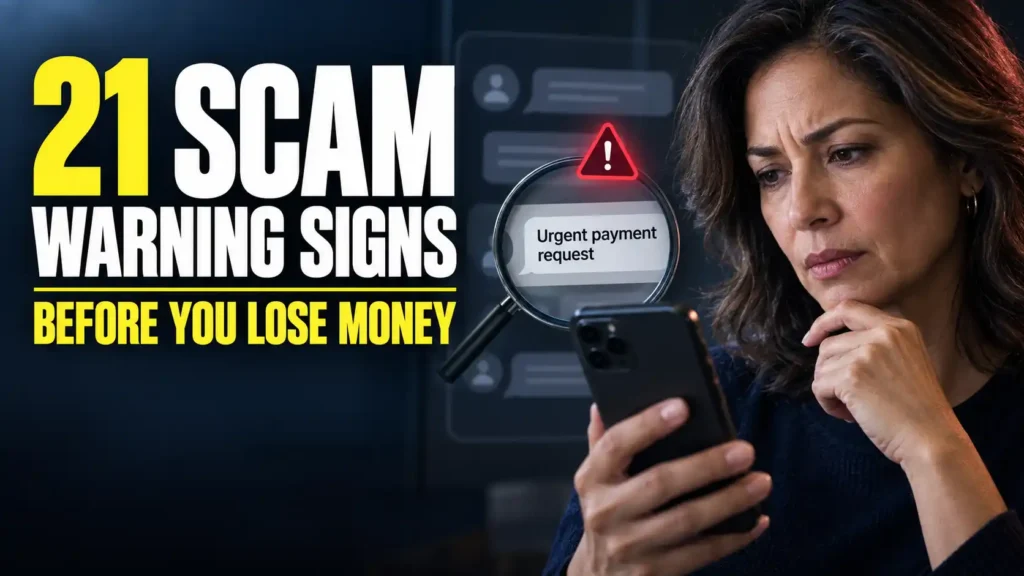
The caller knows your name. The message carries a familiar company logo. The website looks professional. The person speaks confidently and already seems to know something about your account.
Then everything changes.
You are told to act immediately. You must not speak to anyone. Your money is supposedly in danger. A family member needs urgent help. A guaranteed investment opportunity will disappear within minutes.
Your heart starts racing, and making the payment feels like the fastest way to end the crisis.
Stop.
How To Identify A Scammer On WhatsApp: 19 Red Flags And A 5-Minute Test
That emotional pressure is not an accidental part of the conversation. It may be the scammer’s most powerful weapon.
Modern scams are no longer limited to badly written emails or unbelievable promises from obvious strangers. Criminals can spoof trusted phone numbers, copy legitimate websites, take over social media accounts and use artificial intelligence to create convincing voices, photographs and videos.
However, their objective remains the same: control your emotions, prevent independent verification and push you into sending money or revealing sensitive information.
Learning the most common scam warning signs can help you recognize that manipulation before the damage is done.
Last reviewed: September 2026
Editorial note: This guide has been reviewed for alignment with current consumer-fraud, identity-theft and cybercrime prevention guidance. Scam methods change constantly, so always verify unexpected financial requests through official channels.
Scam Warning Signs: The Quick Answer
Most scams contain more than one red flag. Use this quick checklist whenever an unexpected person requests money, information or access to one of your accounts.
| Scam warning sign | What it may sound like |
|---|---|
| Unexpected contact | “This is your bank’s fraud department.” |
| Extreme urgency | “You have only 30 minutes to act.” |
| Threats | “Pay now or you will be arrested.” |
| Secrecy | “Do not discuss this with your family or bank.” |
| Unusual payment | “Buy gift cards and send me the numbers.” |
| Upfront fee | “Pay the tax before receiving your prize.” |
| Security-code request | “Read the six-digit code we just sent you.” |
| Remote-access request | “Install this app so we can protect your account.” |
| Guaranteed profit | “You cannot lose money with this investment.” |
| Blocked verification | “Do not hang up or the protection will fail.” |
| Changing story | “There is one more fee before we can release the money.” |
| Emotional emergency | “Your son is in trouble and needs money immediately.” |
A single warning sign deserves caution. Two or more should make you stop the conversation and verify everything independently.
Why Scam Warning Signs Are Becoming Harder to Recognize
Scammers do not need to fool everyone. They only need to reach one person at the right emotional moment.
You may be tired, distracted, worried about money, waiting for a delivery or concerned about a relative. A message that would normally appear suspicious can feel believable when it matches something happening in your life.
Criminals also collect information from social media, public records, stolen databases and previous data breaches. That information helps them create a more convincing story.
A scammer may already know:
- Your full name
- Your telephone number
- Your home address
- Your employer
- The name of your bank
- The names of family members
- Places you recently visited
- Products you purchased
- Part of an account or card number
Knowing these details does not prove that the person is legitimate. It only means the criminal found information about you.
The best protection is not relying on appearance, confidence or familiarity. You must examine the person’s behavior.
1. You Receive Unexpected Contact
Many scams begin with a call, email, text message, social media message or letter you were not expecting.
The person may claim to represent:
- Your bank
- A government agency
- A delivery company
- A utility provider
- A well-known business
- A charity
- A potential employer
- A family member
- A romantic interest
Unexpected contact does not automatically mean fraud. The real danger begins when the person requests money, login details, verification codes or immediate action.
For example, you might receive this message:
“Your package could not be delivered because of an unpaid $1.47 fee. Update your address and payment details within six hours to avoid cancellation.”
The small amount is deliberate. It makes the request appear harmless. However, the linked page may be designed to steal your card details.
Never verify an unexpected message using the phone number or link provided inside it. Contact the organization through its official application, website or publicly listed number.
2. You Are Pressured to Act Immediately
Urgency is one of the clearest scam warning signs.
A scammer may tell you:
- Your account will be suspended today.
- The police are coming to arrest you.
- Your electricity will be disconnected within an hour.
- Someone is withdrawing money from your account.
- Your computer has been infected.
- Your relative needs emergency help.
- The investment opportunity expires tonight.
The objective is not simply to frighten you. It is to prevent you from thinking, checking the story or asking another person for advice.
A typical pressure message might say:
“We detected a $2,400 transfer from your account. If you hang up before the investigation is complete, the transaction cannot be reversed.”
That statement is designed to keep you under the caller’s control.
Real emergencies can happen, and legitimate organizations may impose deadlines. However, a trustworthy organization should allow you to verify its identity and understand what you are being asked to do.
When someone tries to rush you, slow down.
3. The Person Demands Secrecy
“Do not tell your bank.”
“Do not speak to your family.”
“Keep this investment opportunity confidential.”
“Stay on the phone while you make the payment.”
These instructions are enormous red flags.
Scammers know that another person may notice weaknesses in their story. They isolate you because secrecy protects the scam—not you.
Investment scammers may claim that you have received access to a private trading opportunity. Romance scammers may say that family members would not understand the relationship. Bank impersonators may claim that local branch employees are involved in the fraud.
Different stories, same objective: preventing outside verification.
If someone tells you not to discuss a payment or financial decision, end the conversation. Speak to a trusted relative, friend, bank representative or professional before proceeding.
A legitimate transaction should withstand outside scrutiny.
4. You Must Pay With Gift Cards
A request for payment by gift card is one of the strongest signs that you are dealing with a scammer.
Gift cards are intended for purchasing products or giving presents. They are not a normal method for paying:
- Taxes
- Fines
- Bail
- Utility bills
- Technical-support charges
- Government fees
- Legal expenses
- Account-verification charges
Scammers prefer gift cards because they can obtain the card number and PIN, use or sell the balance and disappear.
The instructions may sound like this:
“Purchase four $500 gift cards. Do not tell the cashier why you are buying them because the investigation is confidential. Call us from the parking lot and read the numbers.”
The request for secrecy is meant to prevent a store employee from warning you.
Never send a photograph of a gift card or receipt to someone who contacted you unexpectedly. Never read the card number or PIN over the phone.
5. You Are Asked to Use Cryptocurrency, a Wire Transfer or a Payment App
Scammers often request payment methods that move money quickly and provide limited opportunities for reversal.
Be suspicious when someone insists on payment through:
- Cryptocurrency
- A wire transfer
- A peer-to-peer payment app
- A cryptocurrency ATM
- A prepaid debit card
- Cash sent through a courier
- Gold or another valuable item
The payment method alone does not prove fraud. People and businesses use some of these services legitimately.
However, the combination of an unusual payment method, urgency and secrecy is extremely dangerous.
A supposed government employee who tells you to deposit cash into a cryptocurrency ATM is not helping you settle a legitimate government debt. A bank representative who asks you to transfer money into another person’s account is not protecting your savings.
Before sending money, contact your bank using the number printed on your card or displayed inside its official application.
6. The Offer Sounds Too Good to Be True
You may be told that you won a competition you never entered, received an unexpected inheritance or discovered an investment with guaranteed profits.
The story is designed to overpower skepticism with excitement.
Common examples include:
- Lottery and sweepstakes scams
- Fake government grants
- Secret investment opportunities
- Guaranteed cryptocurrency profits
- Extremely cheap products
- High-paying jobs requiring little work
- Loans with no meaningful approval process
- “Risk-free” business opportunities
Imagine receiving this message:
“Congratulations! Your phone number was selected to receive $750,000. Pay a $295 processing charge today to release your winnings.”
The promised reward makes the fee appear small. Nevertheless, after you pay, another charge usually appears.
If the reward is extraordinary but the explanation is vague, stop and investigate. Real investments carry risk. Real employers do not normally pay enormous salaries for simple tasks. Legitimate prize organizers do not require winners to pay mysterious fees before receiving their winnings.
7. You Must Pay Money to Receive Money
This tactic appears in prize, inheritance, loan, grant, refund and job scams.
The scammer promises a large payment but first demands a smaller amount for:
- Taxes
- Insurance
- Processing
- Customs charges
- Account activation
- Verification
- Legal documents
- Training materials
- Equipment
- Release fees
After you pay, a new problem appears. Then another fee is requested. The promised money never arrives.
This pattern is sometimes called advance-fee fraud. Its power comes from making the next payment appear like the final obstacle between you and a much larger reward.
Do not let the money you have already sent trap you. Previous payments do not make the opportunity more genuine. They only make it emotionally harder to walk away.
8. Someone Requests Your Password, PIN or Security Code
Passwords, PINs and one-time verification codes are designed to keep other people out of your accounts.
A scammer may say:
- “Read the code so I can confirm your identity.”
- “We need your PIN to stop the transaction.”
- “Send a screenshot of the message you received.”
- “Approve the login request so we can secure your account.”
- “Move the money when the security notification appears.”
In reality, the criminal may already be attempting to reset your password, add a new device or authorize a payment. The code you reveal could provide the final piece needed to take over the account.
A genuine representative should not need you to read back a secret authentication code during an unexpected call.
End the conversation and contact the company through its official application or trusted phone number.
9. The Caller ID Looks Real, but the Call Is Suspicious
A familiar name or number on your screen does not guarantee that a call is genuine.
Criminals can manipulate caller ID information to make a call appear to come from a bank, police department, government office or local business. This practice is known as caller ID spoofing.
The caller may even say:
“Look at your screen. You can see that I am calling from the official bank number.”
That proves nothing.
Caller ID should never be your only method of verification. Hang up, wait briefly and call the organization using a number you found independently.
If the caller says that you must not hang up, treat that pressure as an additional warning sign.
10. The Message Contains a Suspicious Link or Attachment
Fraudulent links can lead to fake sign-in pages that steal usernames, passwords, payment details and personal information.
A message may ask you to click because:
- A package could not be delivered.
- Your bank account has been locked.
- You owe an unpaid toll.
- A subscription is about to renew.
- Someone logged into your account.
- You are entitled to a refund.
- You received a document or photograph.
- Your tax information needs updating.
The visible words may look legitimate while the actual link leads somewhere completely different.
Unexpected attachments can also contain harmful software. A fake invoice, receipt, résumé or legal notice may be used to make you open the file.
Do not rely solely on spelling mistakes. Modern phishing messages can use correct grammar, copied branding and accurate personal information.
Open the organization’s official application or type its known website address into your browser instead.
11. The Website Address Is Almost—but Not Quite—Correct
A fake website may differ from the legitimate address by only one character.
Watch for:
- Added or missing letters
- Replaced characters
- Unusual hyphens
- Extra words
- Strange domain endings
- Misspelled company names
- Subdomains designed to imitate the real domain
For example, a criminal may register an address that adds words such as “secure,” “verification” or “customer-support” to a trusted company’s name.
A padlock symbol or “https” does not prove that the business behind a website is honest. It only means the connection between your browser and that website is encrypted. Fraudulent websites can also use encryption.
Before entering login or payment information, inspect the entire domain carefully.
12. The Person Wants Remote Access to Your Device
Technical-support and bank-impersonation scammers may ask you to install an application that allows them to control your computer or phone.
They may claim that they need access to:
- Remove a virus
- Cancel a fraudulent payment
- Issue a refund
- Secure your bank account
- Repair an internet problem
- Investigate suspicious activity
- Remove criminals from your device
Once connected, the scammer may view your files, steal passwords, access online banking or manipulate what appears on the screen.
For example, the criminal may cover part of your screen while transferring money in the background. You may believe you are receiving a refund when money is actually leaving your account.
Never provide remote access to someone who contacted you unexpectedly. If you need technical assistance, select and contact a trusted provider yourself.
13. You Are Told to Move Money to a “Safe Account”
There is no legitimate reason for a bank employee, police officer or government official to ask you to protect your savings by transferring them to another person’s account.
The scammer may claim that your current account has been compromised and your funds must be moved immediately. The so-called safe account actually belongs to the criminal or an associate.
The story may sound like this:
“Someone inside your local branch is stealing from customers. We have opened a secure holding account in your name. Transfer your balance there now, but do not speak to branch employees.”
Your bank can take protective action within its own system. It does not need you to send your savings to an unfamiliar account.
Treat any request to move money for “protection” as a serious fraud warning.
14. Someone Sends You a Check and Requests Money Back
Fake-check scams frequently appear in job offers, online sales, mystery-shopping opportunities and prize notifications.
The scammer sends a check for more than the agreed amount. You are then instructed to deposit it and:
- Return the excess
- Purchase gift cards
- Pay a supplier
- Buy equipment
- Send money to another worker
- Transfer part of the funds elsewhere
Your bank may temporarily make some of the money available before discovering that the check is fraudulent. When the check eventually fails, the deposit is removed from your account—but the money you sent is still gone.
A visible balance does not necessarily mean that a check has permanently cleared.
Never return an overpayment until your bank has independently confirmed that the original payment is final and legitimate.
15. A Job Requires You to Pay Before You Can Work
Fake employers may advertise attractive remote jobs, conduct interviews through messaging applications and send professional-looking documents.
However, the scheme becomes clearer when you are asked to pay for:
- Training
- Certification
- Background checks
- Starter kits
- Software
- Account upgrades
- Equipment from a specified supplier
- Cryptocurrency to unlock tasks
Task scams may initially pay a small amount to gain your trust. You might receive $10 or $20 for rating products, liking videos or completing simple “optimization” tasks.
Later, you are told to deposit larger amounts to unlock premium assignments or withdraw your supposed earnings. The balance shown on the platform is not necessarily real.
A legitimate employer pays you. It does not require you to deposit money repeatedly to unlock your salary.
16. An Investment Promises Guaranteed Returns
No genuine investment can guarantee enormous profits without risk.
Be cautious of anyone who promises:
- Consistent daily earnings
- Guaranteed cryptocurrency profits
- Secret trading systems
- “Zero-risk” opportunities
- Exclusive access available only today
- Returns far above normal market performance
- Information from a supposed insider
Fake investment platforms can display impressive profits on a dashboard. Those figures may be entirely fabricated.
At first, the scammer may allow you to withdraw a small amount. That payment is designed to build confidence and encourage a much larger deposit.
When you eventually try to withdraw your money, the platform demands taxes, commissions, security deposits or verification charges. Paying those fees does not release the funds because the displayed profits never existed.
Verify the person’s professional registration and the company’s legal identity through independent official channels. Do not rely on documents, screenshots or testimonials supplied by the promoter.
17. A New Romantic Interest Soon Needs Money
Romance scammers do not always request money immediately. Many spend weeks or months building emotional trust.
Eventually, an emergency appears:
- A medical crisis
- A frozen bank account
- A business problem
- A customs fee
- A travel expense
- A military-related difficulty
- An investment opportunity
- A family tragedy
The person may avoid meeting you, repeatedly cancel video calls or provide excuses for why normal payment methods cannot be used.
Some romance scammers also introduce fake investments. They first build a relationship and then claim that a relative or friend has a profitable cryptocurrency system. The emotional bond makes the financial opportunity appear safer.
If an online romantic partner requests money, speak privately with someone you trust before taking action. Genuine affection should not require financial secrecy.
18. A Relative Appears to Be in an Emergency
You may receive a call from someone who sounds like your child, grandchild, spouse or sibling. The caller claims to have been arrested, kidnapped, injured or stranded.
Another person may join the call while pretending to be a police officer, lawyer, doctor or kidnapper.
Artificial intelligence can make voice impersonation more convincing, but even a realistic voice is not proof of identity.
Hang up and call your relative using a number you already know. If the person does not answer, contact another family member.
Families can also create a private verification word for genuine emergencies. Choose something that cannot be guessed from birthdays, pets’ names or information posted on social media.
To understand how criminals manufacture panic during these calls, read how AI family-emergency scams use fear to defeat careful thinking.
19. You Are Threatened With Arrest, Deportation or Account Closure
Government-impersonation scammers may accuse you of tax violations, immigration problems, missed jury duty, benefit fraud or involvement in a crime.
They may know personal details about you. They may provide a badge number, case number or fake warrant. None of that proves that the threat is genuine.
A typical threat might sound like this:
“A warrant has been issued in your name. Stay on the line and pay the security bond today, or officers will arrive at your home.”
Legitimate authorities do not resolve arrest warrants through gift cards, cryptocurrency or immediate payment during a threatening telephone call.
Do not argue with the caller or reveal additional information. End the call and contact the relevant agency using its publicly listed number.
20. The Person Discourages Independent Verification
A scammer may insist that:
- You must not hang up.
- You cannot visit a physical office.
- Their supervisor is unavailable.
- Online information is outdated.
- Your bank employees are involved in the fraud.
- You must use only the contact details they supplied.
- Verification will cancel the opportunity.
- Speaking to another person will delay the emergency response.
This behavior reveals what the criminal fears most: independent confirmation.
Never allow the person making a claim to control how you verify that claim. Find a separate and trustworthy way to contact the organization or individual involved.
If the story is genuine, independent verification will confirm it. If the story collapses as soon as you ask questions, you may have just avoided a scam.
21. The Story Keeps Changing
Scams often begin with a simple promise or threat. As questions appear, the criminal adds explanations to keep the scheme alive.
A delivery fee becomes a customs fee. Then insurance is required. After that, you must purchase a certificate.
A romantic partner’s planned visit is delayed by a medical crisis. Then the passport disappears. Next, the bank account is frozen.
An investment withdrawal requires tax. After the tax is paid, a compliance charge appears. Then an anti-money-laundering deposit is supposedly needed.
Changing stories, repeated emergencies and endless additional fees are strong signs of manipulation.
Stop sending money. More money will not repair a story that was fraudulent from the beginning.
AI Scam Warning Signs You Should Know
Artificial intelligence has made impersonation faster, cheaper and more convincing. Nevertheless, AI-powered scams still rely on the same pressure, secrecy and payment tactics found in traditional fraud.
AI Voice-Cloning Scams
A scammer may use a short audio sample from a social media video, voicemail or public recording to imitate someone’s voice.
The cloned voice might claim to be in an accident, under arrest or in immediate danger. The criminal then demands money before you can verify the story.
A familiar voice is no longer enough. Ask a personal question, use a family verification word and contact the person through a known number.
Deepfake Video Calls
A video call can feel like strong proof of identity, but manipulated or pre-recorded footage can imitate a real person.
Warning signs may include:
- Unnatural blinking or facial movement
- Delayed lip synchronization
- Repeated gestures
- Poor detail around the face
- Refusal to perform a spontaneous action
- Pressure to keep the call extremely short
- An immediate request for money or sensitive information
Technical imperfections are not always visible. The safer approach is independent verification, not trying to become a deepfake expert.
Fake Celebrity Endorsements
Criminals can create videos that appear to show celebrities, financial experts or business leaders promoting an investment or giveaway.
A familiar face does not prove that the endorsement is genuine.
Ignore the video’s links and comments. Search independently for information about the company, promoter and investment. Claims of guaranteed profit remain dangerous regardless of who appears to make them.
AI-Written Phishing Messages
Poor spelling is no longer a dependable way to identify phishing. AI tools can produce polished emails and messages in multiple languages.
Focus on what the message wants you to do.
Does it ask you to click a link, reveal information, bypass a normal procedure or make an urgent payment? Behavior is a better warning signal than grammar.
Scam Warning Signs by Communication Method
Scammers adapt their methods to the platform they use. Understanding how fraud appears during calls, text messages, emails and social media conversations can help you detect danger faster.
Warning Signs of a Phone Scam
Be cautious when an unexpected caller:
- Demands immediate payment
- Threatens arrest or account closure
- Requests a verification code
- Refuses to let you hang up
- Tells you to withdraw cash
- Asks you to install an application
- Directs you to a cryptocurrency ATM
- Claims that caller ID proves legitimacy
End the call and contact the organization independently.
Warning Signs of a Text-Message Scam
Suspicious texts frequently contain:
- Unexpected delivery problems
- Fake unpaid toll notices
- Account-security warnings
- Refund offers
- Shortened links
- Requests for personal information
- Messages from unfamiliar numbers
- Pressure to respond before a deadline
Do not click the link. Open the official application or website yourself.
Warning Signs of an Email Scam
Do not judge an email only by its spelling and grammar. Modern fraudulent emails can look polished and professional.
Check for:
- A sender address that does not match the company
- Unexpected attachments
- Requests to update payment information
- Unrecognized invoices
- Urgent password-reset messages
- Links leading to unfamiliar domains
- Generic greetings when personalization would be expected
- Instructions to bypass normal company procedures
If the email relates to your job, verify unusual payments or account changes through a different communication method.
Warning Signs of a Social Media Scam
Common social media warning signs include:
- A new profile pretending to be an existing friend
- A celebrity promoting a guaranteed investment
- A seller who refuses protected payment methods
- A buyer who wants to overpay
- A stranger offering easy work
- A giveaway requesting fees
- Pressure to move the conversation to another app
- Requests for verification codes
An account can be copied or taken over. A message from a familiar profile may not have been sent by the real owner.
Warning Signs of an Online Marketplace Scam
Be cautious when a buyer or seller:
- Refuses to use the platform’s payment system
- Sends a payment notification you cannot verify in your account
- Requests your email address to “complete” payment
- Overpays and asks for a refund
- Uses stolen or inconsistent product photographs
- Refuses to provide additional photographs
- Creates an unnecessary emergency
- Sends a courier before payment is confirmed
Check your actual account balance. Never rely on a screenshot or emailed payment confirmation.
How Scammers Manipulate Intelligent People
Falling for a scam does not mean that someone is stupid or careless.
Scammers target normal human emotions. Fear can make a person obey. Excitement can make risk appear smaller. Sympathy can override suspicion. Loneliness can create trust. Authority can make questioning someone feel inappropriate.
They also use psychological techniques that make stopping more difficult.
Emotional Overload
The scammer creates fear, excitement or sympathy so intense that careful reasoning becomes harder.
Authority
The criminal pretends to be a police officer, government employee, doctor, bank investigator or company executive. The title is intended to discourage questions.
Social Proof
Fake testimonials, fabricated reviews and controlled group chats create the impression that many people have already benefited.
Sunk-Cost Pressure
After you send money, walking away can feel like accepting the loss. The scammer exploits that feeling by promising that one final payment will solve everything.
Isolation
The criminal encourages secrecy and discourages contact with anyone who might challenge the story.
The most effective protection is not trying to outsmart every scammer. It is developing a fixed response to pressure:
Stop. Disconnect. Verify independently.
What to Do When You Notice Scam Red Flags
Noticing a warning sign is only useful if you respond correctly. These steps can help you interrupt a scam before money or personal information changes hands.
Stop Communicating
Do not continue the conversation to prove that you cannot be fooled. Every response gives the scammer another opportunity to manipulate you or collect information.
Stop replying, end the call and close the suspicious website.
Do Not Click, Download or Install Anything
Avoid links, attachments, applications and browser extensions provided during unexpected contact.
If you already downloaded something, do not open it. If you installed remote-access software, disconnect the device from the internet and seek trusted technical assistance.
Do Not Send a Test Payment
A scammer may suggest sending a small amount to prove that a platform or opportunity works.
Small initial payments are often used to lower your resistance. Once you participate, the requested amounts usually increase.
Verify the Claim Independently
Contact the organization or person using information you already trust.
You can use:
- The number printed on the back of your bank card
- The organization’s official application
- A verified government website
- A saved contact number
- An in-person branch or office
Do not use contact information supplied by the suspected scammer.
Preserve the Evidence
Save:
- Screenshots
- Emails
- Receipts
- Usernames
- Phone numbers
- Website addresses
- Cryptocurrency wallet addresses
- Transaction references
- Dates and times
- Copies of the conversation
This evidence may help your bank, payment provider or investigators understand what happened.
Block and Report the Account
Block the caller, sender or social media account. Report the profile or message through the platform where the contact occurred.
Reporting suspicious activity may help the platform identify related accounts and protect other users.
What to Do If You Already Paid a Scammer
Act immediately. The faster you respond, the greater the possibility that a bank or payment provider may be able to stop, trace or reverse the transaction.
Your next step depends on how you paid.
Credit or Debit Card
Contact the card issuer using the number printed on the card. Report the fraudulent transaction and ask whether the payment can be disputed or reversed.
If the card details were exposed, request a replacement card.
Bank Transfer
Call your bank’s fraud department immediately. Ask whether the transfer can be stopped, recalled or traced.
Provide the recipient’s account details, payment reference, amount and time of transfer.
Payment App
Report the transaction inside the application and contact the provider’s fraud team. If the app was connected to a bank account or card, notify that financial institution as well.
Gift Card
Contact the company that issued the gift card. Keep the card and receipt. Provide the card number only through the issuer’s official reporting process.
Some issuers may be able to freeze an unused balance, but speed is critical.
Cryptocurrency
Contact the cryptocurrency exchange or service used to send the payment. Provide the wallet address and transaction identification number.
Blockchain transfers are usually difficult to reverse, but reporting quickly may help an exchange identify or freeze funds that enter an account it controls.
Wire Transfer
Contact the wire-transfer company immediately and request a cancellation or recall. Save the transaction number and all recipient information.
Cash or Courier
Contact local law enforcement and provide the delivery address, time, courier details and any available surveillance evidence.
Check
Contact your bank and ask whether the check can be stopped. If the scammer sent you a check, do not spend the deposited money until the bank confirms that the payment is final.
Do not trust anyone who later contacts you promising to recover your money for an upfront fee. Recovery scammers deliberately search for previous fraud victims because they know those victims are desperate to reverse the loss.
For a complete emergency response plan, follow what to do immediately after you realize you have been scammed.
What to Do If You Shared Personal Information
If you disclosed sensitive information, the risk may continue even if no money was taken immediately.
Take these steps:
- Change the affected password immediately.
- Change every account using the same or a similar password.
- Enable multi-factor authentication.
- Contact your bank or card issuer.
- Review recent transactions.
- Check email forwarding rules and recovery details.
- Remove unfamiliar devices from your accounts.
- Freeze your credit if identity theft is possible.
- Monitor credit reports and financial statements.
- Report identity theft through the appropriate official channels.
If you shared a Social Security number, tax identification number or government identification document, monitor your financial and official records closely.
If you gave someone remote access, disconnect the device from the internet and have it checked before using it for banking, shopping or email.
A Simple Five-Question Scam Test
Before sending money or sharing information, ask yourself:
- Did this person contact me unexpectedly?
- Am I being rushed, frightened or overly excited?
- Am I being asked to pay in an unusual way?
- Does this person want information they should not need?
- Can I verify the claim without using anything they gave me?
If several answers raise concern, stop the transaction.
This test is intentionally simple. During an emotional conversation, complicated security advice is difficult to remember. Five direct questions can interrupt the pressure and give you time to think.
Frequently Asked Questions About Scam Warning Signs
Scams can arrive through calls, emails, text messages, social media, online marketplaces and face-to-face conversations. These answers address 25 common questions people ask when trying to determine whether an offer, request or emergency is genuine.
What is the biggest warning sign of a scam?
Pressure to act immediately is one of the biggest warning signs. Scammers create urgency because pausing gives you time to verify their claims, speak to someone you trust and notice inconsistencies.
How can you tell whether someone is a scammer?
Examine the person’s behavior rather than how professional or convincing they appear. Requests for secrecy, unusual payments, passwords, verification codes or remote access are serious red flags.
Can a scam call appear to come from a real number?
Yes. Scammers can manipulate caller ID information so that a call appears to come from your bank, the police, a government agency or another trusted organization. Hang up and call the organization independently.
Do scammers always make spelling and grammar mistakes?
No. Many fraudulent messages use correct spelling, professional branding and natural language. Poor grammar can be a warning sign, but perfect grammar does not prove that a message is legitimate.
Will a bank ask for a verification code?
A bank may send a code when you initiate an action. However, you should never read that code to someone who contacted you unexpectedly. End the conversation and call your bank directly if you are uncertain.
Is every cryptocurrency payment a scam?
No. Cryptocurrency itself is not automatically fraudulent. However, an unexpected demand for cryptocurrency combined with urgency, threats or secrecy should be treated as highly suspicious.
How Do You Tell If You Are Talking to a Scammer?
You may be talking to a scammer if the person contacts you unexpectedly, pressures you to act quickly, refuses independent verification, changes important details in their story or asks for money through gift cards, cryptocurrency, wire transfers or payment apps. Stop communicating temporarily and verify the person or organization through contact information you find independently.
Can a legitimate organization request gift cards?
Legitimate organizations do not require gift cards to pay taxes, fines, utility bills, government charges or technical-support fees. Anyone insisting on this payment method is probably attempting fraud.
How do I check whether an online seller is genuine?
Inspect the full website address, examine the seller’s history, search for independent information and use a payment method with buyer protection. Do not rely exclusively on reviews displayed on the seller’s website.
What should I do with a suspicious link?
Do not click it. Open the organization’s official application or type its known address into your browser. Contact the company through verified information if the message concerns your account.
What if the person knows my personal information?
Personal knowledge does not prove legitimacy. Names, addresses, family connections and partial account details can come from social media, public records, data breaches or stolen databases.
Can scammers imitate a family member’s voice?
Yes. Voice-cloning technology can make a caller sound like someone you know. Contact the family member independently and use a private verification word before believing the emergency.
Can a video call still be fake?
Yes. Criminals can use manipulated footage, prerecorded video or deepfake technology. Verify unusual financial requests through another trusted communication method.
Why do scammers ask victims to remain on the phone?
They want to control the situation, prevent independent verification and guide the victim through each payment or account-access step.
Should I confront a suspected scammer?
No. End communication, preserve the evidence, block the account and secure any exposed information. Arguing may give the criminal additional opportunities to manipulate you.
Can money sent to a scammer be recovered?
Sometimes, particularly when the bank or payment provider is contacted immediately. Recovery is never guaranteed, so report the transaction as quickly as possible.
Are scam-recovery services legitimate?
Some legitimate professionals assist fraud victims, but recovery scams are common. Be suspicious of unexpected contact, guaranteed recovery claims and demands for upfront fees.
How can I tell whether a text message is a scam?
Watch for unexpected links, unpaid toll notices, delivery problems, account warnings, refunds and requests for personal information. Artificial urgency is another major warning sign.
Can scammers send messages from a real email address?
Yes. An email account can be compromised. Even when a message appears to come from someone you know, verify unusual requests through another communication channel.
How do I recognize a fake website?
Look for misspelled domains, additional words, unusual endings, copied content, missing contact details and risky payment methods. A padlock symbol alone does not prove that the website is trustworthy.
What are the warning signs of an online shopping scam?
Prices far below normal, recently created websites, stolen product photographs, missing return policies and demands for unprotected payment methods are common red flags.
How can I identify a fake job offer?
Be suspicious if the employer hires you without a meaningful interview or asks you to pay for training, software, equipment or access to tasks. A legitimate employer should not require repeated deposits before paying you.
What are the warning signs of an investment scam?
Guaranteed returns, secret strategies, pressure to invest immediately, unlicensed promoters and difficulties withdrawing money are serious warning signs.
What should I do if I gave a scammer my password?
Change the password immediately. Update other accounts using the same password, enable multi-factor authentication and remove unfamiliar devices or active sessions.
What should I do if I shared my bank details?
Contact your bank immediately, explain what happened and follow its security instructions. Monitor transactions, replace affected cards if necessary and change your online banking password.
How can I protect an older family member from scams?
Discuss common scams without blaming or embarrassing the person. Encourage them to pause, verify unexpected requests independently and consult a trusted relative before making urgent payments.
Final Thoughts: Trust the Pause, Not the Pressure
The most dangerous scam is not always the most technologically advanced one. It is the scam that reaches you at the wrong emotional moment—when you are frightened, distracted, hopeful, lonely or desperate for a solution.
Remember the pattern:
Unexpected contact creates emotion.
Emotion creates urgency.
Urgency leads to money, information or account access.
Break that chain before the final step.
You do not need to decide immediately. You do not need to remain on the phone. You do not need to trust a company logo, caller ID, familiar voice or impressive website.
Stop. Disconnect. Check the story. Speak to someone. Verify independently.
Recognizing these scam warning signs may take only a few seconds, but those seconds could protect your savings, identity and peace of mind.
Pingback: How To Identify A Scammer On WhatsApp: 19 Red Flags And A 5-Minute Test - SafeGuard Press
Pingback: Romance Scams: 17 Romance Scammer Red Flags Before You Trust the Wrong Person - SafeGuard Press
Pingback: Credit Card Fraud: 15 Warning Signs and What to Do Immediately - SafeGuard Press
Pingback: Health Fraud: 12 Warning Signs a “Miracle Cure” Could Put You at Risk - SafeGuard Press
Pingback: How to Tell If an Email Is From a Scammer: 21 Red Flags and a 60-Second Test - SafeGuard Press
Pingback: eBay Scams for Buyers: How to Check Sellers and Listings Before You Pay - SafeGuard Press