The message was so thoughtful that you read it again.
They remembered something you told them weeks ago. They asked about your family. They said they were counting the days until you could meet. Then, in the middle of an otherwise ordinary conversation, they asked for money.
Now you are looking back through the chat. Were the affectionate messages genuine? Was the emergency real? And how can you tell without accusing someone unfairly?
Start with this: no single romantic sentence proves that a person is a scammer. What matters is how the messages develop. A suspicious conversation often moves from attention and closeness to secrecy, repeated excuses, and a request that puts your money, accounts, or safety at risk.
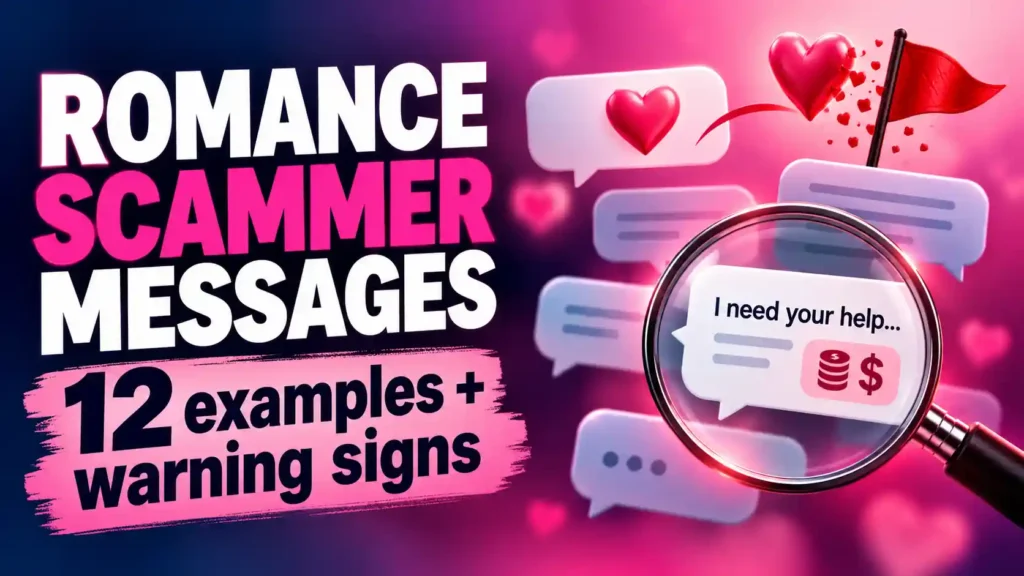
Below are 12 distinct types of romance scammer messages to watch for. The messages are original examples written to show how each tactic can sound. They are not copied conversations or phrases that every scammer uses.
Romance Scammer Messages at a Glance
If you have a chat open and need a quick answer, compare its pattern with this table.
| Message | Possible warning sign | What to do |
|---|---|---|
| “You seem nice, even though I messaged the wrong person.” | A stranger turns accidental contact into a personal relationship | Limit what you share |
| “Let’s talk on WhatsApp instead.” | Pressure to move away from the app where you met | Stay where you feel comfortable |
| “I think I’m in love with you.” | Intense commitment before you know each other well | Slow the relationship down |
| “Please keep us a secret.” | Isolation from people who could offer another view | Tell someone you trust |
| “I can’t meet or call right now.” | Repeated barriers to checking their story | Avoid financial commitments |
| “I need help with one urgent payment.” | Emotion and a deadline attached to money | Do not pay |
| “I can show you how to invest.” | A romantic relationship becomes a financial pitch | Do not transfer funds |
| “If you loved me, you would help.” | Guilt used to override a boundary | End the negotiation |
A genuine person might send one of the less alarming messages. The strongest warning signs appear when several of these behaviors occur together.
12 Romance Scammer Message Examples Explained
1. The “wrong number” message
“Sorry, I meant to text someone else. But you seem lovely. What’s your name?”
This message makes contact feel accidental and harmless. If you respond, the stranger may quickly ask about your location, job, relationship status, or interests.
Of course, people do send messages to the wrong number. Look at what happens next. Do they apologize and leave, or do they persist in getting to know you? Does the chat become flirtatious almost immediately?
You do not have to continue a conversation simply because the person sounds friendly. If you choose to reply, avoid sharing details you would not give to any other stranger.
2. The push to leave the dating app
“I never check this app. Send me your WhatsApp number so we can talk properly.”
There are ordinary reasons to switch messaging apps. The concern is pressure to do it before you have had time to assess the person.
Try setting a simple boundary: “I’d like to keep chatting here for now.” A person interested in getting to know you can respect that. Someone who becomes insistent, offended, or unusually urgent has given you another reason to pause.
If the chat has already moved, read How to Identify a Scammer on WhatsApp for warning signs specific to conversations on that platform.
3. The declaration of love after a few conversations
“I know this sounds fast, but I’ve never felt a connection like ours. I love you.”
Hearing this can feel powerful, especially if the person has been attentive and easy to talk to. Your feelings are not the problem. The question is whether the level of commitment matches how well you actually know each other.
Have you seen how they handle disagreements? Do you know much about their daily life beyond what they tell you? Have their plans and details remained consistent?
You can appreciate someone’s affection while saying, “I want to take my time.” Be wary if they treat your wish to slow down as a rejection or a test you have failed.
4. The constant check-ins that become demands
“Good morning, sweetheart. Why didn’t you answer last night? I was worried. Message me as soon as you wake up.”
A morning message is not suspicious. Neither is missing someone. The warning sign is a shift from attention to control.
Perhaps they send dozens of messages when you are busy. Perhaps they want to know whom you are with. Perhaps a few hours away from your phone leads to an argument that ends with you apologizing.
Ask yourself whether you still feel comfortable setting your own pace. A new relationship should not require you to remain available every hour of the day.
5. The request to keep the relationship secret
“Let’s keep what we have between us. Your friends won’t understand until we’ve met.”
Privacy and secrecy are different. You might choose not to announce a new relationship to everyone. But being told not to discuss a person’s story or requests with anyone is a warning sign.
The request becomes especially concerning if they say your family is jealous, your friends will “poison” the relationship, or you must hide a transfer of money.
Speak to someone you trust. Show them the actual messages, including anything that makes you uncomfortable. You do not have to defend the relationship before asking for an outside opinion.
6. The job that explains why they cannot meet
“I’m working overseas on a contract. I want to see you, but I can’t leave until the assignment ends.”
Plenty of people work far from home. What deserves attention is a story that repeatedly prevents you from meeting while the person asks for increasing trust.
Make a note of what they have told you. Where are they working? When does the contract end? Do those details stay the same? Every postponement may have a plausible explanation on its own, but the full pattern can tell a different story.
The safest boundary is straightforward: do not send money or make financial plans based on promises to meet later.
7. The video call that never happens
“I’m sorry. The connection dropped again. I promise we’ll video call tomorrow.”
One failed call proves nothing. Repeated excuses are more significant, particularly if the person is also asking you to believe claims you cannot check.
They may say the camera is broken, their internet is poor, or their workplace does not allow calls. You do not need to determine which explanation is true to protect yourself. Until you have a sound reason to trust the person, avoid sending money, account details, or intimate images.
Also, a completed video call is only one piece of information. Seeing a face does not verify a person’s name, job, emergency, or intentions. If you want to explore that distinction, read Deepfake Romance Scams: Can You Trust a Live Video Call?
8. The promised visit that requires a fee
“I finally arranged the trip. There’s one last fee before I can fly to you. Can you help me pay it?”
This request is persuasive because it appears to solve the problem of not meeting. You might think that paying the fee will finally give you an answer about the relationship.
But a payment does not guarantee a visit. After one fee, there may be another: a changed flight, missing paperwork, a visa issue, or an unexpected charge at the airport.
A ticket screenshot or booking email is not enough to make the request safe. Do not pay for an online partner’s travel. If the meeting is real, they can arrange their own trip without making your payment a condition of seeing you.
9. The emergency that cannot wait
“My mother has been taken to the hospital. I’m ashamed to ask, but I need the money tonight.”
A family emergency appeals to your compassion. A deadline makes it harder to pause, ask questions, or speak to someone else.
You may genuinely care about the person. Still, you cannot establish whether the emergency is real through messages supplied by the person asking you to pay. Even a photo or document they send may not answer that question.
Do not let urgency make the decision for you. Step away from the chat, talk to someone you trust, and keep your money in your own account.
10. The request disguised as an investment opportunity
“I’d never ask you for money. I just want you to earn what I’ve earned. Let me show you this investment site.”
This message sounds different from a plea for help. The person claims to be helping you.
They may show screenshots of profits, describe a successful friend or relative, and guide you through opening an account. At first, the site may display gains. What you see on a screen does not prove that your money has been invested or that you will be able to withdraw it.
Treat investment advice from an online romantic interest as a serious warning sign. Do not transfer money because you trust the person or because an account dashboard looks convincing.
11. The request to receive or forward money
“My account has a temporary problem. Can my client pay you? You can send the money on to me.”
This may sound safer than lending money because they claim the funds will come to you first. It is not a safe favor.
You may not know where the payment came from or why they cannot receive it themselves. Do not allow someone you met online to use your bank account to receive, withdraw, or forward funds.
If you have already done this, stop moving the money and contact your bank promptly. Explain the arrangement and ask what you should do next.
12. The test of love
“After everything we’ve shared, you still won’t help me? I guess you never loved me.”
This message can appear after you refuse money, an investment, a gift card, a verification code, or another request. It shifts attention away from what they asked you to do and puts your feelings on trial.
Read it carefully. They have not made the request safer. They have made it harder for you to say no.
You can care about someone and still refuse. Try: “I’m not sending money or sharing account information. I’m not discussing it further.” If they continue applying pressure, you can end the conversation.
The Pattern Matters More Than the Exact Words
Suppose an online match sends you these messages over six weeks:
“Talking to you makes my day better.”
“I can see a future for us.”
“My overseas assignment has been extended, so we’ll have to wait to meet.”
“I found a flight, but I need help with a fee before I can travel.”
The first message is ordinary. The second could be sincere. The third explains why you cannot meet. The fourth asks you to spend money to make the promised future possible.
That last step changes the conversation.
A scammer does not need to use a familiar phrase. They can remember your birthday, ask thoughtful questions, speak fluently, and stay in touch for months. Looking only for spelling mistakes or a copied script can cause you to miss the more important question: Are their messages leading you toward a risk that benefits them?
If you are still trying to decide what has happened, How to Know If You Are Scammed can help you review the signs and choose your next step.
How to Check Your Own Conversation
You do not need special software to review a suspicious chat. Take a few minutes and work through these questions.
What do I know independently?
Separate what you have verified from what the person has said. A profile description, photograph, screenshot, and personal story are all information the person can present to you. Ask what, if anything, you have confirmed without relying on them.
What has changed over time?
Look back at their location, job, travel plans, family situation, and reasons they cannot meet. An honest person can make a mistake or change plans. Repeated contradictions deserve a closer look.
What have they asked me to keep secret?
Have they discouraged you from speaking to friends or family? Have they asked you to hide a payment? Secrecy can keep you from getting useful advice.
What have they asked me to give or do?
Write down every request involving money, investments, gift cards, account details, verification codes, intimate images, or receiving payments. Include requests they described as “small favors.”
What happened when I said no?
A boundary often reveals more than an affectionate message. Did they respect your decision? Or did they become angry, withdraw affection, introduce a deadline, or question your love?
You do not need to prove someone’s identity is false before refusing a request that feels unsafe.
What to Do If You Think You Are Talking to a Romance Scammer
First, stop sending money or information. Do not pay “one final fee” to see whether they will visit. Do not follow an investment link, forward funds, or share a code sent to your phone.
Next, preserve the relevant messages. Save the person’s profile, phone number, payment instructions, transaction details, and any threats. Then show the conversation to someone you trust. Include the troubling parts rather than only the messages that make the relationship feel real.
If you have paid, contact the company you used to send the money as soon as possible. That could be your bank, card issuer, payment app, transfer service, or gift card company. Explain that you believe the payment was part of a scam and ask whether it can be stopped or recovered. Recovery depends on how you paid and is not guaranteed.
If you shared a password or verification code, go directly to the affected service through its official app or website. Change your password, review account activity, and follow its security instructions. Contact your bank immediately if your financial accounts may be exposed.
You can also report the profile on the dating or social platform where you met. Use the fraud reporting channels available in your country.
Finally, watch for a second approach. Someone may claim they can track the scammer or recover your money if you pay a fee first. Before responding to any such offer, read Fund Recovery Scams: 17 Warning Signs Before You Pay a Fake Investigator.
Frequently Asked Questions About Romance Scammer Messages
What do romance scammers usually say first?
There is no universal first message. They may begin with a compliment, a dating-app introduction, a social media message, or an apparent wrong-number text. Focus on how the conversation progresses, especially whether it leads to secrecy, unverifiable claims, or financial requests.
Do romance scammers always say “I love you” quickly?
No. Some move quickly; others take their time. A fast declaration of love is a reason to slow down, but its absence does not prove that a person is genuine.
Can someone be a romance scammer if we have video called?
Yes. A call may give you more information about the person you are speaking with, but it does not verify every claim they make or establish that their financial requests are safe.
Is moving a chat to WhatsApp proof of a scam?
No. Many genuine people use WhatsApp. It becomes more concerning when someone insists on moving immediately and combines that pressure with repeated excuses, intense declarations, secrecy, or requests for money.
What if they only ask for a small amount?
A small amount is still your money. You do not have to pay to establish trust. More requests may follow, but even if they do not, you are allowed to refuse the first one.
Can I search their exact message online to find out whether it is a scam?
You can search it, but do not rely on the result. A scammer may write a new message, change a familiar script, or tailor their words to you. Review the requests and behavior across the conversation instead.
Should I confront the person?
You do not have to. Preserve any evidence you need, protect your accounts, and report and block the profile if appropriate. A confrontation can become another opportunity for the person to pressure you.
What if I have already sent money and still have feelings for them?
Those feelings do not make you foolish. Stop further payments and contact your payment provider promptly. Speak to someone you trust about both the money and the relationship. You can take protective action while your feelings are still complicated.
When a Sweet Message Becomes a Warning
The hardest romance scammer messages to recognize are often the ones that do not sound threatening. They sound hopeful: “I miss you.” “We’ll meet soon.” “I want us to build a life together.”
Read those messages alongside what the person has asked you to do. A promise about the future cannot verify an emergency today. Months of attention do not make an investment safe. And refusing to send money does not mean you have failed a test of love.
If the conversation is moving toward secrecy, payment, account access, or pressure, pause it. Save the messages. Let someone you trust see the full picture. You are allowed to protect yourself before you have every answer.
Pingback: Oil Rig Romance Scams: Is Your Offshore Love Interest Real? Check These 13 Signs Before You Pay - SafeGuard Press
Pingback: Doctor Romance Scam: Is the Doctor You Met Online Real? 12 Checks Before You Send Money - SafeGuard Press
Pingback: Facebook Blackmail Scams: What to Do If Someone Threatens to Expose You - SafeGuard Press
Pingback: Military Romance Scam: Is Your Online Soldier Real? 15 Red Flags and the Payments You Should Never Make - SafeGuard Press