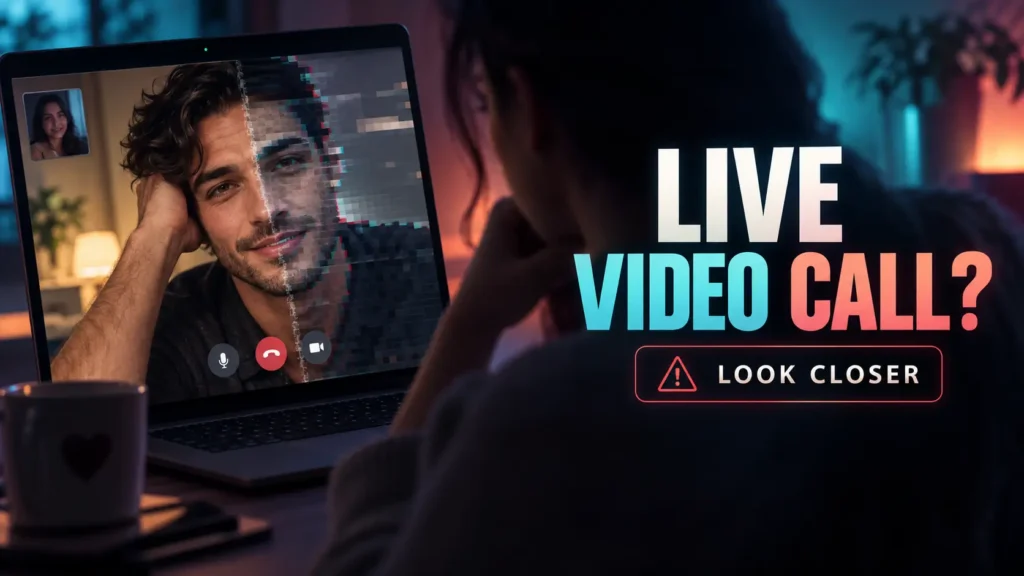
You were unsure about the person you met online. So you asked for a video call.
They agreed.
You saw their face. They answered your questions. They smiled when you made a joke. Afterward, it felt unreasonable to keep doubting them.
Then came the request: money for an emergency, a payment to arrange a visit, or help with an investment they said could benefit you both.
The call may have been live. The person may even have looked exactly like their photographs. Neither fact verifies the request.
A caller can appear with an altered face. Someone else can appear for the person behind the messages. A real person can also show you their real face while lying about their name, circumstances, or intentions.
If an online partner is asking you to send money, share identification, reveal a security code, or provide intimate images, pause. You do not need to identify a deepfake before you decide to protect yourself.
This guide will help you work out what the photos, voice notes, and video calls actually establish—and what you still need to check.
First, it helps to separate the technology from the scam.
Can a scammer fake a live video call? Yes. But even a completely genuine call does not prove the caller’s identity, emergency, investment, or payment instructions. Check the specific claim through information the caller does not control.
What Is a Deepfake Romance Scam?
A deepfake romance scam uses AI-generated or manipulated content to support a false romantic identity or story.
That content might be a profile photo of someone who does not exist, an altered picture of a real person, a generated voice note, or a face changed during a video call. AI can also help someone write persuasive messages and keep track of a long conversation.
But a romance scam does not need sophisticated technology. A person can use ordinary photographs, speak in their natural voice, and still invent an emergency to get your money.
The central question is therefore not simply, “Was AI used?” It is:
“Have I independently verified the person and the claim I am being asked to act on?”
This article focuses on checking the identity and evidence presented to you. For the broader relationship pattern—including pressure, secrecy, and repeated requests for help—read the romance scammer red flags guide.
With that distinction in mind, let’s look at the form of proof people often trust most.
Can a Romance Scammer Fake a Live Video Call?
Yes. A video call can appear convincing without proving that the person is who they claim to be.
There are four different situations worth considering.
A real caller appears with an altered face
Someone speaks to you while software changes the face you see. Because a human is conducting the conversation, they can answer a question, respond to your expression, and react to an unexpected comment.
A responsive call is therefore stronger evidence than a static photograph, but it is not conclusive proof of identity.
You are shown a prerecorded clip
A caller may present prepared footage and keep the interaction brief. Poor sound, a dark room, or an apparently unstable connection can make limited interaction seem less unusual.
An unexpected question might reveal a recording. If the caller answers, though, you still have to consider the other possibilities.
An accomplice appears on camera
Another person can speak to you using the identity established in messages. Their face and movements are real. The lie is that they are the person whose name, history, and circumstances you believe you know.
Looking for visual glitches will not settle this.
The caller is real, but their story is false
You might have repeated calls with the same person. Their face could match the pictures, and their voice could be natural.
That does not establish that they are single, employed where they say they work, stranded abroad, or unable to access their money. It certainly does not verify an investment website they recommend.
A call can help you assess whether someone is interacting with you. It cannot verify every claim they make afterward.
That may sound like a small distinction. In practice, it changes what you check next.
What Do Photos, Voice Notes, and Video Actually Prove?
When emotions are involved, one convincing detail can make the whole story feel true. Slow down and separate what you observed from what the person told you.
| What you received | What you can reasonably say | What you still need to check |
|---|---|---|
| Profile photographs | Images are attached to the account | Whether they show the person using it |
| A voice note | Someone supplied audio | Who recorded it and whether the message is truthful |
| A responsive video call | Someone interacted with you during a call | Their identity, history, and intentions |
| An identity document | Someone supplied an image of a document | Whether it is genuine and belongs to the caller |
| A screenshot of a bill or emergency | Someone supplied an image supporting a claim | Whether the event and payment request are real |
| A verified-profile badge | The account met a particular platform check | Whether its user is honest or safe to send money to |
Here is how that distinction works in an ordinary situation.
An illustrative example
Suppose someone you have spoken with for two months says they need $800 to leave a hospital abroad. You ask for a call. They appear on video, speak naturally, and show you what looks like a hospital document.
What have you confirmed?
You have confirmed that you spoke with someone and saw an image of a document. You have not confirmed the hospital admission, the bill, why this person cannot use their own funds, or who controls the account receiving your payment.
Your next step is not another test of their facial movements. It is an independent check of the hospital and the payment request. If that cannot be done, do not send the money.
The same reasoning applies to photographs, which are often the first things an online match uses to establish trust.
How to Check an Online Partner’s Photographs
You do not need to determine whether every picture was made by AI. Look for evidence about the person and the story attached to the images.
Reverse-search several photos
Search more than the main profile photograph. Try a clear portrait and any image with a distinctive setting.
If you find the same photograph under another name or on an older, unrelated account, that is a serious reason to stop and investigate.
However, no search result does not mean the image is genuine. An AI-generated picture may have no earlier match. A stolen image that has been cropped or altered may also be difficult to locate.
Compare the photographs as a group
Do they plausibly show the same person over time? Do their explanations about the location, job, or event in each picture remain consistent?
One odd-looking hand or shadow is not enough to decide a photograph is fake. Lighting, camera quality, compression, and ordinary editing can create strange details.
Repeated contradictions between the pictures and the person’s account are more useful than a single visual flaw.
Check claims connected to the images
If they say a photograph was taken at their workplace or at a public event, can you find independent information supporting that claim?
A photograph can look convincing while its backstory is invented. Check the backstory when it matters to your decision.
Next, consider voice notes. They can create a strong sense of closeness, but they have similar limits.
Can You Trust a Voice Note?
A voice note proves that you received a recording. It does not prove who made it.
The voice could be natural, altered, generated, or recorded by another person. Trying to hear a “robotic” sound is not a reliable way to settle the question. A poor microphone can make a real voice sound odd, while a manipulated voice can sound natural.
Instead, ask what the recording wants you to believe or do.
Imagine a voice note saying:
“I’m at the airport now. They say I need to pay a fee before I can board. Please help me today, and I’ll pay you back when we meet.”
The voice may sound worried. The claim you need to check is the fee. You also need to know who would receive your money.
An emotional voice cannot verify a financial demand.
Once you stop treating media as complete proof, you can use a simpler and more useful verification process.
How to Verify an Online Partner Before You Send Anything
You do not need technical expertise. Work through the specific decision in front of you.
1. Write down what you know firsthand
Use precise statements:
- “I have exchanged messages with this account.”
- “I heard a voice note.”
- “I spoke with someone on video.”
Then list what you have only been told:
- “Their name is the name on the profile.”
- “They work at the organization they named.”
- “The emergency happened.”
- “The payment will resolve that emergency.”
This prevents one genuine observation from turning into proof of several unrelated claims.
2. State the request plainly
What does the person want right now?
Perhaps the request is:
“Someone I have never met in person wants me to transfer money to an account they provided.”
That description may feel uncomfortable. It is also more useful for making a decision than “My partner needs my help.”
The same approach works for requests to send an ID photograph, reveal a login code, receive a transfer, or invest through a particular website.
3. Check the claim through information you find yourself
If an organization, employer, hospital, or public event is central to the request, look for an independent way to check it. Do not rely solely on a telephone number, website, document, or contact supplied by the person asking you to act.
Several social accounts that tell the same story are not necessarily independent. One person can control multiple accounts.
You may be unable to verify every private detail of someone’s life. You can still decide not to take an unverified financial risk.
4. Have a normal, unscripted conversation
Ask ordinary questions about their circumstances and things you have discussed previously. Notice whether the answers remain reasonably consistent over time.
A forgotten detail proves little. Everyone forgets things. Pay closer attention if important explanations repeatedly change or every reasonable check produces a new obstacle.
5. Verify the transaction separately from the person
Even if you are confident that the caller’s name and face are genuine, examine what they are asking you to do.
A real person can direct you to a fake investment platform. A real person can invent a travel problem. A real person can ask to use your account to move money that does not belong to them.
Confirming who appears on the call does not confirm why they want your money.
6. Set a boundary without debating the technology
You can say:
“I won’t send money or share private information until I can verify this independently.”
You do not need to accuse the person of using AI. You also do not need to prove a crime before saying no.
If they respond by telling you that caution means you do not love them, notice the pressure. It does not make the request safer.
7. Show the request to someone you trust
Tell a trusted person how you met, whether you have met face-to-face, what you have checked independently, and exactly where the money or information would go.
Ask them to examine the request itself. An outsider may spot a contradiction that has become easier for you to overlook.
At this point, you may be wondering whether there is a quick test you can perform during the next call.
Should You Ask the Caller to Turn Sideways or Hold Up Fingers?
An unexpected movement request may help you notice a problem. A prerecorded clip cannot respond appropriately to a new instruction. Some manipulated video might also show visible flaws during movement.
But passing such a test does not verify identity. An accomplice can follow instructions. Someone using a false name can follow them. A real person running a scam can follow them.
Likewise, refusing an unusual request does not prove someone is dishonest. They may simply find it uncomfortable.
Use an unscripted call as one clue. Do not make it your final test. The payment, investment, or emergency still needs its own independent check.
In fact, what happens after you ask reasonable questions may tell you more than the video itself.
A movement test may expose prerecorded footage, but passing it does not prove the caller is honest. An accomplice—or a real person telling a false story—can pass it too.
Warning Signs That Matter More Than a Visual Glitch
Be especially cautious if the person:
- Requests money while discouraging you from checking the reason.
- Wants payment sent to a person or account unrelated to the claimed expense.
- Insists on cryptocurrency, gift cards, or another method that may be difficult to reverse.
- Says a deadline leaves no time to verify.
- Tells you to keep the request secret from family, friends, or your bank.
- Repeatedly promises to visit but encounters a new problem requiring payment.
- Introduces an investment platform and pressures you to deposit money.
- Asks you to receive or forward funds through your account.
- Requests passwords, security codes, identification, or intimate images.
- Treats a reasonable safety question as an insult or betrayal.
These signs matter even when the video looks flawless. They also appear in romance scams that use no AI. For the full relationship pattern, see the 17 romance scammer red flags.
Perhaps you are reading this after you have already sent money. If so, spend your energy on the steps you can take now, not on proving precisely how the call was made.
What to Do If You Already Sent Money
Act as soon as you can. Recovery depends on the payment method and circumstances, so nobody can promise that you will get the money back. Prompt action may give you more options.
Stop any further payment
Do not send another amount to complete a visit, release an investment withdrawal, cover a supposed tax, or obtain a promised refund.
Contact the service you used to pay
Speak to your bank, card issuer, payment app, wire-transfer service, gift-card issuer, or cryptocurrency platform. Explain that you believe the payment may have resulted from fraud. Ask whether it can be stopped, disputed, or investigated.
Use the provider’s genuine app, website, or customer-service number—not contact details supplied by the person who requested the payment.
Save evidence before you block the account
Keep the profile URL, usernames, messages, payment instructions, receipts, transaction IDs, photographs, documents, and threats. Retain original files where possible.
Secure any account they could access
If you shared a password or one-time security code, go directly to the real service to secure your account. Review recent activity. If the person used your bank account or persuaded you to receive money, tell your bank what happened.
Report the account and the suspected fraud
Report the profile through the dating app or social platform. If you are in the United States, you can report suspected fraud at ReportFraud.ftc.gov and internet crime at IC3.gov. If you live elsewhere, use your local fraud-reporting or law-enforcement channel.
Be wary of anyone who then promises to retrieve your money for an advance fee. Losing money once can make you a target for another approach.
Money is not the only thing someone may use against you. If they have private images—or claim they have created them—respond to that threat separately.
What If They Threaten to Share Intimate Images?
Do not send more images or money in response to the threat. Save the messages, usernames, demands, and relevant links. Report the account to the platform and tell someone you trust what is happening.
The threatened image might be real, altered, or fabricated. You do not need to settle that question before seeking help.
If you are an adult facing the sharing of intimate images without your consent, StopNCII.org explains a tool that creates a digital fingerprint of an image on your device. Participating platforms can use that fingerprint to identify matching content. The site explains how to submit certain synthetic images as well. It cannot guarantee removal from every platform or private conversation.
If an image was taken when the person depicted was under 18, even if that person is now an adult, see Take It Down for its eligibility rules and process.
If you shared identification documents or account credentials too, protect those separately. Contact the relevant issuing organization, financial institution, or account provider to ask what steps apply.
Finally, let’s clear up the questions that often remain after a convincing call.
Frequently Asked Questions
Does a live video call prove a dating profile is genuine?
No. It can show that you interacted with someone, but it cannot independently confirm the person’s identity, history, intentions, or financial claims.
Can a scammer answer unexpected questions during a manipulated call?
Yes. A real speaker whose appearance is altered can answer in real time. An accomplice or a person lying about their identity can also respond naturally.
Does poor lighting mean a caller is using a deepfake?
No. Ordinary calls can have poor lighting. Consider the wider pattern, particularly whether the person repeatedly prevents meaningful verification while requesting money or private information.
Can reverse-image search prove a photograph is real?
No. It may expose a stolen photograph, but a search without results does not establish that an image or profile is genuine.
Are unusual fingers or facial details reliable signs of AI?
They are reasons to look more closely, not a final verdict. Camera quality, lighting, and editing can affect genuine images. Check the identity and story as well.
Does a verified dating profile make a request for money safe?
No. A badge indicates that an account completed a particular platform check. It does not verify a claimed emergency or guarantee honest intentions.
What if the person passes every video-call test?
Investigate the request anyway. A real person can lie about a bill, an investment, or where your payment will go.
Do I have to prove the person used a deepfake before reporting them?
No. Report the suspicious conduct and preserve the evidence you have. You can describe what happened without claiming to know which technology was used.
Should I confront the person?
Protect your money, information, accounts, and evidence first. You do not need to win an argument before refusing another request.
What is the safest rule before sending money?
Check the exact reason for the payment and who will receive it through information the person does not control. If you cannot verify those points, do not pay.
A Live Call Is One Clue, Not a Final Answer
You can see someone’s face, hear their voice, and still be missing the facts that matter most.
Before you take a financial or personal risk, separate what you observed from what you were told. Then check the specific claim behind the request through a route the person does not control.
You do not need to catch a visual glitch. You do not need to prove a deepfake. And you do not have to send money or private information to show someone you care.
Pingback: Romance Scams: 17 Romance Scammer Red Flags Before You Trust the Wrong Person - SafeGuard Press
Pingback: Facebook Blackmail Scams: What to Do If Someone Threatens to Expose You - SafeGuard Press
Pingback: Celebrity Romance Scam: Is That Famous Person Really in Love With You? How to Check Before You Pay - SafeGuard Press
Pingback: Romance Scammer Messages: 12 Examples and What the Warning Signs Mean - SafeGuard Press
Pingback: Love Bombing Signs: Is It Real Affection or the Start of a Romance Scam? - SafeGuard Press