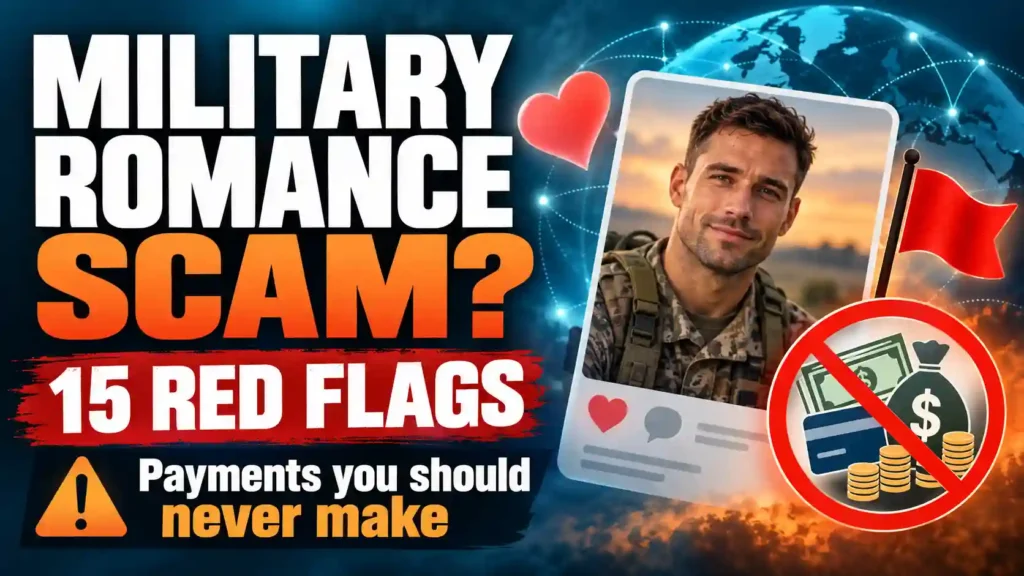
You want to believe them. They remember what matters to you. They check whether you got home safely. They send a photo in uniform and tell you how much they look forward to meeting when their deployment ends.
Then the message changes: “I’ve been approved to visit, but I need you to pay for my leave papers first.”
Your heart says this is the person you have been talking to every day. Your instincts say something is wrong.
Stop before you pay. If someone claiming to be a U.S. service member asks you to pay for military leave, a flight home from deployment, communications access, or an urgent fee so they can reach you, treat the request as a serious sign of a military romance scam. You do not need to settle the entire relationship today. You only need to protect yourself while you check the story.
What Is a Military Romance Scam?
A military romance scam is an online relationship built around a false military identity. The person may pose as a soldier, sailor, airman, Marine, or other service member. Their goal is to gain your trust and persuade you to send money, share sensitive information, or receive and move money for them.
Some scammers steal photographs and names from real service members. Others invent an identity around a uniform photo. This makes online searches tricky: you may find proof that the person in the photograph exists without finding proof that they are the person messaging you.
The military story also solves problems for the scammer. Deployment explains why they live far away. Security supposedly explains why they cannot call. A dangerous assignment creates urgency. And when they ask for money, they present payment as the final obstacle between the two of you.
The question is not simply, “Does this person have military photos?” It is, “Can I independently trust this person’s behavior and requests?”
How the Fake Relationship Usually Develops
Most military dating scams begin with an ordinary conversation. You meet on a dating app, receive a social media message, or start talking after a comment on a post. The person seems thoughtful and respectful. They may share a story about being widowed, raising a child, or longing for a quiet life after service.
Soon, they want to move the conversation to private messages. They become part of your daily routine. They ask about your family, your worries, and your hopes. Within days or weeks, they may say they love you.
Then comes a reason they cannot meet yet. They are deployed. Their orders changed. Their commanding officer has not approved travel. You might accept these explanations because their work sounds demanding.
Finally, an emergency appears. They have enough money, they say, but cannot access it. A fee must be paid before they can visit. A valuable package meant for you is stuck in customs. They promise to repay you as soon as they return.
At that point, refusing can feel cruel. That is how the scam works: it turns a financial decision into a test of love.
15 Military Romance Scam Red Flags
No single missed call or sparse profile proves fraud. Look at the pattern. Pay particular attention to requests for money, demands for secrecy, and what happens when you set a boundary.
1. They ask you to pay for military leave
A supposed soldier says you must pay for “leave papers,” a leave application, or approval from an officer so they can visit you.
Do not pay. U.S. service members handle leave through military channels. A romantic partner does not purchase their permission to take time off. A form, invoice, or message from someone claiming to be an officer does not make the request legitimate.
2. They need you to fund a flight home from deployment
They may send a travel itinerary and say they will be with you next week. Then, at the last moment, a transportation fee appears.
Focus on the request, not the excitement of the proposed visit. An itinerary can be fabricated. If the only way this person can meet you is for you to pay an urgent fee, stop.
3. They say deployment has frozen their bank account
This story often includes a reassuring promise: “I have the money. I just can’t get to it until I’m home.”
You cannot verify their balance or their promise to repay you. Do not make their alleged banking problem your financial responsibility. The same rule applies if they claim an officer is holding their pay or a transfer will clear “tomorrow.”
4. They ask for money to keep talking to you
A scammer might request payment for military internet, a special phone, a laptop, or a secure communication service. They may add, “I hate asking, but I don’t want to lose contact with you.”
That is emotional pressure attached to a bill you cannot verify. You do not have to pay to maintain an online relationship.
5. They send you to an official-looking payment website
A fake military site may display a flag, seal, case number, payment deadline, or formal instructions. It can look convincing on a phone screen.
Do not treat appearance as verification. If the person you are dating supplied the link, the website is part of their story. Do not enter your card details or identity documents to test whether it works.
6. Their valuable package is “stuck in customs”
They claim to have sent you a box containing gifts, money, documents, jewelry, or personal belongings. Then an agent contacts you: the package cannot be released until you pay shipping, insurance, tax, or customs fees.
Once you pay one fee, another may appear. You might be told the package is too valuable to abandon, even though you have never seen it. Do not pay to release a stranger’s supposed valuables.
7. They promise a gift but ask you to pay first
In another version, they say they bought you an expensive present to prove their love. The gift is supposedly on its way, but you must pay a delivery or clearance charge.
A promised gift is not evidence that anything was shipped. Do not spend real money to receive something whose existence you cannot establish independently.
8. A medical emergency suddenly needs your money
The person may say they were injured, their child needs treatment, or a family member is in the hospital. The story can arrive immediately after you decline an earlier payment request.
Take your reaction seriously: you can care about someone’s safety without transferring money to an account they provide. If a stranger uses a medical crisis to demand urgent payment, pause and seek independent advice.
9. They ask you to pay a third party
Instead of sending money to the person you know, you are told to pay a colleague, agent, doctor, shipping company, or commanding officer. The account name does not match your romantic interest.
That extra person is not proof of a real process. It makes the payment harder for you to understand. Do not send money merely because a second account repeats the same story.
10. Every chance to meet ends in a new emergency
First, their assignment is extended. Next, their leave is almost approved. Then, on the day they are due to travel, a fee or crisis blocks the trip.
Plans can change in genuine relationships. The warning pattern is repeated postponement followed by another request for money. Write down the dates and explanations. Seeing the whole timeline may reveal what each isolated message hides.
11. Every live conversation is impossible
Military duties can limit availability. Still, notice whether someone who chats with you daily has an endless series of reasons they cannot speak or meet when agreed.
Do not turn one video call into your final test, either. A call may help you assess the person, but images and voices can be manipulated. A convincing face cannot make a demand for leave fees safe.
12. Their photographs are real, but their profile is doubtful
A reverse image search might show the same uniform photo under a different name. You may find several accounts using the same pictures. Those are strong signs of impersonation.
However, a search that finds nothing does not clear the account. Stolen photos are not always widely indexed, and the person in a genuine photograph may have nothing to do with the messages you received.
13. They send an ID or official letter to silence your doubts
You ask a question; they respond with a military ID image, deployment letter, leave form, or passport photo. The document may include a name and photograph that match the profile.
A document image is easy to forward, steal, or alter. It does not prove who controls the account. Do not send a copy of your own ID in exchange.
14. They want gift cards, cryptocurrency, or a hard-to-reverse transfer
The supposed emergency may be vague, but the payment instructions are precise. They tell you which gift cards to buy, ask for the numbers on the back, provide a cryptocurrency address, or insist on a wire transfer.
The more pressure they put on a specific payment method and deadline, the more important it is to stop. Never buy a gift card to pay an online romantic partner’s “military fee.”
15. They punish you for asking questions
You say you need time. They reply that you do not trust them, that you have broken their heart, or that your delay puts them in danger. They tell you not to speak to friends or family.
This is the moment to step back. You are allowed to question a stranger’s financial request. Someone who cares about you will not require immediate payment as proof of love.
The Military Leave Scam: What You Need to Know
The leave request deserves special attention because it sounds plausible to someone unfamiliar with military procedures. Scammers know that. They build an entire scene around it: an approved visit, a form bearing a seal, an officer waiting for payment, and a deadline that leaves no time to think.
Here is the practical answer: do not pay anyone to obtain leave for a person claiming to serve in the U.S. military. An online partner cannot buy leave approval for a service member.
You do not need to inspect every line of a form or debate military policy with the person who sent it. You can reply once: “I will not make a payment for leave or travel.” Then stop discussing payment.
If they respond with a new fee, another official, or an emotional appeal, the story has given you more reason to protect yourself.
How to Check Someone Claiming to Be a Soldier
You may want a definite answer: Is the person real? Unfortunately, there is no single name search, photograph, document, or call that guarantees it. Use several checks, and do not pay while you investigate.
Search the images and the claimed name
Run a reverse image search on more than one profile photo. Search the person’s name together with words such as “scam” and “imposter.” Look for the same face attached to different names or accounts.
A match can uncover stolen pictures. No match simply means the search did not find one.
Review the relationship timeline
Go back to the first messages. When did they declare love? When did they say they would visit? What stopped the visit? Did a financial request follow each setback?
Keep the answers in a short dated list. The goal is to examine events clearly, away from the pressure of the latest message.
Talk through the facts with someone you trust
Show a friend or family member the actual messages and payment instructions. Ask them to focus on the requests, promises, and changing explanations.
You do not have to persuade them that the relationship is real or false. You are asking for help making a safe decision.
Set a firm financial boundary
Say: “I do not send money or share banking information with someone I have not met.”
Then watch their response. A profile search may be inconclusive, but pressure, threats, or a new emergency after that boundary tell you something useful.
If you are trying to assess the full pattern of an online relationship, how to know if you are scammed can help you review the warning signs without relying on one photograph or message.
Military Romance Scam Messages: What the Requests Sound Like
The examples below are fictional. They show how a request can be hidden inside an affectionate conversation.
“My commander approved my visit. You just have to complete the partner payment for my leave papers.”
The promise of a visit makes the payment feel like a small final step. Do not pay for military leave.
“I bought you something special. The delivery company says there’s a customs charge before they can release it.”
The gift creates excitement; the fee turns it into a loss. Do not pay for a package you cannot independently verify.
“I can’t use my bank while I’m deployed. If you cover my flight, I’ll send everything back as soon as I land.”
The repayment promise does not protect your money.
“Please don’t tell your family about my situation. Security rules are strict, and they won’t understand us.”
Secrecy prevents you from hearing an outside opinion. Tell someone you trust.
A scammer’s wording may be gentler or more polished. If you want to examine repeated patterns of affection, urgency, and guilt, read romance scammer messages alongside the conversation you received.
What to Do If You Already Sent Money
You may feel angry, embarrassed, or still unsure whether the person deceived you. Act on the payment now; you can sort through your feelings later.
- Stop sending money. Do not pay another fee to release a package, finish a trip, or unlock a promised refund.
- Contact the company that handled your payment immediately. Tell your bank, card issuer, transfer service, payment app, or gift card provider that you suspect fraud. Ask whether the payment can be stopped or reversed. The options depend on the method and timing.
- Save the evidence. Keep the profile link, screenshots, messages, documents, email addresses, phone numbers, receipts, payment details, and any website links. Do this before blocking the account.
- Secure your accounts. Change passwords if you shared them or used a link the person sent. If you gave out card or banking details, contact the relevant provider. If you sent identity documents, seek guidance from your country’s identity theft reporting service.
- Report the account and transaction. Report the profile on the dating or social platform. If you are in the United States, you can also report the fraud at ReportFraud.ftc.gov. Elsewhere, contact your local fraud reporting authority.
- Tell someone you trust. Scammers may keep contacting you with promises, apologies, threats, or new identities. Having someone aware of the situation makes it easier to maintain your decision.
Finally, be wary of anyone who says they can retrieve the money for an upfront fee. Fund recovery scams can target people soon after an initial loss.
What If You Received Money Instead of Sending It?
Do not assume you are safe because no money has left your account. A supposed service member may ask to send you funds, have you deposit a check, or persuade you to forward money to another person. They may call it a favor because they cannot access their account during deployment.
Do not accept or move the funds. Contact your bank if money or a check has already arrived, explain what happened, and ask how to handle it. A payment appearing in your account does not guarantee it is legitimate or permanent.
The same caution applies to packages. Do not agree to receive and forward items for a person you have never met.
Frequently Asked Questions
If you’re still unsure whether the person messaging you is genuine, these answers address the questions that matter most before you trust their story or send money.
Can a real soldier start a relationship online?
Yes. The claim of military service alone does not make an online relationship fraudulent. Requests for money, secrecy, and repeated excuses that prevent verification are the issues to examine.
Do soldiers have to pay for leave?
A U.S. service member does not need an online romantic partner to buy leave approval. Treat a request for “leave papers” or an officer’s approval fee as a serious scam warning.
Can a deployed soldier access a bank account?
Do not rely on a stranger’s claim that deployment prevents all access to their money. Whatever their stated banking problem, you have no obligation to pay their bills or fund their travel.
Does finding their military photo online prove they are real?
It may prove that the person in the photo exists. It does not prove they control the account messaging you. Scammers can use photographs of real service members.
Will a video call prove the person is trustworthy?
No. A call can give you more information, but it cannot validate every claim they make or make a money request safe. Consider their behavior over time.
What if they have never asked me for money?
You do not have to label someone a scammer because they are far away or difficult to reach. Take your time, protect your personal information, and reassess if a financial request appears.
Should I tell them I think they are a scammer?
You do not need a confrontation. Save the evidence, stop payments, report the profile, and end contact. Arguing may give them another opportunity to pressure you.
Can I recover money I already sent?
It depends on the payment method and timing. Contact the payment provider immediately and ask what can be done. Be suspicious of anyone who guarantees recovery if you first pay them.
One Decision You Can Make Today
You may still care about the person behind the messages. You may be hoping there is an innocent explanation. You do not need to resolve either feeling before protecting your money.
If an online love interest claiming to be in the military asks you to pay for leave, travel, communications, a medical emergency, or a package, stop. Save the conversation. Speak to someone you trust. If you have paid, contact the payment provider now.
A relationship worth having can survive your decision to be careful.