They say they cannot wait to meet you. Their offshore contract is nearly finished, and they are already talking about what the two of you will do when they return to land.
Then the plan changes. A piece of equipment has failed. Their wages are tied up. They need money for a helicopter trip, a repair bill, or a package that must be released before they can leave.
You want to help the person who has been messaging you every day. Yet you have never met them, and the only way you can check the emergency seems to be through people and documents they introduce.
Pause before sending anything. An oil rig romance scam uses a remote job and a promised meeting to make an online partner’s request for money feel urgent. You do not need to prove the person is lying before you protect yourself. You can refuse the payment while you examine the story.
What Are Oil Rig Romance Scams?
Oil rig romance scams are online relationship scams in which someone pretends to work on an offshore rig or related project. They may call themselves a petroleum engineer, drilling contractor, supervisor, technician, or offshore manager.
The job gives them a useful explanation for being far away. A rotating schedule accounts for missed calls. A remote platform explains why you cannot visit. An upcoming trip ashore gives you something to look forward to.
Eventually, the relationship becomes the reason you are asked to pay. The person may need help with equipment, transport, medical treatment, a work contract, or a shipment. They promise to return your money when they are back on land.
Real offshore workers exist, and their schedules can be difficult. The warning is the combination of an online relationship you cannot verify, a repeatedly delayed meeting, and a financial problem that is handed to you.
If They Are Asking You for Money Right Now
Before reading further, deal with the immediate request.
Do not pay a supposed supplier, transport agent, hospital, shipping company, or colleague on the instructions of an online love interest you have not met. Do not give them access to your bank account, receive a transfer for them, or send copies of your identity documents.
Save the messages and the payment details. Then step away from the conversation and show the full request to someone you trust. If you have already paid, contact the company that handled the payment immediately.
You can assess the rest of the relationship afterward. You do not have to decide whether every photograph or story is false before deciding not to fund this emergency.
Why the Offshore Story Works So Well
The scammer’s claimed location creates distance you can imagine. You know that an oil rig is not somewhere a person can casually leave for dinner. When they say the internet is unreliable or transport depends on the weather, the explanation may sound reasonable.
Meanwhile, the messages make the relationship feel close. They learn about your family, remember a difficult day at work, and describe the life they want with you. By the time money comes up, the request is tied to someone you feel you know.
The promised first meeting adds another layer. You might be told, “Once this bill is paid, I can finally come to you.” Sending money then feels like moving toward the relationship you want.
That is why it helps to separate two questions:
- Could someone genuinely work offshore and have trouble meeting?
- Should I pay this online contact’s work or travel expense?
The first answer may be yes. The second should be no when you cannot independently establish who they are or why the payment is needed.
How an Oil Rig Romance Scam Unfolds
The details vary, but the sequence often tells you more than any single message.
The profile offers an attractive explanation for distance
You meet on a dating app or social platform. Their profile may show them in work clothes or near industrial equipment. They say they are offshore for several weeks or months and will be free to meet when the contract ends.
You may exchange photos and move to a private messaging app. At this stage, there may be no request for money.
The connection becomes intense
They message regularly and speak about a future together. They might say they are widowed, have a child, or have been lonely while working away from home.
The details make the person feel familiar. They can also give later requests more emotional weight: a payment is no longer “helping a stranger” in your mind.
A meeting is planned, then delayed
There is a date when they expect to come ashore. Then a job problem, transport issue, injury, or unexpected extension stops them.
One changed plan is not proof of fraud. The concern grows when every proposed meeting produces a fresh obstacle and the solution requires your money.
The financial requests escalate
The first amount may seem manageable. After you pay, another fee appears. Perhaps the repair costs more than expected, the helicopter company needs insurance, or a shipment cannot be released.
Look at the full sequence. Repeated payments tied to a meeting that never happens are a serious warning.
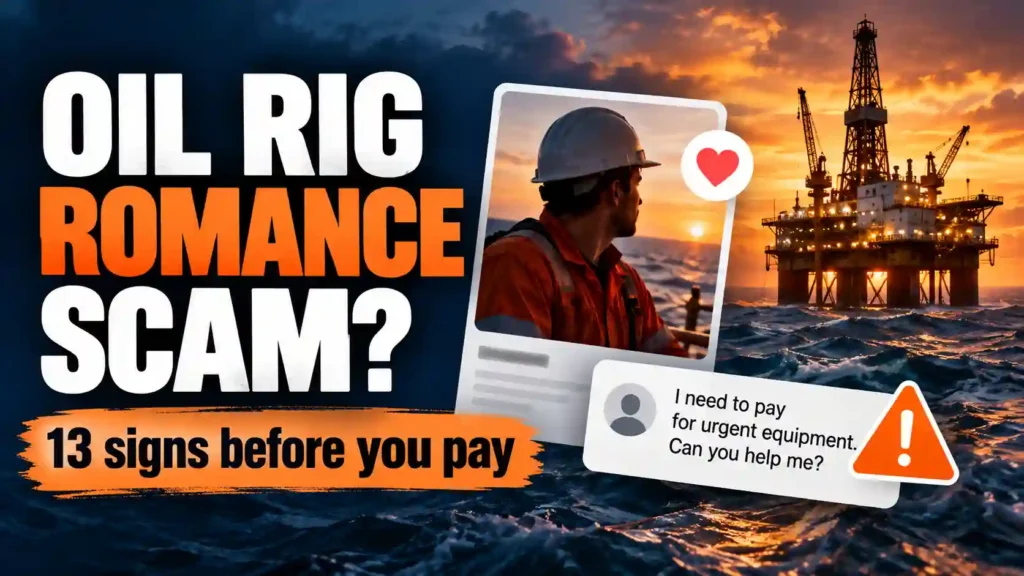
13 Signs of an Oil Rig Romance Scam
No single detail can identify every scam. These signs are most useful when you read them against the timeline of your own conversation.
1. A work emergency becomes your bill
A supposed engineer says a machine has broken and they must personally buy a replacement part. They send a supplier’s invoice or ask you to transfer funds to an account.
You do not need specialist knowledge of offshore equipment to make a safe decision. You are not responsible for an online contact’s work costs, even if the description sounds technical.
2. Your first meeting depends on paying for a helicopter or boat
They tell you they are ready to leave the rig but need money for transport. The request may arrive shortly before the date you expect to meet.
This is a powerful trap because payment is presented as the final step between you and them. Do not send money to make an unverified online partner’s first visit happen.
3. Their substantial wages are always out of reach
They describe a high-paying job, then say their bank account is frozen, the connection prevents transfers, or their contract will not pay out until they return to shore.
Their stated income cannot repay you. Only an actual returned payment could do that, and you have no reason to take the risk.
4. They want you to pay a person they introduce
A “supplier,” “supervisor,” “travel coordinator,” or “shipping agent” contacts you. This second person confirms the emergency and provides payment details.
Ask how you found them. If every name, email address, website, and phone number came from your online love interest, those are parts of the same story. They are not independent verification.
5. A company document is offered as proof
You receive a work contract, employee badge, invoice, accident report, or letter with a company logo. It may include the same name and project location you were told earlier.
A document image can be copied or altered. More importantly, even a real company’s existence would not establish that the person messaging you works there or that you owe its supposed bill.
6. They repeatedly avoid meeting after their contract ends
The date changes once, then again. A new contract begins unexpectedly. Their replacement fails to arrive. Travel is postponed, but they assure you the next date is certain.
Write down each promised date and what prevented it. A dated list can reveal a cycle that gets lost among affectionate daily messages.
7. Calls fail, but messages arrive whenever money is needed
Connectivity offshore may vary. The concern is a pattern in which useful live conversations never work, yet the person can reliably send long explanations and urgent payment instructions.
Do not rely on the opposite conclusion either. A completed video call does not prove their employment story or make a payment request safe.
8. A medical crisis requires immediate payment
The person claims to have been hurt at work. Someone posing as a colleague or doctor may say they cannot receive treatment or leave the rig unless you pay.
You can take a claimed injury seriously without transferring money to an account supplied in the messages. Step away, preserve the details, and seek an outside opinion before acting.
9. A gift or package needs a release fee
They say they have sent you jewelry, personal belongings, savings, or documents as proof of their commitment. Then a delivery agent demands customs, insurance, or handling charges.
The promise of a valuable package can make a fee seem small. Do not pay for goods whose existence and ownership you cannot independently establish. Another charge may follow the first.
10. The reason for payment changes when you refuse
You decline to pay for equipment. The person says the real issue is transport. You question the transport fee. Now an agent wants a refundable deposit.
The moving explanation matters more than whether any one story sounds possible. Keep a record of what you were first told and what changed.
11. Affection is used to overcome your boundary
They respond to “I do not send money to people I haven’t met” with “I thought you loved me” or “You are abandoning me when I need you.”
A respectful person can hear a financial boundary. You do not owe a payment to prove that your feelings are sincere.
12. Their photos lead to another name or identity
A reverse image search shows the same face on a different profile. Or a photograph they claim was taken during this contract appeared online years earlier.
That is a strong reason to stop. But a search that finds nothing is inconclusive. You still need to assess the request for money and the repeated obstacles to meeting.
13. They ask to move money through your account
They may say their account is inaccessible and ask you to receive a payment, deposit a check, or forward funds to a supplier. They insist it costs you nothing.
Do not accept or move money for them. An incoming transfer may be linked to fraud, and a deposited check may later fail. If you already received funds, tell your bank what happened before taking another step.
Oil Rig Scam Messages: The Payment Is the Clue
Scammers do not all copy the same script. The following examples are fictional, but each shows how a relationship can be used to make a financial request sound reasonable.
“I’ve finished my contract. The helicopter company needs payment today, and then I can finally come to you.”
The hoped-for meeting is being made conditional on your payment.
“A piece of equipment failed on my shift. My account is locked offshore, so please pay the supplier directly. I’ll return everything when I land.”
The person’s work problem is being transferred to you, along with all the financial risk.
“I sent my savings and belongings ahead because I trust you. Please pay the agent to release the package.”
The supposed shipment makes you feel included in their future while creating a fee.
“If you really believed in us, you wouldn’t leave me stranded over a small amount.”
Now refusing a transaction is framed as refusing the person.
When you review your conversation, look beyond a single phrase. Notice whether expressions of love repeatedly lead toward urgency, secrecy, or money. For more examples of that pattern, see romance scammer messages.
How to Check the Story Without Sending Money
You may want to know for certain whether the person works offshore. There is no single online test that will give you absolute certainty. You can, however, examine the claim without putting your finances at risk.
Search the photos and details separately
Reverse-search several photographs, especially images showing the person’s face clearly. Search their name and distinctive phrases from their messages. If the same pictures appear under another identity, save the results.
Remember that a clean search is not a clearance. Some stolen or altered images will not appear in the results.
Build a short timeline
Write down when you met, when they first said they loved you, each date they promised to leave the rig, and each reason they could not. Add every payment request, including the amount and recipient.
This turns a long, emotional conversation into a sequence you can assess.
Check where every piece of “proof” came from
Did you find the company contact independently, or did they send it? Did you locate the supplier yourself, or did an “agent” introduced by your online partner contact you?
Do not treat a website, invoice, badge, or second person as independent evidence when the path to all of them began with the same account.
Set a financial boundary
You can say:
“I will not send money, pay a third party, receive funds, or share banking details with someone I have not met.”
Then stop debating individual invoices. Their response to a clear boundary may tell you more than another document will.
If you need to assess the relationship as a whole, how to know if you are scammed can help you organize the evidence and decide on your next step.
What to Do If You Already Paid an Oil Rig Scammer
Act promptly, even if the person says a refund is on the way or promises to meet you soon.
- Stop sending money. Do not pay another charge to complete a repair, release a package, arrange transport, or unlock a refund.
- Contact the payment provider immediately. Tell your bank, card issuer, transfer company, payment app, gift card company, or cryptocurrency platform that you suspect fraud. Ask what can be stopped, disputed, or reported. Your options depend on how you paid and when you act.
- Save the evidence. Keep the profile, conversations, photos, invoices, emails, website addresses, phone numbers, account details, receipts, and transaction IDs.
- Protect your accounts. Change passwords if you shared them or entered them through a link the person supplied. Tell your bank if you disclosed financial details. If you sent an identity document, seek identity theft guidance where you live.
- Report the account. Use the dating or social platform’s reporting feature. In the United States, you can also report suspected fraud at ReportFraud.ftc.gov. Elsewhere, use your local fraud reporting authority.
- Tell someone you trust. The person may return with a new identity, a new emergency, or a promise to repay you. Support makes it easier to hold your boundary.
Be cautious if someone then offers to recover your losses in exchange for an upfront payment. Fund recovery scams can follow the original fraud.
Frequently Asked Questions About Oil Rig Romance Scams
An offshore job can explain some unusual schedules. It cannot answer every concern about a person who asks you for money. These answers address the most common doubts.
Do oil rig workers have limited internet access?
Connectivity can vary by location and employer. A failed call alone is not proof of a scam. Repeatedly avoiding calls and meetings while reliably sending payment requests is much more concerning.
Can a real offshore worker be unable to leave immediately?
Yes, work schedules and transport can be complicated. That possibility does not make you responsible for paying to bring someone you have never met to shore.
Should I pay for an offshore engineer’s broken equipment?
No. Do not fund an online romantic interest’s supposed work bill, even if they send an invoice or promise to repay you.
What if they work for a real oil company?
A real company name does not prove that the person messaging you works there. Be especially careful if the contact details and documents all came from the person asking for money.
Can a video call rule out an oil rig romance scam?
No. A call can provide more information, but it does not verify an employment claim, an emergency, or a payment instruction. Consider the entire pattern.
What if the person has never asked me for money?
Working offshore is not, by itself, evidence of fraud. Take time to get to know the person and protect your private information. Reassess promptly if a request for money or account access appears.
What if I already paid for a helicopter or boat trip?
Contact the payment provider immediately and explain that you suspect a scam. Save the travel claim, payment instructions, and transaction record. Do not pay another charge to “complete” the trip.
Should I tell the person I know it is a scam?
You do not need to argue or obtain a confession. Save the evidence, stop payments, report the profile, and end contact when you are ready.
The Decision You Can Make Today
You may still care about the person behind the messages. You may hope their story is true. Neither feeling requires you to pay their offshore bills.
If an online love interest says they work on an oil rig and needs money for equipment, a helicopter, treatment, a shipment, or an agent, stop before sending it. Examine where the “proof” came from. Show the request to someone you trust. If you already paid, contact your payment provider now.
You can take time to understand the relationship. You do not have to risk more money while you do.