They remember your birthday. They ask how you slept after a difficult day. When they talk about their patients, you hear someone who seems patient, skilled, and kind.
You have never met in person, but you have begun to trust them. Then comes the message you were not expecting: a patient needs urgent treatment, a medical shipment is stuck, or the doctor needs money to get home from an overseas assignment.
The request leaves you torn. You want to help. You also want to know whether the person on your phone is really the doctor they claim to be.
Start with this decision: do not send money or identity documents to an online romantic partner you have not met because they claim to be a doctor. You can check their story without paying for a patient, a hospital bill, or a flight. And you do not need to prove that every part of their identity is false before protecting yourself.
What Is a Doctor Romance Scam?
A doctor romance scam is an online relationship scam in which someone claims to be a physician, surgeon, or medical aid worker to gain trust. After building a connection, they ask for money, personal information, or help moving funds.
The claimed job may be part of an ordinary dating profile. Or it may explain why the person is far away: they are treating patients overseas, working in a conflict area, or finishing a hospital assignment before they can visit you.
Their medical title makes the story more persuasive. A doctor sounds like someone who should earn well and act responsibly. If they describe a patient in danger, you may feel that refusing to help would be cruel. If they promise to repay you from their salary, the payment may seem temporary.
Real doctors use dating apps and work abroad. The job claim alone is not evidence of a scam. The warning is an online relationship that you cannot independently verify becoming the reason you must pay.
Asked to Help a “Doctor” Today? Do This First
If a person you have only met online says a medical or travel emergency needs your money immediately, pause the conversation. Do not pay a hospital, supplier, colleague, travel agent, or patient’s relative using details they gave you.
Instead:
- Save the message, invoice, link, account details, and any documents they sent.
- Do not share your banking information, password, passport, or other ID.
- Tell someone you trust what you have been asked to do. Show them the actual messages.
- If you already paid, contact the company that handled the payment immediately.
A genuine emergency does not become yours to finance simply because someone described it in a romantic conversation. You can care about the person and still refuse an unverified transaction.
How to Check Whether an Online Doctor Is Real
You may be hoping for one test that settles everything. There is no single photograph, license number, or video call that can do that. Check several separate pieces of the story, and be clear about what each result proves.
Check the license through an independently found register
Many places have a public register where you can look up a doctor’s name or license. Find the appropriate medical regulator yourself. Do not start with a link your online contact sends you.
A matching record can tell you that a doctor with those details exists. It cannot tell you that the person messaging you owns that identity. A scammer can copy the name, specialty, license number, and photograph of a real physician.
No matching result also needs care. Names can be spelled differently, and registers vary between countries. Do not turn one search result into a final verdict. Whatever the result, keep your money out of the conversation.
Search the photographs separately
Run a reverse image search on more than one clear photograph. Look for the same face under a different name, on several dating accounts, or attached to a professional biography that conflicts with the story you were told.
Finding a mismatch is a serious warning. Finding nothing is not proof that the account is genuine.
Examine the claimed workplace without using their links
If they say they work for a hospital or aid organization, find its official website yourself. Do not rely on a badge, contract, email signature, or website introduced by the person requesting money.
A real hospital can exist while someone falsely claims to work there. Also, a hospital may be unable to discuss an employee’s private life. You do not need confirmation from the workplace before declining a payment request.
Review what has happened between you
Write down when you first spoke, each date they promised to meet, what prevented the meeting, and every request for money. Include the amount, reason, and account you were told to pay.
This timeline may answer a more useful question than a license search: has the relationship repeatedly moved toward a meeting, only to produce a new emergency that you are expected to fund?
Finally, do not ask for patient records as proof. A real doctor should protect patient privacy. You can respect that boundary while maintaining your own: you will not pay an online contact’s supposed medical bills.
Why the Doctor Story Makes Financial Requests Hard to Refuse
When someone says they are a doctor, you may assume they know how to handle emergencies. You may also assume they would not risk their career by lying to you.
An impersonator benefits from both assumptions. Their title can make an unfamiliar person seem credible before you have met. Their patients can become a powerful reason to act quickly.
For example, you might question a request for travel money. Then the story changes: the money is actually needed to help a child receive treatment. Now saying no feels like abandoning a patient rather than refusing a stranger’s transfer request.
Keep the relationship and the payment separate. You cannot confirm a patient’s situation through messages from the person asking for money or an “administrator” they introduce. Do not let an appeal to compassion replace verification.
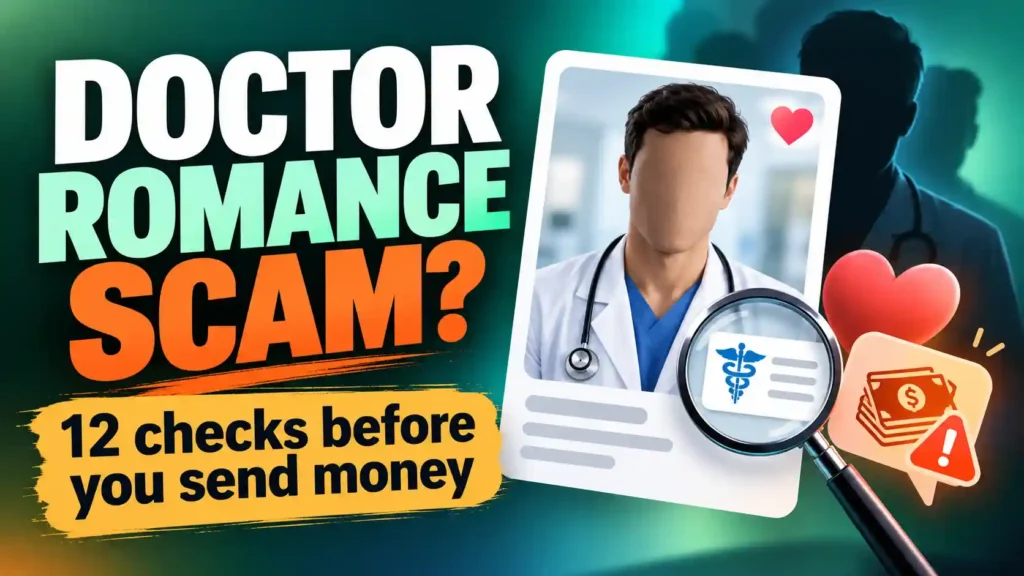
12 Signs of a Doctor Romance Scam
One busy week or canceled call does not prove someone is an impostor. Look for a pattern, especially repeated delays, shifting explanations, and requests for your money.
1. Their medical assignment explains every delay
They cannot meet because they are operating overseas. When that assignment ends, another urgent posting begins. A patient crisis cancels the next visit.
Doctors can have unpredictable schedules. The warning grows when the promised meeting never happens and the delays eventually require financial help from you.
2. A patient’s care suddenly depends on your payment
The person describes a patient who needs surgery, medication, or transport. They say the hospital cannot proceed until you pay.
You have no reliable way to establish that the patient exists through an online partner’s messages. Do not pay an account supplied as part of the same story.
3. They ask you to buy medical supplies
An invoice may list medicine, surgical materials, or equipment. The document might carry a hospital logo and an urgent deadline.
The presence of medical terms does not make you responsible for a clinic’s supposed expenses. Save the invoice; do not pay it.
4. They earn a good salary but cannot access it
They claim their overseas bank account is frozen or their wages will be released after the assignment. You only need to lend them money for a few days, they say.
You cannot verify their earnings or repayment promise. Their stated profession does not reduce the risk of sending money to someone you have never met.
5. They need you to pay for their flight home
They say their assignment is finally over and they are ready to meet. Then a ticket, travel permit, or last-minute fee becomes your responsibility.
Notice the timing. The payment is attached to something you have wanted for a long time: seeing them in person. A promised arrival date does not prove the trip is real.
6. Their credentials arrive as soon as you question them
They send a photo of a medical license, diploma, ID badge, or work letter and ask why you still doubt them.
Those images may belong to a real doctor. They do not establish who controls the dating account. Nor do they explain why you should send money.
7. A colleague confirms the emergency
An apparent hospital administrator or fellow doctor emails you with payment instructions. It may feel reassuring to hear from another person.
Ask how that contact reached you. If your online partner supplied the address or introduced the colleague, the second message is part of the same unverified chain.
8. They always have a reason a live call cannot happen
They can send affectionate messages and documents but cannot speak when you arrange a call. The explanation may be a long shift, poor connection, or a confidential assignment.
A missed call is ordinary. A continuing pattern deserves caution. At the same time, even a completed video call cannot verify the person’s employment, a patient emergency, or a payment request.
9. The hospital or mission website came from them
They send you a professional-looking website and ask you to use its payment page. You may see a logo, photographs, and staff names.
A polished page can still be false or unrelated to the person you are speaking with. Do not enter card details or identity documents into a site supplied through the same conversation as the money request.
10. They ask you to receive or forward money
They say donors, family, or a hospital will send funds to your account because theirs is inaccessible. Your only task is to transfer the money onward.
Decline. Money reaching your account does not guarantee it is legitimate or permanent. If you have already received it, contact your bank before moving it.
11. The reason or recipient changes when you refuse
You decline to pay for supplies. Now the money is for a ticket. You question the ticket, and an agent asks for a smaller “processing” charge.
Record what you were originally told and what changed. You do not have to resolve every new explanation before deciding against further payments.
12. They use guilt to challenge your boundary
They say you do not trust them, accuse you of letting a patient suffer, or suggest your relationship will end unless you help.
You are allowed to say, “I will not send money to someone I have not met.” Their response to that sentence is worth more attention than another photograph or certificate.
Fake Hospital Bills and Medical Missions: What to Examine
A document can make the emergency feel tangible. There may be a patient number, an invoice, or a letter stating that supplies will be withheld unless you pay. Yet you usually received the document because your online partner sent it.
Start by tracing the request back to its source. Did you independently learn of this bill, or did every detail come from the person asking you to fund it? Did you find the payment recipient yourself, or did a supposed colleague provide it?
If the person claims to work for a humanitarian organization, apply the same test. An organization’s real reputation does not verify an individual’s dating profile. Do not send money to a private account because someone says it will help patients or bring an aid worker home. If you want to donate, independently find the organization’s official donation channel.
Most of all, do not let urgency decide for you. An invoice that must be paid in an hour gives you less opportunity to think; it does not provide more proof.
Doctor Romance Scam Messages: What the Pressure Sounds Like
These examples are fictional. Focus on the request and the pressure around it rather than searching for an exact sentence.
“The hospital is short on medication for a child. Please send the payment to our administrator, and I will reimburse you when my salary clears.”
The patient creates urgency. The administrator creates an appearance of confirmation. The reimbursement promise asks you to accept the financial risk.
“My assignment ends this week. If you buy my ticket tonight, we can finally be together.”
The payment is presented as the last obstacle to your first meeting.
“I sent you my license. If you still need proof, perhaps you never trusted me.”
A document is being used to turn a reasonable question into a test of loyalty.
“Please keep this between us. I could get in trouble for asking you to help with a patient.”
Secrecy stops you from seeking another opinion.
Your messages may be gentler or more detailed. Look at the sequence: affection, a barrier to meeting, an urgent expense, then guilt when you hesitate. Romance scammer messages explores that pattern across different fake identities.
What If You Find a Real Doctor With the Same Name?
Do not stop at the name match. A real doctor’s public details can be copied.
Suppose you find a physician’s registration and a hospital biography matching the name and photograph your online contact uses. You have confirmed that the professional exists. You have not confirmed that they created the dating profile, sent your messages, or requested the transfer.
This is the most important distinction in a doctor romance scam. The identity being impersonated may be entirely genuine. The account contacting you may still be fraudulent.
Return to the practical questions: Have you met? Do the planned meetings keep falling through? Are you being asked to pay a person or organization you know only through this contact? Does the story change when you refuse?
If the wider situation remains confusing, how to know if you are scammed can help you review the evidence without relying on one apparently convincing detail.
What to Do If You Already Sent Money
Act quickly, even if the person says they are about to repay you or finally book the visit.
- Stop sending money. Do not pay another bill for supplies, treatment, travel, or the release of a refund.
- Contact the payment provider. Tell your bank, card issuer, payment app, transfer company, gift card company, or cryptocurrency platform that you suspect fraud. Ask whether the transaction can be stopped, disputed, or reported. Your options depend on how you paid and when you act.
- Preserve the evidence. Save the dating profile, messages, photographs, medical documents, invoices, links, account details, and receipts.
- Secure what you shared. Change exposed passwords. Contact your bank if you disclosed financial information. If you sent identity documents, seek identity theft guidance where you live.
- Report the profile. Use the dating or social platform’s reporting feature. In the United States, you can also report suspected fraud at ReportFraud.ftc.gov. Elsewhere, use your local fraud reporting authority.
- Tell someone you trust. It is easier to resist another emergency or repayment promise when someone else knows what has happened.
Be wary of a stranger who then offers to retrieve your losses for an upfront fee. Fund recovery scams can follow an initial loss.
Frequently Asked Questions About Doctor Romance Scams
A medical title can make a profile seem credible. These answers address what the title, documents, and calls can actually tell you.
Do real doctors use dating sites and apps?
Yes. A doctor’s presence on a dating app is not suspicious by itself. Be cautious when a person you have not met turns the relationship into a request for money or sensitive information.
Can a medical license prove that my online partner is real?
It can help establish that a licensed doctor with those details exists. It cannot prove that the person messaging you owns that identity.
Does a hospital badge prove they work there?
No. A photograph of a badge can be copied or altered. It does not verify the account or make you responsible for a payment.
What if they will not share patient details?
A real doctor should protect patient privacy. You do not need confidential patient information to decide that you will not pay an online contact’s bill.
Should I call the number on their hospital invoice?
Do not use only the contact information on a document they sent you to verify that same document. If you investigate, find an organization’s public contact details independently. You can still decline payment without making any call.
Does a video call rule out a doctor romance scam?
No. It may give you more information about the person, but it cannot confirm every professional claim or validate an invoice.
What if their bank account really is frozen?
You are not required to take on their financial problem. Do not lend money to an online romantic partner you have not met based on a promise of repayment.
Can a doctor legitimately ask me to donate to their patients?
You can choose to support a genuine cause through an official channel you find yourself. Do not send money to a private account or payment page supplied by an online romantic contact.
What if they have never asked me for money?
Do not assume the person is a scammer solely because they claim to be a doctor or work abroad. Take your time, protect your private information, and reassess if a financial request appears.
Can I recover money I already paid?
Possibly, depending on the payment method and timing. Contact the payment provider immediately. Be wary of anyone promising guaranteed recovery for a fee.
You Can Care Without Paying
It may hurt to question someone who has listened to you, remembered your life, and spoken about a future together. You do not have to dismiss those feelings to make a careful decision.
If the doctor you met online asks you to pay for a patient, medical supplies, a flight, or another urgent problem, stop. Check the identity through sources you find independently, and remember that a real doctor’s record does not prove who controls the account. Share the payment request with someone you trust.