The message arrives after you comment on a celebrity’s post.
“I noticed what you wrote. Thank you for supporting me.”
You check the profile. The photograph looks right. The account knows about the celebrity’s latest work. Soon, the conversation moves beyond fan messages. They ask about your family, remember details you shared, and tell you they feel a connection they cannot explain.
Part of you is thrilled. Another part keeps asking: Is this really them?
If someone claiming to be an actor, musician, athlete, influencer, or other public figure is building a private relationship with you, pause before sending money or personal information. A familiar face, a convincing voice note, and even a video call cannot answer every question about who controls the account.
This guide will help you check the claim, recognize the warning signs of a celebrity romance scam, and act if you have already paid.
What Is a Celebrity Romance Scam?
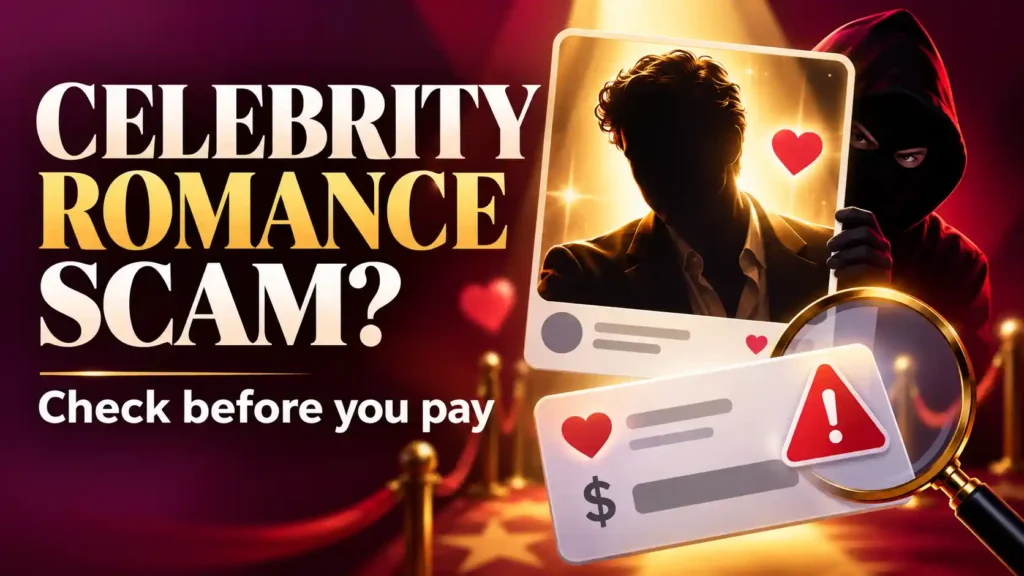
A celebrity romance scam happens when someone pretends to be a famous person and develops an emotional relationship with a fan to obtain money, personal information, account access, or another benefit.
The impersonator may copy the celebrity’s name and photographs or approach you through a fan page. They may claim their public account is managed by staff while they use a separate account for private conversations.
At first, they might ask for nothing. They send affectionate messages, discuss a future together, and make you feel trusted. Eventually, a problem appears. They need help paying a fee, arranging a visit, handling an emergency, or accessing money that is supposedly tied up.
By then, refusing can feel difficult. You are no longer responding to a stranger’s request. You are responding to someone you believe you have grown close to.
That emotional connection is why the scam works. To understand the broader pattern behind it, see Romance Scams: 17 Romance Scammer Red Flags Before You Trust the Wrong Person.
Before you decide whether every photograph looks authentic, though, start with something more useful: check the account itself.
Is a Celebrity Really Messaging You? Use This Four-Step Check
You may not be able to prove immediately who controls a private account. These four steps will help you decide whether you have enough independent evidence to trust it—especially before a payment.
Step 1: Identify the exact account that contacted you
Open the profile from the original message. Save its full username and profile link.
Look beyond the display name and photograph. An impersonator can copy both. Check the account’s history. Notice whether the username has extra numbers, unusual spelling, or words such as “private,” “backup,” or “official.”
A polished profile is a starting point for your check. It is not the result.
Step 2: Find the celebrity’s established channels yourself
Leave the conversation and search for the celebrity’s public account or official website. Do not use a link the person messaging you supplied.
Now ask: Does an established channel clearly confirm that this private account or supposed representative belongs to the celebrity?
If the only “proof” comes from the account you are investigating, you have not independently verified it. A screenshot of the celebrity’s public profile does not bridge that gap.
Step 3: Examine the request separately from the identity claim
What does this person want you to do?
Perhaps they want a fan-card payment, a security deposit, help with travel, a cryptocurrency transfer, a login code, or an intimate photograph. You do not have to settle every question about their identity before refusing.
If the account is unverified, do not send money or sensitive information.
Step 4: Watch what happens when you slow down
Say that you will check the account independently and will not pay while you do so.
Notice the response. Do they respect your decision? Or do they say you have hurt them, introduce a sudden deadline, ask you to hide the conversation, or bring in a “manager” to pressure you?
Their reaction tells you how the relationship handles an ordinary safety boundary.
If you cannot independently connect the private account to the celebrity, treat it as unverified. If the person also asks for money, stop the transaction.
How a Fake Celebrity Relationship Develops
The first message in a celebrity impersonation scam may sound harmless. That is why it helps to look at the whole sequence.
Here is an illustrative conversation showing how a request can develop. It is an example, not a transcript from an actual case.
Day 1: “I saw your comment. Thank you for always supporting me.”
Day 5: “My team runs my public account. This is where I can speak freely.”
Day 14: “Talking to you has become the best part of my day.”
Day 24: “Please keep us private. People would misunderstand.”
Day 38: “I want us to meet. My assistant can arrange it, but the security fee must be paid first.”
The request on day 38 rests on everything that came before it.
The first message makes you feel noticed. The private-account explanation answers your doubts about the profile. Frequent conversation creates closeness. Secrecy keeps other people from checking the story. Finally, the fee is presented as the last obstacle between you and a meeting.
The turning point is when the online relationship begins directing a real-world decision. You are asked to pay, borrow, share a code, or keep a financial request hidden. That is the moment to pause, even if the conversation has felt sincere for weeks.
11 Warning Signs of a Celebrity Romance Scam
You do not need to spot every sign on this list. A single payment request from an unverified account is enough reason to protect yourself.
1. They contact you from a “private” or “backup” account
The sender says their public account belongs to their team, while this second profile lets them speak as themselves.
That story explains why you cannot easily verify the account. It does not prove the story is true. Look for independent confirmation outside the conversation.
2. They found you after you interacted with fan content
You may have commented on a photograph, shared a song, or joined a fan group. When the account mentions that interaction, the message feels personal.
However, a stranger can also see a public comment. Knowing that you admire the celebrity makes you an easier person to approach.
3. They move the conversation to another app
The sender wants to switch to WhatsApp, Telegram, Signal, or text. They may say they rarely check the original platform or want more privacy.
People move genuine conversations between apps, too. The concern is the wider pattern: a private account contacts you, claims a special relationship, and quickly moves the conversation away from the place where it began.
Save the original profile link and early messages before anything disappears. If the conversation moves to WhatsApp, use the checks in How to Identify a Scammer on WhatsApp before replying to requests for money, links, or codes.
4. The relationship becomes serious unusually fast
They call you their soulmate or discuss a shared future before you have independently confirmed who they are. The messages may become so frequent that the relationship begins to shape your routine.
Enjoying the attention does not mean you have done anything wrong. But the strength of your feelings cannot verify the sender’s identity.
5. They insist that nobody else can know
They blame the media, their management, a former partner, or jealous fans. Secrecy may be presented as a sign that they trust you.
It also prevents you from getting another person’s view of the situation. You are free to discuss an online relationship—especially a request for money—with someone you trust.
6. A “manager” or “assistant” contacts you
A second account sends formal messages about scheduling, security, or payment. It may provide documents, a company name, or instructions that appear professional.
Do not assume a second person has verified the first. Both accounts may be controlled by the same scammer or group. Check the representative’s identity through a channel you found independently.
7. You must pay before you can meet
The payment may be called a fan card, VIP membership, security clearance, reservation fee, or refundable deposit.
The name of the fee matters less than the request itself. An unverified online contact is making a private meeting conditional on your payment. Do not pay to find out whether the meeting will happen.
8. A wealthy person cannot access their money
They claim their account is frozen, a contract prevents them from withdrawing funds, or they are stranded while traveling. The problem sounds temporary, and they promise to repay you.
Step away from the details for a moment. A person claiming to be famous and financially successful is asking someone they met online to solve a private money problem. You can refuse without investigating every part of the excuse.
9. A photograph, voice note, or video call is offered as final proof
Seeing a familiar face can silence your doubts. Yet a photograph may be reused or altered, audio may be imitated, and video may lack the context needed to establish who is speaking.
A call can be one piece of information. It should not be the only reason you trust an account or make a payment. For a closer look at this problem, read Deepfake Romance Scams: Can You Trust a Live Video Call?
10. The way you must pay keeps changing
You hesitate over a bank transfer, so they ask for gift cards. You question the recipient’s name, so they say the account belongs to their assistant. You cannot afford the amount, so they offer to cover half.
The changing instructions serve the same purpose: to get you to send something valuable. A more convenient payment method does not resolve an unanswered identity question.
11. They react badly when you check
They accuse you of lacking trust, threaten to end the relationship, or say the opportunity to meet will disappear unless you act immediately.
You are allowed to ask questions about your money and safety. A person’s anger does not turn an unverified account into a real one.
Can a Verified Badge or Video Call Prove It Is the Celebrity?
Not by itself. The important detail is which account or claim the evidence actually supports.
| What you see | What it tells you | What it does not tell you |
|---|---|---|
| A celebrity photograph | The sender has the image | The sender is the person pictured |
| A screenshot of a verified account | That public account exists | A separate private account belongs to the same person |
| A voice note | Someone sent you audio | Who made or recorded it |
| A video call | You saw moving images during a call | Who controlled the call or whether a payment request is legitimate |
| A message from a “manager” | A second account supports the story | That the account represents the celebrity |
| Accurate facts about the celebrity | The sender knows those facts | How they learned them |
Suppose the person sends a photograph holding a note with your name. That might feel much stronger than an ordinary publicity photo. Still, you need to establish where the image came from and whether it independently connects the account requesting money to the celebrity.
The same caution applies to a reverse-image search. Finding the same photograph under another name can reveal a problem. Finding no match does not prove the photograph or the account is authentic. If you need to investigate a picture, How to Spot a Deepfake Image: 14 Clues and a 3-Minute Verification Test explains what to check beyond its appearance.
When a visual detail leaves you uncertain, return to what you can control: do not pay or share sensitive information while the identity remains unverified.
What Do Fake Celebrities Ask Fans to Pay For?
There is no single celebrity romance scam script. The request is shaped around the story the sender has built with you.
One person is asked to buy a fan card to keep chatting. Another is told that a private meeting needs a security deposit. Someone else is asked to cover a flight, medical bill, legal expense, charitable donation, or temporary problem with a frozen account.
A different scammer may never ask for an emergency payment. Instead, they offer an “exclusive” investment or say they can help you build wealth for your future together.
Pay attention to what happens after you say no. Does a smaller fee suddenly become available? Does a new deadline appear? Does the assistant join the conversation to make the request sound official?
For example, the account might say, “I can pay you back once my team releases my funds, but if you don’t send the deposit today, we will lose our chance to meet.”
You do not have to prove whether the supposed funds or meeting exist. You only have to decide whether an unverified account gets your money. The answer should be no.
What If They Have Never Asked You for Money?
Do not assume every unusual message is a completed scam. At the same time, do not treat the absence of a payment request as proof of identity.
Keep your boundaries while you check. Avoid sharing your address, ID documents, bank details, intimate images, passwords, or login codes. Do not agree to receive and forward money or packages for the person.
You can also tell someone you trust about the conversation. If the sender becomes upset because you want an outside opinion, take that reaction seriously.
Perhaps no demand will ever come. Perhaps one will come later. You do not need to predict which outcome is coming to protect your information today.
What to Do If You Already Sent Money
You may want to go back through every message before accepting what happened. That is understandable. Take the practical steps first, while the payment and account details are easier to trace.
Contact the payment provider immediately
Tell your bank, card issuer, payment app, gift-card company, or cryptocurrency platform that the payment may be connected to an impersonation scam. Give them the transaction details and ask whether it can be stopped, disputed, recalled, or traced.
The available options depend on how you paid and how much time has passed. A refund is not guaranteed, but waiting reduces the chance of taking any available action.
Save the evidence
Keep the original account link, usernames, phone numbers, messages, voice notes, receipts, payment instructions, wallet addresses, and details of any supposed assistant or manager.
Write down the dates and amounts. Save the information before reporting or blocking the account, because a profile or conversation may later become unavailable.
Secure anything you shared
Change affected passwords and turn on two-factor authentication. If you shared a login code, contact the account provider promptly. If you sent ID documents or financial details, ask the relevant provider or consumer authority what protective steps apply where you live.
Report the account and the fraud
Report the profile to the platform where the contact began. Report the payment and impersonation to the appropriate fraud-reporting authority in your country as well.
You may feel embarrassed. You do not need to explain why you developed feelings before you ask for help. Give the provider or investigator the messages, account details, and transaction information they need.
Refuse anyone promising guaranteed recovery
After you report a loss, someone may contact you claiming they can get every payment back for an advance fee. Do not send more money or give them access to your accounts.
Work directly with your payment provider and the appropriate reporting channels. Be cautious with anyone who finds you through a private message and promises a guaranteed result.
How to Help Someone Who Thinks They Are Dating a Celebrity
If a friend or family member is involved, do not begin by mocking the relationship. The messages may have become an important part of their life. Humiliation can make them withdraw and rely more heavily on the person contacting them.
Start with the specific action that worries you: “I’m concerned about this payment. Can we check who controls the account before you send anything?”
Ask to see the original profile and conversation. Look together at when the account first contacted them, how the identity was supposedly proved, and where the money would go. Offer to help save the evidence and contact the payment provider.
You may not settle the question in one conversation. Agreeing on no further payments while checking is a valuable first step. Make it easy for them to come back to you if another request arrives.
Celebrity Romance Scam FAQs
These answers address the questions that often come up when a private conversation feels real, but the person behind the account remains unverified.
1. Do celebrities ever message fans privately?
A public figure may interact with fans online. A private message alone, however, cannot establish who controls the account. Check the specific profile independently, especially before sharing information or paying anyone.
2. Why would a scammer pretend to be a celebrity?
A famous identity comes with recognizable photographs, public information, and fans who already feel connected to the person. An impersonator can use those details to make a message from a stranger feel personal.
3. Is a celebrity’s private account automatically fake?
No. The word “private” does not prove an account is fake or real. You need independent evidence linking that exact account to the public figure. Until you have it, treat the identity as unverified.
4. Does a verified badge prove a private account is genuine?
A badge on a public account does not verify a different account or phone number contacting you. Check the exact profile involved in the conversation.
5. Can a scammer copy a celebrity’s verified profile?
An impersonator can copy the name, photo, biography, and appearance of a public profile. Always check the exact username and account link rather than relying on a screenshot.
6. Is a paid fan card necessary to date a celebrity?
Do not pay an unverified account for a card or membership that supposedly allows a private romantic relationship. Treat the payment demand as a serious warning sign.
7. What if the person says the meeting fee is refundable?
A promise of a refund does not protect your money. Do not send a deposit to an unverified account or representative to arrange a romantic meeting.
8. What if the celebrity’s manager contacts me?
A second account does not independently verify the first. Check the manager’s identity and role through established channels you found yourself, especially before following payment instructions.
9. What if the account knows private details about the celebrity?
First ask whether those details are truly private. Interviews, social posts, fan discussions, and public records may provide more information than you expect. Knowledge of facts is not proof of identity.
10. What if the person knows details about me?
They may have read your public posts or learned those details during your conversations. Their attentiveness can feel meaningful, but it does not verify who they are.
11. Can a live video call prove I am speaking to the celebrity?
A video call can provide information, but it should not be your only test. Check the account and any financial request independently. Do not pay because a call looked convincing.
12. What if the celebrity sends me a photograph made just for me?
You still need to establish where the image came from and who controls the account. A personal-looking photograph should not be the sole basis for sending money or sensitive information.
13. Why do scammers ask to move to WhatsApp or Telegram?
They may want a more private conversation or to separate later messages from the original social media profile. Moving apps alone is not proof of fraud, but it becomes more concerning alongside secrecy, fast romance, and payment requests.
14. What if the person has never asked me for money?
Keep your boundaries and continue checking the identity. Do not share sensitive information or agree to receive money or packages. No request today does not guarantee there will be no request later.
15. What if we have been talking for months?
Months of conversation can make the relationship feel real, but time does not establish identity. Review how it began, what you verified outside the chat, and whether secrecy or financial requests have appeared.
16. What if I already sent a small amount?
Contact the payment provider promptly and ask what options are available. Save the messages and payment details. Do not send another payment to “unlock” a meeting, refund, or larger transfer.
17. Can I get my money back?
It depends on the payment method, timing, and provider. Report the transaction immediately and ask about stopping, disputing, or tracing it. Be wary of anyone who guarantees recovery for a fee.
18. Should I confront the account?
You do not need a confession to protect yourself. Save the evidence, stop payments, secure your accounts, and report the profile. An argument may give the sender another chance to pressure you.
19. What if the person threatens to share my private photos?
Preserve the threats and account details. Do not send more images or assume that paying will end the threat. Secure your accounts, report the profile, and contact the appropriate authorities or support services where you live.
20. How can I help someone who refuses to believe it is a scam?
Avoid ridicule. Focus on the immediate payment request and ask them to pause while you check the exact account together. Remain available so they can tell you about the next request without fearing your reaction.
The Decision That Protects You
A celebrity romance scam can make a basic safety check feel like a betrayal. The account may ask you to focus on the affection, the calls, and the future you have discussed instead of the payment it wants today.
You can care about what you have experienced and still stop.
Find the exact account. Look for confirmation through channels you discovered yourself. Tell someone you trust about any request for money or secrecy. If you cannot verify the identity, do not send money, codes, or private documents.
You do not have to prove beyond doubt that the sender is a scammer before setting that boundary. You only have to decide that an unverified online relationship will not control your finances or your safety.