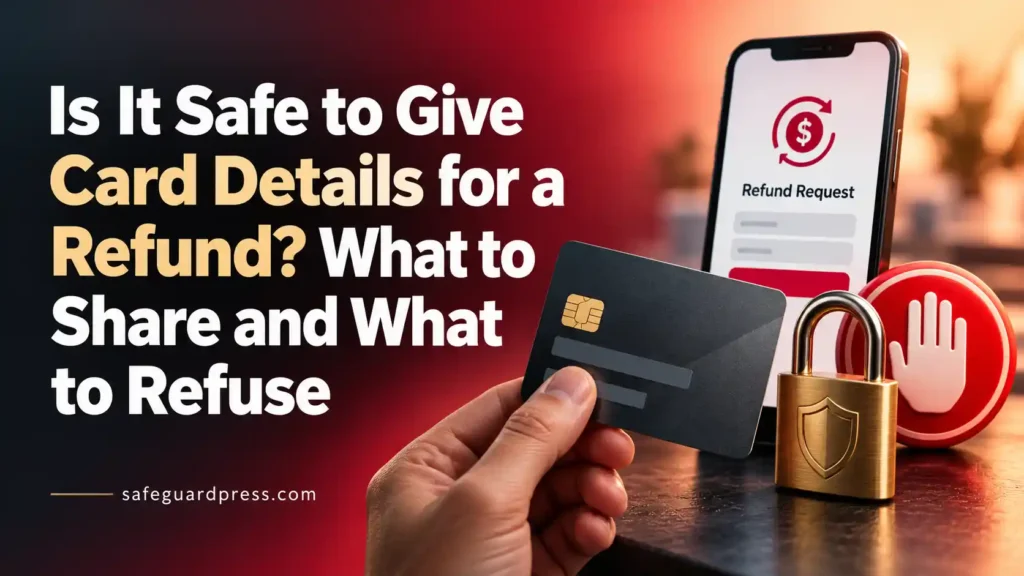
You finally get the message you wanted: your refund has been approved. Then comes an unexpected request—send your card number and expiry date to receive the money.
Should you cooperate, or could this turn one bad purchase into a bigger loss?
For a normal refund of an existing card purchase, you usually do not need to provide your full card details again. Never send them through an unverified email, text, chat, or phone call.
There are legitimate exceptions, particularly some in-store returns and alternative refund arrangements. But an exception should come with a clear explanation and independent verification.
Here is how to check the request, protect your card, and act if you have already shared something.
Is It Safe to Provide Your Credit Card Number and Expiry Date for Refund Purposes?
Only consider providing sensitive card information when you have independently verified the business, confirmed why the information is necessary, and established a secure way to provide it.
An ordinary refund linked to a card purchase generally uses the original payment record. The merchant finds that transaction and issues the refund against it, rather than asking you to make another payment.
For example, this documented refund process sends funds back to the original payment method.
Your first response should therefore be:
“Can you refund the original transaction? If additional card information is necessary, please explain why and tell me how to complete the process through my account.”
Then contact the merchant through its official app, website, or an established telephone number you found yourself.
Do not use a contact number supplied only in the questionable message. You would be asking the person making the claim to verify their own claim.
If you already sent your card details to a suspicious recipient, go straight to the section below titled “Already Shared Information? Use This Action Table.”
What Information Might a Merchant Need for a Refund?
A business may need to locate your purchase or confirm who is requesting the return. That does not automatically require your complete card information.
The difference matters: an order reference identifies a purchase; a banking password provides access to an account.
| Information Requested | Possible Legitimate Purpose | What You Should Do |
|---|---|---|
| Order number or receipt | Locate the purchase | Provide through verified merchant support |
| Purchase date and amount | Match the transaction | Share only what is relevant |
| Name or email used for the order | Find the customer record | Use the official support channel |
| Last four digits of the card | Identify the payment method | Reasonable after verifying the recipient |
| Full card number and expiry date | Certain separate card-credit arrangements | Ask why the original transaction cannot be refunded; verify before proceeding |
| CVV or CVC security code | Sensitive card verification information | Do not send it through a message for a routine refund |
| Photograph of your card | Exposes several card details together | Ask for another verification method |
| Card PIN | Sensitive authentication | Never tell it to a caller or support agent |
| One-time banking code | May authorize a payment, login, or other action | Never relay it to the person contacting you |
| Banking password | Access to your account | Never provide it to a merchant |
This table is a decision guide, not a guarantee that a request is genuine.
Even an order number should go to the right person. A scammer who collects purchase details can use them to make the next call or message more convincing.
When a Genuine Refund Might Involve Your Card
“Never provide a card for any refund” sounds simple, but it overlooks legitimate situations.
The safer rule is to understand the process before participating.
An In-Store Return at a Payment Terminal
You return an item to a shop with your receipt. The cashier asks you to present a card at the terminal.
That can be legitimate. Some retail systems support card refunds that are not linked to a previous payment in that system. Their in-store refund instructions may involve tapping, inserting, or swiping the customer’s card.
Before proceeding:
- Confirm the refund amount.
- Ask whether the terminal is processing a refund.
- Read any instructions displayed.
- Keep PIN entry private if the verified terminal requests it.
- Obtain a receipt.
Presenting a card at a verified shop’s terminal is different from sending photographs of it to someone in a private chat.
A Failed Refund or a Different Payment Arrangement
An alternative arrangement may be necessary if the original refund fails or the merchant cannot use its previous payment system.
Ask for a specific explanation:
“Was the original refund attempted? What prevented it from completing, and which verified process will you use instead?”
Confirm the answer with the business through a separate, established channel.
The words “manual refund” do not prove anything. They describe a claimed procedure, not the identity of the person requesting your information.
A Secure Form Confirmed Through Official Support
A merchant might use a payment provider’s form for a particular refund arrangement.
Before entering details, verify that exact process through the merchant’s official support channel. Ask whether you can reach it from your account.
A secure connection alone is insufficient. A fraudulent website can also display a padlock.
If you need help examining the page, follow how to tell if a website is safe before entering sensitive information.
Can Someone Use Your Card Number and Expiry Date Without the CVV?
Do not treat the missing security code as a guarantee of safety.
Card number and expiry information is sensitive. Payment checks vary, and someone who obtains those details may try to combine them with information collected elsewhere.
That does not mean every disclosure will lead to a successful charge. It means you should not dismiss a suspicious disclosure because you withheld one detail.
Think about the full picture:
- Did you also provide your billing address?
- Did you send a photograph?
- Did you approve a banking notification?
- Did you reveal a code?
- Did you sign into a page the person supplied?
Tell your issuer exactly what happened. Do not describe it simply as “I shared some information.”
For the broader ways card information gets exposed, read how scammers get your credit card number.
How to Verify a Refund Request in Five Steps
You do not need to identify the sender or prove criminal intent before protecting yourself.
You need to confirm that the refund exists and that the proposed process belongs to the real business.
1. Match the Claim to an Actual Purchase
Find your receipt, order history, and card statement.
Check:
- Which purchase is being refunded?
- What amount is involved?
- Did you request a return or cancellation?
- Does the order number match?
- Is there a refund notification inside your account?
A refund for a purchase you cannot identify deserves particular caution.
However, a correct order number is not enough. Accurate information can appear in an impersonation attempt.
2. Open the Merchant’s Account Yourself
Leave the message.
Open the app you already use, use a trusted bookmark, or type the known website address yourself. Find the order and contact support there.
If you need a telephone number, use an existing receipt or the business’s verified contact page.
Do not depend on the name displayed by the caller. Do not choose a telephone number simply because it appears first in a search advertisement.
3. Ask Why Additional Details Are Necessary
Use a direct question:
“Why can’t you issue this refund against the original payment?”
If there is a genuine exception, ask how to confirm and complete it securely.
An answer such as “this is mandatory” leaves the important questions unanswered. You still need to know what information is required, why, and where it should be entered.
4. Read What You Are Authorizing
Look at the actual screen or banking message.
If it describes a purchase, transfer, account login, or new digital-wallet setup, stop.
A caller may say:
“The bank labels all refund approvals as payments. Just press approve.”
Do not let that explanation override the information shown by your bank.
Contact your issuer independently before authorizing an action you do not understand.
5. Keep Written Confirmation
Ask for confirmation showing:
- The original order or transaction
- The refund amount
- The date it was initiated
- The expected processing period
- A refund reference, if available
Monitor your own account afterward.
A screenshot supplied by the other person is supporting material, not final confirmation that money has reached you.
Seven Refund Requests That Should Make You Pause
These examples are illustrative. Focus on what the sender wants you to do, rather than memorizing particular wording.
1. “Enter Your Card Details Before the Refund Expires”
“Your refund of $86.40 is ready. Complete verification within 30 minutes.”
The deadline encourages you to act before checking.
Open the original account and ask verified support whether the request belongs to them.
If it arrived by email, use how to tell if an email is from a scammer to assess the message.
2. “Send Your New Card Because the Old One Expired”
An expired or replaced card does not automatically prevent a refund. Issuers often handle the credit through the associated replacement card or another arrangement, although refunds can fail.
Speak with your issuer before giving someone new card details.
The card’s expiry date is a question to resolve—not a reason to bypass verification.
3. “Read Me the Code to Release Your Money”
A code may relate to an action very different from the promised refund.
Read the message yourself. Never relay it to the person contacting you.
If it mentions a payment, login, or wallet enrollment, explain that exact wording to your issuer.
4. “Send a Photograph of Both Sides of Your Card”
This can expose your number, expiry date, name, and security code together.
An instruction to cover one part of the image does not make sending the rest automatically safe.
Ask for another way to verify the purchase.
5. “Pay a Small Fee to Unlock the Refund”
A disclosed return-shipping cost or deduction under a genuine return policy differs from an unexpected demand to send money to release funds.
Be especially cautious if the requested payment goes to a personal account or requires gift cards or cryptocurrency.
Do not pay merely because the promised refund is much larger than the fee.
6. “Install This App So We Can Refund You”
The person asks you to install remote-access software, share your screen, or log into your bank while they watch.
Stop.
Refund verification should not require surrendering control of your device or exposing your banking session to an unverified contact.
7. “We Sent Too Much—Return the Difference”
The person shows a supposed refund confirmation, then says you owe them money.
Do not make a separate payment based on their screenshot or a screen they control.
Ask your bank to examine what actually happened. If a genuine error occurred, resolve it through the institutions involved.
Realistic Refund Situations: What to Do Next
The following fictional examples show how context changes the decision.
You Requested a Return Inside a Shopping App
You open the official app and find the returned item. The refund status identifies the original payment.
What to do: Follow the verified process, retain confirmation, and monitor your account. Question any sudden request to move into a private chat and provide full card details.
A Text Arrives Shortly After Your Complaint
You complained yesterday. Today a text promises the correct refund amount and links to a card form.
What to do: Contact support through the original account. Timing and a matching amount make the message believable, but they do not verify the link.
You Are at the Store With the Item and Receipt
The cashier explains the refund and asks you to present your card at the terminal.
What to do: Confirm the amount and transaction type, follow the terminal instructions, and keep the receipt.
Someone Offers a Refund for an Unfamiliar Subscription
The message claims you were overcharged and provides a telephone number to cancel the charge.
What to do: Check your statement first. If the charge exists, investigate through your issuer and the verified merchant. Do not call the supplied number simply to find out whether the charge is real.
Already Shared Information? Use This Action Table
Stop the conversation. Contact your issuer through its official app or the number on your card. Describe the exposure accurately and ask what protection is needed.
| What Happened | Immediate Action |
|---|---|
| Shared card number and expiry date | Lock the card if available; ask the issuer whether replacement is necessary |
| Shared the security code or a card photograph | Tell the issuer which details were exposed; request guidance on blocking further use |
| Shared a banking code or approved a notification | Explain what the message authorized; ask the issuer to check relevant payments and access |
| Entered a password | Change it through the real service on a trusted device; secure other accounts using that password |
| Allowed remote access | Disconnect the session; contact the bank from another trusted device |
| Money was taken | Report promptly; ask about stopping the payment or the applicable dispute process |
These steps after a scam provide further guidance for exposed information, payments, and device access. Recovery is not guaranteed.
Give the Bank a Clear Description
You can say:
“Someone claiming to arrange a merchant refund obtained my card number and expiry date. I am concerned the details are exposed. Please check the account and explain whether the card needs replacing.”
If you approved something, add:
“The message described a payment of [amount]. I approved it because the caller said it was required for a refund.”
Be precise. Distinguish an unauthorized charge from a payment you were deceived into approving.
Save Evidence Without Continuing the Conversation
Keep the message, sender details, website address, transaction reference, and relevant times.
Do not delay contacting your issuer while trying to collect perfect evidence.
For other activity to check, read credit card fraud warning signs and what to do immediately.
What If the Merchant Still Has Not Refunded You?
A missing refund does not automatically mean fraud.
Start by clarifying its status:
- Was it approved but not initiated?
- Was it initiated and is still processing?
- Did it fail?
- Was the original charge canceled instead?
Some early refunds appear as a reversal: the original charge disappears rather than a separate credit appearing. Check both possibilities.
Ask verified support for a reference your issuer can use and contact the issuer if the expected period has passed.
Also ask about dispute deadlines. Do not assume repeated promises from the seller extend the time you have to raise a complaint.
If someone contacts you offering to recover the refund for an upfront fee, check fund recovery scams before engaging.
Frequently Asked Questions About Card Details for Refunds
These answers address additional concerns that can arise while you are checking a refund request.
Does “Card Verification” Mean the Request Is Genuine?
No. It is a description supplied by the sender. Confirm what the verification does through the real merchant or issuer.
Is Sharing Only My Name Safe?
A name alone is different from complete card information, but context matters. Do not keep supplying more details to an unverified recipient.
Should I Email My Card Details to a Small Business I Know?
Ask for a safer process. Knowing the business does not remove the risk of sending sensitive information through ordinary email.
Can I Trust a Refund Request From a Previous Chat?
Review the requested action anyway. A familiar conversation does not justify sharing codes, passwords, or complete card photographs.
What If the Merchant Says My Refusal Will Cancel the Refund?
Ask official support to confirm that policy in writing. Pressure does not establish that the requested information is necessary.
Should I Keep My Card Locked While Waiting for the Refund?
Ask your issuer how its lock affects incoming credits. Card controls vary; do not assume the same behavior across banks.
Will Replacing My Card Automatically Cancel the Refund?
Not necessarily. Tell your issuer that a refund is expected and ask how it will handle the credit.
What If I Paid Through a Digital Wallet?
Start with the original merchant and wallet transaction. Do not assume an unfamiliar number shown on a receipt means the purchase cannot be traced.
Can I Receive a Refund Without Logging Into Online Banking?
A normal linked card refund does not require giving a merchant access to your banking session. Check the account independently when needed.
Is a Small “Test Payment” Harmless?
Do not approve it solely because the amount is small. Establish why any new payment is being requested for a refund.
Should I Return Money If It Appears in My Account?
If someone claims an error, ask your bank to investigate. Do not send a separate transfer to a destination supplied by that person.
Is a Pending Credit Final Proof of a Completed Refund?
Ask your issuer about its status. Do not rely on a pending entry as a reason to approve unrelated payments.
Can a Refund Confirmation Contain My Card’s Last Four Digits?
Yes, masked details can help identify the payment. Their presence alone does not authenticate an email or attachment.
What If I Clicked the Link but Entered Nothing?
Close it. If you downloaded a file, installed software, or granted permission, investigate that separately. Clicking alone does not prove your card details were exposed.
What If I Typed Details but Did Not Press Submit?
Treat sensitive information entered on a suspected fraudulent page as potentially exposed. Tell your issuer what you typed.
Does Deleting the Message Protect My Card?
No. Deleting a message does not withdraw information already provided. Secure the account and retain relevant evidence first.
Should I Call a Number Found in a Sponsored Search Result?
For sensitive refund or banking issues, use an established contact route. A prominent search placement is not identity verification.
Can Someone Else Receive My Refund for Me?
Avoid arrangements proposed by an unverified contact. Ask the merchant to explain its official policy and the consequences of changing the destination.
What If the Refund Is for a Debit Card?
Use the same verification precautions. If information was exposed or money moved, contact the issuer immediately and ask about protections applicable to that account.
What Is the Most Important Question to Ask?
“Why can’t you refund the original payment?” Then verify the explanation through a route you found independently.
Keep Control While Getting Your Money Back
You should not have to choose between receiving a refund and protecting your account.
Find the original purchase. Contact the real business. Ask why additional information is needed. Read what every approval actually authorizes.
A promised refund is not proof that a request is safe. Verify the process before sharing details—and contact your issuer promptly if you already exposed them.