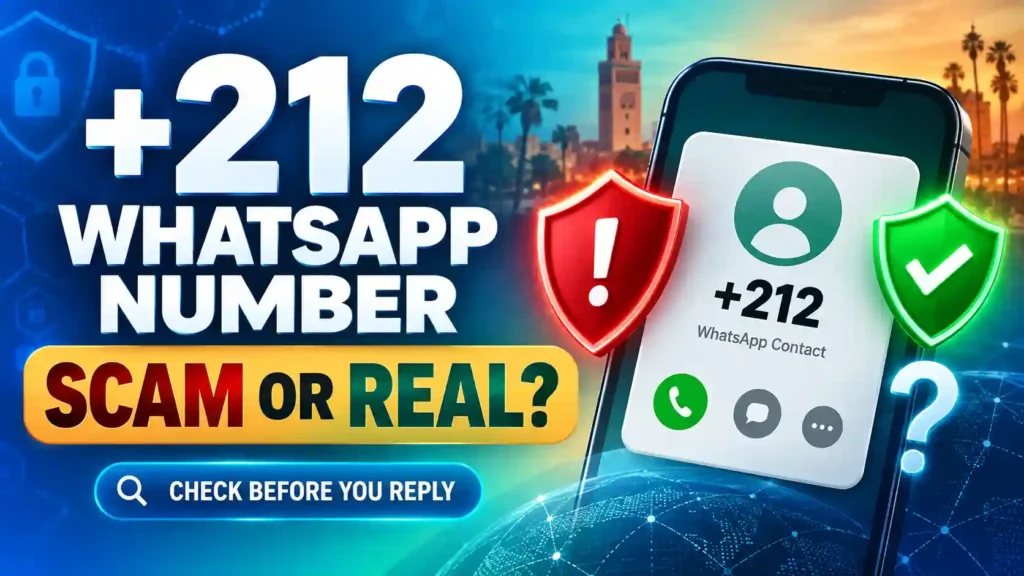
You look at WhatsApp and see an unexpected message or missed call from a number beginning with +212.
You do not recognize the sender. You may not know anyone in Morocco. Perhaps the person simply wrote “Hello,” claimed to have contacted the wrong number or offered you an easy online job.
So, is the +212 WhatsApp number a scam?
The +212 country code is the legitimate international calling code for Morocco. Therefore, a +212 number is not automatically fraudulent. However, the country code does not prove that the person contacting you is honest, lives in Morocco or is who they claim to be.
If an unknown +212 number contacts you, do not judge it by the prefix alone. Examine the message, the sender’s identity and what they want you to do.
| Question | Quick answer |
|---|---|
| Which country uses +212? | Morocco |
| Is every +212 WhatsApp number a scam? | No |
| Does +212 prove the sender is in Morocco? | No |
| Should you reply to an unknown +212 number? | Not until you verify the sender |
| Is 212 also associated with New York? | Yes, but New York appears internationally as +1 212 |
| Should you open a link from the sender? | No, unless you independently verify it |
| What should you do with a suspicious account? | Preserve evidence, block it and report it |
What Country Uses the +212 Code?
The +212 country code belongs to Morocco.
It is used when Moroccan mobile and landline numbers are written in international format. A number may appear on WhatsApp in a format such as:
+212 X XX XX XX XX
The precise digits following the country code depend on the telephone service and number range.
If someone saves a Moroccan telephone number for international use, the domestic leading zero is normally removed and replaced with +212.
For example, a Moroccan mobile number written locally with an initial zero would appear internationally without that zero after the +212 prefix.
Are +212 and 00212 the Same?
They can represent the same Moroccan country code.
The plus sign tells the telephone system to use the appropriate international dialing prefix. In many countries, that international prefix is written as 00.
Therefore:
+212represents Morocco in standard international format.00212can also represent Morocco when dialed from countries using00as the international access prefix.
Seeing 00212 instead of +212 does not automatically make the number fraudulent.
Is 212 a Moroccan Code or a New York Area Code?
It can refer to either one, depending on how the complete number is written.
+212is the international country code for Morocco.00212can also indicate Morocco.212is an area code associated with New York City.+1 212is a US number using the New York 212 area code.
The plus sign and the number immediately following it matter.
A number beginning with +212 is associated with Morocco’s telephone numbering system. A number beginning with +1 212 belongs to the North American numbering system.
Scammers may hope that someone in the United States mistakes +212 for a familiar New York number. Always inspect the complete prefix before answering.
Is a +212 WhatsApp Number Automatically a Scam?
No. A +212 WhatsApp number can belong to a completely legitimate person or organization.
The account could belong to:
- A Moroccan resident
- A hotel or tour operator
- A customer or supplier
- A student or professional
- A legitimate business
- A friend or relative travelling abroad
- Someone responding to an enquiry you made
- A person who accidentally entered the wrong number
However, criminals can also register WhatsApp accounts using legitimate telephone numbers. Some use numbers obtained specifically for fraudulent campaigns. Others take control of existing accounts or impersonate real people and businesses.
The country code tells you where the number was issued. It does not reliably tell you:
- Where the user is currently located
- Whether the profile name is genuine
- Whether the photograph belongs to the user
- Whether the account has been compromised
- Whether the business exists
- Whether the sender’s story is true
- Whether the request is safe
Instead of asking only whether +212 numbers are scams, ask a better question:
Why is this unknown person contacting me, and what do they want me to do?
A suspicious request is more important than the country code.
Why Am I Receiving WhatsApp Messages From +212 Numbers?
Receiving an unexpected message does not necessarily mean your phone or WhatsApp account has been hacked.
Your number may have reached the sender in several ways.
Your Number Was Entered Incorrectly
The sender may have made a genuine typing mistake.
If so, the conversation should normally end after you explain that they contacted the wrong person.
Be cautious when the supposed mistake becomes an excuse to continue talking. Wrong-number scammers often apologize, compliment your kindness and attempt to develop a friendship.
Your Number Appears Publicly
Your telephone number may be visible on:
- A business website
- A social-media profile
- A public WhatsApp group
- An online marketplace
- A property advertisement
- A professional directory
- A résumé or employment platform
- An old forum account
- A classified advertisement
Criminals can collect publicly available numbers and use them for targeted messages.
Your Information Was Exposed
A data breach may expose telephone numbers, email addresses, names and other personal information.
Lists containing these details can be sold or shared. Scammers may then use the information to create messages that appear more convincing.
Knowing your name does not prove the sender knows you personally.
The Sender Is Testing Random Numbers
Some scammers contact large numbers of people with extremely short messages, such as:
“Hello.”
“Can we talk?”
“Are you available?”
“Is this Sarah?”
The objective may be to discover which numbers are active and which people are willing to respond.
Someone Else Shared Your Number
A customer, acquaintance, group member or online contact may have shared your number without explaining it clearly.
Ask the sender how they obtained it. A legitimate person should be able to provide a specific, verifiable explanation.
Common +212 WhatsApp Scams
There is no single scam connected exclusively to +212 numbers. An unknown account may use the same fraudulent stories found on other messaging platforms and country codes.
The following patterns deserve particular attention.
The country code identifies a numbering region, not the sender’s honesty. These WhatsApp scammer warning signs explain what to check before you trust the message.
1. The Friendly Wrong-Number Scam
The message begins as an apparent mistake:
“Hello, is this David?”
You say no. The sender apologizes but continues the conversation.
They may ask:
- Where do you live?
- What do you do for work?
- Are you married?
- How old are you?
- Do you invest?
- Do you use cryptocurrency?
Over the following days, the stranger may present themselves as a successful entrepreneur or investor. Eventually, they introduce an investment platform, private trading opportunity or cryptocurrency scheme.
A genuine wrong-number sender usually apologizes and ends the conversation. Persistent friendliness after an obvious mistake is a warning sign.
2. Fake Remote Job Offers
The sender claims to represent a recruitment company, marketing agency, travel business or online platform.
You are offered easy work involving:
- Liking social-media posts
- Reviewing hotels
- Rating products
- Completing online orders
- Following accounts
- Watching videos
- Optimizing applications
- Performing simple digital tasks
The promised income is unusually high compared with the effort required.
Some task scams send a small initial payment. This is designed to make the opportunity feel legitimate. The victim is later required to deposit money to unlock tasks, correct a negative balance or qualify for a larger commission.
A legitimate employer pays you. It does not require you to deposit money before you can receive your wages.
3. Fake Parcel and Delivery Messages
The sender claims that a package cannot be delivered because your address is incomplete.
A typical message may say:
“Your parcel could not be delivered because the address is incorrect. Confirm your information within 24 hours to prevent the package from being returned.”
The message contains a link to a website imitating a delivery company.
The page may request:
- Your full name
- Home address
- Telephone number
- Card number
- Card security code
- Banking login
- A small redelivery payment
The small fee may appear harmless, but the real objective can be stealing your card or account information.
If you are expecting a delivery, visit the courier’s official website yourself. Do not use the link supplied in the message.
4. Family or Friend Impersonation
The sender claims to be someone you know using a temporary number.
The message might read:
“Mum, my phone is damaged. This is my new number. I need help paying an urgent bill.”
The person may know names or personal details taken from social media.
Do not continue the conversation as proof. Call the supposed relative using the telephone number you already have. You can also ask a private question that a stranger could not answer using public information.
Never send money until you independently speak with the real person.
5. Romance and Friendship Scams
The stranger uses an attractive photograph and begins a warm, frequent conversation.
They may claim to be a:
- Doctor
- Engineer
- Business owner
- Military officer
- Widowed parent
- International contractor
- Traveller experiencing an emergency
The relationship can develop over weeks or months. Once trust has formed, the person requests money for travel, customs fees, medical expenses, business problems or an investment.
Profile photographs are not proof of identity. They may be stolen from an innocent person, edited or created artificially.
6. Cryptocurrency and Investment Scams
The sender claims to have earned large profits from cryptocurrency, foreign exchange, artificial intelligence or a private trading group.
They may show screenshots of:
- Account balances
- Successful withdrawals
- Trading results
- Luxury purchases
- Testimonials
- Conversations with supposed investors
You are directed to an unfamiliar website or application. The platform displays rapid profits, encouraging you to deposit more.
When you attempt to withdraw, the platform demands a tax, security deposit, verification fee or wallet-activation payment.
Do not pay more money to release an investment. Figures displayed on a fraudulent dashboard do not prove that real funds exist.
7. Verification-Code Theft
The sender says a code was accidentally sent to your phone and asks you to forward it.
Never share the code.
The person may be trying to register an account using your number, reset a password or bypass an account-security check.
A stranger has no legitimate reason to request a security code delivered to your device.
8. Fake Business or Customer Support
The account may impersonate:
- A bank
- WhatsApp support
- An online marketplace
- A cryptocurrency exchange
- A delivery company
- A government department
- A well-known retailer
The sender claims that your account has been compromised or that a transaction must be stopped immediately.
They may ask you to provide login information, share your screen, install an application or transfer money to a “safe account.”
A legitimate bank or company will not ask you to reveal a password, PIN or one-time code through WhatsApp.
9. Missed Voice or Video Calls
You may receive one or more missed calls without an explanatory message.
A missed call alone does not prove fraud. Nevertheless, there is no reason to return an unexpected international WhatsApp call merely because you are curious.
A legitimate caller should be able to leave a message stating their name and reason for contacting you.
10. Blackmail and Sextortion
A stranger begins a flirtatious conversation and asks for private photographs or a video call.
The material is then recorded or saved. The person threatens to send it to your family, employer or social-media contacts unless you pay.
Do not send money. Payment rarely ends the threats because the criminal can continue demanding more.
Preserve the evidence, stop communicating and report the account. If the threats involve a child or credible danger, contact the appropriate authorities immediately.
Warning Signs of a +212 WhatsApp Scam
A foreign country code alone is not evidence of fraud. Concern should increase when several behavioral warning signs appear together.
Watch for these signs:
- You did not expect the message.
- The sender cannot explain how they obtained your number.
- They claim it was a wrong number but keep talking.
- They ask personal questions immediately.
- Their name, photograph and story do not match.
- They offer high pay for simple online tasks.
- They guarantee investment returns.
- They create an emergency or deadline.
- They ask for cryptocurrency, gift cards or a bank transfer.
- They request a password, PIN or verification code.
- They send an unexpected link or attachment.
- They ask you to install an application.
- They want remote access to your device.
- They ask you to share your screen.
- They refuse independent verification.
- They discourage you from contacting the real company.
- They ask you to keep the situation secret.
- They become aggressive when you ask questions.
- They demand another payment to release money already sent.
- They claim that waiting will cause arrest, financial loss or account closure.
You do not need to identify the scam perfectly before refusing the request.
If an unknown person wants money, sensitive information or access to your device, stop and verify the situation independently.
How to Check a Suspicious +212 WhatsApp Number
There is no universal database containing every WhatsApp scammer. Numbers can be abandoned, reassigned, compromised or replaced quickly.
Use several checks together.
Confirm the Complete Prefix
Determine whether the number begins with:
+21200212+1 212
The first two can indicate Morocco. The third represents a North American number using New York’s 212 area code.
Search the Exact Number
Place the complete number inside quotation marks when searching online.
For example:
“+212XXXXXXXXX”
Look for reports describing the same:
- Name
- Message
- Website
- Job offer
- Company
- Payment account
- Investment platform
One unsupported accusation is not conclusive. Several independent complaints describing the same conduct are more meaningful.
Examine the WhatsApp Profile
Check the sender’s:
- Displayed name
- Profile photograph
- About section
- Business description
- Website
- Email address
- Claimed profession
Look for inconsistencies.
A WhatsApp Business label does not prove that the company is legitimate. It only indicates the type of account being used.
Reverse-Search the Profile Picture
A reverse-image search may show whether the photograph appears elsewhere under another name.
Finding the same picture on unrelated accounts is a serious warning sign.
However, finding no result does not prove the photograph is genuine. It may have been cropped, edited, generated or recently stolen.
Verify the Person Separately
If the sender claims to represent a company, find the company’s official website yourself.
Do not use the link, email address or telephone number supplied by the stranger.
Contact the company independently and ask:
- Does this person work for you?
- Is this your official WhatsApp number?
- Are you currently offering this job?
- Is this payment request genuine?
- Does this website belong to you?
If the sender claims to be someone you know, contact that person using a number or account you previously trusted.
Focus on the Requested Action
The sender’s request often exposes the fraud more clearly than the number.
Ask:
- Do they want money?
- Are they requesting private information?
- Do they want a security code?
- Are they asking me to click a link?
- Do they want me to install software?
- Are they offering guaranteed profits?
- Are they pressuring me to decide immediately?
- Are they preventing me from verifying the story?
The more control the sender tries to exercise, the greater the danger.
Use the WhatsApp Scammer List: Check a Suspicious Number, Profile or Message to investigate the complete situation instead of relying only on the country code.
Should You Reply to an Unknown +212 WhatsApp Number?
If you do not recognize the sender and were not expecting the contact, you are not obligated to reply.
Do not respond merely to ask, “Who is this?”
Replying can confirm that:
- Your number is active
- Someone reads the messages
- You are willing to engage
- Your language and time zone
- The account belongs to a real person
If the message might be legitimate, investigate the number and verify the claimed identity before continuing.
Never send personal documents, banking details, passwords, verification codes or intimate images to an unverified stranger.
What to Do With a Suspicious +212 Message
Follow this order:
- Do not click any link.
- Do not download an attachment.
- Do not call the number back.
- Do not provide personal information.
- Do not share a verification code.
- Do not send money.
- Take screenshots.
- Record the complete telephone number.
- Save payment details or website addresses.
- Block and report the account.
Preserve useful evidence before deleting the conversation.
How to Block and Report a +212 Number on WhatsApp
The wording may vary slightly by device and application version, but the general process is straightforward:
- Open the conversation.
- Tap the number or profile name.
- Scroll through the account information.
- Select Block or Report.
- Follow the instructions displayed by WhatsApp.
Blocking prevents that account from contacting you through the same number.
Reporting allows WhatsApp to review relevant account information and recent messages. A scammer may still create or obtain another number, so remain cautious if a similar message arrives later.
Can a +212 Number Hack Your Phone?
Simply receiving or reading a WhatsApp message does not normally mean your phone has been hacked.
The greater danger comes from what the sender persuades you to do.
You may expose yourself if you:
- Install an unknown application
- Open a malicious attachment
- Enter a password on a fake website
- Share a verification code
- Approve an unfamiliar login
- Grant remote access
- Share your screen
- Reveal banking information
- Disable security settings
If you only received the message and did not open anything, install anything or provide information, block and report the sender if the contact appears suspicious.
What to Do If You Clicked the Link
Do not panic, but act carefully.
If You Only Opened the Page
Close it immediately. Do not enter information, accept downloads or grant permissions.
Check your downloads folder for unexpected files and run a security scan.
If You Entered a Password
Change that password immediately through the official application or website.
If you reused the same password elsewhere, change it on every affected account.
Start with your email because access to your inbox may allow a criminal to reset other passwords.
If You Entered Card or Banking Details
Contact your bank or card issuer immediately.
Explain that you entered the information on a suspected fraudulent website. Ask whether the card should be frozen or replaced and whether additional monitoring is necessary.
Review recent transactions for unfamiliar charges.
If You Installed an Application
Disconnect the device from the internet if you believe the application provided remote access.
Remove the suspicious software and run a thorough security scan. Use a different trusted device to change important passwords.
Tell your bank if the person could see your screen, banking application or security codes.
What to Do If You Sent Money
Time matters. Contact the payment provider immediately.
Provide:
- The amount
- Date and time
- Recipient’s name
- Account or wallet details
- Transaction reference
- Screenshots
- A clear explanation of the deception
Ask whether the transaction can be stopped, recalled, reversed or disputed.
Do not describe it vaguely as a mistake. State clearly that a scammer deceived you.
Next:
- Stop every further payment.
- Secure your email and financial accounts.
- Change exposed passwords.
- Review connected devices.
- Preserve the entire conversation.
- Report the account and payment destination.
- Watch for identity theft.
- Report the incident through the appropriate fraud-reporting and law-enforcement channels available in your country.
Be especially careful after reporting the loss. Recovery scammers may contact you and promise to retrieve the money for an upfront fee.
Read Fund Recovery Scams: Warning Signs Before You Pay a Fake Investigator before trusting anyone who guarantees a recovery.
Frequently Asked Questions
Which country uses +212 on WhatsApp?
The +212 country code belongs to Morocco.
Is every +212 WhatsApp number fraudulent?
No. Legitimate individuals and businesses use Moroccan numbers. The sender’s conduct and request determine whether the contact is suspicious.
Why is a Moroccan number messaging me?
It may be a genuine contact, wrong number, business enquiry or scam attempt. Verify the person before replying.
Does +212 mean the sender lives in Morocco?
Not necessarily. It means the account uses a telephone number from Morocco’s numbering system. The user may be physically located elsewhere.
Is +212 the same as New York’s 212 area code?
No. Morocco appears as +212. New York’s 212 area code appears internationally as +1 212.
Is 00212 the same as +212?
It can be. In many countries, 00 is used as the international dialing prefix, making 00212 another way of representing Morocco’s code.
Should I answer a +212 WhatsApp call?
Only if you recognize the caller or can verify the reason for the contact. An unknown caller can leave an explanatory message.
Should I reply to “Hello” from an unknown +212 number?
There is usually no benefit in replying to an unexplained message from a stranger. Investigate first.
What if the sender says they contacted the wrong number?
A genuine mistake normally ends after an apology. Be careful if the person continues chatting or introduces investments, employment or money.
Can I identify the sender from their profile picture?
Not reliably. The image may be stolen, edited or artificially generated.
Is a WhatsApp Business account always legitimate?
No. A business account label does not independently verify every claim made by the user.
What if the sender knows my name?
Your name and number may have appeared publicly or been exposed through a data breach. Knowing your name does not establish trust.
Can replying hack my WhatsApp account?
A simple reply does not normally hand over your account. The danger increases if you share a verification code, enter credentials, install software or grant access.
Can I block every +212 number?
WhatsApp generally allows you to block individual accounts and limit certain unknown-account activity. Blocking an entire country code may not be available as a standard option.
What if I already shared a verification code?
Secure the affected account immediately. Review connected devices, change relevant passwords and contact the service through its official support channel.
What if the sender threatens to release private pictures?
Do not pay. Preserve the threats, stop communicating, report the account and contact the appropriate authorities. Payment may lead to repeated demands.
Final Verdict: Is a +212 WhatsApp Number a Scam?
The +212 country code is a real international prefix belonging to Morocco.
That does not make every +212 WhatsApp number safe, and it does not make every one fraudulent.
Treat the contact as dangerous when an unknown sender:
- Requests money
- Offers guaranteed profits
- Promises easy employment
- Asks for a verification code
- Sends an unexpected link
- Requests personal or banking information
- Creates an urgent emergency
- Prevents you from independently checking their story
Remember this simple rule:
A country code can identify a telephone numbering system. It cannot verify the character or identity of the person using the number.
Pause before replying. Investigate the account. Contact claimed organizations through official channels. Never let curiosity, fear or urgency push you into sending money or exposing private information.
For a complete examination process, follow How to Identify a Scammer on WhatsApp Before You Reply or Send Money.