You received an unexpected WhatsApp message, and something does not feel right.
Perhaps the sender claims to be your relative using a new number. Maybe they are offering you a job, introducing an investment, requesting an urgent payment or pretending that you have met before.
Now you want to know one thing:
Is this WhatsApp number connected to a scammer?
A WhatsApp scammer list can reveal numbers previously reported by other users, but no list contains every scammer. Fraudsters constantly replace numbers, use temporary SIM cards and take control of legitimate accounts. To investigate a suspicious contact, search the complete number, examine the profile, reverse-search the photograph, check the message and verify the sender through a separate trusted channel.
If the person is pressuring you right now, stop replying. Do not send money, share a verification code, open a link or download a file until you complete the checks below.
Check a Suspicious WhatsApp Number in Five Minutes
A number search cannot tell you everything about the person behind a message. If you found no reports but the conversation still feels suspicious, learn how to identify a scammer on WhatsApp by checking their requests, pressure tactics, and responses to verification.
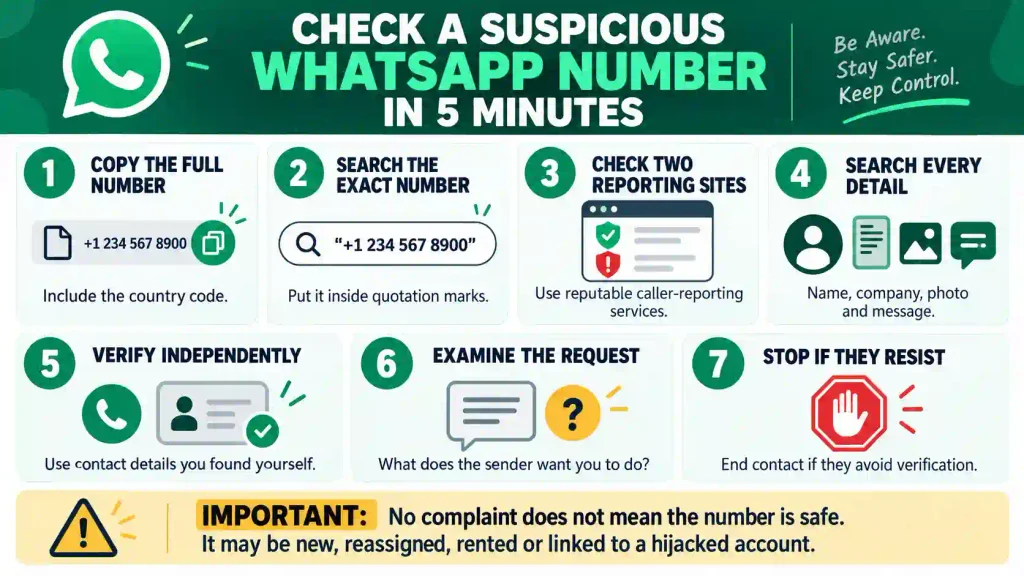
You do not need to become a private investigator. Start with this quick WhatsApp scammer number check:
- Copy the complete phone number, including its country code.
- Search the exact number online using quotation marks.
- Check the number on at least two reputable caller-reporting services.
- Search the sender’s name, company, photograph and message separately.
- Verify the claimed identity using contact information you found independently.
- Examine what the sender wants you to do.
- Stop communicating if the person resists reasonable verification.
Do not assume that a number is safe simply because you cannot find a complaint about it. It may be new, recently reassigned, temporarily rented or connected to a hijacked account.
Is There an Official WhatsApp Scammer List?
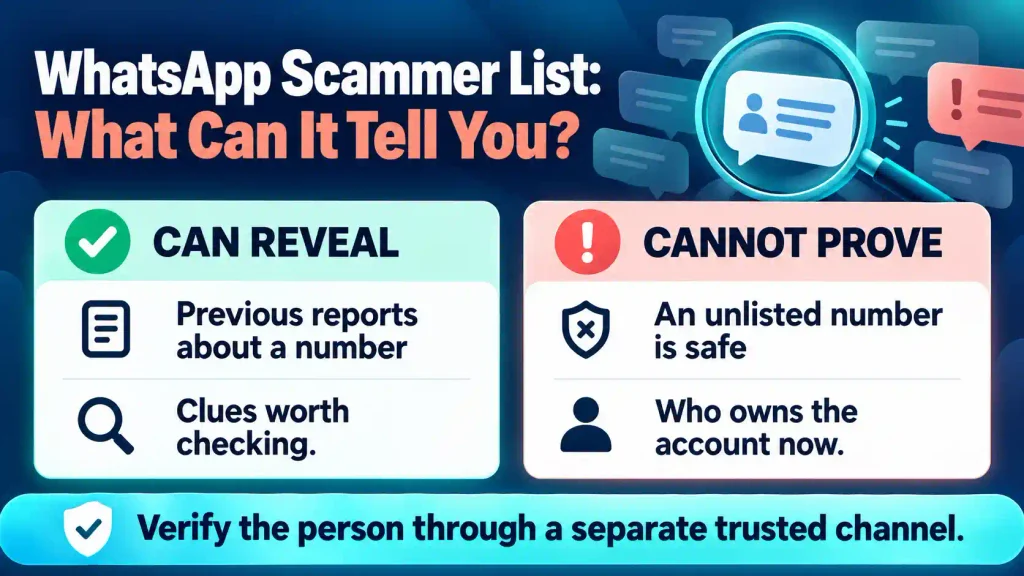
No complete worldwide WhatsApp scammer list is available to the public.
You may find community databases, discussion boards, complaint websites and caller-identification services containing reported WhatsApp scammer numbers. These resources can help you uncover warnings, but they have serious limitations.
A reported number could be:
- Correctly connected to fraud
- Incorrectly reported after a disagreement
- Reassigned to a new owner
- Used by an innocent person whose account was hijacked
- Abandoned by the original scammer
An unreported number could be:
- Newly activated
- Used only for a short campaign
- A virtual or temporary number
- A compromised legitimate account
- A number that previous targets never reported
Therefore, inclusion on a WhatsApp scammer list is a warning, not a criminal conviction. Absence from the list is not proof of safety.
Your decision should be based on the number, profile, message, story and requested action together.
How to Search a WhatsApp Number Online
Searching the number correctly can reveal complaints that a normal search misses.
Search the complete number in quotation marks
Copy the number exactly as it appears, including the plus sign and country code.
For example:
“+1 000 000 0000”
Quotation marks tell the search engine to look for that exact sequence. Repeat the search using alternative formats:
- With spaces
- Without spaces
- With hyphens
- Without the plus sign
- With the sender’s displayed name
- With words such as “scam,” “fraud,” “WhatsApp” or “complaint”
Look beyond the first result. A complaint may appear on a forum, business-review page, social-media post or community-reporting website.
Search distinctive sentences from the message
Scammers often send the same script to hundreds of people.
Copy a distinctive sentence from the message and search it inside quotation marks. Avoid searching common greetings such as “Hello” or “How are you?” Choose a longer and more unusual sentence.
For example:
- “You must complete the task before your balance can be released.”
- “This is my temporary private number.”
- “Pay the verification fee to activate your withdrawal.”
- “I accidentally reported your account.”
If identical wording appears in multiple fraud complaints, you have found a major warning sign.
Search the name and claimed organization
Search combinations such as:
- “[Person’s name] scam”
- “[Company name] WhatsApp fraud”
- “[Company name] fake recruiter”
- “[Job title] WhatsApp scam”
- “[Website address] reviews”
- “[Email address] fraud”
- “[Payment recipient’s name] scam”
Then find the organization’s official website yourself. Do not use a website address or telephone number supplied by the suspicious sender.
Where to Check Reported WhatsApp Scammer Numbers
No single database is complete. Use several types of resources and compare the results.
Caller-identification services
Some caller-identification applications show labels and comments submitted by their users. A number may be marked as spam, fake support, investment fraud or an unwanted sales caller.
These reports are useful clues, but community labels can be wrong. Confirm the information elsewhere.
Search engines
Search engines can uncover complaints, public posts and duplicated scam scripts. Search both the number and the sender’s other details.
Social-media searches
A phone number, username, photograph or message may have been reported publicly. Search relevant platforms without contacting accounts connected to the number.
Company fraud departments
If the sender claims to represent a real business, contact that company through independently verified information. Ask whether the person, department, promotion, vacancy or invoice is genuine.
National fraud-reporting portals
Some countries publish warnings about current fraud campaigns. They may not list every telephone number, but they can confirm whether the sender’s story matches an active scam.
Never pay a website merely because it promises to reveal the “true identity” behind a WhatsApp number. Some number-lookup pages use misleading claims, hide results behind repeated fees or collect the searcher’s personal information.
How to Check a WhatsApp Profile for Warning Signs
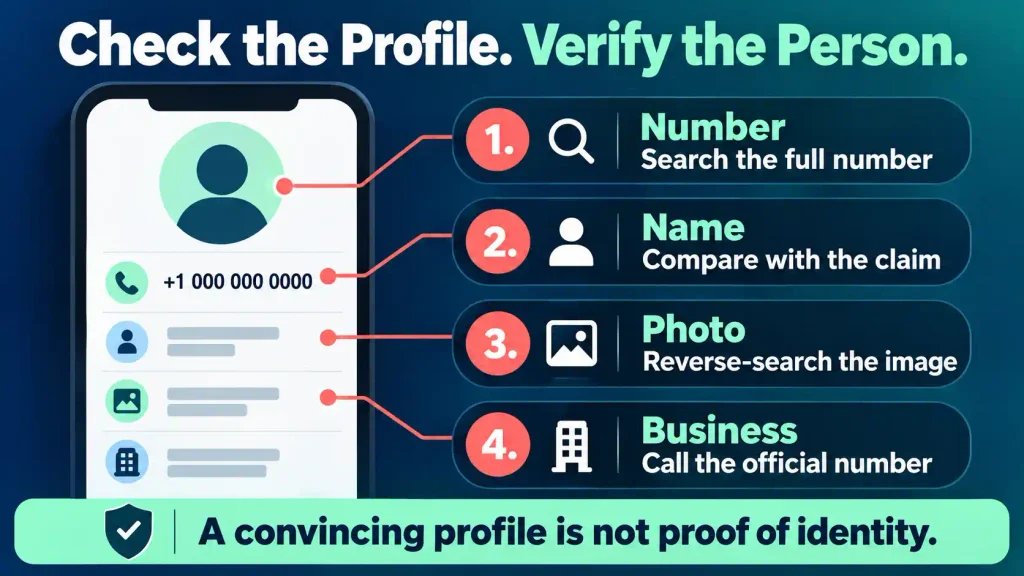
A profile photograph, familiar name or business logo does not prove identity. All three can be copied within minutes.
Examine the displayed name
Ask whether the name matches the person’s story and other contact information.
Be suspicious when:
- The name changes during the conversation
- The spelling differs from official records
- The person uses several unrelated identities
- A company representative uses a completely unrelated personal name
- The sender avoids giving a full name
- The payment recipient has a different unexplained identity
One mismatch may be innocent. Several unexplained mismatches are not.
Check the profile photograph
Save or screenshot the photograph, then use a reverse-image search service.
Look for the same image:
- Under a different name
- On modeling or stock-photo websites
- In scam warnings
- On multiple unrelated profiles
- In old news articles
- On a real person’s account with different contact information
A matching image can expose impersonation. However, no match does not establish authenticity. The image may be private, altered or artificially generated.
Look for signs of an artificial or manipulated face
Possible clues include:
- Unnatural skin texture
- Distorted earrings
- Inconsistent glasses
- Strange hair edges
- Uneven eyes
- Blurred teeth
- Warped backgrounds
- Unreadable text
- Odd reflections
- Unnatural lighting
Modern image-generation tools can produce convincing faces, so do not rely on visual inspection alone.
If the photograph looks unusually polished or contains distorted details, use these deepfake image detection clues before trusting the profile.
Check the About information
An empty or generic About section is not proof of fraud. Many legitimate people protect their privacy.
However, an incomplete profile becomes more concerning when combined with:
- An unsolicited message
- A new or foreign number
- An urgent request
- A copied photograph
- An inconsistent story
- Refusal to verify identity
- A demand for money or sensitive information
How to Verify the Sender’s Identity Safely
The best verification happens outside the suspicious conversation.
Contact the person through an existing channel
If someone claims to be your child, friend, employer or colleague, contact that person using a number or email address you already trusted before the message arrived.
Do not ask the suspicious sender which number you should call. That allows the scammer to control the verification.
Call the organization independently
If the sender claims to represent a bank, government office, delivery company, school or employer:
- Leave the WhatsApp conversation.
- Find the organization’s official website yourself.
- Call the number published there.
- Ask whether the message, employee, payment or offer is genuine.
Do not use contact information contained in the suspicious message, attachment or screenshot.
Ask questions an impersonator may not know
When a supposed relative or colleague contacts you, ask something specific that is not publicly visible on social media.
Avoid questions with obvious answers or information the scammer could easily research.
A family safety word can also help. Agree on a private word that relatives must provide during unusual emergency requests.
Request reasonable real-time verification
For non-sensitive situations, you may request a brief live call and ask an unpredictable question.
However, do not treat a video call as absolute proof. A scammer may use an accomplice, prerecorded material, manipulated video or a stolen identity.
Read deepfake video-call scam warning signs when a live-looking face or familiar voice is the main reason you trust the request.
What the Sender Wants Matters More Than the Number
A number can look normal. A profile can look professional. The sender may know your name, workplace and relatives.
The most revealing question is:
What does this person want me to do?
Stop when an unfamiliar or insufficiently verified contact asks you to:
- Send money
- Buy gift cards
- Transfer cryptocurrency
- Pay a release fee
- Deposit money to earn a commission
- Reveal a password
- Share a verification code
- Scan an unfamiliar QR code
- Install an application
- Enable remote access
- Share your screen
- Send identity documents
- Move money to a “safe” account
- Keep the transaction secret
- Bypass normal approval procedures
A convincing identity does not make a dangerous request safe.
WhatsApp Scammer List: 15 Common Schemes Behind Suspicious Numbers
People searching for a list of WhatsApp scammer numbers are often dealing with one of the following schemes.
1. “Hi Mom” or “Hi Dad” impersonation
The sender claims to be your child using a new number because their phone was damaged, lost or stolen.
After a short conversation, they introduce an urgent bill or financial emergency.
Do not continue verification through the new number. Call your child using the number you already have or contact another trusted family member.
2. Wrong-number investment scam
A stranger appears to message you accidentally. Instead of ending the conversation, they become friendly and begin discussing their successful lifestyle.
Eventually, they introduce cryptocurrency, precious metals, foreign exchange or another investment.
The wrong message was not accidental. It was the opening of a long-term manipulation campaign.
3. Fake recruiter scam
The sender claims to have found your résumé or received a recommendation. They offer attractive remote work with limited interviews and unusually high pay.
Warning signs include:
- Hiring entirely through WhatsApp
- Vague job responsibilities
- No company-domain email
- Immediate acceptance
- Upfront fees
- Requests to buy equipment
- Payments involving cryptocurrency
- Depositing money to complete work
Compare the offer with these job scam examples that often look legitimate before submitting personal information or paying for equipment.
A legitimate employer pays you. You do not pay the employer to unlock your salary.
4. Task scam
You are offered money for liking videos, reviewing products or completing simple online actions.
Small early payments may be real. They are designed to build trust.
Later, you must deposit increasingly large amounts to unlock tasks, correct a mistake or withdraw your supposed earnings. The balance displayed on the platform may be completely fabricated.
5. Romance scam
The sender builds emotional trust before introducing financial problems. They may claim to work overseas, serve in the military, manage a business or travel constantly.
Common requests involve medical bills, travel costs, customs fees, frozen accounts or investment opportunities.
Study romance scammer red flags before sending money to someone whose repeated emergencies prevent an in-person meeting.
6. Account-verification scam
The scammer requests a six-digit code sent to your phone. They may claim the code was sent accidentally or that sharing it will verify your identity.
Never share a registration code or two-step verification PIN. It may allow someone else to take control of your account.
7. Fake WhatsApp support
A profile uses a WhatsApp logo and warns that your account will be suspended.
The sender requests a verification code, password, PIN or payment. A logo inside an ordinary profile picture does not make the account official.
8. Fake delivery message
The sender claims that a package is waiting but requires a small customs, address-correction or redelivery fee.
The link may lead to a fake payment page that steals card and personal information.
Open the delivery company’s official application or website independently and check the tracking number there.
9. Bank impersonation
A message warns about a suspicious transaction, frozen account or security problem. You are told to click a link, disclose account information or transfer funds to a protected account.
Contact the bank using the number printed on your card or available inside its official application.
10. Fake business invoice
A criminal impersonates a supplier, executive or colleague and requests an urgent payment.
The account may be genuinely compromised, meaning the message could arrive from a number you recognize.
Verify new or changed payment instructions using existing company records and a separate communication channel.
11. Lottery or prize scam
You are told that you won cash, a phone, a vehicle or another prize. Before receiving it, you must pay taxes, delivery costs or administrative fees.
If you did not enter a legitimate competition, you did not win it. A genuine prize should not require secret payment to a stranger.
12. Loan scam
A supposed lender guarantees approval regardless of your credit history but requires an insurance, processing or release fee.
After the first payment, additional charges appear. The loan never arrives.
13. Marketplace scam
A fake buyer sends a link that supposedly allows you to receive payment. A fake seller demands a deposit before allowing you to inspect the item.
Keep communication and payments inside the marketplace’s approved system whenever possible.
14. Video-call blackmail scam
A stranger quickly pushes the conversation toward nudity, records the interaction and threatens to distribute it.
Do not pay. Preserve evidence, secure your accounts, report the threat and contact the appropriate authorities. Payment may lead to larger demands rather than ending the extortion.
15. Recovery scam
After losing money, you are contacted by someone claiming to be a hacker, investigator, lawyer or recovery specialist.
They promise to recover the funds after you pay a fee.
The recovery agent may be working with the original criminal—or may be the same criminal using another identity.
Suspicious WhatsApp Message Examples
Fraudulent messages can contain perfect grammar, professional logos and convincing personal details. Focus on the manipulation behind the words.
Common examples include:
- “Hello Mom, this is my temporary number.”
- “Can you make an urgent payment for me?”
- “Complete the final task to unlock your balance.”
- “Send the six-digit code you just received.”
- “Your parcel will be returned unless you pay today.”
- “You have been selected for a remote position.”
- “Transfer the money to this safe account.”
- “Do not contact your bank because it will delay the process.”
- “Buy gift cards and send photographs of the numbers.”
- “Pay the tax before your investment profit can be released.”
- “My camera is broken, so I cannot video call.”
- “Keep this confidential until the transaction is completed.”
- “Install this application so I can fix the problem.”
- “You must act within ten minutes.”
- “I guarantee that you cannot lose money.”
Poor spelling can be suspicious, but good spelling is not proof of legitimacy. Scammers can use copied templates, translation tools and artificial intelligence to create polished messages.
Screenshots of conversations, transfers and account balances can be edited, so learn how to recognize a fake WhatsApp screenshot before treating it as evidence.
The 60-Second WhatsApp Scammer Test
Pause the conversation and answer these questions:
- Did the person contact me unexpectedly?
- Is the sender creating urgency, fear, secrecy or excitement?
- Do they want money, gift cards or cryptocurrency?
- Are they asking for passwords, PINs or verification codes?
- Do they want me to open a link, scan a code or install software?
- Does the number conflict with the sender’s story?
- Has the sender avoided independent verification?
- Has the story changed?
- Are the promised profits, salary or rewards unrealistic?
- Would I trust this request without the profile photograph, title or emotional story?
One unusual detail may have an innocent explanation. Several positive answers mean you should stop and verify everything independently.
For a deeper behavioral check, use how to identify a scammer on WhatsApp before continuing the conversation.
Are Some WhatsApp Country Codes More Dangerous?
Scams can come from numbers associated with any country.
For example, receiving a 13-digit +234 WhatsApp number does not automatically mean the sender is fraudulent, but the number, profile and request still require verification.
Articles that label entire country codes as fraudulent oversimplify the problem and can falsely accuse millions of legitimate users. Scammers can use virtual numbers, travel SIMs, compromised accounts and numbers registered far from their actual location.
Instead of asking whether a country code is automatically dangerous, ask:
- Does the location match the sender’s story?
- Can the sender reasonably explain the number?
- Does the claimed company operate there?
- Does the payment destination match the claimed organization?
- Is the person willing to verify their identity independently?
A location mismatch is a warning sign—not a conviction.
Can You Trust a WhatsApp Business Account?
Not automatically.
A business account may provide useful information, but criminals can create professional-looking profiles, copy company logos and impersonate legitimate employees.
Verify:
- The exact business name
- The website domain
- The email domain
- The physical address
- The employee’s identity
- The company’s published telephone number
- The payment recipient
- The offer, invoice or vacancy
Do not trust a profile merely because it says “business.”
Can You Trust a WhatsApp Video Call?
A live call can support verification, but it is not enough for a financial decision.
The caller could be:
- An accomplice playing a role
- Someone using a stolen identity
- A person hiding behind poor lighting
- Using prerecorded footage
- Using face or voice manipulation
- A real person lying about the investment or opportunity
During a call, request an unpredictable physical response while asking a specific question. Then verify the person through another channel.
Never approve a payment solely because you recognized a face or voice.
How to Inspect a Suspicious WhatsApp Link Safely
Do not open a link merely to see where it goes.
Instead:
- Carefully copy or preview the address without opening it.
- Identify the actual domain name.
- Check for misspellings and added characters.
- Compare it with the organization’s official domain.
- Search the domain together with “scam” or “reviews.”
- Visit the company’s genuine website independently.
- Contact the company if the message concerns an account or payment.
Watch for:
- Misspelled brand names
- Unnecessary hyphens
- Extra words before or after the brand
- Shortened links
- Unusual domain endings
- Random letters and numbers
- An address that only resembles the real domain
A padlock or “https” does not prove that the business behind a website is honest. Use these additional checks to determine whether a website is safe before entering login, identity or payment information.
What to Do When You Find a Suspected WhatsApp Scammer
Do not threaten the sender or announce that you discovered the scam. Quiet action protects your evidence and reduces further manipulation.
Preserve the evidence
Save:
- The complete conversation
- The telephone number
- Profile details
- Voice messages
- Photographs
- Website addresses
- Email addresses
- Payment instructions
- Account names
- Transaction receipts
- Dates and times
Take full screenshots before blocking the account. Avoid cropping out details that could later help an investigation.
Stop sharing information
Do not provide:
- Verification codes
- Passwords
- Banking credentials
- Card details
- Identity documents
- Your home address
- Personal photographs
- Contact lists
- Screen-sharing access
- Remote control of your device
Report and block the account
Open the chat, view the contact information and use the available reporting option. Then block the number to stop additional WhatsApp messages and calls from that account.
The scammer may return using another number. Warn close contacts if the person was impersonating you or someone you know.
Notify the impersonated organization
If the sender used a real company’s name, send the evidence to that organization’s official fraud or security department.
If the sender impersonated a relative or colleague, contact the real person through a trusted channel. Their account may have been compromised.
Report serious fraud
Report financial theft, identity theft, extortion and credible threats to the appropriate fraud-reporting or law-enforcement agency in your country.
Include the evidence you preserved, but keep copies for yourself.
What to Do If You Already Sent Money
Speed matters. Do not wait for the scammer to honor another promise.
Follow this complete scam recovery plan to protect your accounts, preserve evidence and limit further losses.
Contact the payment provider immediately
Explain that you were deceived and request a reversal, recall, dispute or account freeze.
Contact the appropriate provider:
- Your bank for a bank transfer
- Your card issuer for a card payment
- The payment application used
- The wire-transfer company
- The gift-card issuer
- The cryptocurrency exchange or ATM operator
Recovery is not guaranteed, especially with cash, gift cards or cryptocurrency. Nevertheless, immediate reporting may improve your chances.
Secure your accounts
If you shared login information:
- Change the compromised password.
- Change it anywhere else you reused it.
- Enable two-step verification.
- Secure the connected email account.
- Review linked WhatsApp devices.
- Remove unfamiliar sessions.
- Check financial accounts for suspicious activity.
- Contact your mobile provider if SIM theft is possible.
If you installed software or gave remote access, disconnect the device from the internet, remove the application, run a trusted security scan and change important passwords from a safe device.
Ignore recovery promises
Someone may contact you claiming that your stolen money has been located. They will ask for an upfront legal, tax, hacking or release fee.
Do not pay. This may be a second scam aimed specifically at previous victims. Before paying anyone who claims they can retrieve the money, check the warning signs of fund recovery scams and fake investigators.
How to Protect Your WhatsApp Account
Prevention makes account takeover much harder.
Take these precautions:
- Enable two-step verification
- Never share registration codes
- Protect your voicemail account
- Review linked devices regularly
- Restrict who can view your profile information
- Avoid scanning unfamiliar QR codes
- Keep WhatsApp and your operating system updated
- Use a strong screen lock
- Protect your email account
- Be careful when sharing your phone number publicly
Tell close relatives that you will never request emergency money from a new number without independent confirmation.
How Can You Track Down Someone Who Scammed You on WhatsApp?
Start by saving the full chat, the scammer’s number and profile, payment details, receipts, links, and any voice messages. Search the number and distinctive phrases from their messages to see whether others have reported them. These checks may uncover clues, but a WhatsApp number or profile photo cannot reliably identify the person behind the account.
If you sent money, contact your bank or payment provider immediately and give them the transaction details. Report the account in WhatsApp and file a fraud report with the relevant authorities, including the evidence you saved. Do not pay anyone who promises to “trace” the scammer or recover your money for an upfront fee.
Frequently Asked Questions About WhatsApp Scammer Lists
These answers address the most important questions people ask while checking a suspicious WhatsApp number.
1. Is there an official WhatsApp scammer list?
No complete official list contains every WhatsApp scammer number. Fraudsters change numbers frequently and sometimes take over legitimate accounts.
2. How can I check whether a WhatsApp number is a scam?
Search the complete number online, review reports on reputable caller-identification services, examine the profile and verify the sender independently.
3. Can I perform a WhatsApp scammer number check for free?
Yes. Search engines, reverse-image searches and some community-reporting platforms provide free information. Be careful with websites demanding payment before revealing vague results.
4. Does a clean number lookup mean the person is legitimate?
No. The number may be new, temporary, recently reassigned or connected to an unreported scam.
5. Does one fraud report prove that the number belongs to a scammer?
Not necessarily. Community reports can contain mistakes. Treat the report as a serious warning and confirm it with additional evidence.
6. Can scammers use real people’s WhatsApp accounts?
Yes. Criminals may take control of legitimate accounts and contact the owner’s friends, relatives or colleagues.
7. Can a scammer use a local WhatsApp number?
Yes. A local country or area code does not prove that the sender is nearby or trustworthy.
8. Are all international WhatsApp numbers suspicious?
No. Many legitimate people use foreign numbers. Focus on whether the number, identity, story and request make sense together.
9. Can scammers hide their real location?
Yes. They may use virtual numbers, temporary SIM cards, compromised accounts or other methods that make the displayed number unreliable.
10. Does a WhatsApp Business profile prove that a company is real?
No. Verify the business through its official website, published contact information and legitimate registration records where appropriate.
11. How can I check a WhatsApp profile photograph?
Use a reverse-image search and look for the photograph under other names, on stock-image websites or in previous scam reports.
12. Can an AI-generated profile picture pass a reverse-image search?
Yes. A newly generated image may have no previous online matches. That is why image searching must be combined with identity verification.
13. Should I reply to an unknown WhatsApp number?
If the message is clearly suspicious, do not reply. Responding confirms that your number is active and may encourage further contact.
14. Is it safe to call a suspicious WhatsApp number?
Calling can reveal that your number is active and may expose you to more manipulation. Verify the claimed identity through a separate trusted channel instead.
15. What should I do if someone says they contacted me by mistake?
You can end the conversation politely. Be particularly careful if the stranger continues building a friendship and later introduces an investment or money-making opportunity.
16. Why would a WhatsApp job ask me to deposit money?
A legitimate job should not require deposits to unlock tasks, commissions or wages. This pattern strongly suggests a task scam.
17. Can a scammer make a small payment to gain my trust?
Yes. Some task scams provide a small initial payment before demanding much larger deposits.
18. Should I share a WhatsApp verification code with support?
No. Never share a registration code or two-step verification PIN with anyone.
19. Can a live video call still be fake?
Yes. The caller could be an accomplice, use manipulated media or be a real person supporting a fraudulent story.
20. What should I do with a suspicious WhatsApp link?
Do not open it. Inspect the domain, search for warnings and visit the claimed company’s official website independently.
21. How do I report a WhatsApp scammer?
Open the contact or chat information and select the reporting option. Preserve important evidence before blocking the account.
22. Will the sender know that I reported them?
The reporting process does not normally notify the sender that you submitted the report.
23. Can I recover money sent to a WhatsApp scammer?
Possibly, depending on the payment method and how quickly you act. Contact the payment provider immediately and request a reversal or dispute.
24. What if I gave the scammer my identification document?
Report the exposure, monitor your financial accounts and follow this step-by-step guide to recover from identity theft before the stolen document is used against you.
25. How can I protect my family from WhatsApp impersonation scams?
Create a private family safety word, verify new-number requests through existing contacts and agree never to send emergency money without direct confirmation.
Conclusion
A WhatsApp scammer list can help you uncover numbers previously reported by other users. However, it cannot tell you with certainty that an unlisted number is safe.
The strongest investigation combines several checks:
- Search the complete number
- Look for previous reports
- Reverse-search the profile photograph
- Search distinctive parts of the message
- Verify the claimed person or organization independently
- Examine the payment destination
- Focus on what the sender wants you to do
Scammers want you to make a fast decision based on fear, excitement, affection or authority. Slow the conversation down.
A legitimate person should understand why you need to verify an unusual financial or security request. A scammer will often become angry, create more urgency or invent reasons why normal verification is impossible.
When the story creates pressure but verification creates excuses, stop communicating. Preserve the evidence, report the account and protect your money.
Pingback: +44 Country Code on WhatsApp: Is It a Scam or a Real UK Number? - SafeGuard Press
Pingback: +212 Country Code on WhatsApp: Is It a Scam or a Real Moroccan Number? - SafeGuard Press
Pingback: Is It Safe to Open a WhatsApp Message From an Unknown Number? What Actually Happens - SafeGuard Press
Pingback: +92 Country Code on WhatsApp: Is It a Scam or a Real Pakistani Number? - SafeGuard Press
Pingback: How To Identify A Scammer On WhatsApp: 19 Red Flags And A 5-Minute Test - SafeGuard Press
Pingback: Telegram Scammer List: Check a Suspicious Username, Group or Channel Before You Pay - SafeGuard Press