The first warning might be a $7 purchase you do not remember making.
It could be a password-reset message you almost delete, a medical bill for treatment you never received or a letter welcoming you to a bank you have never used.
Each incident appears small—until you realise someone else may be living a financial life under your name.
Identity theft in 2026 does not always begin with a stolen wallet. Your personal information can be exposed through a data breach, fake job application, phishing message, hacked email account, card skimmer or convincing impersonation call. A criminal may also combine one piece of your real information with invented details to create an entirely new identity.
You may not discover the theft until your money disappears, your credit score drops or an application is rejected because of a debt you never created.
The sooner you recognise the warning signs, the less time an identity thief has to deepen the damage.
This guide explains 17 signs that your identity may have been stolen, the different forms identity theft can take and the practical steps you can use to protect your money, credit, medical records and family.
Some warning signs are obvious. Others are easy to dismiss—and those quiet clues deserve your closest attention.
What Is Identity Theft?
Identity theft happens when someone obtains and uses your personal information without your permission.
The criminal may use your identity to:
- Enter your existing accounts
- Open new credit cards or loans
- Make purchases
- Withdraw money
- Obtain medical treatment
- Claim benefits
- File a fraudulent tax return
- Rent a home
- Get telephone or utility services
- Create a synthetic identity
- Give your information after an arrest
- Take control of your email or mobile number
Your personal information is valuable because it can answer security questions, pass identity checks and make fraudulent applications appear legitimate.
An identity thief may target your:
- Full name
- Date of birth
- Home address
- Identification number
- Driver’s licence
- Passport
- Bank account details
- Card information
- Email address
- Telephone number
- Medical insurance number
- Tax information
- Login credentials
- Biometric information
The criminal does not always need every detail at once. One stolen password could expose your email account, and your inbox may reveal enough information to access several other services.
Identity Theft vs. Identity Fraud: What Is the Difference?
Identity theft and identity fraud are closely connected, but they describe different stages of the crime.
Identity theft begins when someone obtains your personal information without permission.
Identity fraud happens when that information is used to steal money, access an account, obtain services or commit another offence.
For example, copying your identification number is identity theft. Using it to apply for a loan in your name is identity fraud.
In everyday conversation, people often use “identity theft” to describe both stages. What matters most is recognising that your information may be compromised before money disappears.
A leaked identification number creates risk even when you cannot see fraudulent activity yet.
Why Identity Theft Is Harder to Detect in 2026
Identity thieves have more ways to collect, combine and exploit personal information.
Artificial intelligence can help criminals write convincing phishing messages, create fake identification documents and automate applications across multiple companies. Voice cloning can make an account-recovery call sound like you, while deepfake video may be used to defeat poorly designed identity checks.
Large data breaches have also placed enormous amounts of personal information in criminal marketplaces. A scammer may already possess your name, address, telephone number and date of birth before contacting you.
They only need to trick you into revealing the missing piece.
For example, a fake bank representative may read several correct details to earn your trust, then ask for a security code. Because the information they already know is accurate, the final request feels safer than it is.
Identity theft can also remain hidden for months or years. A criminal may slowly build credit under a synthetic identity or use a child’s information long before the child applies for their first account.
That delay is why you should not depend on obvious financial losses as your only warning.
How Do Identity Thieves Get Your Information?
Protecting yourself becomes easier when you understand how personal information escapes. They get it through:
Phishing Messages
A message appears to come from your bank, employer, delivery company or another familiar organisation. It directs you to a fake website where you enter your login details.
The page may look genuine, but the information goes directly to the criminal.
Learning how to spot a phishing email before you click can protect far more than one account. A stolen email password may give a criminal access to years of personal conversations, receipts and password-reset links.
Data Breaches
A company storing your information is hacked. Your password, address, account number or identification details may be exposed without you doing anything wrong.
You cannot prevent every breach, but you can limit the damage by using unique passwords and responding quickly to a genuine breach notice.
Social Engineering
A criminal manipulates you into revealing information or approving access.
They may pretend to be a bank employee, technical-support specialist, police officer, colleague or relative. The story changes, but the goal remains the same: make you act before verifying who they are.
Stolen Mail and Documents
Bank statements, tax records, medical letters and pre-approved credit offers can contain useful information.
An identity thief may steal mail, redirect it to another address or search discarded documents that were not properly destroyed.
Card Skimmers
A hidden device attached to a cash machine, fuel pump or payment terminal captures card information. A nearby camera or false keypad may record your PIN.
Before inserting your card, examine the machine for loose, damaged or unusual parts. Cover the keypad while entering your PIN.
Fake Job Applications
A fraudulent employer advertises an attractive remote position and requests your identification, banking details or tax information during the application process.
The interview may happen entirely through text messages. You could receive convincing employment documents even though the company and position are fake.
A legitimate employer needs certain information after hiring you, but an unsolicited recruiter should not need your banking password, card details or payment to consider your application.
Publicly Shared Information
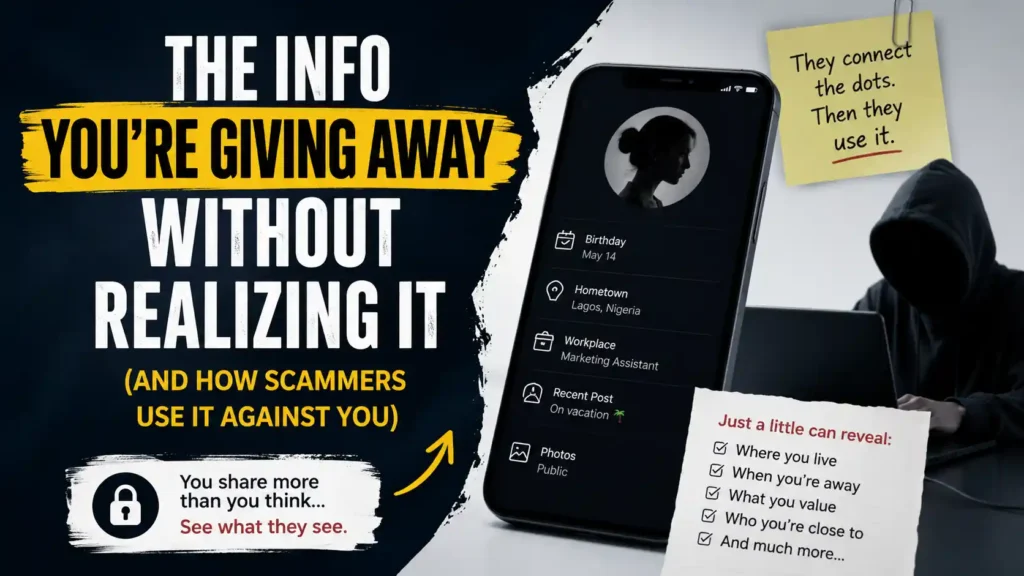
Your social-media accounts may reveal your birthday, relatives, employer, hometown and travel plans.
Those details can help a criminal answer security questions or create a believable impersonation story.
A harmless birthday post combined with information from a breach may give an identity thief more than you realise.
Malware and Remote Access
You install a file, browser extension or remote-support program at someone’s request.
The software may capture passwords, monitor your activity or give the criminal control of your device.
Never install remote-access software because an unexpected caller claims your computer or bank account has a problem.
Common Types of Identity Theft in 2026
Identity theft is not one single crime. Your information can be misused in several different ways.
Financial Identity Theft
A criminal uses your information to access your bank account, open credit, obtain a loan or make purchases.
You may first notice unexplained transactions, unfamiliar accounts or a sudden credit-score change.
Account Takeover
Instead of opening a new account, the criminal enters one you already own.
They may change the password, telephone number and recovery email before transferring money or making purchases.
Email, banking, shopping, social-media and mobile accounts can all be targeted.
Tax Identity Theft
Someone uses your personal information to file a tax return and claim a refund in your name.
You may discover the theft when your legitimate return is rejected or you receive correspondence about income you never earned.
Medical Identity Theft
A criminal uses your identity or insurance information to receive treatment, medication or medical equipment.
This form of theft can affect more than your finances. Incorrect diagnoses, allergies or procedures may become mixed into your medical history.
Child Identity Theft
A child’s identification number can be valuable because it may have no existing credit history.
The crime can remain hidden until the child applies for financial aid, housing, a job or their first credit account.
Synthetic Identity Theft
A criminal combines real information with invented details.
For example, they may use a genuine identification number with a different name, address and date of birth. They slowly build a credit profile before borrowing heavily and disappearing.
Because the identity is partly real and partly fabricated, the crime can be difficult to connect to one victim.
Criminal Identity Theft
Someone gives your name or identification information to police after being arrested or stopped.
You may later discover fines, court notices or a record connected to an offence you did not commit.
Employment Identity Theft
A person uses your information to obtain employment or pass workplace checks.
You may learn about it through tax records, benefit problems or income attributed to you from an unfamiliar employer.
17 Warning Signs of Identity Theft You Should Never Ignore
Identity theft rarely arrives with a clear announcement. You are more likely to notice an account, transaction or message that does not make sense.
1. You See Transactions You Do Not Recognise
An unfamiliar purchase, withdrawal or transfer is one of the clearest signs that someone may have accessed your financial information.
Do not ignore a transaction because the amount is small.
Criminals sometimes make a low-value purchase to test whether an account or card is active. If the payment succeeds, they may attempt a much larger transaction.
Examine the merchant name carefully because the description on your statement may differ from the business name you recognise. Ask family members or authorised users whether they made the purchase.
If no one recognises it, contact your financial provider immediately. Ask it to secure the account, investigate the transaction and replace any compromised card or account details.
You should also review earlier statements. The first fraudulent transaction may have happened weeks before the one you noticed.
2. Your Credit Report Contains an Unfamiliar Account
A credit card, personal loan, mobile account or collection record appears under your name even though you never opened it.
This can mean someone has used your information to create a new financial identity.
Do not contact a suspicious telephone number printed on an unexpected letter. Find the company’s official contact details independently and ask for its fraud department.
Request:
- The application date
- The account-opening method
- The address used
- Copies of relevant documents
- The current balance
- The transaction history
You should also examine your other credit files because the criminal may have submitted several applications.
Disputing one account without securing your complete identity can allow new fraudulent accounts to appear.
3. You Find a Credit Inquiry You Did Not Authorise
A credit inquiry may appear when someone applies for financing using your information.
The application might be declined, which means no new account appears. However, the inquiry still reveals that someone attempted to use your identity.
Contact the company connected to the inquiry and ask what type of application was submitted.
Then check whether your address, telephone number or employment details have been changed. If the application was fraudulent, secure your credit files before the criminal tries another lender.
An unfamiliar inquiry is not something to monitor passively. Treat it as evidence that your information may already be circulating.
4. Your Credit Score Drops Without an Obvious Reason
A credit score can change for legitimate reasons, including higher balances, late payments and new applications.
But if your score falls sharply while your own financial behaviour has not changed, investigate immediately.
The cause could be:
- A fraudulent account
- An unfamiliar hard inquiry
- A missed payment on an account you did not open
- A collection you do not recognise
- A card balance created by an account takeover
- Incorrect information connected to your identity
Do not focus only on the score itself. Review the underlying report and identify exactly which item caused the change.
A monitoring application may alert you to the drop, but it cannot correct the damage for you. You still need to contact the relevant company and dispute the fraudulent information.
5. Bills or Statements Stop Arriving
Missing mail may look like a delivery problem, but it can signal that someone changed your account address.
An identity thief who gains access to an account may redirect statements so you do not notice fraudulent activity.
Contact the provider if a regular bill suddenly disappears. Confirm the mailing address, email address, telephone number and communication preferences on the account.
You should also check whether your mail has been redirected without your permission.
Do not assume switching to paperless billing makes this warning irrelevant. A criminal could change the email address or disable notifications instead.
6. You Receive Bills for Products or Services You Never Used
An unexpected medical bill, utility statement, mobile contract or purchase invoice could mean someone opened an account using your identity.
Do not pay simply because your name appears on the bill.
Contact the organisation through a verified channel and explain that you do not recognise the account. Ask when and how it was opened, which identification was used and where the product or service was delivered.
Keep written records of every conversation. If the account is fraudulent, you may need those details to dispute it and prevent collection activity.
One unknown bill may not be the only problem. Review your financial and credit records for other accounts created around the same time.
7. Debt Collectors Contact You About an Unknown Debt
A collector calls or writes about a debt you never created.
The contact could be a simple debt-collection scam, but it could also indicate that someone opened an account in your name and stopped paying it.
Do not provide additional personal information during the first conversation. Ask for written details showing:
- The original creditor
- The amount owed
- The account-opening date
- The account number
- The collector’s company information
Verify the collector and creditor independently.
If the debt is connected to identity theft, dispute it in writing and begin securing your identity immediately. Ignoring the calls will not remove the account from your records.
8. You Are Unexpectedly Denied Credit
You apply for a credit card, loan, mobile contract or rental agreement expecting approval, but the application is rejected.
A denial does not automatically mean your identity has been stolen. Your income, debt, credit history or recent applications may explain the decision.
However, you should investigate if the rejection surprises you—especially when you have maintained good credit and made your payments on time.
Someone may have:
- Opened accounts in your name
- Accumulated unpaid balances
- Submitted several credit applications
- Created a collection account
- Changed information connected to your credit file
- Increased the balance on an existing account
Read the denial notice carefully and identify the reason given. Then review your credit reports for unfamiliar accounts, enquiries, addresses and names.
Do not repeatedly apply elsewhere before understanding the rejection. More applications will not remove fraudulent information and may make your credit profile harder to examine.
If you discover an account you did not open, contact the company’s fraud department and begin the dispute process immediately.
9. Your Tax Return Is Rejected
You submit your tax return and learn that another return has already been filed using your identification number.
That message may mean an identity thief submitted a fraudulent return to claim your refund.
You might also receive:
- A notice about a return you never filed
- Questions about income from an unfamiliar employer
- A refund you did not request
- Information about a tax account you did not create
- A demand for taxes connected to work you never performed
- A message saying your online tax account was accessed
Do not assume the problem will correct itself.
Contact the appropriate tax authority through its official channel and explain that your information may have been used fraudulently. Continue preparing your legitimate return, even if you must submit it through a different process.
Collect documents proving your identity, income and previous filing history. Keep copies of every notice, form and conversation.
You should also investigate beyond the tax return. A criminal with enough information to file in your name may try to open credit, claim benefits or access existing accounts.
Change the passwords connected to your email, financial and tax accounts. Review your credit files and consider placing stronger restrictions on new applications.
10. You Receive Authentication Codes You Did Not Request
A security code arrives by text or email even though you are not trying to sign in.
Do not ignore it.
Someone may know your password and be attempting to complete the login process. The code could be the only barrier preventing them from entering your account.
You may receive a call shortly afterward. The caller pretends to represent the company and asks you to read the code aloud to “cancel” the login or verify your identity.
Never share the code.
Instead:
- Open the official application independently
- Change your password
- Review recent login activity
- Remove unfamiliar devices
- Confirm your recovery information
- End active sessions you do not recognise
If you reused the same password on other websites, change those passwords too. Criminals often test stolen credentials across banking, shopping, email and social-media accounts.
A security code you did not request is not merely an annoying message. It may be evidence that someone has already passed the first stage of your account’s security.
11. You Receive Password-Reset Messages You Did Not Initiate
An unexpected password-reset email may mean someone is attempting to take control of your account.
The criminal could be testing whether your email address is registered with a particular service. They may also be trying to trigger a link they hope to steal from your inbox.
Do not click the reset button in the message.
Open the service through its official application or type the website address yourself. Review your account information and change the password if anything looks suspicious.
Pay particular attention to your email account. If an identity thief controls your inbox, they may:
- Reset your banking passwords
- Intercept security warnings
- Search for identity documents
- Find old account statements
- Impersonate you
- Hide confirmation messages
- Access cloud-stored files
Check whether forwarding rules have been added to your email. A criminal may create a hidden rule that sends copies of your messages to another address or automatically deletes security alerts.
Also examine your sent and deleted folders. Unfamiliar messages may reveal that someone has been communicating from your account.
12. Your Mobile Phone Suddenly Loses Service
Your phone shows no service even though you are in an area with a reliable signal.
Restarting the device does not solve the problem, and your mobile provider has not announced an outage.
A criminal may have transferred your telephone number to another SIM card or provider. This allows them to receive calls and security codes intended for you.
With control of your number, they may attempt to enter your:
- Bank account
- Payment applications
- Social-media profiles
- Cryptocurrency accounts
- Shopping accounts
Contact your mobile provider immediately using another phone. Ask whether a replacement SIM, account change or number transfer was recently approved.
Then contact your financial providers and warn them that your telephone number may be compromised.
Do not wait for service to return on its own. A successful number transfer can give an identity thief the security codes needed to change your passwords and lock you out.
Protect your mobile account with a unique PIN or passcode. Do not use your birthday, address or the last digits of your telephone number.
13. You Are Locked Out of an Account
Your normal password suddenly stops working.
At first, you may assume you forgot it or the website has a technical problem. However, an identity thief may have changed the password, email address, telephone number or security questions.
Other account-takeover signs include:
- Your profile information has changed
- New recipients appear in your payment account
- Messages have been sent without your knowledge
- Purchases appear in your order history
- Your recovery email is unfamiliar
- Notifications have been disabled
- A new device is listed as trusted
- Your account language or location has changed
Use the official recovery process immediately. If you still have access on another device, do not sign out until you review the security settings and remove the intruder.
Contact the service provider and explain that the account may have been taken over.
If the compromised account contains payment information, contact your bank or card issuer. If it is an email account, secure every important service connected to that address.
Do not create a new account and forget the old one. The criminal could continue using your name to contact friends, request money or steal more information.
14. Your Medical Records Contain Treatment You Never Received
You examine a medical statement and find a consultation, prescription, diagnosis or procedure that does not belong to you.
Someone may have used your identity or insurance information to receive medical care.
You could also notice:
- Benefits reaching their limit unexpectedly
- A bill from an unfamiliar provider
- A prescription you never collected
- A treatment date when you were somewhere else
- A denial because a service was supposedly already used
- An allergy, blood type or condition that is not yours
- Questions about a procedure you never had
Medical identity theft can create serious health risks. Incorrect information may influence future treatment if it remains inside your records.
Contact the healthcare provider and insurance company. Request a complete explanation of benefits and copies of the records connected to the unfamiliar treatment.
Explain which entries are inaccurate and ask how to dispute them. Keep the genuine parts of your medical history separate from the fraudulent records.
Do not simply refuse to pay the bill and assume the problem is over. You need to correct both the financial charge and the medical information.
Review every document carefully. If the thief received treatment under your name, their medical details may have been added to your file.
15. You Receive Notices About Unemployment or Government Benefits
You receive a letter confirming benefits you never requested, or your legitimate application is rejected because someone is already receiving assistance under your identity.
A criminal may use stolen information to claim:
- Unemployment payments
- Retirement benefits
- Healthcare assistance
- Food support
- Disability payments
- Housing assistance
- Emergency relief
You may also receive a tax document showing benefit income you never collected.
Contact the department administering the benefit through a verified channel. Explain that the application or payment was not yours.
Ask for written confirmation that your identity-theft report has been recorded. Keep all reference numbers and copies of the correspondence.
Then check whether the criminal changed your address, email or bank information.
Because benefit applications often require detailed personal information, you should assume the thief may be able to commit other forms of fraud. Review your credit, tax and financial records for additional warning signs.
16. Your Child Receives Financial or Collection Notices
A letter addressed to your child mentions an unpaid loan, credit account, tax debt or service contract.
You may initially dismiss it as an administrative error. That could be a dangerous mistake.
A criminal may have used your child’s identification number to:
- Open credit
- Obtain employment
- Rent a property
- Apply for utilities
- Claim benefits
- File tax documents
- Create a synthetic identity
A child’s information is attractive because you may not think to monitor it. The fraud can continue for years before your child applies for a student loan, apartment or first credit card.
Other warning signs include:
- Your child is denied a benefit because someone already uses the identification number
- A tax notice reports income earned by your child
- A credit offer arrives in your child’s name
- A debt collector contacts your family
- Your child unexpectedly has a credit record
- A financial account appears under a variation of your child’s name
Do not assume every marketing letter proves identity theft. However, investigate any notice involving an existing debt, account or employment record.
Request a manual search of your child’s credit information. If a file exists, determine whether every account is legitimate.
When permitted, freeze your child’s credit so new accounts cannot be opened easily. Store identity documents securely and avoid carrying them unnecessarily.
You should also be selective about who receives copies. Schools, sports organisations and medical providers may have legitimate reasons for collecting information, but you can still ask why it is required, how it will be stored and who can access it.
Learning how to protect your child from identity theft can prevent a criminal from damaging their financial future before it begins.
17. You Receive Notices About Crimes, Fines or Court Cases You Do Not Recognise
You receive a traffic fine, court notice or background-check result connected to an incident that does not involve you.
Someone may have provided your personal information during an arrest, traffic stop or investigation.
You could discover the problem when:
- A job background check fails
- A licence renewal is rejected
- A warrant appears under your name
- You receive a court summons
- A fine arrives from an unfamiliar location
- Police question you about an incident
- Your fingerprints are requested to separate your identity from another person’s record
Criminal identity theft requires urgent attention because it can affect your employment, travel and legal status.
Do not contact the person you suspect or attempt to resolve the matter privately.
Collect evidence showing where you were when the incident occurred. Report the identity theft and ask the relevant authority how to challenge the incorrect record.
You may need official identification, fingerprints or a written identity-theft report to separate your identity from the offender’s.
Keep certified copies of corrected records. An inaccurate entry may appear in more than one database, and resolving it in one place may not automatically correct every background-check system.
What to Do If You Notice an Identity Theft Warning Sign
One suspicious event does not always prove that your identity has been stolen. However, waiting for a second sign can give a criminal more time to act.
Follow these steps as soon as something appears wrong.
Confirm the Activity Is Not Yours
Check whether an authorised user, relative or joint account holder made the transaction.
Examine the date, amount and merchant description. A familiar purchase may appear under the parent company’s name rather than the business name you recognise.
If you still cannot explain it, treat it as suspicious.
Contact the Company Involved
Use contact information from an official application, statement or website you entered yourself.
Explain that you believe the account or transaction may involve identity theft. Ask the company to freeze the activity while it investigates.
Request written confirmation of your report and record:
- The representative’s name
- The date and time
- Your case number
- The action promised
- Any documents you must submit
Change the Relevant Passwords
Start with the affected account, then secure the email address connected to it.
Use a unique password that you have never used elsewhere. Remove unfamiliar devices and review your recovery information.
If you reused the compromised password, change it on every account where it appears.
Review All Your Financial Accounts
Do not stop after finding one fraudulent transaction.
Check your:
- Current accounts
- Savings accounts
- Credit cards
- Payment applications
- Investment accounts
- Cryptocurrency wallets
- Online shopping accounts
A criminal may test several accounts or move gradually to avoid detection.
Examine Your Credit Files
Look for unfamiliar:
- Accounts
- Inquiries
- Addresses
- Employers
- Names
- Collections
- Balances
Save copies of the reports before making disputes. They provide a record of what appeared and when you discovered it.
Place Stronger Restrictions on New Credit
If your identity information is exposed, consider preventing new creditors from accessing your file.
A credit freeze is usually stronger than monitoring alone because it can interfere with a criminal’s ability to open new credit. You must generally place it separately with each major credit-reporting company.
A fraud alert tells businesses to take additional steps to confirm your identity. It can be useful when you suspect fraud but still need regular access to your credit.
Monitoring alerts you after something changes. It does not necessarily stop the application from being submitted.
Report the Identity Theft
Create an official report through the appropriate identity-theft reporting service and contact local law enforcement when necessary.
The report may help you:
- Dispute fraudulent accounts
- Challenge collection activity
- Correct inaccurate records
- Request transaction documents
- Explain the theft to creditors
- Establish when you discovered the crime
Write a clear timeline of what happened. Include every account, transaction, message and telephone number connected to the theft.
Keep an Identity Theft Recovery File
Store your evidence in one secure location.
Include:
- Credit reports
- Account statements
- Screenshots
- Emails and letters
- Transaction receipts
- Case numbers
- Police or identity-theft reports
- Copies of identification
- Notes from telephone calls
- Dispute letters
- Delivery confirmations
How to Protect Yourself From Identity Theft in 2026
You cannot prevent every data breach or control how every organisation stores your information. However, you can make your identity much harder to exploit.
The strongest protection does not depend on one application or subscription. It combines secure accounts, limited information sharing, credit controls and regular monitoring.
Freeze Your Credit Before Criminals Use It
A credit freeze restricts access to your credit file. When a lender cannot review that file, opening a new credit account in your name becomes more difficult.
You do not need to wait until identity theft happens. You can freeze your credit as a preventive measure and temporarily lift the restriction when you need to apply for financing.
A freeze generally does not:
- Lower your credit score
- Close existing accounts
- Stop you from using your credit cards
- Prevent you from reviewing your credit
- Eliminate existing debts
However, a freeze does not protect every part of your identity. It will not automatically stop someone from taking over an existing account, using your card information or filing a fraudulent tax return.
That is why you should treat it as one important layer—not your entire protection plan.
Place the freeze separately with each major credit-reporting company. Use their official websites rather than links from advertisements, emails or text messages.
Protect the passwords and PINs connected to your freezes. You will need them when you want to lift or manage the restrictions.
Understand the Difference Between a Credit Freeze and Fraud Alert
A credit freeze restricts access to your credit file. A fraud alert allows access but tells potential creditors to take additional steps to verify that the applicant is really you.
A freeze usually provides stronger protection against new-account fraud.
A fraud alert may be useful when:
- You suspect your information has been exposed
- You need regular access to credit
- You want lenders to perform additional verification
- You are beginning an identity-theft investigation
Credit monitoring serves a different purpose. It watches for changes and sends you alerts.
Monitoring may help you detect fraud earlier, but it often notifies you after an inquiry or account has already appeared. It does not physically prevent someone from submitting an application.
For stronger protection, combine monitoring with a freeze rather than assuming one replaces the other.
Use a Different Password for Every Important Account
Reusing one password across several websites turns a single breach into a much larger identity-theft risk.
If criminals obtain your password from an online shop, they may try it on your:
- Bank
- Payment applications
- Social-media accounts
- Mobile provider
- Cloud storage
- Investment accounts
Use long, unique passwords that are difficult to guess. A reputable password manager can create and store them so you do not have to memorise every combination.
Never include your name, birthday, telephone number or common phrases in important passwords.
Your email password should be especially strong. Your inbox may contain enough information to reset several other accounts and impersonate you convincingly.
Turn On Multifactor Authentication
Multifactor authentication requires another form of verification after your password.
Depending on the account, that second step might involve:
- An authentication application
- A physical security key
- A device notification
- A fingerprint
- A facial scan
- A text-message code
Use an authentication application or security key when available. Text-message codes can still provide protection, but they may be intercepted if a criminal takes control of your telephone number.
Never approve a login notification you did not initiate.
If repeated approval requests appear, do not accept one simply to make them stop. Someone may already know your password and be trying to exhaust your patience.
Open the account independently, change the password and review recent login activity.
Protect Your Email Account First
Your email is the recovery centre for much of your digital identity.
Someone who controls it may reset passwords, intercept security warnings and search for financial documents.
Strengthen your email account by:
- Using a unique password
- Enabling strong login verification
- Reviewing active sessions
- Removing old recovery addresses
- Checking forwarding rules
- Examining connected applications
- Signing out of unfamiliar devices
- Saving recovery codes securely
Consider using separate email addresses for financial accounts and casual online registrations. This reduces the number of places where your most important address appears.
Do not publicly display the email connected to your banking or investment accounts.
Secure Your Mobile Telephone Account
Your telephone number may receive security codes and password-reset messages. Protect it as carefully as a financial account.
Create a strong account PIN with your mobile provider. Ask whether additional protection can be added before your number is transferred or a replacement SIM is issued.
Avoid using an easily guessed PIN such as:
- Your birth year
- Your address
- Repeated digits
- The last four digits of your number
If your phone unexpectedly loses service, contact the provider immediately from another device.
You should also lock your physical phone with a strong passcode. A six-digit code is generally harder to guess than a simple four-digit pattern.
Enable remote-location and remote-erasure features so you have options if the device is lost or stolen.
Review Your Credit Reports Regularly
Checking your credit should not be something you do only before applying for a loan.
Review your reports for:
- Accounts you did not open
- Inquiries you do not recognise
- Incorrect addresses
- Unfamiliar employers
- Balances that do not belong to you
- Collection accounts
- Variations of your name
Look at all major credit files because the same information may not appear on each one.
If something is wrong, save a copy of the report before submitting a dispute. Keep the confirmation number and check later to ensure the correction remains.
Do not assume a credit score alone tells you everything. Your score could remain relatively stable while an unfamiliar inquiry or newly opened account is already present.
Monitor Bank and Card Activity Frequently
A monthly review may not be fast enough when a criminal is actively using your account.
Check transactions weekly or enable real-time notifications for:
- Purchases
- Withdrawals
- Transfers
- New recipients
- Password changes
- Contact-detail updates
- New device logins
- International activity
Investigate small transactions as seriously as large ones. A criminal may test your card with a low-value purchase before spending more.
If you receive an alert, do not tap a link inside an unexpected message. Open your banking application independently and examine the account.
Limit the Personal Information You Share
You do not need to publish your full birthday, address, workplace or family relationships for criminals to find you interesting.
Review the information displayed on your social-media profiles. Remove details that could answer security questions or strengthen an impersonation story.
Be careful when posting:
- Birthday celebrations
- Travel plans
- New addresses
- Identification documents
- Employment information
- Children’s full names
- School details
- Vehicle registrations
- Boarding passes
- Tickets containing QR codes
Even an innocent photograph can contain visible personal information in the background.
Do not answer online quizzes that ask for your first school, childhood nickname, first vehicle or mother’s maiden name. Those questions may resemble the security prompts used by financial accounts.
Stop Using Personal Facts as Security Answers
A security answer does not have to be historically accurate. It needs to be memorable to you and difficult for someone else to discover.
If an account asks for your childhood street, you can create an unrelated answer and store it in your password manager.
Avoid answers visible in public records or social-media posts.
A criminal who knows your hometown and relatives may be able to guess genuine answers more easily than a random password.
Protect Your Identification Documents
Keep passports, tax records, birth certificates and identification cards in a secure location.
Do not carry every document in your wallet. If your wallet is lost, one card should not provide everything needed to impersonate you.
Before sending a document, ask:
- Why is it required?
- Which details are necessary?
- How will it be transmitted?
- How long will it be stored?
- Who can access it?
- Can unnecessary information be covered?
If only your name and photograph are needed, you may not need to expose every number on the document.
Never send identification through an unverified messaging account because someone claims to be recruiting, lending money or releasing a prize.
Shred Sensitive Paperwork
Financial information can still be stolen offline.
Destroy documents containing:
- Account numbers
- Identification numbers
- Medical information
- Credit offers
- Tax details
- Passwords
- Signatures
- Insurance numbers
- QR codes connected to accounts
Tearing a document once may leave the important details readable. Use a cross-cut shredder where possible.
Remember to destroy expired cards and labels on delivered packages if they contain account or tracking information that could support a convincing scam.
Protect Your Physical Mail
Collect your mail promptly and avoid leaving outgoing financial documents in an unsecured box.
If expected statements or cards stop arriving, contact the sender.
Consider electronic statements for important accounts, but secure the email address receiving them. Paperless delivery is not safer if your email is poorly protected.
When moving home, update your address directly with banks, insurers, creditors and government services. Do not assume one postal change will update every important account.
Be Careful With Public Wi-Fi
Public internet connections can be convenient, but they are not the best place for sensitive financial activity.
Avoid logging into banking, investment or tax accounts on an unfamiliar network. If the task cannot wait, use your mobile connection or a trusted encrypted service.
A network name that resembles the café, hotel or airport does not prove it belongs to that business. A criminal can create a similarly named hotspot and wait for people to connect.
Disable automatic Wi-Fi connections so your device does not join unfamiliar networks without your knowledge.
Keep Your Devices Updated
Software updates frequently repair security weaknesses.
Enable automatic updates for your:
- Telephone
- Computer
- Tablet
- Browser
- Banking applications
- Password manager
- Security software
- Home router
Remove applications and browser extensions you no longer use. An abandoned program may stop receiving security updates while retaining access to your data.
Download applications only from trusted stores. Check the developer and permissions before installing anything.
A calculator application should not need access to your contacts, microphone, messages and location.
Do Not Install Remote-Access Software for an Unexpected Caller
A caller claims your computer, bank account or payment service has been compromised. They ask you to install a program so they can fix it.
The software gives them access to your screen and possibly control of the device.
Once connected, they may:
- Watch you enter passwords
- Search for financial documents
- Move money
- Change account settings
- Install malware
- Hide transactions
- Photograph identity records
Do not install anything.
End the call and contact the organisation through a verified channel. If you already installed the program, disconnect the device from the internet and use another secure device to change important passwords.
Verify Breach Notifications Carefully
A genuine data breach can create a second opportunity for criminals.
You may receive a fake notice claiming your information was exposed. The message directs you to a fraudulent protection page that steals even more information.
Do not click immediately.
Visit the company’s official website by typing the address yourself. Check whether it has published information about the incident.
A genuine breach notice should explain:
- What happened
- Which information was affected
- When the breach occurred
- What the company is doing
- Which protective actions are recommended
- How to obtain legitimate assistance
Be suspicious if the notice demands payment, requests a password or pressures you to disclose sensitive information.
Avoid Oversharing During Job Applications
A fake employer may ask for documents before a genuine hiring decision has been made.
Early in the application process, question requests for:
- Bank account details
- Card information
- Copies of both sides of your identification
- Tax numbers
- Online banking credentials
- Payment for equipment
- Money for a background check
- Security codes
Research the company independently. Contact it through its official website and confirm that the recruiter, vacancy and email address are genuine.
A professional-looking contract does not prove the job exists. Documents, signatures and company logos can be copied.
Examine Cash Machines and Payment Terminals
Before inserting your card, gently check whether the card slot or keypad appears loose, damaged or unusually thick.
Cover your hand while entering your PIN. A hidden camera can be as useful to a thief as the skimming device itself.
Contactless payment or a secure digital wallet may reduce the number of places where you physically insert your card.
If a machine keeps your card unexpectedly, contact the financial provider immediately. Do not accept help from a stranger standing nearby.
Use Payment Cards Carefully Online
Before entering card information, confirm that the website address is correct.
A padlock symbol does not prove that an online store is legitimate. It only indicates that the connection is encrypted.
Search for independent evidence that the business exists. Check its contact information, return policy and domain spelling.
Avoid allowing unfamiliar websites to store your payment details. If your financial provider offers temporary or virtual card numbers, consider using them for online purchases.
How to Protect Your Child From Identity Theft
Children can be attractive targets because their identification information may remain unused for years.
You should protect your child’s details before suspicious activity appears.
Store Your Child’s Documents Securely
Keep birth certificates, passports and identification records in a protected location.
Do not carry them daily unless they are required.
If a school, activity provider or medical office requests a sensitive number, ask why it is necessary and whether another identifier can be used.
Be Careful What You Post About Your Child
A birthday post may reveal your child’s full name and date of birth. A school photograph can show their location, uniform and routine.
Limit who can view these details. Ask relatives not to publish private information without permission.
Check Whether Your Child Has a Credit File
A child who has never applied for credit generally should not have a developed credit history.
If a file exists, investigate why. Do not wait until your child needs financial aid or their first apartment.
Freeze Your Child’s Credit Where Available
A freeze can prevent criminals from easily opening new credit in your child’s name.
Keep the confirmation details securely because your child may need them years later.
Watch for Unusual Letters
Investigate collection notices, credit offers, tax correspondence and benefit problems addressed to your child.
A marketing letter alone may not prove fraud, but an existing account or unpaid debt requires immediate attention.
How to Protect Older Family Members From Identity Theft
Older relatives should be protected without being treated as incapable.
Fear of losing independence can cause someone to hide a suspicious call or payment. Respectful communication works better than criticism.
Create a Family Verification Rule
Agree that unusual requests involving money, identity documents or remote access will be discussed with a trusted person first.
The rule should apply to everyone, not just older relatives. That makes it feel like a shared safety habit rather than supervision.
Set Useful Account Alerts
With the account holder’s permission, enable notifications for large transfers, new recipients or changed contact information.
The goal is to detect unusual activity quickly while preserving their control.
Discuss Common Impersonation Stories
Explain that criminals may pretend to be:
- A bank investigator
- A government official
- A police officer
- A technical-support employee
- A relative in trouble
- A romantic partner
- An investment adviser
Focus on what the scammer asks them to do. A demand for secrecy, remote access, cryptocurrency, gift cards or a “safe account” is more revealing than the caller’s story.
Create a Family Safe Phrase
Choose a phrase relatives can use during an emergency call to confirm their identity.
Do not use a birthday, pet’s name or other information available online.
If the caller cannot provide the phrase, end the conversation and contact the relative directly.
Is Identity Theft Protection Worth Paying For?
A paid identity-protection service may offer convenience, but it cannot guarantee that your identity will never be stolen.
Depending on the plan, it may include:
- Credit monitoring
- Account alerts
- Data-breach monitoring
- Identity-recovery assistance
- Insurance for certain expenses
- Child identity monitoring
- Dark-web monitoring
Before paying, check which services you already receive through your bank, card provider, employer or insurance.
Read the limitations carefully. Identity-theft insurance may reimburse certain recovery expenses, but it does not necessarily repay every dollar stolen.
You should also examine:
- Which credit files are monitored
- How quickly alerts are delivered
- Whether family members are included
- What recovery assistance involves
- Which losses are excluded
- Whether reimbursement requires specific documentation
- How cancellation works
A monitoring subscription is not a substitute for strong passwords, account verification and a credit freeze.
If you pay for protection but continue reusing passwords and sharing security codes, the subscription will not save you.
What to Do If Your Identity Has Been Stolen
Discovering identity theft can feel overwhelming, especially when several accounts or records are involved. You do not have to solve everything in one hour, but you should complete the most urgent actions first.
Secure the Account Where You Found the Fraud
Contact the affected company through an official telephone number or website.
Ask it to:
- Freeze suspicious activity
- Close or restrict the compromised account
- Cancel unauthorised transactions
- Replace exposed cards
- Remove unfamiliar devices
- Restore your contact information
- Issue a case number
- Send written confirmation
Explain that the activity resulted from identity theft. Do not describe it merely as a transaction you do not remember.
If someone changed your telephone number or email address, make sure the company restores your correct information before sending recovery links or security codes.
Protect Your Email Account
Change your email password from a trusted device. Choose a unique password you have never used elsewhere.
Then review:
- Active sessions
- Trusted devices
- Recovery addresses
- Recovery telephone numbers
- Connected applications
- Automatic forwarding rules
- Email filters
- Sent messages
- Deleted messages
A criminal may create a rule that forwards financial emails to another address or hides security warnings.
Sign out of every unfamiliar session. If you cannot regain access, begin the provider’s account-recovery process immediately.
Change Compromised Passwords
Start with your most important accounts:
- Banking
- Payment applications
- Mobile provider
- Credit cards
- Investments
- Tax account
- Cloud storage
- Social media
Do not make a small variation of the old password. If the previous password was “River2025,” changing it to “River2026” will not provide meaningful protection.
Use a password manager to generate and store strong, unique credentials.
Freeze Your Credit Files
Place a credit freeze with every major credit-reporting company.
Freezing only one file may leave another available to lenders. A criminal could apply through a company that checks a different report.
Keep the confirmation details secure. You will need them when you want to manage or temporarily lift the freeze.
If your child’s information was exposed, ask whether a protected credit file and freeze can be created for them.
Add a Fraud Alert
A fraud alert tells potential creditors to take extra steps to confirm your identity before opening an account.
It can provide another layer of protection, particularly during the early stages of recovery.
Keep your contact details current so a genuine creditor can reach you when verification is required.
Review Every Credit Report
Examine each report carefully.
Look for:
- New accounts
- Hard inquiries
- Incorrect addresses
- Unfamiliar names
- Unknown employers
- Collection accounts
- Balances that are not yours
Save copies before filing disputes.
Create a separate list of every fraudulent item, the company involved, the date it appeared and the action required. This keeps the recovery process organised when several accounts are affected.
Dispute Fraudulent Accounts in Writing
Contact both the company reporting the account and the credit-reporting organisation displaying it.
Explain that the account resulted from identity theft and include the requested supporting documents.
Do not send original identity documents. Submit copies and cover information that is not required.
Keep:
- Copies of your letters
- Upload confirmations
- Postal tracking details
- Case numbers
- Responses
- Corrected credit reports
If a company confirms that an account will be removed, check later to make sure the change actually happened.
Report the Identity Theft
Create an official identity-theft report through the appropriate reporting channel in your country.
You may also need to contact local police if:
- You know the suspected thief
- Your physical documents were stolen
- A creditor requests a police report
- Your identity was connected to a crime
- Cash or valuable property was collected
- You face immediate threats
Write a clear timeline before making the report. Include dates, transaction amounts, account names and the methods the criminal used.
Replace Stolen Identification
If your passport, driver’s licence or identity card was stolen, contact the issuing authority.
Report the document as missing and ask whether a replacement number or security marker is available.
Do not continue using a document after it has been officially cancelled. Store the replacement securely and provide copies only when necessary.
Contact Your Mobile Provider
If your telephone number may have been transferred, contact the provider and ask it to restore your service.
Add a strong account PIN and request additional security before future SIM changes or number transfers.
Then review every account that uses your number for authentication.
Correct Medical Records
If someone used your identity to receive treatment, request copies of the relevant medical and billing records.
Identify information that does not belong to you, including:
- Diagnoses
- Medications
- Allergies
- Procedures
- Test results
- Treatment dates
- Provider visits
Ask the healthcare provider and insurer to separate fraudulent information from your genuine medical history.
Do not focus only on removing the bill. Incorrect medical information could affect future care.
Address Tax or Benefit Fraud
Contact the relevant authority if someone filed a return, reported income or claimed benefits in your name.
Ask what documents you must submit to confirm your identity and correct the record.
Continue meeting your legitimate filing deadlines whenever possible. Identity theft does not automatically remove your real obligations.
Keep Detailed Recovery Records
Create a recovery file containing:
- Your identity-theft report
- Credit reports
- Account statements
- Dispute letters
- Email confirmations
- Screenshots
- Receipts
- Case numbers
- Call notes
- Names of representatives
- Delivery confirmations
- Corrected records
After every call, write down the date, time, person’s name and action promised.
If the problem continues for months, these records will help you prove what you reported and when you reported it.
Monitor Your Identity After the Immediate Crisis
Identity theft is not always a one-time event.
A criminal may reuse or sell your information months later. Continue watching your credit files, bank accounts, email and mobile service after the original issue appears resolved.
Set calendar reminders to check your records. Do not depend entirely on automatic alerts.
Mistakes to Avoid After Identity Theft
Fast action matters, but acting without a plan can create new problems.
Do Not Pay a Recovery Scammer
After reporting identity theft, you may be contacted by someone promising to recover your money, erase fraudulent records or catch the criminal.
They demand an upfront fee for legal work, hacking, insurance, taxes or account activation.
Do not pay.
Your information may have been sold by the original criminal to another scammer who knows you are desperate for a solution.
A legitimate professional cannot guarantee that stolen money will be returned or that every record will be corrected immediately.
Do Not Delete the Evidence
Embarrassment may make you want to erase messages and block everyone immediately.
Preserve the evidence first.
Save conversations, telephone numbers, profile links, receipts, account details and website addresses. Then block the criminal.
Do Not Use Links Sent by the Suspected Criminal
A scammer may continue sending fake recovery pages, refund forms or security links.
Access every organisation independently. Do not trust a website simply because it displays the correct logo and your personal information.
Do Not Assume Replacing One Card Solves Everything
A stolen card number may be only one part of the problem.
If the criminal also has your email password, telephone number or identification details, they could continue opening accounts and taking over services.
Investigate how the information was exposed and secure every connected account.
Do Not Ignore Small Charges
A small transaction may be a test.
Report it and review previous activity. Waiting for a larger charge gives the criminal more time.
Do Not Stop Checking After One Clean Month
Stolen information does not expire quickly.
Continue monitoring your identity even when no new fraud appears. A criminal may wait until you lower your guard.
Frequently Asked Questions About Identity Theft
These answers address common concerns you may have while protecting or recovering your identity.
1. How Can You Tell If Someone Is Using Your Identity?
Look for unfamiliar transactions, new credit accounts, unexplained inquiries, missing mail, unknown debts, password-reset messages and sudden changes to your credit.
You should also investigate tax notices, medical bills and benefit correspondence that do not match your activity.
One unexplained event may have an innocent cause. Several connected warning signs require immediate action.
2. What Information Does Someone Need to Steal Your Identity?
The information required depends on what the criminal wants to do.
A card number may be enough for an online purchase. Your email password could allow access to several other accounts. Opening credit may require your name, address, date of birth and identification number.
Do not assume one exposed detail is harmless. Criminals can combine it with information obtained elsewhere.
3. Can Someone Steal Your Identity With Only Your Name and Address?
Your name and address alone may not be enough to open a major financial account, but they can support a larger scam.
A criminal may use them to impersonate a legitimate company, search public records or trick you into revealing more information.
Protect these details, but prioritise highly sensitive information such as identification numbers, passwords and security codes.
4. Can Someone Steal Your Identity With Your Telephone Number?
Your telephone number can help a criminal target password resets, impersonate you or attempt a SIM transfer.
It becomes more dangerous when combined with your name, email address and date of birth.
Protect your mobile account with a PIN and act immediately if your service unexpectedly disappears.
5. Can Someone Steal Your Identity With Your Email Address?
An email address alone usually does not provide complete control of your identity. However, it helps criminals locate your accounts and send targeted phishing messages.
If they obtain your email password, the threat becomes much more serious. They may reset other passwords and intercept security alerts.
6. Can Identity Theft Happen Without You Losing Money?
Yes.
A criminal may open an account, use your medical insurance, claim benefits or build a synthetic identity before you experience a direct financial loss.
The damage may appear later through debt collection, rejected applications, tax problems or inaccurate records.
7. What Is the First Thing You Should Do After Identity Theft?
Secure the account where you discovered the problem.
Contact the company, stop suspicious activity and change the relevant credentials. Then protect your email, freeze your credit and review your other accounts.
The exact order may change if money is actively leaving an account. In that situation, contact the financial provider immediately.
8. Should You Freeze Your Credit?
A credit freeze is one of the strongest tools for reducing new-account fraud.
It may be particularly useful when your identification information has been stolen or exposed. Remember that you generally need to freeze each major credit file separately.
A freeze will not stop every form of identity theft, so continue protecting your existing accounts.
9. Does a Credit Freeze Hurt Your Credit Score?
A credit freeze does not normally lower your credit score.
It restricts access to your credit file rather than changing the information used to calculate the score.
You can temporarily lift the freeze when you need to apply for legitimate credit.
10. Can You Still Use Your Credit Cards After Freezing Your Credit?
Yes.
A credit freeze does not close your existing credit cards or prevent normal purchases. It mainly affects access to your credit file during new applications.
Continue monitoring your existing cards for account takeover and unauthorised transactions.
11. What Is the Difference Between a Credit Freeze and Credit Lock?
Both may restrict access to your credit file, but they can differ in legal protections, terms and cost.
A credit freeze is a formal protection you place with a credit-reporting company. A credit lock may be offered as a separate product controlled through an application or subscription.
Read the complete terms before assuming they provide identical protection.
12. Is a Fraud Alert the Same as a Credit Freeze?
No.
A fraud alert tells creditors to verify your identity carefully. A credit freeze restricts access to your credit file.
A freeze generally creates a stronger barrier to new-account fraud, while an alert may allow more flexibility.
13. Is Credit Monitoring Enough to Stop Identity Theft?
No.
Credit monitoring can alert you when information changes, but it may not prevent someone from submitting an application.
It also may not detect tax, medical, employment or account-takeover fraud.
Use monitoring as one part of a larger protection strategy.
14. How Long Does Identity Theft Recovery Take?
Recovery may take days, months or longer, depending on the type and extent of the theft.
Replacing a card can happen quickly. Correcting multiple credit accounts, medical files or criminal records may require repeated disputes.
Detailed documentation and consistent follow-up can make the process more manageable.
15. Can Identity Theft Affect Your Credit Score?
Yes.
Fraudulent applications, high balances, missed payments and collections can damage your credit.
Once you identify the fraudulent information, dispute it with the company reporting it and every credit file displaying it.
16. Are You Responsible for Debt Created by an Identity Thief?
You generally should not be held responsible for a debt you did not create, but it may not disappear automatically.
You must report the identity theft, dispute the account and provide the requested evidence.
Do not pay an unfamiliar debt simply to stop collection calls. Payment could complicate your claim that the account was never yours.
17. Can a Family Member Commit Identity Theft?
Yes.
A relative may have access to your personal documents, address and background information. That access can make the fraud harder to recognise and emotionally difficult to report.
Protect your identity regardless of who you suspect. Secure your accounts, preserve the evidence and use the formal dispute process.
18. Can Children Become Victims of Identity Theft?
Yes.
A child’s information may be used to open credit, obtain employment, rent property or claim benefits.
Because children rarely check their credit, the fraud can remain hidden for years.
Protect their documents and investigate any unexpected financial or tax correspondence.
19. How Do You Check Whether Your Child’s Identity Was Stolen?
Ask the major credit-reporting companies to search for a file connected to your child’s identification information.
If a file exists, request the details and investigate every account.
You may need to provide proof of your identity, the child’s identity and your relationship to the child.
20. Can Someone Use Your Identity for Medical Treatment?
Yes.
A criminal may use your name or insurance information to obtain treatment, medication or equipment.
Review medical statements and benefit explanations. Correct fraudulent charges and inaccurate medical information because both can create future problems.
21. Can Someone File Taxes Using Your Identity?
Yes.
A criminal may submit a return early and claim a refund using your information.
You may discover the theft when your legitimate return is rejected or when income from an unfamiliar employer appears under your name.
Report the problem and follow the alternative filing process provided to you.
22. What Is Synthetic Identity Theft?
Synthetic identity theft combines real information with fabricated details.
A criminal might pair a genuine identification number with a different name, address and date of birth. They then build a credit history under that blended identity.
The activity can be difficult to detect because it may not immediately appear as a complete identity match.
23. Can Artificial Intelligence Make Identity Theft Worse?
Yes.
Artificial intelligence can help criminals create realistic messages, fake documents, cloned voices and manipulated images. It can also make large-scale impersonation attempts faster.
However, the basic protection remains effective: pause, verify independently, secure your accounts and never share security codes.
24. Should You Pay for Identity Theft Protection?
Paid protection may be useful if you want broader monitoring and recovery assistance.
Before subscribing, check which services you already receive for free. Read the limitations, reimbursement terms and cancellation conditions.
No paid service can guarantee that your identity will never be stolen.
25. How Often Should You Check Your Credit?
Check regularly rather than waiting until you need a loan.
You should also review your reports after a data breach, lost wallet, suspicious inquiry or unexpected account notice.
Account alerts can provide faster warnings between full reviews.
26. Should You Change Your Identification Number After Identity Theft?
Changing a permanent identification number is usually difficult and may be permitted only in specific circumstances.
Start by freezing your credit, disputing fraud and strengthening account security.
If misuse continues despite these measures, ask the issuing authority whether replacement is possible and which evidence is required.
27. Can Identity Theft Return After You Fix It?
Yes.
Stolen information can be reused or sold to other criminals. A corrected account does not make the exposed information private again.
Continue monitoring your records and keep protective restrictions in place for as long as they remain useful.
28. How Can You Prevent Identity Theft From Happening Again?
Identify how the first theft happened whenever possible.
Then strengthen the weak point by changing passwords, securing your email and mobile number, freezing your credit, limiting shared information and monitoring your accounts.
Do not depend on one solution. Identity protection works best when several safeguards support one another.
Final Thoughts on Identity Theft in 2026
Identity theft does not always begin with a dramatic loss. It may begin with a missing statement, an unfamiliar inquiry or a security code you did not request.
Do not dismiss those small inconsistencies.
A criminal who controls one part of your identity may use it to reach your email, phone, money, credit, medical records or tax account. The sooner you investigate, the fewer opportunities they have to expand the damage.
Protect yourself with habits you can follow consistently:
- Use unique passwords
- Secure your email and phone
- Turn on strong account verification
- Freeze your credit when appropriate
- Review transactions and credit reports
- Limit the information you share
- Question unexpected requests
- Verify through a separate channel
- Preserve evidence
- Act quickly when something is wrong
You do not need to live in fear or distrust every message. You need a reliable pause between an unexpected request and your response.
That pause gives you time to verify the person, examine the warning signs and protect the identity you have spent a lifetime building.
Pingback: Credit Card Fraud: 15 Warning Signs and What to Do Immediately - SafeGuard Press
Pingback: How to Protect Your Child From Identity Theft Before the Damage Starts - SafeGuard Press
Pingback: AI Scams in 2026: 17 Dangerous Types and How to Protect Yourself - SafeGuard Press
Pingback: How to Tell If Someone Is Trying to Steal Your Identity: 17 Warning Signs You Should Never Ignore - SafeGuard Press