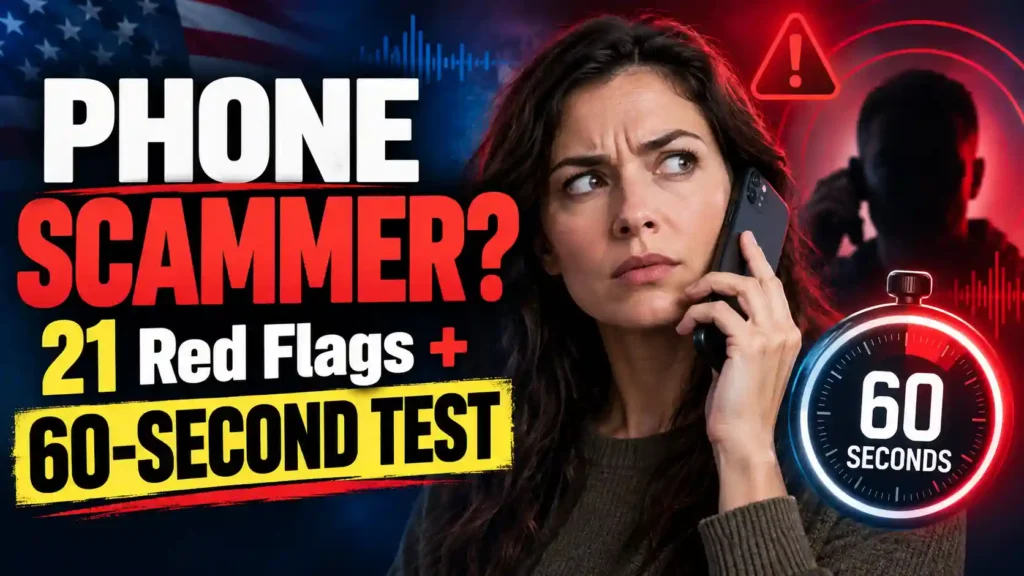
The number on your screen appears to belong to your bank.
The caller knows your name, where you live and perhaps even the last four digits of your account. They sound calm, professional and genuinely concerned. Then they reveal the emergency: criminals are supposedly trying to steal your savings.
Fortunately, the caller can protect your money—but only if you act immediately.
That is where the trap begins.
Modern phone scammers do not always sound confused, robotic or unprofessional. They can spoof trusted telephone numbers, use information from data breaches, send convincing documents and transfer you between several fake “departments.” Some can even imitate the voice of someone you know.
To identify a scammer on the phone, watch for an unexpected call that creates a problem or prize, pressures you to act immediately and requests money, security codes or sensitive information. Do not trust caller ID. Hang up and call the organization using a number you find independently.
The strongest warning is rarely the caller’s accent or grammar. It is the pattern connecting identity, urgency, secrecy and an unusual request.
This guide reveals 21 phone scammer red flags, realistic examples, safe response scripts, a scammer phone-number check and a 60-second verification test you can use before fear or excitement turns one call into a costly mistake.
How to Identify a Scammer on the Phone Quickly
A caller may be a scammer if they:
- Contact you unexpectedly
- Refuse to explain the call clearly
- Announce a frightening problem or unexpected prize
- Demand immediate action
- Use caller ID as proof of identity
- Threaten arrest, deportation or account closure
- Claim your Social Security number will be suspended
- Ask you to move money into a “safe” account
- Request gift cards, cryptocurrency, gold or cash
- Ask for passwords, PINs or security codes
- Want remote access to your device
- Prevent you from hanging up and calling back
- Demand secrecy
- Tell you to deceive your bank
- Send photographs of badges or official documents
- Transfer you to another supposed authority
- Offer guaranteed investment returns
- Promise a loan or debt solution for an upfront fee
- Request payment to release a prize or refund
- Become aggressive when you ask questions
- Create another fee after you have already paid
One unusual detail does not prove fraud. Legitimate businesses sometimes call customers, and genuine emergencies happen.
However, the risk becomes serious when someone combines an unexpected call, emotional pressure and a request for money, information or account access.
Legitimate Call vs. Scam Call
The fastest way to evaluate a questionable call is to observe what happens when you slow the conversation down.
| What to examine | More likely legitimate | More likely fraudulent |
|---|---|---|
| Reason for calling | Gives a clear, verifiable explanation | Creates a vague crisis or opportunity |
| Caller ID | Does not treat it as proof | Insists the displayed number proves identity |
| Time | Allows you to investigate | Demands immediate action |
| Callback | Lets you call through an official number | Prevents you from disconnecting |
| Payment | Uses normal, published methods | Demands gift cards, crypto, cash or gold |
| Information | Uses established security procedures | Asks for passwords, PINs or complete credentials |
| Security codes | Does not ask you to read them aloud | Requests a one-time code |
| Verification | Accepts independent confirmation | Controls the verification process |
| Questions | Answers clearly | Deflects, threatens or becomes angry |
| Privacy | Allows you to consult others | Demands secrecy |
| Bank involvement | Respects normal safeguards | Tells you to deceive bank employees |
| Prize | Does not require payment to claim it | Invents taxes, shipping or processing fees |
| Emergency | Can be confirmed separately | Collapses if you call someone else |
A calm, polite caller can still be dishonest. Independent verification—not personality—must determine whether you trust the request.
21 Signs the Person on the Phone May Be a Scammer
Phone scams can involve banks, government agencies, charities, technology companies, relatives, investments and healthcare services.
Although the stories differ, the emotional machinery behind them is remarkably repetitive.
1. The Call Was Unexpected
An unexpected call is not automatically fraudulent. Nevertheless, it deserves caution when the person immediately requests money, personal information or account access.
The caller may claim to represent:
- Your bank
- A government agency
- A police department
- A utility company
- A delivery service
- A technology company
- A charity
- An investment firm
- A debt collector
- A healthcare provider
- A family member
Ask yourself:
- Was I expecting this call?
- Have I recently contacted this organization?
- Can I confirm the issue outside this conversation?
- Why does this situation require immediate action?
Do not provide personal details merely to discover what the caller knows.
2. The Caller ID Shows a Trusted Name or Local Number
Caller ID can be manipulated through a practice known as spoofing.
A scammer may make the call appear to come from:
- Your bank
- Social Security
- A police station
- A courthouse
- A hospital
- A utility provider
- A local business
- A number resembling your own
The caller may say:
“You can see this is your bank’s official number.”
That proves nothing.
Even when the displayed number genuinely belongs to the organization, someone else may have caused it to appear on your screen.
End the conversation. Find the organization’s number through its official website, application, statement or the back of your bank card. Do not use redial as your only verification method.
3. The Caller Creates an Immediate Crisis
Scammers use fear because frightened people make faster decisions.
The supposed crisis may involve:
- Fraud on your account
- A relative in trouble
- An arrest warrant
- An unpaid tax bill
- A computer infection
- A benefits problem
- Utility disconnection
- Identity theft
- A suspicious package
- A medical emergency
A real emergency can be urgent. However, urgency does not make verification unnecessary.
Tell the caller:
“I will verify this independently before taking any action.”
Then hang up.
4. They Threaten Arrest, Deportation or Legal Action
A caller says police officers are coming to your home unless you pay immediately.
They may accuse you of:
- Missing jury duty
- Owing taxes
- Receiving illegal money
- Using a compromised Social Security number
- Violating immigration rules
- Ignoring a debt
- Being connected to criminal activity
The threat is designed to stop you from thinking clearly.
Real legal problems are not settled through gift cards, cryptocurrency, gold bars or cash delivered to a courier. A person demanding immediate payment to prevent arrest is exposing the scam.
End the call and contact the relevant agency through an independently verified number.
5. They Claim Your Social Security Number Will Be Suspended
A scammer may claim your Social Security number was used in a crime, found in an abandoned vehicle or connected to money laundering.
They offer to solve the problem if you confirm personal information or make a payment.
Be extremely suspicious when the caller:
- Threatens arrest
- Claims your number will be suspended
- Demands immediate payment
- Requests banking information
- Tells you to move your savings
- Wants gift cards or cryptocurrency
- Says a benefit increase requires a fee
A Social Security number is not suspended because an unknown caller says so.
Read these Social Security scam warning signs before trusting a government call.
6. The Caller Knows Personal Information About You
A caller who knows your name, address, bank or relatives can feel credible.
Personal knowledge is not proof.
Scammers can gather information from:
- Data breaches
- Public records
- Social-media accounts
- Stolen mail
- Previous scams
- Marketing databases
- Compromised email accounts
- People-search websites
The caller may reveal information they already possess and ask you to complete the rest:
“I have the first numbers of your account. Please confirm the remaining digits.”
Do not complete sensitive information during an incoming call. Contact the organization separately.
7. They Ask You to Confirm Sensitive Information
The caller presents the request as a routine security check.
They ask for:
- Your Social Security number
- Bank-account information
- Card details
- Date of birth
- Online banking username
- Password
- PIN
- Mother’s maiden name
- Answers to security questions
- A photograph of your identification
The person may already possess part of the information and need you to supply what is missing.
If the caller claims to represent a company you use, hang up and contact it through a trusted channel.
8. They Request a One-Time Security Code
A one-time code can authorize a login, password reset, payment or account change.
The caller may say:
“I sent you a code to verify your identity.”
“Read the numbers back so I can cancel the fraudulent transaction.”
“We need the code to secure your account.”
In reality, the code may approve the scammer’s attempt to enter your account.
Read the message containing the code carefully. It may specifically warn you not to share it.
Never disclose a one-time code during an incoming call. Contact the company directly and check for unfamiliar activity.
9. They Tell You to Move Money Into a “Safe” Account
A fake bank employee claims criminals are targeting your savings. To protect the money, you must move it to a secure account controlled by the fraud department.
There is no safe account.
If you transfer the money, you are sending it to the scammer.
The caller may warn that dishonest employees at your bank are involved. This gives them an excuse to demand secrecy and tell you to ignore fraud warnings.
A legitimate bank does not protect your money by telling you to transfer it to an unknown account.
Hang up and call the number printed on your bank card.
10. They Demand an Unusual Payment Method
The payment method may reveal what the caller’s professional voice tries to hide.
Be suspicious when someone demands:
- Gift cards
- Cryptocurrency
- Gold bars
- Cash
- Wire transfers
- Prepaid debit cards
- Payment applications
- Cash mailed inside a package
- Payment into a personal account
- Money collected by a courier
A government agency does not settle taxes through gift cards. Police do not accept cryptocurrency to cancel an arrest. A bank does not protect savings by collecting gold.
The explanation does not make the method legitimate.
11. They Keep You on the Phone While You Pay
A phone scammer may insist that you remain connected while:
- Driving to the bank
- Withdrawing cash
- Buying gift cards
- Visiting a cryptocurrency ATM
- Transferring money
- Packaging cash or gold
- Speaking with a cashier
- Waiting for a courier
Keeping you on the line prevents other people from questioning the story.
The caller may also coach you on what to tell a bank employee.
End the call immediately. A person instructing you to deceive your bank is not protecting you.
12. They Demand Secrecy
Secrecy isolates you from the people most likely to recognize the deception.
The caller may say:
“This is a confidential investigation.”
“Do not tell your spouse.”
“Your bank employees may be involved.”
“Talking about this will violate the court order.”
“You will lose your money if anyone finds out.”
A genuine investigation does not require secret gift-card payments.
Before making an unusual financial decision, discuss the situation with someone you trust.
13. They Refuse to Let You Hang Up and Call Back
A legitimate organization should understand why you want to verify an unexpected call.
A scammer may claim:
- The case will close if you disconnect
- The telephone line is secure
- Your account will be frozen
- The caller cannot receive incoming calls
- Calling back will alert the criminals
- The police will treat disconnection as noncompliance
- You will lose your only chance to act
Do not negotiate.
Say:
“I do not make financial or security decisions during incoming calls. I will contact the organization directly.”
Then hang up.
14. They Transfer You to Another Supposed Authority
A coordinated scam may involve several people.
The first caller claims to represent your bank. They transfer you to a supposed police officer, government investigator, lawyer or security specialist.
Each person confirms the same story, making it appear that several organizations are involved.
They are not independent if the original caller controls the transfer.
Do not accept a transferred call as verification. Disconnect and find the relevant organization’s number yourself.
15. They Send Official-Looking Documents or Badges
The caller may send a text or email containing:
- A police badge
- Government identification
- An arrest warrant
- A court document
- A bank letter
- A transaction report
- An employee card
- A business license
- A payment invoice
Logos, signatures and identification cards can be copied or fabricated.
Do not use evidence supplied by the caller to verify that same caller. Confirm the organization independently.
An official-looking document does not make an unusual payment demand legitimate.
16. They Claim You Won a Prize You Never Entered
The caller congratulates you on winning:
- A lottery
- A sweepstake
- A vacation
- A vehicle
- A grant
- Cash
- An expensive product
- A publishers’ prize
However, you must pay taxes, insurance, shipping or processing fees first.
If you must pay to receive an unexpected prize, the prize is bait.
Do not disclose banking information or send money to claim something you do not remember entering.
17. They Offer Technical Support You Did Not Request
A caller claims your computer, telephone, internet connection or online account has been compromised.
They may say:
“Your computer is sending error messages.”
“Hackers are using your internet.”
“Your account contains a dangerous virus.”
“We need to connect to your device immediately.”
The caller then asks you to install remote-access software.
Once connected, they may steal passwords, access banking information, copy files or manipulate what appears on your screen.
Do not give an unsolicited caller remote access to your device.
Contact the manufacturer, service provider or a trusted technician through an official channel.
18. A Medicare or Health-Insurance Caller Wants Personal Information
A scammer may pretend to represent:
- Medicare
- A health insurer
- A doctor’s office
- A pharmacy
- A medical-equipment provider
- A genetic-testing company
They may offer a free brace, replacement card, medical test or new benefit.
The “free” service requires your Medicare number, Social Security number, banking details or other personal information.
Do not verify the caller using the telephone number they provide. End the call and contact the organization through the number printed on your official card or statement.
A genuine-looking caller ID does not prove the call came from your healthcare provider.
19. They Guarantee Investment, Business, Loan or Debt Results
A caller may promise:
- Guaranteed investment returns
- Risk-free cryptocurrency profits
- A business that cannot fail
- Immediate credit repair
- Debt elimination
- Loan approval regardless of credit
- Lower interest rates
- Student-loan forgiveness
- A guaranteed timeshare buyer
- Recovery of money lost in another scam
The person usually requires an upfront fee.
No legitimate investment can guarantee extraordinary returns without risk. Honest lenders do not guarantee approval because you paid an unknown caller.
Request written information, investigate independently and refuse to pay during the call.
20. The Call Begins With Silence or a Recorded Question
Some suspicious calls begin with several seconds of silence. Others play a recording:
“Can you hear me?”
“Press one to speak with an agent.”
“Press nine to be removed.”
“Your package could not be delivered.”
“This is an urgent notice about your account.”
The silence may come from an automated system waiting to connect an answered call to an available operator.
Saying “yes” does not automatically authorize a payment or give someone access to your bank account. The more immediate risks are confirming that your number is active, keeping you engaged and persuading you to reveal additional information.
Do not continue answering questions merely because you already responded.
Do not press buttons during an unwanted robocall unless you independently know it is legitimate. Hang up.
21. Every Solution Requires Another Payment
You already paid, but the problem remains.
The caller now claims:
- The first transfer failed
- Tax must be paid
- The prize needs insurance
- The account requires verification
- The loan requires another deposit
- The refund needs processing
- The investment withdrawal needs clearance
- The recovery company needs a tracing fee
The person promises this is the final payment.
It rarely is.
Money already lost does not make another payment sensible. The caller is using your desire to recover the first amount to obtain more.
Stop paying. Preserve the evidence and contact the financial provider involved.
The 60-Second Phone Scammer Verification Test
You do not need to investigate the caller while they are pressuring you.
Use this four-step test.
Stop the Requested Action
Do not:
- Transfer money
- Read out a code
- Confirm sensitive information
- Buy gift cards
- Install software
- Visit a link
- Approve a login
- Withdraw cash
Say:
“I do not make financial or security decisions during incoming calls.”
Ask for Identifying Information
Request the caller’s:
- Full name
- Organization
- Department
- Reference number
- Reason for calling
Their answers are not proof. You are collecting details for independent verification.
End the Call
Do not allow the person to transfer you to another department.
Hang up completely.
When using a landline, consider waiting briefly or using another telephone before making your verification call.
Call an Independently Verified Number
Use:
- The number printed on your bank card
- The organization’s official website
- A recent legitimate statement
- A trusted mobile application
- A relative’s number already saved in your contacts
- An official government directory
Do not use the displayed caller ID, a number supplied during the conversation or the redial button as your only verification method.
If the caller tried to prevent these steps, your suspicion should increase.
The Phone Scam Risk Score
Give the call one point for every “yes.”
- Was the call unexpected?
- Did the caller create a serious problem or irresistible opportunity?
- Are they demanding immediate action?
- Are they using caller ID as proof?
- Did they threaten arrest, account closure or loss of benefits?
- Do they want money, account access or sensitive information?
- Did they request gift cards, crypto, cash or gold?
- Are they preventing you from calling back independently?
- Did they demand secrecy or tell you to deceive your bank?
- Does solving the problem require another payment?
| Score | Risk level | What to do |
|---|---|---|
| 0–1 | No clear conclusion | Remain cautious and verify independently |
| 2–3 | Significant concern | Refuse the request and end the call |
| 4–6 | High risk | Preserve evidence and contact the real organization |
| 7–10 | Extremely high risk | Report the call and secure affected accounts |
The score does not legally prove fraud. It helps you recognize when the risk is too high to continue.
How to Check a Suspected Scammer’s Phone Number
Search the complete telephone number inside quotation marks. Look for reports from other recipients and check whether the number is associated with the organization claimed.
You may also use:
- Your carrier’s caller-identification service
- A reputable reverse-number lookup
- Built-in spam labels
- Community call-reporting databases
- The organization’s official contact directory
However, phone-number lookup has serious limits.
No Complaints Does Not Mean the Number Is Safe
The number may be:
- New
- Temporary
- Recently hijacked
- Spoofed
- Used for only a few calls
- Replaced frequently
A scammer can abandon one number and begin using another.
A Genuine Number Does Not Prove the Call Was Genuine
If a search shows that the number belongs to your bank, police department or government agency, the caller may still have spoofed it.
Do not verify the caller by searching only the displayed number.
Hang up and initiate a new call through contact information you locate independently.
Do Not Call Suspicious International Numbers Back
A missed call may be intended to make you return it. Calling an unfamiliar international or premium-rate number could create charges or confirm that your line is active.
If the caller left a message claiming to represent an organization, contact that organization separately.
Common Phone Scam Scripts and the Correct Response
Recognizing the script can help you interrupt the scam quickly.
“Your Bank Account Has Been Compromised”
The caller asks you to move money into a protected account.
Correct response: Hang up and call the number printed on your bank card. Never transfer money to protect it from fraud.
“Your Social Security Number Has Been Suspended”
The caller requests payment or identity information.
Correct response: Hang up. Verify through an official government channel.
“You Missed Jury Duty”
The caller threatens arrest unless you pay a fine.
Correct response: Contact the court or local police using an independently found number.
“Your Computer Is Infected”
The caller requests remote access.
Correct response: Do not install anything. Contact a trusted technician or the company’s official support service.
“Your Relative Has Been Arrested”
A supposed lawyer demands bail money and secrecy.
Correct response: Call the relative directly. Contact another family member and verify the court or police department independently.
“You Won a Prize”
The caller requests taxes, insurance or shipping charges.
Correct response: Do not pay. A prize requiring an upfront payment is not a prize.
“We Can Recover the Money You Lost”
The caller claims to be an investigator or recovery specialist.
Correct response: Do not pay an upfront fee. Recovery scammers deliberately target previous victims.
What About AI Voice Cloning?
A familiar voice is no longer conclusive proof of identity.
A scammer may use recorded, edited or generated audio to imitate:
- Your child
- Spouse
- Parent
- Employer
- Friend
- Business partner
Do not verify a familiar voice with that same voice.
End the call and contact the person through a number or channel you already trusted. Ask a private question based on a recent shared experience or use a family emergency word.
Read 11 red flags that may expose a voice-cloning scam for the complete verification process.
You can also review what to do before trusting a familiar voice during an AI scam call.
How to Protect Your Family From Phone Scams
Preparation makes a frightening call easier to handle.
Create a Family Safe Word
Choose a private word or phrase that:
- Does not appear online
- Is unrelated to birthdays, schools or pets
- Is easy to remember
- Can be replaced if exposed
Do not reveal the word while asking the caller to provide it.
Establish a No-Secret-Payment Rule
Agree that nobody will send emergency money without speaking to at least one other trusted person.
This breaks the isolation on which many scams depend.
Create a Callback Rule
Make this automatic:
“We never make payments or reveal security information during an unexpected incoming call.”
End the call and contact the person or organization separately.
Talk to Older Relatives Without Insulting Them
Do not claim that only foolish people fall for phone scams.
Professional criminals use caller-ID spoofing, stolen information, coordinated call centers and emotional manipulation. Intelligence alone does not provide immunity.
Ask relatives to call you before paying—even when the caller orders them to keep the situation secret.
Reduce Public Personal Information
Review what strangers can learn about:
- Family relationships
- Workplaces
- Schools
- Birthdays
- Travel
- Telephone numbers
- Daily routines
- Financial institutions
The less a scammer knows, the harder it becomes to create a believable story.
How to Reduce Scam Calls
No service blocks every fraudulent call, but several measures can reduce your exposure.
Use Call Blocking and Spam Labels
Check what your carrier and telephone provide. Many devices can label suspected spam or silence calls from unknown numbers.
A call without a warning is not automatically safe. Spoofed and newly used numbers may not appear in blocking databases.
Let Unknown Calls Go to Voicemail
A genuine caller can leave a clear message. You can then verify the organization and return the call through an official number.
Do Not Interact With Unwanted Robocalls
Do not press buttons merely to reach an operator or remove your number from the list.
Hang up.
Block Repeat Callers
Blocking one number cannot stop every scam because criminals change and spoof numbers. However, it can reduce repeated calls from the same source.
Use Do-Not-Call Registration Appropriately
Registration may reduce legitimate sales calls, but criminals do not respect marketing rules. Continue treating unexpected financial calls cautiously.
What to Do If You Gave a Phone Scammer Information
Act according to what the caller obtained.
If You Shared a Password
Change it immediately.
If you used the same password elsewhere, change it on every affected account. Secure your email first because it may control password resets for other services.
If You Shared a One-Time Code
Contact the company involved immediately. Review recent logins, payments, devices and account changes.
Change the password and strengthen the account’s authentication.
If You Shared Card Information
Call the number printed on the card. Ask the issuer to secure or replace it and review recent transactions.
If You Shared Bank Information
Contact the bank’s fraud department. Explain exactly what the caller obtained and ask what protections should be added.
If You Shared Your Social Security Number
Treat it as potentially compromised. Follow an identity-theft recovery plan and monitor credit and financial accounts for unfamiliar activity.
If You Installed Remote-Access Software
Disconnect the device from the internet.
Use another trusted device to change important passwords. Contact your bank if you opened financial accounts while the caller could view or control the screen.
Have the device examined by a trusted security professional before using it for sensitive activity again.
What to Do If You Paid a Phone Scammer
Act immediately. Do not wait for the caller to promise a refund.
Credit or Debit Card
Contact the card issuer. Report the transaction as fraudulent and ask whether it can be reversed or disputed.
Bank Transfer
Call the bank’s fraud department and request an urgent recall or freeze.
Payment Application
Report the recipient and transaction through the application. If it was linked to a card or bank account, contact that provider as well.
Wire Transfer
Contact the transfer company immediately with the transaction reference.
Gift Card
Contact the gift-card issuer. Keep the card, packaging and receipt.
Cryptocurrency
Contact the exchange used to purchase or send the cryptocurrency. Provide the receiving wallet address and transaction identifier.
Cash Sent by Mail or Courier
Contact the postal or delivery service immediately and ask whether interception is possible.
Then follow these five urgent steps after being scammed before the damage gets worse.
How to Report a Phone Scammer in the United States
Save the following evidence first:
- Date and time of the call
- Number displayed on caller ID
- Callback number provided
- Name used by the caller
- Organization claimed
- Exact demands or threats
- Payment instructions
- Messages and documents sent
- Transaction details
- Voicemails
Then report according to the situation.
Report Financial Phone Scams
Submit the incident through:
ReportFraud.ftc.gov
Include the number that received the call, the number displayed on caller ID and any callback number supplied.
Report Unwanted Sales Calls
Use:
DoNotCall.gov
This is appropriate when you did not lose money but want to report an unwanted call.
Report Caller-ID Spoofing and Robocalls
Submit a complaint through:
consumercomplaints.fcc.gov
Report Social Security Impersonation
Use:
oig.ssa.gov/report
Report IRS Impersonation
Use the IRS impersonation reporting process provided by the Treasury Inspector General for Tax Administration.
Report Immediate Threats or Cash Collection
Contact local law enforcement when:
- Someone threatens physical harm
- A courier is coming to collect money, cash or gold
- The caller claims to know your location
- You believe another person is in immediate danger
Do not delay contacting your bank while completing formal reports. Financial intervention is often most useful when it happens immediately.
Beware of Recovery Scammers
After losing money, you may receive another call from someone claiming to be:
- A government investigator
- A lawyer
- A recovery company
- A hacker
- A bank employee
- A cryptocurrency specialist
They claim your money has been located, but you must pay a tracing, tax, legal or processing fee before receiving it.
This is often another scam.
Your information may have been retained by the original criminal or sold to other fraudsters.
Never pay an unsolicited caller who guarantees recovery.
Frequently Asked Questions About Identifying Phone Scammers
These answers address the questions people commonly ask after receiving suspicious calls.
What is the biggest sign of a phone scammer?
The strongest pattern is an unexpected call followed by urgency and a request for money, sensitive information or account access through an unusual process.
Can a scammer make my bank’s number appear on caller ID?
Yes. Caller-ID information can be spoofed. Contact the bank using the number printed on your card or statement.
Can a scammer use a local telephone number?
Yes. A local area code does not prove that the caller is nearby.
Should I answer calls from unknown numbers?
You can allow unfamiliar calls to go to voicemail. A genuine caller can leave a message that you verify before returning.
Can saying “yes” give a scammer access to my account?
No, saying “yes” alone does not automatically provide account access or authorize a payment. The greater risks are confirming that your number is active and continuing a conversation that leads to sensitive information.
Why do silent calls happen?
An automated dialing system may be checking whether the number is active or waiting to connect your answered call to an operator.
Should I press a number to stop robocalls?
Do not interact with an unwanted robocall unless you independently know it is legitimate. Hang up instead.
Will a bank ask for a security code?
Banks may legitimately use security codes, but you should not read one to an unexpected caller. End the call and contact your bank directly.
Will a government agency demand payment by telephone?
A caller demanding immediate payment through gift cards, cryptocurrency, cash or wire transfer is not following a legitimate government payment process.
Can police collect a fine through gift cards?
No legitimate police department collects fines through gift-card codes.
Can my Social Security number be suspended?
A caller threatening to suspend your Social Security number unless you pay is using a known impersonation tactic.
Why do phone scammers want gift cards?
Gift-card value can be redeemed quickly after the criminal receives the card number and PIN.
Why do scammers request cryptocurrency?
Cryptocurrency can move quickly between wallets and may be difficult to recover.
What is a safe account?
A “safe account” described by an unexpected caller is usually controlled by a scammer. A bank does not protect your savings by transferring them to a stranger.
Should I trust a caller who knows my address?
No. Personal information can come from public records, online profiles and data breaches.
Should I challenge a suspected phone scammer?
You do not need to win an argument. End the call and verify the claim independently.
Can a familiar voice be fake?
Yes. Audio can be recorded, edited or generated. Contact the person through a separate trusted channel.
What should I do if a relative calls with an emergency?
End the call and contact the relative through a number you already know. Speak with another family member and use a private safe word.
Can a scammer control my computer simply by calling?
No. The risk begins when you install remote-access software, disclose credentials or approve access.
Can I identify a scammer by searching the telephone number?
A search may reveal complaints, but it cannot prove that a number is safe. Scammers can use new, temporary or spoofed numbers.
Should I return a suspicious call?
Do not use redial. Find the organization’s official number independently and initiate a new call.
How quickly should I report money sent to a scammer?
Immediately. Contact the payment provider before doing anything else.
Can money lost in a phone scam be recovered?
Sometimes, depending on the payment method and timing. Recovery is not guaranteed, but immediate reporting gives you the best available chance.
Are call-blocking applications enough?
No. They can reduce unwanted calls but cannot identify every new or spoofed number.
What is the safest sentence to use during a suspicious call?
Say:
“I do not make financial or security decisions during incoming calls. I will contact the organization directly.”
Then hang up.
Final Thoughts: Trust Independent Verification, Not the Caller’s Voice
A phone scammer may sound helpful, frightened, official or deeply concerned.
The number may appear genuine. The caller may know your name, transfer you to another supposed authority and send professional-looking documents.
None of that replaces independent verification.
Remember the pattern:
- Someone you recognize
- A sudden problem or opportunity
- Pressure to act immediately
- A demand for money, information or account access
When those four elements appear, stop.
Do not verify the caller through a number they control. Do not remain connected while moving money. Do not reveal a security code because the person already knows some of your information.
End the call. Find the official number yourself. Speak with someone you trust. Confirm the story independently.
That 60-second interruption can prevent a stranger from turning fear into an irreversible decision.
Pingback: How to Tell If an Email Is From a Scammer: 21 Red Flags and a 60-Second Test - SafeGuard Press