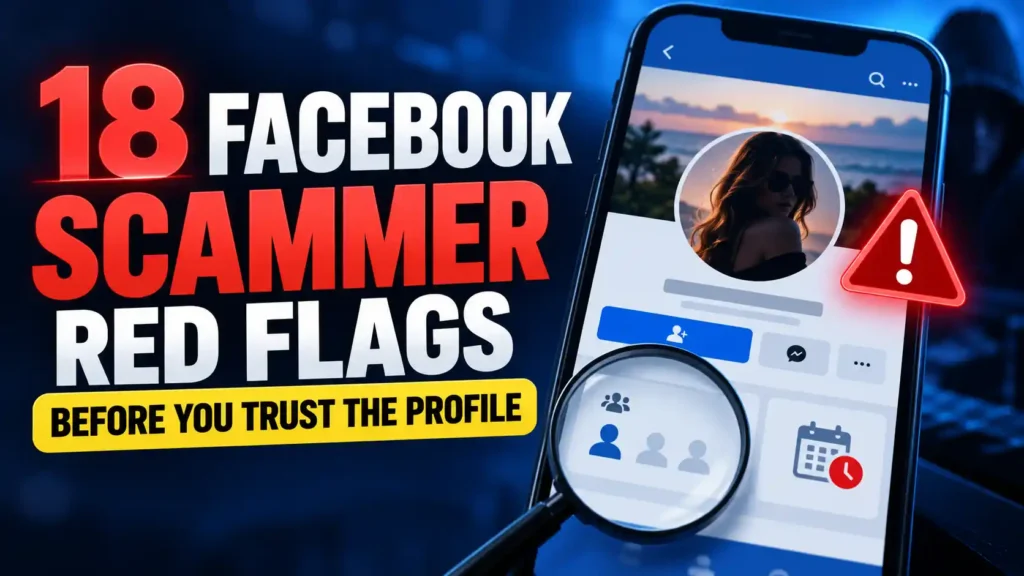
The friend request does not look dangerous.
The profile has a friendly photograph, several public posts and perhaps even a few mutual friends. The person knows where you live, what you do or which Facebook group you recently joined. Nothing immediately screams “scam.”
Then the messages begin.
At first, the stranger is polite. They compliment you, ask harmless questions or offer something useful. However, once they earn your attention, the conversation changes. An emergency appears. An investment opportunity cannot wait. A Marketplace payment requires an “upgrade.” A friend needs a verification code. A romantic interest suddenly needs money.
The strongest signs of a scammer on Facebook are a suspicious profile history, inconsistent personal details, resistance to independent verification and an eventual request for money, sensitive information, account codes or immediate action.
A convincing profile proves very little. Scammers can clone real accounts, steal photographs, hijack established profiles and study your public information before contacting you. Therefore, you must judge the person by the complete pattern—not merely the name and picture displayed on the screen.
This guide reveals 18 Facebook scammer red flags, realistic message examples, a 60-second profile test and the exact actions to take before a suspicious conversation becomes an expensive mistake.
How to Tell If Someone Is a Scammer on Facebook Quickly
Someone may be a Facebook scammer if the person:
- Contacts you unexpectedly
- Has a recently created, unusually empty or inconsistent profile
- Uses photographs that appear stolen or artificial
- Claims a connection that you cannot confirm
- Becomes friendly or romantic unusually fast
- Wants to leave Facebook immediately
- Avoids spontaneous live video calls
- Changes important parts of their story
- Sends suspicious links or attachments
- Asks for a password or verification code
- Introduces an emergency, prize, job or investment
- Demands payment through gift cards, cryptocurrency or another difficult-to-reverse method
- Pressures you to act before verifying the story
- Wants the conversation kept secret
- Becomes angry when you ask reasonable questions
One unusual detail does not prove fraud. A genuine person can have a private profile, few friends or an old camera. The risk becomes serious when several suspicious details appear together—particularly when money, account access or sensitive information enters the conversation.
Genuine Facebook Profile vs. Suspicious Profile
Before trusting someone, compare the person’s behavior with the pattern below.
| What to examine | More likely genuine | More likely suspicious |
|---|---|---|
| Profile history | Normal activity across different periods | Most activity appeared recently |
| Photographs | Varied, natural and connected to real interactions | Polished, repetitive, inconsistent or isolated |
| Friends | Recognizable personal connections | Many unrelated or suspicious accounts |
| Personal story | Details remain reasonably consistent | Age, location, job or family details change |
| Communication | Develops naturally | Becomes intense unusually quickly |
| Verification | Accepts reasonable independent checks | Makes excuses or becomes defensive |
| Video calls | Participates naturally | Repeatedly refuses or sends prerecorded clips |
| Money | Respects financial boundaries | Introduces emergencies, fees or investments |
| Links | Uses official, independently confirmed channels | Sends unexpected login or payment links |
| Urgency | Gives you time to investigate | Demands immediate action |
| Privacy | Allows you to consult others | Insists on secrecy |
| Questions | Answers clearly | Avoids, redirects or punishes questions |
This comparison is not a final verdict. A hacked Facebook account may contain years of genuine photographs and conversations. That is why behavior and independent verification matter more than appearance.
18 Signs of a Scammer on Facebook
Facebook scammers use different stories, but the machinery behind those stories is surprisingly repetitive. They exploit familiarity, emotion, urgency and the assumption that a real-looking account must belong to a real person.
Here are the clues that can expose them.
1. The Profile Was Created Recently or Has Little History
A new Facebook account is not automatically fraudulent. Nevertheless, it deserves closer examination when the person claims to have been active on Facebook for years.
Look for:
- No old posts or photographs
- A profile and cover picture uploaded on the same day
- Dozens of posts added within a short period
- Few tagged photographs
- No birthday messages from previous years
- No conversations with relatives, coworkers or longtime friends
- A sudden gap followed by completely different activity
Some criminals create new profiles from scratch. Others take control of abandoned accounts and replace the photographs, name and personal information.
Do not judge the account only by its creation date. Ask whether the complete history matches the person’s claimed life.
2. The Photographs Look Stolen, Artificial or Too Perfect
A fake account may use images chosen to create instant trust or attraction. Common examples include military uniforms, medical clothing, luxury travel, expensive cars, family photographs and polished professional portraits.
Examine several pictures rather than relying on the profile image.
Ask:
- Does the person’s face remain consistent?
- Do age and appearance match the claimed timeline?
- Are there natural photographs with relatives and friends?
- Do tagged people interact like genuine acquaintances?
- Does every photograph look professionally produced?
- Do the backgrounds match the claimed location?
- Are hands, teeth, jewelry, text or background objects distorted?
Artificial images can look impressive while containing small inconsistencies. However, visual oddities alone are not proof.
Run several pictures through a reverse-image search. If the same face appears under unrelated names, occupations or locations, stop the conversation.
A search returning nothing does not confirm authenticity. The images may be private, recently stolen or artificially created.
3. The Account Has Friends but Almost No Real Interaction
Friend count is weak evidence.
A scammer can add hundreds of strangers, connect with other fake accounts or take over a genuine profile. What matters is whether the activity resembles a real human life.
Look for:
- Generic comments such as “Nice” or “Beautiful”
- The same accounts commenting on every post
- Friends concentrated in countries unrelated to the person’s story
- No conversations that suggest real shared experiences
- Many friends but almost no reactions
- Comments that appear copied or automated
- Posts receiving attention from obviously suspicious profiles
Real profiles are rarely perfect. They contain ordinary conversations, old jokes, changing interests, unflattering photographs and interactions that make sense over time.
A profile filled with attractive pictures but no believable relationships is a display window—not proof of identity.
4. The Name, Username and Personal Details Do Not Match
The display name at the top of a Facebook profile can be copied. Examine the profile address, username, biography and previous public information.
Watch for contradictions involving:
- Name
- Age
- City
- Workplace
- Education
- Marital status
- Children
- Military service
- Travel
- Language
- Time zone
For example, the person may claim to live in Chicago but consistently message according to a completely different time zone. They may say they have one child and later mention two. Their profile may identify one employer while their messages describe another career.
One mistake can be innocent. Repeated contradictions suggest that the person is improvising or managing several false identities.
5. Someone You Already Know Sends You Another Friend Request
A duplicated friend request is a major Facebook impersonation clue.
A criminal may copy your friend’s:
- Name
- Profile picture
- Cover photograph
- Biography
- Public posts
- Friends list
The scammer then sends requests to people connected to the genuine account.
Shortly afterward, the cloned profile may announce a government grant, investment opportunity, prize or personal emergency.
You might receive a message like:
“Hello, how are you? I saw your name on the list of people qualified for the new relief grant. Have you received your money?”
Do not ask the suspicious profile whether it is genuine. Contact your friend through a telephone number, email address or previous conversation you already trust.
If your friend did not create the new account, take screenshots, report the clone and warn mutual contacts.
6. The Person Contacts You With a Convenient but Vague Explanation
Many Facebook scams begin with an excuse designed to make an unsolicited message feel natural.
The person might say:
“Facebook recommended your profile.”
“I saw your comment in a group and liked your opinion.”
“You look familiar. Have we met before?”
“Sorry, I thought you were someone else.”
“You seem like a kind person. I hope you do not mind the message.”
Any one of these statements could be innocent. The problem is what follows.
A vague introduction often becomes a friendship, romantic connection, business offer or investment discussion. If the sender cannot explain clearly why they contacted you, do not supply personal information to help them construct a better story.
7. The Relationship Becomes Intense Unusually Fast
A Facebook scammer may try to create emotional closeness before you have time to examine the evidence.
Within days, the person calls you a close friend, praises your character or suggests that your meeting was destined. A romantic scammer may discuss love, marriage or a shared future before you have had a normal live conversation.
Typical messages include:
“I have never felt this comfortable with anyone.”
“God brought you into my life for a reason.”
“You are the only person I can trust.”
“I think about you every minute.”
“Age and distance cannot stop true love.”
Affection is not evidence of fraud. Speed is the concern.
When emotional commitment develops faster than verifiable knowledge, slow the relationship down. Do not send money, identification documents or intimate content to prove that your feelings are genuine.
For a deeper examination of emotionally driven fraud, read these romance scammer red flags before trusting an online relationship.
8. They Want to Move the Conversation Off Facebook Immediately
The person quickly asks for your telephone number, email address, WhatsApp details or Telegram username.
They may claim:
- Messenger is unreliable
- Their Facebook account may be closed
- They rarely use the platform
- The conversation is too private
- Another messaging application is more secure
- Their employer prevents them from using Facebook
Moving platforms is not automatically dangerous. However, it can help a scammer obtain more information, avoid Facebook’s reporting systems and continue contacting you after the original profile disappears.
Do not move simply because the stranger pressures you.
If the person becomes angry when you prefer to remain on Facebook, that reaction is more suspicious than the request itself.
If you have already moved the conversation, learn how to identify a scammer on WhatsApp using 19 red flags and a five-minute test.
9. They Repeatedly Avoid a Spontaneous Live Video Call
Someone using a stolen face must prevent you from seeing them naturally.
Common excuses include:
- “My camera is broken.”
- “The connection is too poor.”
- “I am not allowed to video-call from work.”
- “I feel shy on camera.”
- “My phone cannot make video calls.”
- “I am deployed in a restricted location.”
- “Let us wait until we know each other better.”
One failed call proves nothing. Repeated excuses become serious when the person is discussing love, business, travel or money.
Do not accept a voice note, photograph or short video as a substitute. Those materials can be stolen, altered or generated.
During a live call, ask the person to respond naturally to an unpredictable request. For example, ask them to turn their head, hold up a particular number of fingers or repeat a harmless phrase you just created.
Even a successful call is not complete proof. The person could show their real face while lying about their name, employment, finances and intentions.
10. Their Communication Does Not Match the Identity
Pay attention to the gap between who the person claims to be and what they demonstrate.
A supposed investment professional cannot explain the investment clearly. A person claiming to be your old friend does not recognize shared experiences. A representative from an American company uses a personal profile and refuses to communicate through an official business address.
Also watch for sudden changes in:
- Writing style
- Vocabulary
- Tone
- Grammar
- Response speed
- Knowledge of previous conversations
- Preferred name for you
A shift could indicate that different people are operating the same account.
Grammar alone is not a reliable test. Genuine people make mistakes, while experienced scammers can write perfectly. The stronger clue is inconsistency between the claimed identity and demonstrated knowledge.
11. They Resist Independent Verification
A genuine person may understand why a stranger needs reassurance. A scammer usually wants to control both the story and the evidence used to verify it.
They may send:
- A passport photograph
- An employee identification card
- A military document
- A business certificate
- A website
- A contract
- A bank statement
- A flight booking
- A photograph outside an office
These materials can all be fabricated, altered or stolen.
Independent verification means using information the person did not provide.
If they claim to represent a business, find the official website yourself and call its publicly listed number. If they claim to know a mutual friend, contact that friend separately. If they claim to hold a professional license, search the relevant official register.
A person who demands trust while preventing independent checks is giving you a reason not to trust them.
12. They Send a Link Designed to Make You Log In
The Messenger message may appear to come from a friend:
“Is this you in this video?”
“I cannot believe they posted this picture of you.”
“Vote for my daughter in this competition.”
“Your Facebook account will be deleted. Appeal here.”
“You violated our community rules. Verify your account now.”
The link opens a page resembling Facebook’s login screen. If you enter your email address and password, the criminal captures them.
The scammer may then take over your account, lock you out and send the same message to your friends.
Do not log in through an unexpected Messenger link. Close the page and open Facebook independently through the official application or your usual saved address.
A padlock or https does not prove that the page belongs to Facebook. It only means the connection to that particular website is encrypted.
13. They Ask for a Verification Code
A verification code is a temporary key to an account.
A scammer might say:
“I accidentally sent my code to your phone. Please send it back.”
“I need the six digits to confirm you are a real Marketplace seller.”
“Facebook support sent you a code so I can secure your account.”
“You won the giveaway. Send the code to confirm your identity.”
Never send the code.
It may allow the person to reset a password, register your telephone number, access an account or approve a login attempt.
Legitimate Facebook support should not need you to read a private security code to an unknown person in Messenger. If you receive a code you did not request, someone may already be trying to access one of your accounts.
14. A Marketplace Buyer Sends a Fake Payment Notice
Facebook Marketplace sellers are often targeted with fraudulent payment claims.
The buyer may say:
“I sent the money, but the payment service emailed you.”
“Your account has a limit. I paid extra to upgrade it.”
“Refund the additional amount after your business account is activated.”
“The courier will collect the item as soon as you pay the insurance fee.”
The scammer may send a professional-looking email or screenshot showing that payment is pending. However, no money has entered your account.
Never rely on a screenshot, email or message from the buyer. Open your bank or payment application independently and check the actual balance and transaction history.
Do not pay to receive a payment. Do not refund an “overpayment” that never arrived. Do not release or ship an item until you have confirmed cleared funds through a trusted payment channel.
15. A Marketplace Seller Demands a Deposit Before Inspection
A fraudulent seller may list a desirable item at a price designed to create urgency.
Common bait includes:
- Vehicles
- Rental properties
- Electronics
- Pets
- Event tickets
- Furniture
- Appliances
- Collectibles
- Luxury products
The seller claims that many people are interested, so you must pay a deposit immediately. They may refuse inspection because they are traveling, working overseas or handling the sale for a relative.
You might receive:
“I cannot hold it without a deposit. Several buyers are coming today.”
“The apartment can only be viewed after the application fee.”
“The puppy will be delivered after you pay the refundable insurance.”
Do not send a deposit merely because the price appears attractive. Verify ownership, inspect the item or property when practical and use a payment method with appropriate protection.
Urgency does not turn an unverifiable listing into a safe purchase.
16. They Introduce a Prize, Grant, Job or Investment
A Facebook scammer may promise money rather than request it immediately.
The person claims you have been selected for:
- A government grant
- A lottery
- A giveaway
- An inheritance
- A remote job
- A business partnership
- A cryptocurrency opportunity
- A secret trading group
- A celebrity promotion
Then the condition appears. You must pay a processing fee, purchase equipment, deposit cryptocurrency or provide banking information.
A fake recruiter might write:
“Your Facebook profile was selected for our remote position. No interview is necessary. You only need to pay for the training software.”
An investment scammer may say:
“I made $12,000 this week with this private trading platform. I can ask my mentor to accept you.”
The dashboard can be fake. The testimonials can be fabricated. The apparent profits may exist only as numbers on a screen.
Never invest through a platform introduced by an unverified Facebook contact. Never pay to receive a prize you did not knowingly enter.
17. Every Problem Requires Gift Cards, Cryptocurrency or Another Unusual Payment
Scammers prefer payment methods that can be moved or redeemed quickly.
They may request:
- Gift-card codes
- Cryptocurrency
- Wire transfers
- Cash
- Prepaid cards
- Transfers through a payment application
- Deposits into a personal account
- Payments sent to a friend, agent or relative
The person may give a complicated explanation for why their own name cannot appear on the receiving account.
That explanation should increase your concern.
A government agency does not collect fines through gift cards. An employer does not require workers to send cryptocurrency. A genuine romantic partner should not instruct you to lie to your bank about a transfer.
If someone dictates what you should tell the bank, stop. They are trying to prevent trained staff from questioning the transaction.
18. They Use Urgency, Secrecy, Guilt or Threats
Manipulation is often the final clue.
The person remains friendly while you cooperate. Once you hesitate, their behavior changes.
They may say:
“If you trusted me, you would help.”
“Do not tell your family. They will ruin this opportunity.”
“You have ten minutes before your account is deleted.”
“The police will arrest you if you disconnect.”
“I will send your photographs to everyone you know.”
“You are the only person who can save me.”
A legitimate person or organization should allow you to stop, investigate and consult someone you trust.
A scammer needs you isolated and hurried because calm verification threatens the story.
Do not debate every claim. Set a firm boundary:
“I do not send money, verification codes, identification documents or account information in response to social-media messages. I will verify this independently.”
Then stop communicating.
The 60-Second Facebook Profile Test
You do not need to become a private investigator. Use this quick test before accepting a suspicious friend request, continuing a private conversation or sending money.
Give the account one point for every “yes.”
Profile
- Was most of the visible activity posted recently?
- Do the photographs lack believable personal interactions?
- Are the name, username, location or life details inconsistent?
Behavior
- Did the person contact you unexpectedly with a vague explanation?
- Are they trying to create friendship, romance or trust unusually fast?
- Do they avoid spontaneous live verification?
Request
- Have they requested money, account information, identification or a code?
- Have they sent an unfamiliar login, payment or investment link?
- Are they using urgency, secrecy, guilt or threats?
What Your Score Means
| Score | Risk level | What to do |
|---|---|---|
| 0–1 | No clear conclusion | Remain cautious and protect personal information |
| 2–3 | Significant concern | Pause and verify the identity independently |
| 4–6 | High risk | Do not click, pay or share information |
| 7–9 | Extremely high risk | Preserve evidence, report the account and block it |
This score does not prove criminal activity. It gives you a reason to slow down before the person’s emotional story controls your decision.
The most important question remains:
Can I verify this person without relying on evidence they supplied?
If the answer is no, do not make a financial decision.
How Facebook’s Scam Warnings Can Help
Facebook may display a warning when a friend request or account shows suspicious characteristics. For example, the account may have few mutual connections or claim to be in a different country.
Messenger may also show a safety notice when a conversation with a new contact resembles a common scam. Depending on your location and account, you may be offered additional information or encouraged to block or report the sender.
Treat these warnings seriously, but do not depend on them completely.
A message without an alert is not automatically safe. No automated system catches every hijacked account, stolen identity or carefully developed fraud.
Use platform warnings as an additional signal—not as a replacement for your judgment.
How to Verify a Suspicious Facebook Profile
If you see several warning signs, do not ask the suspected scammer to prove themselves using documents or links they control.
Use the following independent checks.
Study the Timeline From the Bottom Up
Scroll back as far as the profile allows.
Check whether:
- Posts span several years
- The person’s appearance changes naturally
- Friends refer to shared experiences
- Work and location details remain consistent
- Important life events form a believable timeline
- Older content appears to belong to a different person
A genuine history does not guarantee that the genuine owner still controls the account. Sudden changes in language, interests or financial posts may indicate a takeover.
Examine the Profile Address
Two accounts can display the same name and photograph.
Compare the suspicious profile’s username or address with:
- Old Messenger conversations
- Previous tags
- Saved links
- The account followed by known relatives
- Links from an official website
Do not assume that the first profile appearing in search results is genuine.
Search Several Photographs
Use more than the profile picture. Search images from different posts.
If the photographs belong to a public figure, model, military member, doctor or unrelated private person, the account is using a stolen identity.
No match does not prove legitimacy, but a clear mismatch can expose the scam immediately.
Ask a Mutual Friend What “Mutual” Actually Means
Do not ask, “Are you friends with this person on Facebook?”
Ask:
“Do you personally know this person outside Facebook?”
Your mutual friend may have accepted the same stranger without verification. A mutual connection creates familiarity, but it does not establish identity.
Arrange an Unpredictable Live Conversation
Ask for a normal video call at a reasonable time.
During the call:
- Refer to previous details
- Ask natural follow-up questions
- Request a simple unpredictable action
- Notice whether sound and movement match
- Watch for repeated freezing at convenient moments
Do not accept a prerecorded introduction as a live conversation.
Verify Employment and Business Claims Separately
If the person claims to represent an organization:
- Find the official website independently.
- Use the publicly listed telephone number.
- Ask whether the person works there.
- Confirm whether the offer or payment request is genuine.
- Do not call a number shown on a document the person sent.
A convincing logo is not verification.
What to Do When a Facebook Friend Suddenly Asks for Money
A genuine friend’s account can be hacked.
If a familiar person suddenly requests money, do not rely on the account’s history, photographs or mutual friends. The criminal inherited those details when they gained access.
Contact your friend using a method that existed before the suspicious message:
- Call the saved telephone number
- Send a message through an established email address
- Contact a close relative
- Ask a private question that is not visible online
- Speak in person when practical
Do not include the answer inside the question.
Ask:
“What did we order when we met last Saturday?”
Do not ask:
“Did we order pizza last Saturday?”
The second question gives the criminal information and an easy guess.
Until you confirm the person independently, do not pay.
How to Report a Scammer on Facebook
Take screenshots before reporting because the profile, advertisement, listing or conversation may disappear.
Facebook’s interface can vary by device and change over time, but the reporting option is generally found under the three-dot menu.
How to Report a Suspicious Personal Profile
- Open the profile.
- Select the three dots beneath the person’s name or cover area.
- Choose the option to find support or report the profile.
- Select the reason that best describes the problem.
- Follow the instructions and submit the report.
- Block the account after preserving evidence.
How to Report an Impersonating Profile
- Open the profile pretending to be you or someone you know.
- Select the three-dot menu.
- Choose the reporting or support option.
- Select “Pretending to be someone” or the closest available category.
- Identify whether the account is impersonating you, a friend or a public figure.
- Complete any requested verification.
You may still be able to report impersonation through Facebook’s help process if you do not have access to an account.
How to Report a Messenger Conversation
- Open the conversation.
- Select the person’s name or conversation information.
- Find the privacy, safety or reporting option.
- Choose the most accurate reason.
- Submit the report.
- Block the person.
How to Report a Marketplace Scam
- Open the listing or Marketplace conversation.
- Select the seller’s profile, buyer’s profile or listing menu.
- Choose the reporting option.
- Select scam, fraud, misleading listing or the closest available category.
- Provide the requested details.
- Stop communicating with the person.
How to Report a Fraudulent Facebook Page
- Open the Page.
- Select the three-dot menu.
- Choose the reporting option.
- Select impersonation, fraud, misleading information or another accurate reason.
- Submit the report.
Reporting does not guarantee immediate removal. Preserve the evidence and take your own protective actions instead of waiting for the platform’s decision.
What to Do If You Already Responded, Clicked or Paid
Do not waste time blaming yourself. Act according to what the scammer received.
If You Only Responded
Stop communicating and review what you revealed.
Did you disclose:
- Your telephone number?
- Your email address?
- Your workplace?
- Your home address?
- Your birthday?
- Your relatives’ names?
- Your travel plans?
- Your bank’s name?
Expect possible follow-up attempts through other platforms. Warn close contacts if impersonation is possible.
If You Clicked a Link
Close the page.
If you did not enter information or download anything, the risk may be limited, but you should still:
- Review browser downloads
- Remove suspicious files or extensions
- Run a security scan
- Watch for unusual login alerts
- Avoid reopening the link
If you entered a password, treat it as compromised.
If You Shared Your Facebook Password
- Change the password immediately.
- Use a strong password that you do not use elsewhere.
- Secure the email account connected to Facebook.
- Review active login sessions.
- Log out unfamiliar devices.
- Check whether recovery details were changed.
- Remove unfamiliar applications and permissions.
- Enable two-factor authentication.
Change the password anywhere else you reused it.
If You Shared a Verification Code
Act immediately. The code may already have authorized access or a password reset.
Secure Facebook, your email account, telephone account and any financial service connected to the code. Review recent activity for unfamiliar changes.
If You Sent Money
Contact the bank, card issuer, payment service, wire company, gift-card issuer or cryptocurrency exchange immediately.
Provide:
- Transaction amount
- Date and time
- Recipient details
- Account or wallet address
- Transaction reference
- Screenshots
- The story used to obtain the payment
Ask whether the payment can be stopped, recalled, disputed, frozen or traced.
Recovery is not guaranteed, but waiting reduces your options.
Follow these five urgent steps after being scammed before the damage gets worse.
If You Shared Identification or Financial Information
Consider what could be done with the information.
A criminal may attempt to:
- Open an account
- Reset existing accounts
- Impersonate you
- Apply for credit
- Redirect payments
- Target relatives
- Produce convincing documents
Contact affected institutions, change compromised credentials and monitor financial records for unfamiliar activity.
If You Sent Intimate Images
Do not pay a blackmailer.
Payment does not erase the content or guarantee silence. It shows that the threat works and may lead to repeated demands.
Preserve the conversation, stop negotiating, report the account and seek appropriate law-enforcement support. If a minor is involved, contact a trusted adult and the relevant authorities immediately.
Beware of Facebook Recovery Scammers
After reporting a loss publicly, you may receive messages from “recovery specialists,” hackers, investigators or supposed platform employees.
They may claim:
- Your money has been located
- They can hack the scammer
- They work with law enforcement
- They can remove intimate content
- They can recover cryptocurrency
- You must pay a small activation or investigation fee
Do not pay.
The person may be the original scammer using another account or a separate criminal targeting victims.
No genuine professional can guarantee recovery. Verify any service independently and reject requests for gift cards, cryptocurrency or secrecy.
How to Make Your Facebook Account Harder to Exploit
Scammers study public information before choosing an approach. Reduce what strangers can learn and how easily they can reach you.
Review Your Privacy Settings
Limit who can see:
- Your friends list
- Telephone number
- Email address
- Birthday
- Relationship status
- Workplace
- Location
- Family connections
- Personal posts
- Tagged photographs
The less a stranger knows, the harder it becomes to manufacture familiarity.
Remove Unknown Friends
A large friends list is not valuable if it includes people you cannot identify.
Review unfamiliar accounts, especially those that never interact with you or recently changed their names and photographs.
Enable Two-Factor Authentication
Two-factor authentication adds another barrier when someone obtains your password. Protect the email account connected to Facebook as well, because email access can be used to reset other accounts.
Use a Unique Password
Do not reuse your Facebook password for email, banking, shopping or payment services.
If one service is compromised, reused credentials allow criminals to test the same login elsewhere.
Review Active Sessions
Check where your Facebook account is logged in. Remove unfamiliar devices and change your password if you see locations or activity you cannot explain.
Be Careful With Public Groups and Comments
A scammer may contact you after seeing that you belong to a group for:
- Bereavement
- Dating
- Investment
- Employment
- Health conditions
- Religion
- Immigration
- Financial hardship
- Buying and selling
They use the shared interest to create a believable opening.
Membership in the same group does not make a stranger trustworthy.
Limit Real-Time Travel Information
Avoid publicly announcing that your home is empty or describing your precise location throughout a trip. Post detailed travel photographs after returning when possible.
Never Publish Security-Question Answers
Quizzes and public posts can reveal:
- Your first school
- Childhood street
- Mother’s maiden name
- First pet
- First car
- Favorite teacher
These details may help criminals answer account-recovery questions or create convincing impersonation attempts.
Frequently Asked Questions About the Signs of a Scammer on Facebook
These questions address the most important concerns people have about suspicious profiles, messages and Marketplace activity.
What is the biggest sign of a scammer on Facebook?
The strongest pattern is an unverifiable identity combined with a request for money, sensitive information, a security code or immediate action. Urgency and resistance to independent verification make the situation even more suspicious.
How can I tell whether a Facebook account is fake?
Examine its history, photographs, interactions, username and personal details. Then verify the person outside the account. Do not depend on documents, links or contact information supplied by the person.
Can an old Facebook account belong to a scammer?
Yes. A criminal can hijack, purchase or repurpose an established account. Years of genuine posts may belong to the original owner, not the person currently sending messages.
Does having mutual friends prove someone is genuine?
No. Mutual friends may have accepted the same stranger without knowing them. Ask whether a mutual contact personally knows the individual outside Facebook.
Can a scammer use a real person’s Facebook profile?
Yes. Scammers can clone profiles or take control of genuine accounts. This gives them access to real photographs, posts, conversations and trusted connections.
Can a Facebook scammer make a video call?
Yes. The person may show their real face while using a false name and story. Manipulated or prerecorded video may also be used. Combine video with independent verification.
Why do Facebook scammers want to move to WhatsApp?
Moving can give them your telephone number, reduce platform oversight and allow contact to continue if the Facebook profile is removed. The request alone is not proof, but pressure to move quickly is concerning.
Why would a scammer ask for my email address?
They may use it to send fake payment notifications, phishing links or password-reset attempts. Marketplace scammers often request email addresses so they can send fabricated messages claiming that payment is pending.
Can accepting a friend request hack my Facebook account?
Accepting a request alone does not normally reveal your password. However, it may expose information available to friends and allow the person to send links, study your relationships and build trust.
What does a fake Facebook profile usually look like?
It may have little history, inconsistent details, stolen photographs, generic interactions and many unrelated friends. However, sophisticated scammers may use hijacked accounts that look completely genuine.
How do I check whether a Facebook photograph was stolen?
Save or screenshot the image and use a reverse-image search. Check several photographs. If the face appears under different identities, the profile is likely misrepresenting the person.
Should I reply to a suspected Facebook scammer?
You do not need to reply. Continued engagement can reveal more information and create further opportunities for manipulation. Preserve evidence, report the account and block it.
Should I tell the person that I know they are a scammer?
Usually, no. Confrontation may trigger threats, destroy evidence or teach the criminal which mistakes exposed them. Focus on protecting yourself.
Will Facebook tell someone that I reported their profile?
Reports are generally handled without identifying the person who submitted them to the reported account. Nevertheless, avoid announcing the report to the suspected scammer.
What should I do if my friend’s Facebook account is hacked?
Contact your friend outside Facebook, warn mutual contacts, report suspicious activity and refuse every financial request. Your friend should use Facebook’s account-recovery process and secure the connected email account.
How do Facebook Marketplace scammers fake payments?
They send fabricated screenshots or emails claiming money is pending. Some say the seller must pay to upgrade an account or refund an overpayment. Confirm funds inside your real financial account.
Is it safe to send a Marketplace deposit?
Sending money before independently verifying the seller and item is risky. Inspect the item when practical and use a payment method offering suitable protection.
What should I do if I gave a Facebook scammer my telephone number?
Expect possible calls, texts and account-verification attempts. Never share codes. Strengthen the security of accounts connected to the number and be alert for impersonation attempts.
What happens if I give someone my Facebook verification code?
The person may use it to access an account or approve a login. Secure Facebook and the connected email account immediately, review active sessions and remove unfamiliar devices.
Can Facebook recover money lost to a scammer?
Reporting the profile does not automatically reverse a payment. Contact the bank or payment provider immediately and ask about stopping, recalling or disputing the transaction.
Are Facebook grant messages legitimate?
Be extremely cautious. Fraudulent grant messages often arrive through cloned friend accounts and require fees or personal information. Verify any program through independently located official channels.
Would a real Facebook employee contact me through Messenger?
Do not trust an ordinary profile claiming to represent Facebook support. Open Facebook directly and check your account notifications or help options instead of following links supplied in a message.
Can a verified Facebook account be hacked?
Yes. Verification may help establish the account’s original identity, but it does not make account takeover impossible. Judge unexpected requests by behavior and verify them separately.
What if the suspicious profile passes the 60-second test?
The test identifies risk; it does not certify anyone as safe. Continue protecting personal information and independently verify the person before making financial or account-related decisions.
How can I protect an older relative from Facebook scams?
Discuss common scripts without insulting or frightening them. Establish a family rule requiring independent confirmation before sending money, buying gift cards, sharing codes or acting on online emergencies.
Final Thoughts: Trust the Evidence, Not the Facebook Profile
The most dangerous Facebook scammer may not hide behind an empty account and a ridiculous story.
The profile may be several years old. The photographs may belong to a real person. You may share mutual friends. The messages may contain perfect grammar and believable personal details.
None of that proves who currently controls the account.
Watch the pattern.
A stranger creates familiarity. The relationship moves faster than the evidence. Independent verification becomes difficult. Then money, sensitive information, a suspicious link or a private code enters the conversation.
That is the moment to stop.
Do not allow politeness to silence your doubts. Do not let mutual friends replace verification. Do not let an urgent story make an important decision for you.
Pause. Investigate independently. Speak with someone you trust. Refuse unusual payment methods. Preserve the evidence. Report the account.
The profile may be convincing, but your money, identity and safety deserve more than a convincing appearance.
Pingback: Facebook Blackmail Scams: What to Do If Someone Threatens to Expose You - SafeGuard Press
Pingback: FB Marketplace Scams: How to Spot Fake Buyers and Sellers Before You Pay or Ship - SafeGuard Press