The voice on the phone sounds exactly like your daughter.
She is crying. She says she has been in an accident and needs money immediately. You recognize her accent, her breathing and the way she says your name.
Then another person takes the phone. He claims to be a lawyer, police officer or doctor. He warns you not to waste time calling anyone else.
Every instinct tells you the emergency is real.
But the person you heard may never have made that call.
Scammers can now use artificial intelligence to imitate voices, manipulate faces, create realistic photographs and make people appear to say things they never said. They can even use face-swapping technology during video calls.
These deepfake scams are dangerous because they challenge one of our most basic assumptions: if we can see or hear someone, that person must be real.
That assumption is no longer safe.
Fortunately, you do not have to become a technology expert to protect yourself. Even when a deepfake looks flawless, the scam surrounding it usually contains weaknesses. The identity, story, request, payment method and resistance to verification can expose the fraud.
This guide will show you 17 deepfake warning signs, explain which clues deserve the most attention and give you a practical verification test to use before sending money or revealing information.
What Are Deepfake Scams?
Deepfake scams use AI-generated or digitally manipulated images, audio or video to deceive people.
The criminal may impersonate:
- A family member
- A company executive
- A celebrity
- A government official
- A police officer
- A financial expert
- A romantic partner
- A job candidate or recruiter
- A customer or supplier
The deepfake is not necessarily the entire scam. It is usually the evidence presented to make a false story appear believable.
For example, an advertisement may show a famous entrepreneur apparently promoting an investment platform. The video creates trust, but the fraudulent website and payment request steal the victim’s money.
Similarly, a criminal may clone a relative’s voice and claim there has been an accident. The voice creates panic, while the demand for an urgent transfer completes the scam.
Deepfake technology creates the illusion. Traditional manipulation gets the victim to act.
Deepfake, Cheapfake or Stolen Media: What Is the Difference?
Not every deceptive video is an advanced deepfake.
Scammers use several methods to manufacture false evidence:
Deepfakes
A deepfake uses artificial intelligence to create or manipulate a face, voice, body or scene. It may make a real person appear to say something that was never said.
Cheapfakes
A cheapfake uses simpler editing methods. A scammer might slow down a recording, replace the audio, remove important context, add false captions or cut separate clips together.
Stolen Media
A criminal may steal a genuine photograph or video and attach it to a false identity. The media is real, but the story surrounding it is not.
AI-Generated Identities
Some images do not depict an existing person at all. They are created artificially and used to build fake dating, business or social media profiles.
You do not need to determine which technology was used before protecting yourself.
The correct question is not merely, “Was this made with AI?”
Ask:
“Can I independently prove who sent this, whether the story is true and why they want me to act?”
A manipulated video, stolen photograph and cloned voice all become less powerful when you verify the claim outside the channel controlled by the sender.
Why Deepfake Scams Are So Convincing
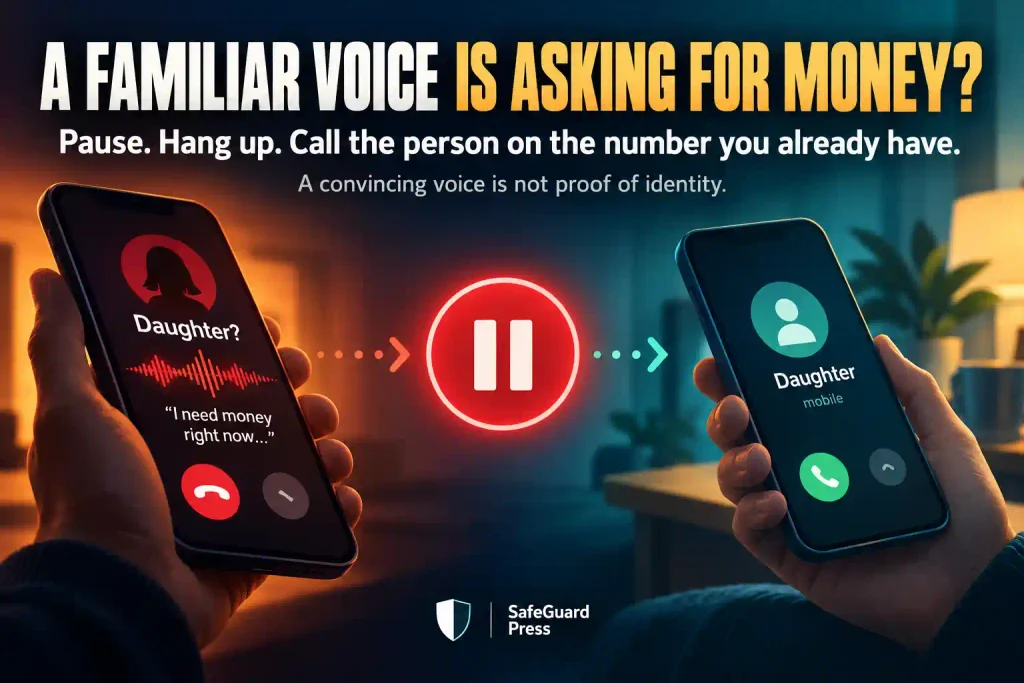
Deepfake scams exploit trust, familiarity and emotion.
Most people become suspicious when an unexpected text asks for money. However, those doubts may disappear when the request comes from a familiar face or voice.
Scammers understand this. They use synthetic media to bypass the victim’s normal caution.
They may collect material from:
- Social media videos
- Public interviews
- Voice notes
- Podcasts
- Online meetings
- Family photographs
- Company websites
- Professional profiles
- Public speeches
The scammer may also study relationships, job titles, travel plans and recent events to make the story more believable.
Nevertheless, the fake does not need to withstand hours of analysis. It only needs to survive a short interaction while the victim is frightened, excited or distracted.
A dimly lit video call can conceal facial problems. Background noise can hide unnatural audio. A supposed emergency can prevent questions. A “confidential” business request can stop an employee from consulting a colleague.
That is why visual clues alone are not enough.
The most reliable signs often come from the request—not the pixels.
Visual Defect or Genuine Danger?
Technical problems can make authentic media look suspicious. The surrounding behavior helps you determine whether a harmless defect has become part of a scam.
| What you notice | Possible innocent explanation | When it becomes dangerous |
|---|---|---|
| Delayed lip movement | Weak internet connection | The person also demands money and refuses verification |
| Blurry facial edges | Video compression or virtual background | The face repeatedly warps during movement |
| An unusual voice | Stress, illness or poor reception | The caller avoids personal questions |
| A new telephone number | The person changed phones | The new contact immediately requests money |
| A short video call | Poor connection or limited time | The caller refuses to reconnect through a trusted number |
| A celebrity endorsement | A legitimate paid promotion | The offer cannot be found on any official channel |
| A strange background | Virtual background software | Objects disappear, bend or change between frames |
| An urgent request | A genuine emergency | You are ordered to remain silent or use an unusual payment method |
One clue should make you cautious. Several connected clues should make you stop.
The 17 Warning Signs of Deepfake Scams
The following signs examine the media, the supposed identity and the request. The later behavioral signs are often more dependable than visible defects because sophisticated deepfakes may look convincing.
1. The Lips and Words Do Not Remain Synchronized
Watch the mouth closely.
In some manipulated videos, the lips begin moving slightly before or after the words. The mouth may not form sounds correctly, or the synchronization may work during one sentence and fail during another.
Look for repeated problems such as:
- Teeth appearing or disappearing
- The jaw remaining still during forceful speech
- Blurring around the mouth
- Words continuing after the lips stop
- Expressions changing before the corresponding words
- Synchronization repeatedly shifting during the video
A weak internet connection can create temporary delays. Therefore, one moment of poor synchronization is not proof.
Repeated mismatches combined with an unusual request deserve greater concern.
2. Facial Edges Flicker, Blur or Change Shape
AI face manipulation can struggle where the face meets the surrounding image.
Examine the:
- Hairline
- Chin
- Jaw
- Ears
- Neck
- Glasses
- Facial hair
These areas may flicker, soften or change shape when the person turns their head.
The effect can be more noticeable when a hand, microphone, cup or another object passes in front of the face. Part of the object may appear to disappear or blend into the skin.
Newer systems can avoid many of these defects. A clean facial outline does not prove that a video is genuine.
3. Skin Texture or Color Looks Inconsistent
A generated face may appear waxy, overly smooth or heavily airbrushed.
You might also notice that:
- The forehead is smooth while the cheeks contain natural detail
- The face and neck have different skin tones
- Wrinkles appear and disappear
- Facial hair blends into the skin
- The face looks much sharper than the body
- Shadows affect the face and ears differently
Filters, makeup and camera processing can create similar effects. Treat this as a clue that requires additional verification, not a final verdict.
4. The Lighting, Shadows or Reflections Do Not Agree
Real light should affect the person and environment in a consistent way.
In a manipulated image, the face may appear brightly lit while the body remains dark. A shadow may move in the wrong direction, or reflections in glasses may not match the visible room.
Ask:
- Does the light hit the face and neck from the same direction?
- Do both eyes have believable reflections?
- Does the shadow move when the person moves?
- Does the face cast a natural shadow?
- Do glasses reflect the surrounding environment?
- Does the person look pasted onto the background?
These inconsistencies are easier to notice when you pause the video at several points.
5. Eye Movements or Blinking Feel Unnatural
Deepfakes have become better at generating blinking, so the outdated advice to “look for someone who never blinks” is not enough.
Instead, examine whether the eyes behave consistently with the person’s head and attention.
Possible irregularities include:
- Pupils moving in different directions
- Eyelids distorting during a blink
- The gaze remaining fixed while the head moves
- Eye contact that appears unnaturally constant
- Reflections changing without changes in lighting
- One eye briefly changing size or shape
Some real people behave unusually when nervous, reading a script or concentrating. Combine eye irregularities with other evidence.
6. The Face, Voice and Emotion Do Not Match
Genuine emotion affects more than the mouth.
A frightened person may show tension around the eyes, changes in breathing and less controlled movement. A joyful person usually changes their voice, posture and expression together.
In a deepfake, these elements may not agree.
A caller may claim to be terrified while speaking with perfectly even breathing. A supposed executive may describe an emergency while showing almost no facial tension. Someone may smile, but the movement stops around the mouth.
This emotional mismatch matters most when the sender is using fear, sympathy or excitement to influence your decision.
7. The Voice Sounds Flat, Metallic or Artificially Clean
A cloned voice may strongly resemble the real person while still containing small irregularities.
Listen for:
- Flat emotion
- Unnatural pacing
- Metallic undertones
- Abrupt changes in volume
- Missing breaths
- Awkward pauses
- Mispronounced names
- Repeated intonation
- Words that sound joined together
- Speech that is unusually clean despite a noisy environment
Do not assume an unfamiliar sound proves the voice is fake. Illness, fear, poor reception and different microphones can change someone’s voice.
Instead, examine how the caller responds when you ask an unexpected question.
For more telephone-specific verification steps, read how to identify a scammer on the phone before trusting an urgent caller merely because the voice sounds familiar.
8. Background Noise Does Not Match the Story
Listen beyond the voice.
Someone claiming to be in a busy hospital may have a completely silent background. A person supposedly calling from a police station may have a repeating sound loop. Traffic noises may stop abruptly between sentences.
Other clues include:
- The voice and background having different sound quality
- Repeated coughs, footsteps or announcements
- An echo that suddenly disappears
- Environmental sounds continuing unchanged after the speaker moves
- Background noise that cuts out whenever the person speaks
Noise-suppression tools can also remove background sounds from legitimate calls. The inconsistency becomes important when the story already contains other warning signs.
9. The Person Avoids Unscripted Questions
This is more important than strange blinking or distorted hands.
A prerecorded video, cloned voice or AI-assisted script works best when the conversation follows a predictable path. Unexpected questions can expose the deception.
The person may:
- Ignore what you asked
- Repeat an earlier sentence
- Give a vague response
- Change the subject
- Claim the connection is failing
- Hand the call to someone else
- Become angry that you are delaying
- End the call after being challenged
Ask something the real person should know but a scammer could not easily find online.
Good questions involve private shared experiences. Bad questions involve birthdays, schools, relatives and pets that may appear on social media.
10. They Refuse an Unpredictable Live Movement
During a suspicious video call, ask the person to perform an unexpected action.
For example:
- Slowly turn your head to the side
- Touch your left ear with your right hand
- Move your hand across your forehead
- Hold up three fingers beside your face
- Pick up a nearby object
- Stand and move farther from the camera
Real-time face manipulation may struggle with sudden movement, side angles or objects crossing the face.
However, this test is not conclusive. Advanced systems may handle the movement, and the scammer could be using a real actor with an altered appearance.
Even if the person passes, independently call the person or organization before acting.
11. Background Objects, Hands or Accessories Change
While the face attracts your attention, other parts of the image may reveal manipulation.
Look for:
- Extra or misshapen fingers
- Jewelry changing position
- Glasses merging with the face
- Earrings disappearing
- Clothing patterns moving unnaturally
- Doorframes bending
- Furniture changing shape
- Hair blending into the background
- Objects appearing or disappearing
- Reflections showing a different scene
AI media continues to improve, so obvious anatomical mistakes are becoming less dependable. Use these flaws as supporting evidence.
12. Text, Logos, Documents or Numbers Look Wrong
Scam videos may include fake news banners, identification cards, account balances, websites or company logos.
Pause and inspect them.
Warning signs include:
- Misspelled names
- Reversed letters
- Meaningless writing
- Inconsistent fonts
- Incorrect telephone formats
- Logos with unusual proportions
- Identification details that change
- Website addresses that imitate a legitimate company
- Captions that do not match what the person says
A perfectly reproduced logo does not establish authenticity. Anyone can copy official branding. Verify the organization using contact information obtained independently.
13. The Account or Telephone Number Is New
A criminal may use a familiar face or voice while contacting you from an unfamiliar account.
Common explanations include:
- “I lost my phone.”
- “My account was hacked.”
- “This is my new work number.”
- “I am travelling.”
- “My normal account is temporarily blocked.”
- “Move the conversation to this private application.”
Any one explanation could be legitimate. The risk rises when the new contact immediately introduces an emergency, investment or payment request.
Never use information supplied by the suspicious sender to verify the suspicious sender.
Call the person using a number you already saved or obtain the organization’s number directly from its official website.
14. The Story Creates Fear, Excitement or Sympathy
Scammers need emotion to move faster than reason.
They may claim:
- Your child has been arrested
- A relative has been kidnapped
- Your manager needs an emergency payment
- Your bank account is under attack
- A celebrity has revealed a private investment opportunity
- You have won an expensive prize
- A romantic partner is trapped abroad
- Intimate content will be published
- A once-only offer is about to expire
Notice what happens inside your body. A sudden rush of panic or excitement is a reason to pause, not act.
The stronger the emotion, the more important independent verification becomes.
15. The Request Involves Secrecy or Isolation
A legitimate emergency may require speed. It rarely requires you to avoid everyone who could confirm the story.
Be suspicious if the person says:
- “Do not tell your family.”
- “Stay on the line.”
- “Do not contact your bank.”
- “This transaction is confidential.”
- “Do not speak to another employee.”
- “The police cannot be trusted.”
- “You will ruin everything if you call anyone.”
- “Only I can help you.”
Secrecy protects the scam, not the victim.
Before complying with a confidential request, confirm it through the organization’s established procedure.
16. They Request Money, Credentials or Remote Access
This is where the illusion becomes financially dangerous.
The supposed person may request:
- Gift cards
- Cryptocurrency
- A wire transfer
- Cash through a courier
- A transfer to a “safe account”
- Banking passwords
- One-time verification codes
- Copies of identity documents
- Remote access to your device
- Installation of an unfamiliar application
- Payment to release winnings or profits
No convincing face, voice or video changes the risk attached to these requests.
A bank will not need your password to secure your account. A legitimate authority will not require gift cards. A genuine executive should not bypass payment controls because a matter is supposedly confidential.
17. They Resist Independent Verification
This is the strongest deepfake scam warning sign.
A genuine person facing an emergency may be impatient, but they should understand why you need to confirm an unusual request.
A scammer may react by:
- Becoming aggressive
- Increasing the threat
- Ending the video
- Claiming verification is impossible
- Insisting the visible face is enough
- Warning that someone will be hurt
- Saying the opportunity will disappear
- Refusing to let you call back
- Providing another number controlled by the same criminal
You do not need the sender’s permission to verify the claim.
End the interaction and reconnect using information the sender did not provide.
The S.A.F.E. Deepfake Test
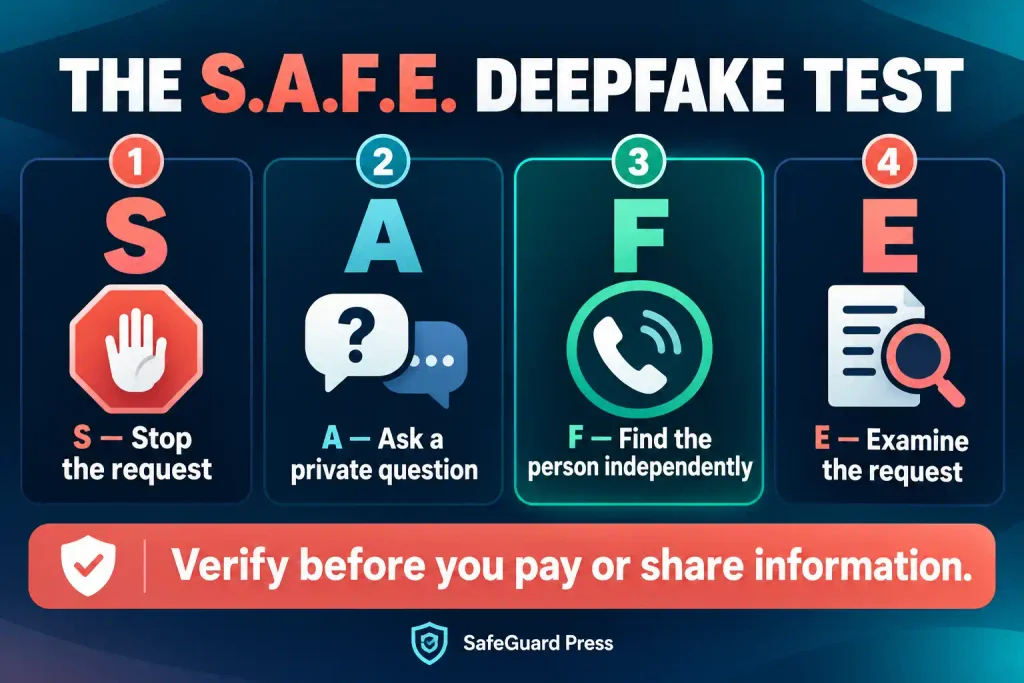
When an unexpected voice, image or video asks you to act, use this four-step test.
It works even when you cannot see any technical defect.
S — Stop the Request
Do not send money, share information, click a link or install anything.
Take a breath and write down exactly what the person wants you to do. Turning the request into plain language can expose the danger.
For example:
“A person using an unfamiliar number wants me to send cryptocurrency before I speak to anyone else.”
That sounds very different from “My son needs help.”
A — Ask an Unpredictable Question
Ask something based on a private shared experience.
You might ask:
- “What did we discuss in the kitchen yesterday?”
- “Where did we sit the last time we met?”
- “What private joke do we share?”
- “What did you ask me to buy last week?”
For a business call, ask about a recent internal matter that is not publicly available.
Do not reveal the correct answer if the person gets it wrong.
F — Find the Real Person Independently
End the call.
Contact the person through a saved number, verified account or trusted third party. If the request supposedly came from a bank or organization, find its official number yourself.
Do not call a number appearing in the suspicious message, video or advertisement.
E — Examine the Request, Not Just the Media
Ask:
- Is this request normal?
- Why must it remain secret?
- Why is the payment method unusual?
- Can the claim be confirmed officially?
- Does the person benefit if I act before verifying?
- What happens if I wait five minutes?
A deepfake may look perfect. A fraudulent request rarely survives careful examination.
Common Types of Deepfake Scams
Deepfakes can strengthen many established fraud schemes. Understanding the larger scam helps you recognize the purpose of the false media.
Family-Emergency Scams
A criminal imitates a child, grandchild, spouse or parent and claims that an accident, arrest or kidnapping has occurred.
The familiar voice may remain on the call briefly before another person takes over. The second caller pretends to be a lawyer, police officer, doctor or kidnapper and demands payment.
Call the relative directly. If they do not answer, contact someone who can physically confirm their location.
Celebrity Investment Scams
A manipulated video shows a well-known entrepreneur, politician, presenter or financial expert promoting an investment opportunity.
The advertisement may lead to a fake news article, messaging group or trading website. The platform may initially display fabricated profits to encourage larger deposits.
Never treat a celebrity video as financial verification. Confirm the company’s registration, website history and withdrawal conditions independently.
Deepfake Romance Scams
A criminal creates a false romantic identity using generated photographs, stolen content or manipulated video calls.
After establishing trust, the person introduces:
- A medical emergency
- A travel problem
- A frozen bank account
- A lucrative investment
- A business crisis
- A request for cryptocurrency
A video call does not prove that the identity, name or history is genuine.
Workplace and Executive Impersonation
An employee receives a call or joins a video meeting with someone who appears to be a senior executive.
The supposed executive requests an urgent wire transfer, new payment details, payroll information or confidential company data.
Businesses must require separate authorization for high-risk requests. A familiar face should never replace financial controls.
Fake Government or Police Calls
A caller appears in uniform or uses an official-looking video background. The victim is accused of tax fraud, money laundering, identity theft or another crime.
The criminal may display fake identification or legal documents and order the victim to remain on camera.
Real authority does not come from a costume, logo or video background. Contact the agency directly through its official published number.
Deepfake Job and Recruitment Scams
A fake recruiter or employer may conduct a convincing video interview before requesting identity documents, bank details, advance payments or purchases from a specified supplier.
Businesses can also face the opposite problem: a candidate using an altered identity during an interview to obtain access to systems or sensitive information.
Employment verification should extend beyond a video call.
Deepfake Sextortion
A criminal creates or threatens to create fake intimate material depicting the victim.
The person may demand money, additional images or account credentials in exchange for not publishing it.
Paying does not guarantee deletion. Preserve the evidence, stop engaging, report the account and seek immediate help.
Fake Giveaways and Product Endorsements
A manipulated celebrity video promotes a prize, giveaway, health product or exclusive offer.
The victim may be asked to pay a small delivery fee. The real purpose may be collecting card information, stealing personal data or enrolling the victim in recurring charges.
Verify the promotion on the company’s official website before entering any information.
What to Do After Encountering a Suspected Deepfake
Your response should depend on what has already happened.
If You Saw It but Did Not Interact
Take these steps:
- Do not click any associated link.
- Save the post address or take a screenshot.
- Report the content through the platform.
- Warn the impersonated person or organization.
- Avoid sharing the original content unnecessarily, even to expose it.
When warning others, use a screenshot clearly marked as false instead of redistributing the deceptive video without context.
If You Shared Personal Information
Act immediately:
- Change the password of the affected account.
- Change any other account using the same password.
- Secure your email account first because it may control password resets.
- Enable multifactor authentication.
- Contact your bank if financial details were exposed.
- Monitor accounts for unfamiliar activity.
- Consider placing a fraud alert or credit freeze where available.
- Preserve the messages and account information.
- Report the impersonation and fraud attempt.
Never share a verification code with someone who contacts you unexpectedly. A code intended to protect your account can also be used to take it over.
If You Sent Money
Do not spend hours arguing with the scammer.
Instead:
- Contact the bank, card issuer or payment service immediately.
- Ask whether the transaction can be stopped, recalled or disputed.
- Contact the gift-card issuer if gift cards were used.
- Report cryptocurrency details to the exchange involved.
- Save transaction references, wallet addresses and receipts.
- Change exposed passwords.
- Report the crime.
- Ignore anyone promising guaranteed recovery for an upfront fee.
Recovery scammers target people who have already lost money. They may claim to be investigators, lawyers or hackers capable of retrieving everything. Their service may be another fraud.
If Your Face or Voice Was Used
Take these actions:
- Save copies or screenshots as evidence.
- Record every username, link and date.
- Report the content as impersonation or manipulated media.
- Warn family members, colleagues and customers.
- Post a clear correction through your verified channels when appropriate.
- Review account security for signs of compromise.
- Search for other copies of the material.
- Contact law enforcement if the content supports fraud, threats or blackmail.
- Obtain legal advice when the impersonation causes serious financial or reputational harm.
Do not destroy evidence while trying to remove the content.
Where to Report a Deepfake Scam in the United States
Reporting creates a record and may help platforms, financial institutions and investigators connect related cases.
Depending on what happened, report the incident to:
- The social media, dating or video platform where the content appeared
- Your bank, card issuer or payment provider
- The Federal Trade Commission through ReportFraud.ftc.gov
- The FBI’s Internet Crime Complaint Center through IC3.gov
- Your local police department when money, threats or blackmail are involved
- The impersonated business or public figure through an official channel
- Credit-reporting agencies if identity information was exposed
If a child is involved in sexualized fake imagery, seek immediate help from the appropriate child-protection and law-enforcement services. Do not download, forward or repeatedly share the material.
Readers outside the United States should report to their national fraud-reporting center, local police, financial institution and the platform hosting the content.
How to Protect Your Family From Deepfake Scams
You cannot prevent every attempt, but you can make your family much harder to deceive.
The most effective measures are simple enough to use during a frightening call.
Create a Private Family Verification Phrase
Choose a word or short phrase that does not appear online.
Do not use:
- A birthday
- An address
- A school
- A pet’s name
- A family member’s middle name
- A favorite sports team
Everyone should understand that an emergency financial request must be independently verified even when the caller knows the phrase. The phrase is an extra barrier, not permanent proof.
Establish a Callback Rule
Agree that nobody in the family will send money solely because of an incoming call or video.
The recipient must end the interaction and call back using an existing trusted number.
This rule removes the scammer’s control over the conversation.
Limit Unnecessary Public Information
Review what strangers can learn from your accounts.
Public posts may reveal:
- Family relationships
- Travel plans
- Schools
- Workplaces
- Birthdays
- Daily routines
- Voice recordings
- Recent purchases
- Private nicknames
You do not need to delete every photograph or video. However, removing unnecessary personal details can make a tailored impersonation more difficult.
Practice a Fake Emergency
Ask your family:
“What would you do if you heard my voice saying I had been arrested and needed money?”
Let everyone practice the correct response:
- Stop.
- Ask a private question.
- Disconnect.
- Call a trusted number.
- Confirm through another family member.
Practice matters because panic can make familiar rules difficult to remember.
How Businesses Can Prevent Deepfake Fraud
Organizations should assume that voices, faces and caller identification can be imitated.
This does not mean distrusting every employee. It means using procedures that do not collapse when an impersonation looks convincing.
Require Separate Payment Verification
A high-risk request should be confirmed through a second channel controlled by the company.
For example, a video request could require approval inside a protected financial system and confirmation from another authorized employee.
Use Multiple Approvers
One employee should not be able to release a large or unusual payment based entirely on an email, telephone call or video meeting.
Additional approval creates time for inconsistencies to emerge.
Protect Changes to Payment Details
Requests to change a supplier’s bank account should be confirmed using contact information already stored in company records.
Do not use the new telephone number included in the change request.
Create Internal Challenge Codes
Teams handling sensitive information or payments can use rotating internal verification procedures.
Avoid permanent codes that remain unchanged for years or appear in insecure messages.
Train Employees to Challenge Senior Staff
Employees must know they will not be punished for delaying a suspicious request from an executive.
A policy is useless if workplace culture makes staff afraid to follow it.
Limit Public Operational Details
Job titles, reporting relationships, travel announcements and supplier information can help scammers create believable stories.
Review what the company publishes and whether every detail needs to be public.
Prepare an Incident Plan
Employees should know:
- Whom to contact
- How to freeze a payment
- How to preserve evidence
- How to warn other departments
- How to secure compromised accounts
- Who communicates with customers or the public
Speed and clarity can reduce losses after an impersonation attempt.
Can Deepfake Detection Tools Be Trusted?
Detection tools can be useful, but they are not lie detectors.
A detector may analyze:
- Facial movement
- Audio characteristics
- Compression patterns
- Pixel inconsistencies
- Metadata
- Signs of synthetic generation
However, a genuine file may appear suspicious after editing, compression or repeated uploading. A sophisticated fake may escape detection.
Different tools may also produce different results.
Use detection software as supporting evidence, not as the only reason to trust or reject media.
A safer decision combines four questions:
- Who sent it?
- Can the identity be confirmed independently?
- Does the request make sense?
- What happens if I refuse to act immediately?
Even genuine media can be used deceptively. A real video might be stolen, edited or presented with a false story.
The Most Reliable Deepfake Warning Signs
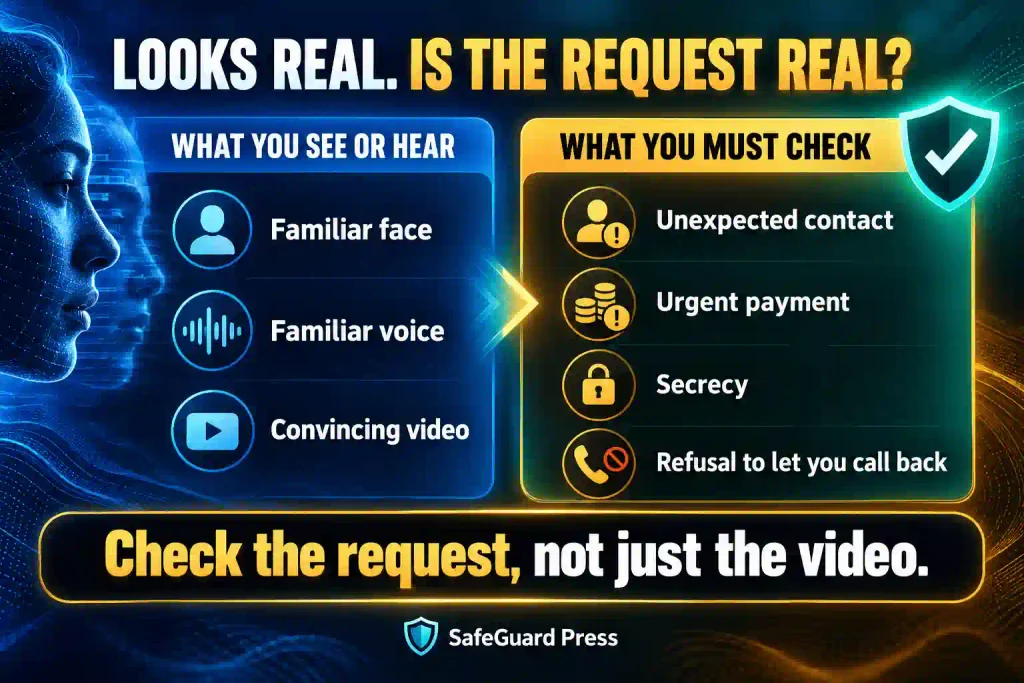
Visual defects receive the most attention because they are easy to demonstrate. They are not necessarily the strongest evidence.
These behavioral signs deserve greater weight:
- The contact is unexpected.
- The account or number is unfamiliar.
- The story produces intense emotion.
- The person demands immediate action.
- You are instructed to keep the matter secret.
- The payment method is unusual or difficult to reverse.
- The claim cannot be found on an official channel.
- The person resists independent verification.
If none of the visual clues appear but several of these behavioral signs do, treat the communication as dangerous.
Use the broader scam warning signs that can expose a fraudster to evaluate the complete interaction rather than becoming fixated on whether one face or voice was generated by AI.
Which Warning Signs Indicate A Call From A Familiar Voice Is A Deepfake Scam?
Warning signs include an urgent request for money, pressure not to call anyone else, a call from a new number, odd pauses, or a caller who avoids personal questions. A familiar voice does not make the request safe.
Imagine your daughter calls and says she has been in an accident. Her voice sounds exactly right, but she needs money immediately and begs you not to contact anyone else. That combination is a reason to stop and check, even if you recognize her voice.
A strange sound alone does not prove the voice is fake. Stress, a poor connection, or a different phone can change how someone sounds. End the call and contact the person using a number you already have.
Frequently Asked Questions About Deepfake Scams
Deepfake technology is changing quickly, but the principles of safe verification remain dependable. These answers address the most important practical questions.
What is a deepfake scam?
A deepfake scam uses AI-generated or digitally manipulated audio, video or images to deceive someone. The false media may impersonate a relative, celebrity, romantic partner, executive or authority figure.
How do I know if a video is a deepfake?
Look for inconsistent lip movement, facial edges, lighting, reflections, expressions and background details. However, independent identity and claim verification are more reliable than appearance alone.
Can scammers deepfake a live video call?
Yes. Real-time face manipulation can alter a person’s appearance during a live call. A video conversation is not automatic proof that the name, face and history belong to the caller.
Can a FaceTime call be deepfaked?
A caller can use manipulated, prerecorded or AI-assisted media through various communication services. Do not treat the application being used as proof. Call the person through trusted details and verify the request separately.
Can a WhatsApp video call be deepfaked?
A video call on WhatsApp or another messaging service can contain manipulated visuals or a person using a false identity. The platform cannot replace independent verification.
Can scammers clone the voice of someone I know?
Yes. Public or stolen recordings can be used to generate speech resembling another person. A familiar voice should never be the sole basis for sending money or disclosing information.
How much audio does a scammer need to clone a voice?
The amount varies by tool and desired quality. Instead of assuming short clips are harmless, treat public voice recordings as information that could potentially support impersonation.
Can a deepfake look completely real?
Some manipulated media can be extremely convincing, especially during short, low-quality or emotionally charged interactions. That is why behavioral evidence and independent verification are essential.
Is poor lip-sync proof of a deepfake?
No. A weak internet connection or editing problem can affect synchronization. Repeated mismatches combined with urgency, secrecy or an unusual request deserve investigation.
Is unusual blinking still a reliable test?
Not by itself. Modern systems can generate natural-looking blinking, while genuine people may blink unusually. Examine several visual and behavioral clues together.
How can I test someone during a suspicious video call?
Ask an unpredictable private question and request an unexpected movement. Then end the call and contact the real person using trusted details. The callback is more important than the movement test.
What questions should I ask a suspected voice clone?
Ask about a private shared experience that was never posted publicly. Do not ask about birthdays, relatives, schools or other facts a scammer could research.
What is a family safe word?
It is a private phrase family members can use during emergencies. It should not appear online and should be combined with an independent callback rather than treated as permanent proof.
How can I check whether a celebrity video is real?
Visit the celebrity’s verified channels, inspect the company independently and look for confirmation outside the advertisement. Do not follow links supplied with the suspicious video.
Are celebrity deepfake scams limited to cryptocurrency?
No. They can promote fake trading platforms, giveaways, health products, subscription schemes and other fraudulent offers.
Can scammers fake a news interview?
Yes. They can alter genuine interviews, replace audio, create false captions or design a page that resembles a news website. Visit the real publication directly and search for the alleged report.
Can reverse-image search expose a deepfake?
It may reveal stolen or previously published media. However, a newly generated image may have no earlier match, so the absence of results does not prove authenticity.
Are deepfake detection websites accurate?
They can provide useful evidence, but no result should be treated as infallible. Media quality, editing and generation methods can affect the outcome.
Can deepfake scams steal my identity?
Yes. False media may be used to obtain identification documents, passwords, banking details, verification codes or remote access to a device.
What should I do if I clicked a deepfake scam link?
Close the page and do not enter more information. Change any password you submitted, secure your email account, check the device and contact your bank if financial information was exposed.
Can my bank recover money lost to a deepfake scam?
Recovery depends on the payment method, timing and circumstances. Contact the bank or payment provider immediately. Delaying reduces the chance of stopping or recalling the transaction.
Should I pay someone threatening me with a fake intimate image?
Paying does not guarantee that the material will be deleted and may lead to further demands. Preserve evidence, stop engaging, report the account and contact law enforcement or an appropriate support service.
What should I do if someone makes a deepfake of me?
Save evidence, report the content, warn people who may be targeted, strengthen account security and search for other copies. Seek legal or law-enforcement help when fraud, threats or serious harm are involved.
Is creating a deepfake illegal?
The answer depends on the location, content and intended use. Fraud, blackmail, impersonation and non-consensual intimate material may violate criminal, civil or platform rules even where no law bans every form of deepfake creation.
What is the best protection against deepfake scams?
Do not treat a familiar face or voice as final proof. Stop the request, ask an unpredictable question, contact the real person independently and examine the behavior surrounding the media.
Final Thoughts
Deepfake scams have changed the meaning of “seeing is believing.”
A photograph can depict someone who never existed. A voice can sound like your child. A celebrity can appear to endorse a fraudulent investment. A criminal can wear another person’s face during a video call.
But the scammer still needs something from you.
They need money, information, access, secrecy or immediate compliance. That request is where the illusion can be broken.
Remember the S.A.F.E. Deepfake Test:
- Stop the request.
- Ask an unpredictable question.
- Find the real person independently.
- Examine the request, not just the media.
Do not waste precious minutes trying to prove which AI tool created a suspicious video. Protect your money and accounts first.

Pingback: Deepfake Video Call Scams: 13 Red Flags and a 90-Second Verification Test - SafeGuard Press
Pingback: How to Catch a Scammer: What to Check Before They Disappear - SafeGuard Press