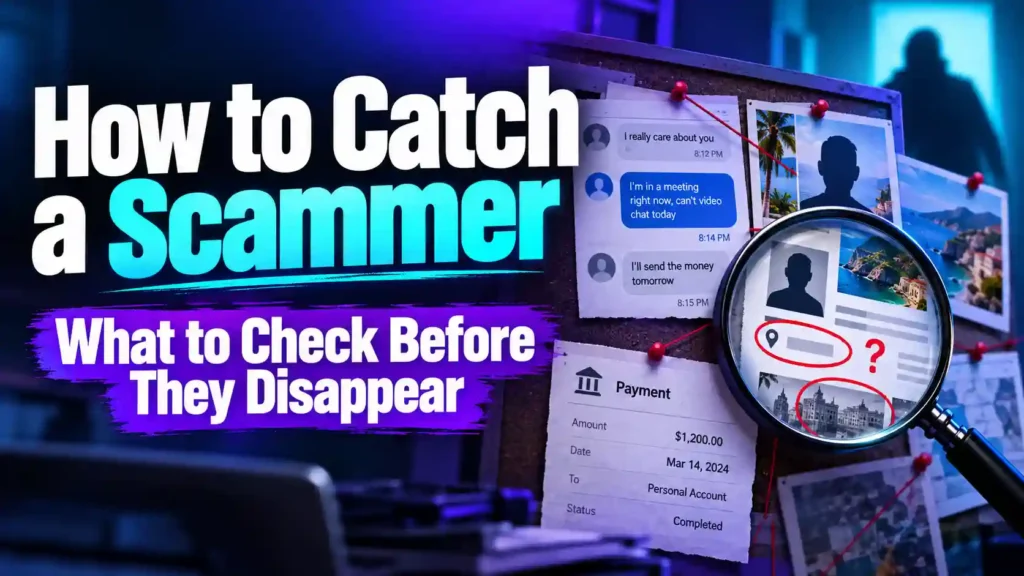
The message is still on your screen. The person has been friendly, convincing, perhaps even patient. But something has changed. They need money today. They want a code sent to your phone. Or the story they told yesterday no longer quite matches what they are saying now.
You want to know who you are dealing with before they delete the account and vanish.
So how do you catch a scammer?
The first thing to understand is that there are two different goals. You may be able to catch someone in a false claim by checking their story. You may also be able to save the details that help a bank, platform, or investigator follow what happened. Finding the real person behind an account is much harder. A photograph, phone number, or payment name can belong to someone else.
That does not leave you powerless. It tells you where to focus. The most useful question is rarely “How do I make them confess?” It is: “Which part of this story can I check without relying on the person telling it?”
How to Catch a Scammer Before You Send Anything
If you are still in contact with the person, stop at the next request. Do not send money, share a verification code, open another link, or install an app while you investigate.
Then follow these steps:
- Save the conversation as it stands. Keep the original messages and take screenshots showing the account, request, dates, and times.
- Identify the claim. Write down who the person says they are and what they want you to believe.
- Find an independent way to check it. Call someone using a number you already had, open your bank’s official app, or contact a company through details you found yourself.
- Check whether the evidence matches the request. A real photograph or genuine company name does not automatically make a request for money genuine.
- Act on any exposure immediately. If you paid or shared account details, contact the affected bank or service before doing more research.
- Report the account and the incident. Give the relevant platform or authority a clear record of what happened.
The order matters. People often spend hours searching a profile while a payment is still pending or an account remains accessible to someone else. Protecting yourself comes first.
Start With the Claim, Not the Profile
A polished profile can pull your attention toward the wrong question. You might study the photograph, count followers, or search the name. Meanwhile, the person’s actual request goes unchecked.
Suppose a message says, “Hi Mum, my phone broke. This is my new number. Can you pay this bill for me?”
The claim to test is not whether the sender knows your child’s name. They may have found that online. The claim is that your child controls the new number and needs the payment. Call your child on the number you already know or reach them through another established contact.
Now imagine a caller says, “I’m from your bank. Someone is stealing your money. Move it to this safe account immediately.”
The claim to test is that your bank has instructed you to make that transfer. End the call. Open the bank’s app or call the number printed on your card. Ask whether the warning is genuine.
With an online seller, the claim might be that an item exists and will be shipped after you pay. With a romantic contact, it may be that their identity and emergency are real. With a supposed employer, it may be that the job offer came from the actual company.
Once you name the claim, the next step becomes clearer. You need a source the person cannot easily control.
Check Their Story Without Following Their Instructions
A scammer may happily offer “proof.” They might send a staff ID, a company website, a video, or a phone number for someone who will vouch for them. All of it can be staged.
That does not mean every document is fake. It means evidence supplied by the person making the claim should not be your only check.
If they claim to be someone you know
Use a contact method you had before the suspicious message arrived. Call your friend, relative, or colleague on their saved number. If you cannot reach them, pause the request until you can.
Be especially careful when the person says you must keep the matter secret or cannot call because their phone is broken. Those explanations may be part of the story you need to verify.
A familiar voice or face is no longer enough on its own for a high stakes request. If someone appears in a video call and urgently asks for a transfer, confirm the instruction through your normal approval route or another established channel. Deepfake scams: warning signs an AI video, voice, or image is fake explains why convincing media can still mislead you.
If they claim to represent a company
Find the company’s contact route yourself. Use its official app, a number on a statement or card you already own, or a website address you know is correct. Do not rely on the link or telephone number inside the suspicious message.
Ask a direct question: “Did your company contact me about this issue?” If the caller supplied a case number, you can ask whether it exists. Never read a one-time login or payment code to someone who contacted you unexpectedly.
Also check what action the person wants. A scammer might use the real name of your bank while asking you to send money to an account the bank does not control. Confirming that the bank exists proves nothing about that request.
If they claim to be an online seller
Check the listing and seller history inside the marketplace. Keep the conversation and payment within the platform where its protections apply. If the seller insists you move to another messaging app or send a deposit directly, pause.
Ask for information that can be checked through the marketplace’s normal process. Do not mistake a photograph of an item for proof that the seller owns it. Images can be copied from another listing.
Likewise, if you are the seller, check the order status inside your own marketplace or payment account. A buyer’s screenshot saying “payment sent” is not proof that you have been paid.
Search for Clues, but Know What They Prove
A quick search can reveal a copied script or reused identity. It can also produce misleading results. Use it to find leads, then judge each lead carefully.
Search a distinctive sentence from the message inside quotation marks. Try the username, email address, website address, or business name with words such as “scam” or “complaint.” Look for repeated wording, conflicting claims, and reports describing the same payment request.
No results? That does not clear the person. A new account or new script may have no searchable history.
Several results calling a number a scam? Read what those reports actually say. Numbers can change hands, and caller ID can be misleading. The reports may support your concern without identifying the current sender.
The strongest checks connect directly to the claim. If someone says they work for a company, an independent response from that company matters more than a general search result. If they say they are your brother using a new number, a call to your brother matters more than the number’s online reputation.
Check profile photographs without accusing the person pictured
A reverse image search may show that a profile photo appears under another name. That is an important inconsistency, particularly when someone is building a relationship and asking for money.
But the person in the picture may be innocent. Scammers often take photographs from real people. Finding the original photograph can tell you the account’s identity claim is unreliable; it does not tell you who operates the account.
Save the pages you found and the dates you saw them. Do not message or publicly name the person pictured. For romance scams, the FTC also recommends checking whether a profile picture appears with another name or conflicting details. consumer.ftc.gov
Look for changes in the story
Sometimes the most useful evidence comes from what the person has already said.
Did they first say they live nearby, then explain they are stuck overseas? Did a seller promise collection today, then demand an unexpected shipping fee? Did an online partner describe a job differently when asking for money?
One mistake is not proof of fraud. People forget details. Look at whether the inconsistencies affect the reason you are being asked to trust or pay them. A changing story, urgent deadline, and refusal to allow independent verification form a more concerning pattern than a typo.
What Evidence Should You Save?
If the account disappears tomorrow, what would you need to show someone who has never seen the conversation?
Start with the original messages or emails. Then save:
- The profile URL, username, display name, phone number, or email address
- The advert, product listing, website, or post that led you to the person
- The exact request for money, account access, personal information, or a verification code
- Payment instructions and recipient details
- Receipts, transaction IDs, amounts, and dates
- Any threats or attempts to move the conversation to another platform
- The results of an independent check, such as a response from the real company
Keep a brief timeline alongside the records. For example:
“On Monday, I replied to a laptop listing. On Tuesday, the seller moved our conversation to WhatsApp and requested a deposit. I sent $150 at 2:14 p.m. The next day, the seller requested another $80 for delivery and stopped answering when I asked to collect the laptop.”
A timeline makes a report easier to understand than a folder of unexplained screenshots.
Keep the full conversation where possible. A cropped image may leave out details that later matter. If you received an email, retain the original message. If a website or account is still visible, save its exact address before it changes.
Store the records somewhere you can find them. Avoid posting personal details publicly in an attempt to rally strangers to investigate. Your evidence is most useful when it reaches your bank, the platform, or an appropriate reporting authority.
Can You Trace a Scammer Yourself?
You can often trace parts of the interaction: which account contacted you, where a link led, and where you sent a payment. Tracing those parts is not the same as identifying the criminal.
The number may be spoofed. The account may be stolen. The photograph may come from a stranger’s page. The person named on a payment account may have received and forwarded money for someone else. Even a genuine video call may not establish who controls the payment destination.
That is why claims such as “I found their real identity from one phone number” deserve skepticism. Record exactly what you found without stretching it:
- “This account requested payment.”
- “This address appeared in the message.”
- “This transaction went to the following recipient.”
- “The profile photo also appeared on this other page.”
Those are useful facts. “This person is the criminal” may be a conclusion the facts do not support.
Resist the urge to expose an address or photograph online. You could target an innocent person and alert the scammer before your report is reviewed.
What If You Already Paid the Scammer?
Stop investigating for a moment and contact the payment provider.
Use your bank’s official app or contact number. Explain that you believe you were deceived into making a payment. Give the amount, date, transaction ID, recipient details, and a short account of the events. Ask what options are available to stop, dispute, recall, or investigate the payment.
What the provider can do depends on how you paid and the circumstances. A refund is never guaranteed. Reporting quickly still gives you a better chance of getting timely help than waiting to discover the scammer’s real name.
Next, consider what else the person obtained. If you shared a password, change it through the real service. If you shared a verification code, tell the affected service immediately. If you allowed remote access to your device, stop that access and contact the relevant bank or account provider from a trusted device.
For a fuller response checklist, read Been scammed? Do these five things in the next hour. The priority is to limit further harm while the incident is fresh.
How to Report the Scammer
Report the account, advert, or message on the platform where you encountered it. Include the account link or username and explain the specific conduct: the payment demand, impersonation, suspicious link, or threat.
Then report the financial transaction separately to your bank or payment service. A social platform can review an account; it cannot handle your bank dispute for you.
If you are reporting an online crime in the United States, the FBI’s Internet Crime Complaint Center accepts complaints involving internet fraud and related cybercrime. Complaints may be referred to law enforcement or partner agencies for possible investigation. Filing a report does not guarantee an investigation, arrest, or recovery of your money. www.ic3.gov
Outside the United States, use the appropriate fraud reporting or police channel for your location. If a real company is being impersonated, notify it through its genuine contact details. It may be able to act on the fake account or website.
Write the report in plain, factual language. Say what the account did, what you did, and what you can document. Separate observations from suspicions. “The account requested $500 after claiming to be my manager” is more useful than “I know exactly who runs this criminal network.”
Should You Keep Talking Until They Admit It?
Usually, no.
A confession may feel satisfying, but continuing the conversation can expose you to more pressure, threats, harmful links, or requests for personal information. Some scammers will change their story as soon as they sense doubt. Others will disappear. Neither response is necessary to confirm a suspicious payment request through your bank or to report an account.
You can save what you already have, make your reports, and block further contact. If the person threatens to expose private material or harm you, preserve the threats and seek help through the relevant platform and authorities. Avoid arranging a meeting or trying to “trap” them yourself.
Also watch for someone who appears after the scam and promises to trace the culprit or recover your money for a fee. They may be targeting you because you have already suffered a loss. Speak to your payment provider before paying anyone who claims they can retrieve it.
How the Checks Change for Different Scams
The basic method stays the same, but each situation has a different claim to test.
An unknown number messages you on WhatsApp
A display name, photograph, or mutual group does not prove who controls the account. If the sender claims to be someone you know, contact that person another way. If they claim to represent a business, check with the business directly.
Do not click a link or give away a code to test whether the sender is legitimate. How to identify a scammer on WhatsApp covers the signs and checks specific to that app.
Someone you met online asks for emergency money
Focus on the request rather than how long you have spoken. Months of affectionate messages do not verify a person’s identity or the emergency they describe.
Check their claims independently, search the photograph, and talk to someone you trust before paying. If the story involves repeated crises, secrecy, or new fees that must be paid before you can meet, compare it with romance scam warning signs.
A marketplace buyer says they paid you
Open your own marketplace or payment account and check the transaction there. Do not rely on an image of a receipt or an email that asks you to pay a fee before your funds can be released.
Save the buyer’s account details and messages. Report the account if the payment claim proves false.
A supposed executive requests an urgent transfer
Follow your established workplace approval process. Call the executive or another authorized colleague using a known number. Do not let a message, voice note, or video call override the checks normally required for a payment. What is CEO fraud? explains how these requests are used to redirect business funds.
Frequently Asked Questions About Catching a Scammer
Can you catch a scammer using their phone number?
You can save and report the number, but it may not identify the caller or account operator. Treat it as one piece of evidence, not proof of a person’s identity.
Can you find a scammer through their bank account?
A bank account or payment address gives your payment provider a place to start reviewing a transaction. It does not necessarily reveal who directed the scam. Send those details to your provider promptly.
Does a video call prove someone is real?
It shows you had a video interaction. It does not, by itself, verify the person’s name, job, location, or authority to request money. Confirm important claims through another channel.
What if a reverse image search finds nothing?
That result does not prove the photograph is genuine or belongs to the account owner. Continue checking the person’s specific claims and requests.
Should you ask the scammer for their ID?
An ID image can be altered or stolen. Asking for one may produce another convincing-looking image without resolving the question. Use independent verification suited to the claim instead.
What if the scammer deletes their profile?
Use the records you kept: messages, notifications, screenshots, email addresses, profile links, and payment receipts. Tell the platform that the account has disappeared.
Is it worth reporting an attempted scam if you lost no money?
Yes. A platform can review a deceptive account, advert, or message. Report exactly what the person attempted; there is no need to claim a loss that did not happen.
Can you confront a scammer to get your money back?
Confrontation does not create a reliable recovery route and may give the person another chance to manipulate you. Contact your bank or payment provider and submit a factual report.
The Check That Matters Most
When you suspect a scam, it is tempting to search for a face, a name, and a satisfying ending. Meanwhile, the person may still be asking you to pay, click, or share something you cannot take back.
Start with their claim. Check it somewhere they cannot control. Save what happened. If money or an account is involved, contact the provider immediately. Then report the evidence without claiming to know more than you do.
You may never learn the real name of the person behind the screen. You can still catch the false story before it costs you more.
Pingback: eBay Gift Card Scams: How Fake Sellers and Payment Requests Trick Buyers - SafeGuard Press