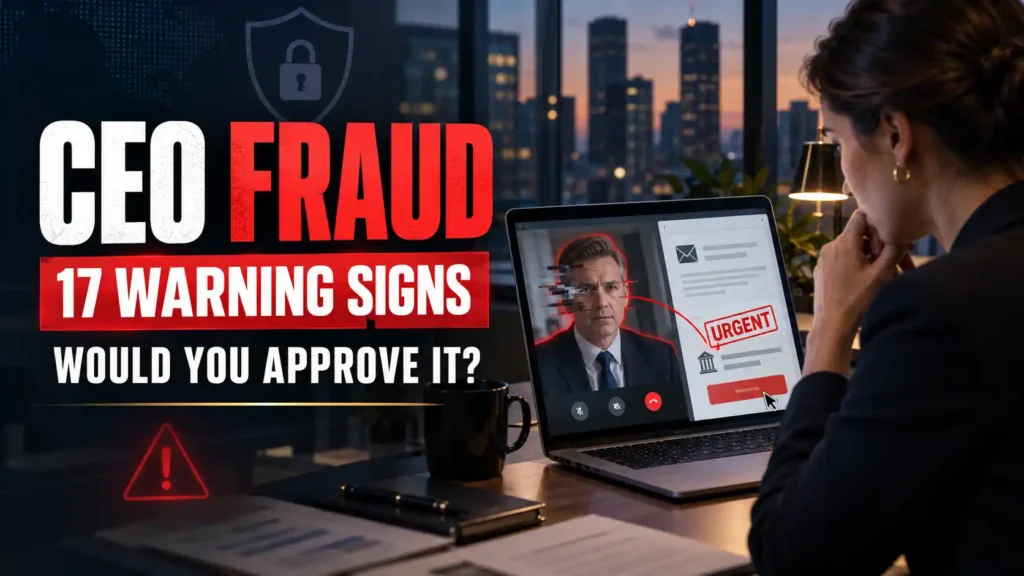
An urgent message arrives from your CEO.
They need a payment approved before a confidential deal closes. They cannot speak because they are in a meeting. You must not involve anyone else. The request uses the CEO’s name, photograph and familiar writing style—and it may even come from the executive’s real email account.
Everything looks convincing.
That is precisely what makes CEO fraud dangerous.
A criminal does not need to break into your accounting system if they can persuade an authorized employee to transfer the money willingly. They exploit authority, urgency, secrecy and fear to push the target past normal verification.
Today, the request might arrive through email, text, WhatsApp, Microsoft Teams, a telephone call, a voice memo or an apparently live video meeting. A familiar face or voice is no longer sufficient proof.
If you receive a voice memo from an executive asking for an urgent payment, you should pause the transaction and verify the request through a separate, trusted channel. Call the executive using a previously verified number—not one supplied in the message. Confirm the recipient, amount and bank details, then follow your company’s normal payment-approval process. A familiar voice does not prove authorization.
If You Receive A Voice Memo From An Executive Asking for An Urgent Payment, What Should You Do?
Do not release the payment based on the recording alone. Pause the transaction, contact the executive independently and verify the payment details before completing the required approvals.
The message might sound exactly like your CEO or finance director. It could mention a real supplier, current project or confidential deal. Those details make the request convincing, but they do not establish that the executive sent it or that the payment is authorized.
Use these five steps.
1. Pause the Payment
Do not send money, add a new beneficiary or change a supplier’s bank details while the request remains unverified.
An urgent deadline does not remove the need for approval. Neither does a statement such as “I take full responsibility” or “We will complete the paperwork later.”
2. Contact the Executive Through a Trusted Route
Call a number from your established company directory or a previously verified contact record. You can also verify in person when practical.
Do not use a new number provided in the voice memo or accompanying message. Replying to the same WhatsApp conversation only reaches whoever controls that account.
The FBI’s business email compromise guidance recommends verifying payment requests and changes to payment procedures directly, and being especially cautious when someone presses you to act quickly.
3. Confirm the Actual Payment Details
Confirm more than whether the executive sent a message. Ask:
- What is the payment for?
- Which invoice, contract or purchase order supports it?
- What amount and currency are authorized?
- Who should receive the money?
- Are the bank details already verified?
- Has anyone requested a change to the beneficiary account?
A real executive can approve a legitimate invoice that contains fraudulent bank details. Verify any new or changed supplier account separately through the supplier’s established contact information.
4. Complete the Normal Approvals
Keep the transaction inside your company’s approved payment process. Obtain every required authorization, including a second approver where company policy requires one.
A voice memo, email confirmation or video meeting should not replace those controls. Two convincing messages can still come from the same attacker.
5. Escalate If Verification Fails
If the executive cannot be reached, keep the payment on hold and contact the designated finance manager, security team or alternate approver through established channels.
Preserve the original recording, surrounding messages, sender details and payment instructions. Report the suspicious request through your company’s incident-reporting process.
An unavailable executive is a reason to escalate—not permission to pay.
Example: “Pay This Supplier Before the Bank Closes”
Illustrative scenario:
You receive a WhatsApp voice memo that sounds like your finance director:
“Please send $18,400 to the supplier now. I’m boarding a flight. Use the new account details I sent, and keep this confidential until tomorrow.”
The familiar voice is persuasive. However, the request combines an urgent deadline, changed bank details, secrecy and an excuse to prevent a callback.
The safe response is to hold the payment, contact the finance director through the company’s established directory and verify the supplier’s bank details independently. If either check fails, escalate the request.
You do not need to prove the recording is AI-generated before refusing to bypass payment controls.
What Can You Say When Someone Pressures You to Pay?
Use this response through your company’s established communication channel:
“I’m holding the payment while I verify the request and beneficiary details through our approved process. Once verification and the required approvals are complete, I can proceed.”
This keeps the conversation focused on procedure without accusing anyone of fraud.
Why Recognizing the Voice Is Not Enough
Criminals can use AI-generated audio to imitate someone you know. The FBI has warned about impersonation campaigns involving AI-generated voice messages.
Unusual pauses or speech patterns may raise suspicion, but natural-sounding audio does not prove authenticity. Voice recognition alone is not a dependable payment check.
For more context, read how AI scams use familiar voices and convincing identities.
The rule to remember: pause the payment, verify independently, check the destination and complete the approvals.
What Is CEO Fraud?
CEO fraud is an executive-impersonation scam in which a criminal pretends to be a company’s CEO or another senior leader to manipulate an employee into sending money, changing payment details, purchasing gift cards, revealing credentials or sharing confidential information.
Despite its name, the impersonated person does not have to be the CEO. A criminal may pose as a:
- Company founder
- Chief financial officer
- Finance director
- Board member
- Senior manager
- Executive assistant
- Lawyer
- Business partner
- Trusted supplier
The expression “CEO fraud” normally refers to someone impersonating an executive. It does not usually refer to a genuine CEO personally committing accounting, investment or corporate fraud.
The intended victim is often an employee with access to money, financial systems, confidential records or senior decision-makers.
How CEO Fraud Works
Most CEO fraud attacks follow a predictable sequence. Understanding that sequence makes suspicious requests easier to recognize.
Step 1: The criminal researches the company
The attacker collects information from company websites, professional profiles, press releases, social-media accounts, public records, stolen data and compromised inboxes.
They may look for:
- Executive names and photographs
- Employee job titles
- Email-address formats
- Reporting relationships
- Suppliers and business partners
- Planned conferences
- Executive travel
- Company acquisitions
- Payment procedures
- Employees authorized to transfer money
The attacker does not need every detail. A few accurate facts can make a false story appear legitimate.
Step 2: The criminal selects a target
An employee may be chosen because they can:
- Approve or initiate payments
- Change supplier details
- Access payroll records
- Purchase gift cards
- View sensitive employee information
- Reset passwords
- Communicate directly with executives
New employees and remote workers may be particularly exposed because they might not recognize an executive’s normal behavior.
Step 3: The executive’s identity is copied or compromised
The criminal may use:
- A misleading display name
- A lookalike email domain
- A spoofed sender address
- A compromised executive account
- A fake WhatsApp profile
- A new telephone number
- A cloned voice
- A manipulated or generated video
In more advanced attacks, the criminal gains access to a real mailbox, studies previous conversations and replies inside an existing email thread.
Step 4: A believable situation is created
The story may involve:
- A confidential acquisition
- An urgent supplier payment
- A legal settlement
- A delayed invoice
- A surprise employee reward
- A tax or payroll request
- An executive travelling
- A changed bank account
- A sensitive board decision
The situation is designed to explain why the request is unusual and why normal verification supposedly cannot happen.
Step 5: Authority, urgency and secrecy are applied
The impersonator uses the executive’s position to discourage questions.
The target may be told:
- The payment must happen immediately.
- The matter is highly confidential.
- No colleague should be involved.
- The executive cannot take a call.
- The employee was selected because they are trusted.
- A delay will damage the company.
- Failure to comply will have consequences.
Step 6: The money or information is moved
Once funds arrive, they may be transferred through additional accounts, converted to another asset or withdrawn.
Stolen credentials can be used to access other systems, send more fraudulent messages or prepare a larger attack.
Common Types of CEO Fraud
CEO fraud is not limited to a fake wire-transfer email. The request changes according to the target’s authority and access.
Urgent wire-transfer fraud
A supposed executive instructs an employee to send money to a new beneficiary for a confidential or time-sensitive transaction.
Fake invoice approval
The attacker presents an invoice and claims that the CEO has approved it. The document may use the name of a real supplier but direct payment to a criminal-controlled account.
Supplier bank-detail fraud
The employee is told that a vendor has changed banks. Future payments are diverted to the new account.
Gift-card fraud
The fake executive asks an employee to purchase gift cards for customers, staff members or meeting participants and send photographs of the redemption codes.
Payroll diversion
The criminal impersonates an executive or employee and asks payroll staff to change the bank account receiving salary payments.
Confidential data theft
The request seeks payroll files, employee tax documents, customer records, contracts or other sensitive information that can enable additional fraud.
Credential and verification-code theft
The impersonator requests a password, login approval, authentication code or password-reset link.
WhatsApp or text-message impersonation
The criminal claims to be an executive using a temporary or new number, often because the executive is supposedly travelling or has lost access to their regular telephone.
Voice-cloning fraud
A generated or manipulated voice is used during a telephone call or voice message to authorize a payment.
Deepfake video-call fraud
A manipulated face, prerecorded clip or AI-generated video is presented as a live executive during a meeting.
CEO Fraud vs. Related Business Scams
Several business scams overlap with CEO fraud, but identifying the differences can help employees understand the attack.
| Attack | Impersonated person | Typical target | Main objective |
|---|---|---|---|
| CEO fraud | Senior executive | Employee | Money, data or access |
| Supplier fraud | Vendor or contractor | Accounts payable | Divert invoice payments |
| Payroll diversion | Employee or executive | Payroll staff | Redirect salary |
| Whaling | Trusted person or organization | Senior executive | Money, credentials or access |
| CEO deepfake | Senior executive | Finance or management | Approve an urgent action |
CEO fraud versus Business Email Compromise
Business Email Compromise, commonly shortened to BEC, is a broader category of targeted fraud involving deceptive business communications.
It can include:
- CEO impersonation
- Supplier impersonation
- Fake invoices
- Payroll diversion
- Real-estate payment interception
- Compromised employee accounts
CEO fraud is therefore one form of Business Email Compromise.
CEO fraud versus whaling
Whaling targets a senior executive with a carefully prepared phishing attack.
CEO fraud normally reverses the roles: the criminal impersonates a senior executive to manipulate another employee.
CEO fraud versus supplier fraud
In CEO fraud, the authority comes from an impersonated executive. In supplier fraud, the criminal pretends to represent a vendor and requests payment to a different account.
Some attacks combine both methods. A fake executive may pressure the employee while a second criminal impersonates the supplier.
Who Is Most Likely to Be Targeted?
Any employee capable of releasing money, information or system access can become a target.
Higher-risk positions include:
- Accounts-payable employees
- Accountants
- Finance managers
- Payroll administrators
- Human-resources personnel
- Executive assistants
- Office managers
- Procurement staff
- IT administrators
- Employees authorized to buy gift cards
- Staff who communicate with suppliers
- Employees with access to tax information
- New employees unfamiliar with senior leaders
Small businesses are not automatically safer. They may have fewer verification layers, limited security training and one employee responsible for several sensitive functions.
17 CEO Fraud Warning Signs
One warning sign may have an innocent explanation. Several signs appearing together should stop the transaction until independent verification is completed.
1. The request creates extreme urgency
The message says that payment must happen within minutes or the company will lose a deal, incur a penalty or damage an important relationship.
Real business emergencies occur. However, urgency does not eliminate the need to verify the request.
2. You are ordered to keep it secret
The supposed executive may claim that the transaction concerns an acquisition, confidential legal matter, private investment or sensitive board decision.
The secrecy instruction prevents you from consulting another authorized employee.
Confidential transactions can still follow secure approval procedures.
3. The executive refuses normal contact
The sender may say:
- “I’m in a meeting.”
- “Do not call me.”
- “I’m boarding a flight.”
- “Reply by email only.”
- “My normal number is unavailable.”
- “Keep this conversation on WhatsApp.”
These explanations help the criminal prevent independent verification.
4. The sender address contains a tiny difference
A lookalike domain may replace, add or remove one character. The difference can be difficult to detect on a telephone screen.
For example:
finance@company.comfinance@cornpany.com
The second domain uses letters arranged to resemble the legitimate company name.
Inspect the complete address. Do not trust the display name alone.
5. The reply-to address is different
The visible sender may appear correct while replies are directed to another account.
Check the sender address, reply-to address and domain. Remember, however, that matching information does not prove safety if a real account has been compromised.
6. The request bypasses company procedure
The sender may instruct you to:
- Skip a second authorization
- Ignore the purchase-order process
- Avoid contacting the supplier
- Divide a payment to stay below an approval limit
- Complete the transaction outside the accounting system
- Send money before documentation is available
No executive title should override essential financial controls.
7. Bank details suddenly change
A request to use a new beneficiary or bank account is a major warning sign.
Never confirm changed payment details by replying to the same message that requested the change. Call the supplier using a previously verified number.
8. The payment method is unusual
Unexpected requests may involve:
- Wire transfers
- Cryptocurrency
- Gift cards
- Peer-to-peer payments
- Personal bank accounts
- Several smaller transfers
- A foreign beneficiary
- A payment service the company does not normally use
The method is not automatically fraudulent. The danger comes from its inconsistency with normal business activity.
9. The beneficiary has no clear connection to the transaction
The recipient may be an unfamiliar company, private individual, overseas account or unexplained intermediary.
A believable explanation inside the message is not enough. Confirm the recipient separately.
10. The sender uses praise to lower your guard
The message might say:
“I selected you because you are the only person I can trust with this.”
The praise makes the target feel important and discourages them from involving anyone else.
11. The sender uses fear or intimidation
The criminal may threaten disciplinary consequences or suggest that questioning the request demonstrates disloyalty.
Pressure from a senior person can make an employee abandon normal judgment.
A responsible executive should not punish an employee for following an approved verification policy.
12. The tone or writing style feels wrong
The message may use unusual greetings, unfamiliar expressions, strange punctuation or a tone that does not match the executive.
Treat this as a clue—not proof. A criminal can study past messages and generate professional business language.
Bad grammar can expose a scam, but perfect grammar cannot prove legitimacy.
13. The message contains accurate company information
Correct details can make an attack more convincing.
The criminal may know:
- A real project name
- The CEO’s travel schedule
- A supplier’s identity
- An employee’s responsibilities
- A recent company announcement
- The wording used in previous messages
This information may have come from public sources, stolen data or a compromised mailbox.
Accuracy does not prove identity.
14. The conversation moves to another platform
An email may instruct you to continue on WhatsApp. A text may direct you to a video meeting. A caller may send a payment link through another service.
Changing platforms can help the attacker escape security filters and separate the victim from established company systems.
15. You are asked to buy gift cards
The supposed CEO may need gift cards for customers, employees, investors or conference guests.
After the purchase, you are told to photograph the cards and send the codes. Once shared, the value may be taken immediately.
Never disclose gift-card redemption codes in response to an unexpected executive request.
16. The request involves passwords or authentication codes
The sender may request:
- Your password
- A one-time verification code
- Approval of an unexpected login
- A password-reset link
- Access to a confidential document
- Installation of remote-access software
A legitimate executive should not need your password or private authentication code.
17. The sender resists reasonable verification
The strongest warning may appear when you try to check the request.
The impersonator may become angry, repeat the urgency, invent another excuse or claim that verification will ruin the transaction.
A genuine request should survive a reasonable verification process. Fraud depends on preventing it.
Realistic CEO Fraud Examples—and What Exposes Them
The following examples show how the manipulation works. They should not be copied or treated as exact templates because criminals constantly change their wording.
Example 1: The confidential wire transfer
“I need you to process an urgent payment for a confidential acquisition. I am in meetings for the next two hours, so do not call. Confirm when you are ready to receive the banking details.”
Warning signs:
- “Urgent” creates time pressure.
- “Confidential acquisition” discourages discussion.
- “Do not call” blocks independent verification.
- The banking details have not yet passed the normal approval process.
Example 2: The gift-card request
“I need digital gift cards for several clients before today’s meeting. Purchase them immediately and email the codes to me. I will explain later.”
Warning signs:
- The request is unexpected.
- The payment method is difficult to recover.
- The codes must be sent directly.
- “I will explain later” attempts to delay scrutiny.
Example 3: The supplier’s new bank account
“Our supplier changed banks this morning. Use the attached account for today’s invoice. Do not send payment to the old account because it will be rejected.”
Warning signs:
- Banking details changed suddenly.
- The employee is pressured to act the same day.
- The change has not been independently confirmed with the supplier.
- The message attempts to make the legitimate account appear unusable.
Example 4: The payroll update
“I changed my bank account. Please update my direct-deposit information before today’s payroll closes. I am travelling, so email me when it is done.”
Warning signs:
- A financial change is requested by message alone.
- The deadline creates urgency.
- Travel is used to explain why normal contact is unavailable.
- The requester wants confirmation after the change rather than verification before it.
Example 5: The confidential employee file
“Send me the complete payroll list, including tax and banking information. It is needed for a confidential audit, and no one else should be copied.”
Warning signs:
- Highly sensitive data is requested.
- The employee is told not to involve anyone else.
- The audit has not been verified.
- The request may violate established data-access rules.
Example 6: The new WhatsApp number
“Hello, this is the CEO. I am using a temporary number while travelling. I need your help with a private payment. Are you available?”
Warning signs:
- The message comes from an unknown number.
- Travel explains the different contact information.
- “Private payment” creates secrecy.
- The sender first checks whether the employee will engage.
Example 7: The executive voice memo
A familiar voice says:
“I cannot talk for long. Approve the transfer now, and I will explain everything after the meeting.”
Warning signs:
- The message relies on voice recognition as proof.
- The executive refuses a normal conversation.
- Payment is requested before an explanation.
- The instruction bypasses established approvals.
The 60-Second CEO Request Test
Before sending money or information, stop and answer these questions:
- Did the request arrive through the executive’s normal channel?
- Can I contact the executive using information stored before this request?
- Does the transaction follow company policy?
- Has the beneficiary or bank account changed?
- Is the sender creating urgency or secrecy?
- Has another authorized employee reviewed the transaction?
- Did I confirm the supplier independently?
- Is the business purpose documented?
- Would I approve this request without recognizing the sender’s name, face or voice?
If any important answer is “no,” do not proceed until the request has been independently verified.
How to Verify an Executive Request Safely
Verification must happen outside the suspicious conversation.
Step 1: Stop the transaction
Do not send a small test payment. Do not share part of a password or one gift-card code.
A small successful transaction can build confidence for a larger theft.
Step 2: Preserve the request
Keep the original email, message, voice memo, telephone number and attachments. Do not delete evidence or forward suspicious files unnecessarily.
Step 3: Contact the executive separately
Use a trusted telephone number, internal directory or verified company account that existed before the request arrived.
Do not use a number or link provided in the suspicious message.
Step 4: Confirm the Payment’s Purpose and Authorization
Confirm the payment’s purpose, amount, recipient and supporting invoice or purchase order through a separate, trusted channel. Check that the executive has authorized this specific transaction and that every required approval is complete.
If the bank details are new or have changed, verify them separately with the supplier using previously verified contact information. Personal questions should never replace payment verification.
Step 5: Verify the recipient independently
Contact the supplier or recipient using previously stored information. Confirm:
- Recipient name
- Bank name
- Account details
- Payment amount
- Invoice number
- Business purpose
Step 6: Complete every required approval
Do not skip dual authorization, payment limits, purchase orders or beneficiary checks because the request appears urgent.
Step 7: Document the verification
Record:
- Who confirmed the request
- When confirmation happened
- Which channel was used
- Which payment details were checked
- Who provided final approval
Should Approval Speed or Identity Verification Come First?
Identity verification must always come before approval speed when a CEO or other executive requests money, sensitive information or account access. A deadline does not prove that the request is genuine, and urgency must never cancel normal financial controls.
Employees should independently confirm the executive’s identity through a trusted channel that existed before the request. They should also verify the recipient, banking details and business purpose before completing every required approval.
A genuine executive request can survive a short verification delay. A fraudulent request usually depends on preventing that verification. If the supposed executive becomes angry, refuses a callback or pressures you to bypass another approver, stop the transaction.
Companies should measure approval efficiency only after identity and payment details have been confirmed. Speed is useful in legitimate business transactions, but speed without verification creates exactly the weakness that CEO-fraud criminals exploit.
Why a Familiar Voice or Live Video Is Not Enough
A telephone call or video meeting can create a false sense of certainty.
A criminal may use:
- A cloned executive voice
- Edited audio
- Prerecorded video
- A virtual camera
- Manipulated facial movement
- Generated images
- A compromised meeting account
- Another person pretending to be a lawyer or colleague
During a suspicious call:
- Refuse to authorize the transaction immediately.
- Ask an unpredictable question.
- Look for vague or evasive answers.
- End the call.
- Contact the executive independently.
- Complete normal payment verification.
Do not let the caller choose the person who supposedly confirms the request. A second participant may be part of the same attack.
What to Do Before Money Has Been Sent
If you recognize the warning signs before completing the transaction:
- Stop communicating through the suspicious channel.
- Notify the appropriate finance or security contact.
- Contact the real executive separately.
- Preserve the message and related evidence.
- Check whether other employees received similar requests.
- Review the involved accounts for suspicious activity.
- Block the fraudulent address, domain or number after evidence has been preserved.
- Warn relevant employees without exposing unnecessary confidential information.
Do not confront the attacker or reveal exactly how the scam was detected. That information could help them improve the next attempt.
What to Do If Money Has Already Been Sent
Act immediately. Do not wait for an internal investigation to finish.
1. Call the bank’s fraud department
Explain that the transfer resulted from executive impersonation or Business Email Compromise.
Ask the bank to:
- Attempt an immediate hold or recall
- Contact the receiving institution
- Flag the beneficiary information
- Explain the next recovery steps
- Give you a case or reference number
Recovery is never guaranteed, but delays can reduce the available options.
2. Notify authorized people inside the company
Inform the appropriate finance leader, management, security team, legal contact and insurer.
Do not hide the incident because of embarrassment. The criminal may still be targeting other employees.
3. Secure affected accounts
If an account may have been compromised:
- Change its password
- Revoke active sessions
- Review recovery information
- Remove unauthorized applications
- Check mailbox forwarding rules
- Review recently sent and deleted messages
- Strengthen authentication
- Examine login activity
Do not change a password from a device you believe may be compromised until that device has been examined or secured.
4. Preserve all evidence
Keep:
- Original messages
- Full email headers
- Screenshots
- Telephone numbers
- Voice recordings
- Meeting invitations
- Payment confirmations
- Beneficiary details
- Invoice copies
- Login records
- Dates and times
- Communications with financial institutions
5. Report the incident
Report the attack to the appropriate cybercrime, law-enforcement and fraud-reporting services in your country.
Provide accurate information without altering the original evidence.
6. Notify affected third parties
A supplier, customer, employee or partner may need to secure an account or stop another payment.
Coordinate notifications carefully to avoid exposing unnecessary confidential information.
7. Beware of fund-recovery scams
After a loss becomes known, another criminal may promise to recover the money for an upfront fee.
No private individual can guarantee recovery. Verify every supposed investigator, lawyer, specialist or recovery company before sending more money or information.
How Businesses Can Prevent CEO Fraud
Software alone cannot stop every executive-impersonation attempt. Strong prevention combines technical controls with procedures employees are allowed to enforce.
Require two-person approval
High-risk payments, new beneficiaries and changes to banking details should require two authorized people.
The second approver must perform a genuine review—not simply click an approval button.
Verify every payment-detail change separately
Contact the supplier through a known number or established portal. Do not confirm the change using contact information included in the request.
Set payment limits
Large or unusual transactions should trigger additional verification. Criminals may divide a payment to avoid those limits, so repeated smaller transfers also require review.
Establish a written executive-request policy
The policy should state that no executive can demand that an employee:
- Share a password
- Reveal an authentication code
- Bypass dual approval
- Hide a transaction from authorized reviewers
- Change bank details without verification
- Purchase gift cards privately
- Ignore security procedures
Protect executive and finance accounts
Use:
- Strong, unique passwords
- Secure authentication
- Login alerts
- Restricted administrative privileges
- Regular account reviews
- Controls against automatic email forwarding
- Careful management of recovery information
Limit unnecessary public information
Publishing every employee’s role, direct contact information and responsibility can help criminals select targets.
Companies should review what is publicly revealed about:
- Reporting structures
- Executive travel
- Payment responsibilities
- Suppliers
- Internal projects
- New employees
Train employees with realistic examples
Training should include:
- Polished messages
- Compromised real accounts
- Lookalike domains
- WhatsApp impersonation
- Supplier bank changes
- Voice cloning
- Deepfake calls
- Requests arriving inside existing conversations
Teaching employees to look only for bad grammar creates false confidence.
Give employees permission to delay suspicious requests
A verification procedure fails if employees fear punishment for questioning senior leaders.
Executives must publicly support employees who pause unusual transactions.
Create an emergency response plan
The plan should identify:
- Who contacts the bank
- Who preserves evidence
- Who secures accounts
- Who communicates with suppliers
- Who reports the incident
- Who notifies insurers or legal advisers
- Who warns other employees
The time to assign these responsibilities is before an attack occurs.
Role-Specific Protection Checklist
Different employees face different versions of CEO fraud.
For finance and accounts-payable staff
- Confirm new beneficiaries separately.
- Require dual approval.
- Question unusual payment methods.
- Watch for repeated transfers below approval limits.
- Verify changed supplier details.
For human-resources and payroll staff
- Verify direct-deposit changes independently.
- Restrict access to employee tax documents.
- Never send complete payroll files through an unexpected request.
- Alert employees when financial details are changed.
For executive assistants
- Treat confidential urgency as a reason to verify—not a reason to skip verification.
- Confirm requests through known executive contact information.
- Avoid disclosing travel and meeting details unnecessarily.
For IT employees
- Never share authentication codes.
- Verify unexpected password-reset requests.
- Review mailbox rules and active sessions.
- Investigate requests for remote access or new administrative privileges.
For executives
- Follow the same approval rules as everyone else.
- Avoid pressuring employees to bypass controls.
- Protect public information about travel and internal responsibilities.
- Make it clear that verification is expected.
Frequently Asked Questions About CEO Fraud
The following answers address common questions about executive-impersonation attacks.
1. What does CEO fraud mean?
CEO fraud is a scam in which a criminal impersonates a CEO or another senior executive to manipulate an employee into transferring money, disclosing sensitive information or granting access.
2. Is CEO fraud committed by a real CEO?
The term normally describes an impersonation scam. It generally does not mean that a genuine CEO committed corporate or financial fraud.
3. Is CEO fraud the same as Business Email Compromise?
CEO fraud is one type of Business Email Compromise. BEC also includes supplier impersonation, invoice interception, payroll diversion and other targeted business scams.
4. What is CEO fraud phishing?
CEO fraud phishing uses a deceptive message that appears to come from a senior executive. The objective is usually to obtain money, credentials or confidential information.
5. Is CEO fraud always conducted through email?
No. It can occur through email, telephone calls, text messages, WhatsApp, workplace platforms, voice memos and video meetings.
6. Who is normally targeted?
Common targets include finance employees, executive assistants, payroll administrators, HR staff, procurement personnel, office managers and IT workers.
7. Can small businesses experience CEO fraud?
Yes. Small businesses may be attractive because they often have fewer approval layers and one employee may control several sensitive functions.
8. What is the clearest CEO fraud warning sign?
An unusual request involving money or confidential information that combines urgency, secrecy and an attempt to bypass normal procedure is highly suspicious.
9. Can CEO fraud come from a genuine email account?
Yes. A criminal may compromise an executive’s actual account and send messages from it. The request must still follow normal approval procedures.
10. Can a CEO’s email address be spoofed?
Yes. The displayed address may be manipulated, or the attacker may register a lookalike domain that differs by one character.
11. Why does the fraudster demand secrecy?
Secrecy prevents the employee from consulting someone who may recognize the fraud or contact the real executive.
12. How does a criminal know private company information?
Information may come from company websites, social media, public announcements, stolen data, compromised accounts or previous communications.
13. Are spelling mistakes a reliable way to detect CEO fraud?
No. Some fraudulent messages contain errors, but others are professionally written. Correct grammar does not prove that the sender is genuine.
14. Why do CEO fraudsters request gift cards?
Gift-card codes can be delivered quickly and may be redeemed or resold before the victim discovers the fraud.
15. What Should You Do If an Executive Sends a Voice Memo Requesting an Urgent Payment?
Pause the payment and contact the executive through a previously verified number or another established company channel. Confirm the payment’s purpose, recipient, amount and bank details, then complete the required approvals. If you cannot verify the request, hold the transaction and escalate it. A recognizable voice is not sufficient authorization.
16. Can a live CEO video call be manipulated?
Yes. Criminals may use prerecorded footage, virtual cameras, manipulated video or generated faces. Video should not replace financial controls.
17. Should I reply to a suspicious CEO email?
Do not use the suspicious conversation to verify itself. Contact the executive separately through a known number or established company system.
18. Should I call a number provided in the message?
No. It may belong to the attacker. Use a telephone number stored before the request arrived.
19. What if the executive says the matter is confidential?
Follow the company’s procedure for confidential transactions. Confidentiality does not justify bypassing authorized reviewers.
20. What should I do if I already purchased gift cards?
Do not send the codes. Contact the retailer or issuer immediately. If the codes were shared, report the fraud without delay.
21. Can a fraudulent transfer be reversed?
Sometimes, but recovery is not guaranteed. Contact the bank’s fraud department immediately and request a hold or recall.
22. Should an employee be punished for delaying a payment?
Employees should be encouraged to pause unusual transactions and follow verification procedures. Punishing reasonable caution weakens the company’s defenses.
23. What evidence should be preserved?
Keep original messages, complete email headers, telephone numbers, recordings, screenshots, payment details, invoices, login records and bank communications.
24. What is the best technical protection against CEO fraud?
No single technology can stop every attempt. Account security, authentication, email protection and monitoring must operate alongside strong payment procedures.
25. What is the most effective overall defense?
The strongest defense is an enforced verification process that no executive, urgent deadline, familiar voice or confidential request can override.
26. Should employees prioritize speed or identity verification during an urgent CEO request?
Employees should prioritize identity verification. No deadline, familiar voice, video appearance or executive title should override independent confirmation and established payment-approval procedures.
Final Warning
CEO fraud succeeds when authority replaces verification.
The message may contain the correct name, photograph, project information and writing style. It may come from a genuine account. The voice may sound familiar, and the face may appear during a video call.
None of those things independently authorize a payment or the release of confidential information.
If you have not acted, stop and verify the request through a trusted channel.
If you have already sent money, contact your bank’s fraud department immediately, preserve the evidence and begin your company’s incident-response procedure.
A legitimate executive request can survive verification. A fraudulent request depends on preventing it.
Pingback: How to Catch a Scammer: What to Check Before They Disappear - SafeGuard Press
Pingback: Gift Card Scams: How to Spot Them and What to Do If You Sent a Code - SafeGuard Press