Your item has barely been listed when a buyer says they have paid. A moment later, they send instructions to “confirm the sale.” You want the money, and you do not want to lose your first customer.
But shipping too quickly—or entering your card details on the wrong page—can turn a small sale into a much bigger loss.
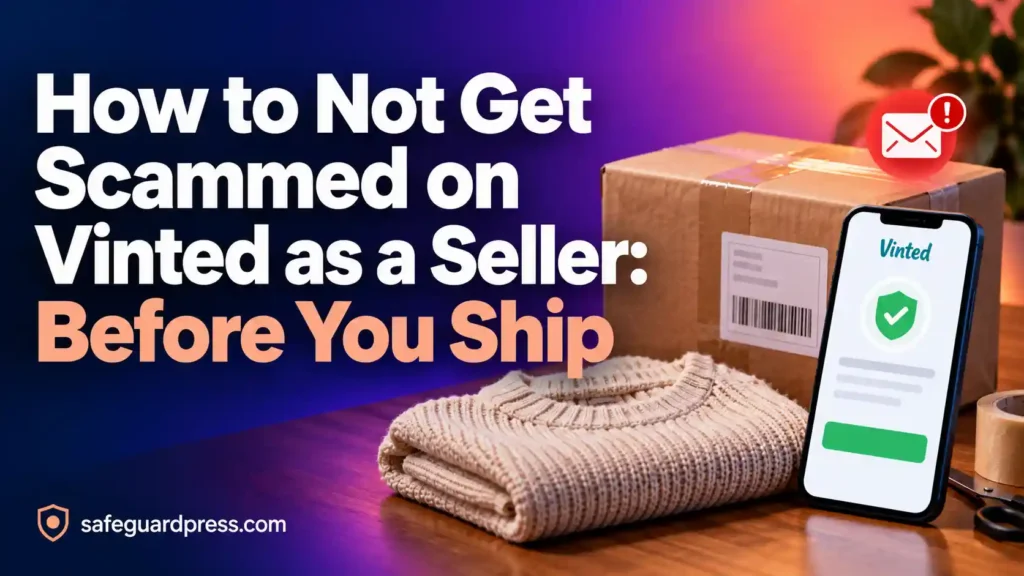
To avoid getting scammed as a Vinted seller, verify the purchased order in your own account, use its shipping instructions, and document the item before dispatch. Do not let a buyer’s screenshot, payment link, or urgent message replace those checks.
This guide explains how to not get scammed on Vinted as a seller at three important moments: before shipping, when a buyer reports a problem, and when a returned parcel arrives.
Should You Ship, Pause, or Contact Support?
Start here if you are holding a packed parcel and wondering whether the sale is safe to proceed with.
| Your Situation | Your Next Step |
|---|---|
| A purchased order appears in your account, it is active, and shipping instructions are available | Prepare and dispatch according to that order. |
| You accepted an offer, but no purchased order appears | Wait for checkout. An agreed price is not proof of payment. |
| The buyer sent a payment screenshot, but your account shows no purchase | Do not ship based on the screenshot. |
| The order exists, but the buyer wants a different address or replacement label | Pause and resolve the change through the official order process. |
| A message asks for card details or a fee to release proceeds | Stop and independently check the request through your account or support. |
| You already dispatched, but the order status is now confusing | Contact support with the order details and dispatch receipt. |
| The buyer opened a complaint | Respond within the transaction and preserve relevant evidence. |
| A return arrives containing something unexpected | Document it immediately and report the discrepancy before confirming that everything is acceptable. |
Pausing means checking the problem promptly. It does not mean ignoring a genuine order until its shipping deadline passes.
Know What a Genuine Sale Looks Like
Understanding the payment sequence prevents two opposite mistakes: sending an item without a purchase and delaying a legitimate sale while waiting for a bank deposit.
An Offer Is Not a Completed Purchase
A buyer can negotiate a price without finishing checkout.
Before preparing a parcel, find the purchased order in your account. Check that it identifies the correct item and provides the next steps.
Keep these separate:
- A buyer expressing interest.
- An offer you accepted.
- A purchase completed through checkout.
Only the last one establishes the transaction you need to inspect.
Pending Proceeds Can Be Normal
The normal sequence involves shipping before proceeds become available for withdrawal. You should not expect the sale money to arrive in your bank before dispatch.
The selling instructions explain that earnings move from pending to available after completion. They also instruct sellers to use the buyer’s selected shipping option. Follow the deadline displayed in your order rather than a deadline invented in a message. vinted.co.uk
Open the Order Yourself
Use your installed app or independently access the website you normally use.
Do not begin your payment check from a link sent by the buyer. Otherwise, you may be inspecting a convincing imitation rather than your actual account.
Spot Buyer Messages That Need an Independent Check
The following examples are fictional, but they illustrate requests that should make a seller stop and investigate.
“Send Your Email So I Can Finish Paying”
Example message:
“The payment is ready. Vinted needs your email because this is your first sale.”
The buyer is asking you to accept their explanation of the payment process.
What to do: Check for a genuine purchase and any account requirement independently.
Optional reply:
“Please complete checkout through Vinted. I’ll use the instructions shown in my order.”
You do not need to provide personal information just to prove that you are a cooperative seller.
“Use This Link To Receive the Money”
Example message:
“Your payment is waiting. Open this page and enter your card details to collect it.”
A logo and familiar layout do not establish who controls a page.
What to do: Leave the link and check your account directly. If you already entered financial information, contact the relevant bank or card issuer promptly.
The guidance on suspicious messages identifies requests involving external links, personal email addresses, and QR codes among phishing examples. vinted.co.uk
For email-specific warning signs, read how to spot a phishing email.
“Pay a Refundable Fee To Unlock Your Balance”
Example message:
“Your seller account needs activation. Pay £10 and you’ll receive it back with the sale money.”
A claim that a charge is refundable does not make it legitimate.
What to do: Verify any supposed fee through your independently accessed account. Do not pay because a buyer or buyer-supplied page says the sale depends on it.
“I Overpaid—Send the Difference Back”
Example message:
“I accidentally paid £80 instead of £30. Transfer £50 back to this account.”
Do not calculate a refund from a screenshot or the buyer’s claim.
What to do: Inspect the actual transaction and use the available official resolution process. Avoid creating a second payment outside the order.
“Use My Label Instead”
Example message:
“The shipping label is wrong. I’ve attached a better one. Send it today.”
An address mistake may be genuine. The solution still needs to keep shipping connected to the order.
What to do: Resolve the problem through the order workflow or support. Do not casually substitute a buyer’s label or hand-edit the destination.
“Cancel the Order, but Send It Anyway”
Example message:
“Cancel here and I’ll pay you directly. You’ll still get the same amount.”
This changes the transaction after you have already agreed to its terms.
What to do: Do not dispatch under a cancelled purchase. If you are confused about the order’s status, resolve that before handing over the parcel.
Related pressure tactics appear in Facebook Marketplace scams. The useful habit is the same: check what happened before acting on what someone claims happened.
Check Behavior Without Misjudging Honest Buyers
A seller needs to identify risky requests without treating every unfamiliar profile as an enemy.
No Reviews Does Not Prove Fraud
A first-time buyer may have no feedback, no profile photograph, and few questions.
That alone does not establish dishonesty. Compare a buyer asking about sleeve length with a buyer demanding a banking code. Their behavior tells you more about the immediate risk.
Good Reviews Do Not Authenticate a Link
Positive feedback can provide context, but it does not verify a separate payment page.
Apply the same transaction checks to every buyer. Do not let an impressive review count persuade you to disclose information you would otherwise protect.
Genuine Verification Must Be Checked Independently
Account, identity, or payment verification can be legitimate. Avoid the inaccurate rule that every verification request is a scam.
Instead, ask:
- Does the requirement appear when I independently access my account?
- Can official support confirm it?
- Am I following the exact verified instructions, including any redaction requirements?
A buyer should not be directing you to send them identity documents or banking credentials.
If a page looks convincing but its address or purpose is uncertain, use how to tell if a website is safe before proceeding.
Build an Evidence Folder Before Dispatch
The strongest records answer specific questions. A pile of unrelated pictures is harder to assess than a short, organized account of the sale.
Describe the Item Precisely
Prevent avoidable disagreements by stating what you know.
For clothing, record the label size and useful measurements. Describe wear plainly. For an item with parts or accessories, list what is included and what is missing.
For example:
“Label size M. Approximately 52 cm across the chest when laid flat. Small mark beside the left pocket, shown in the close-up photograph.”
That is more informative than “perfect condition” when the item has visible wear.
Do not guess about authenticity, materials, or technical specifications to make the listing sound stronger.
Photograph Details That Could Become Disputed
Capture the whole item, then the details relevant to its condition and identity:
- Labels and size information.
- Disclosed marks or damage.
- Closures, seams, handles, or other important features.
- Included accessories.
- Identifying details, where appropriate.
Keep sensitive identifiers and personal information private.
Ask yourself: If someone disputes this feature later, does my photograph actually show it?
A wide photograph of a coat may not establish the condition of a small fastening.
Match Each Record to Its Purpose
| Record | What It Helps Explain | What It Cannot Establish Alone |
|---|---|---|
| Listing copy and photographs | What you represented to the buyer | Everything that happened during delivery |
| Close-ups before packing | Visible condition and identifying details | Whether the carrier handled the parcel safely |
| Packing photographs | How the contents were arranged and protected | What happened after the parcel was sealed |
| Dispatch receipt | Recorded handover and shipment details | The parcel’s complete contents |
| Tracking history | The carrier’s recorded journey | Every possible delivery problem |
A packing video may add context, but it is not an automatic dispute-winning tool.
Keep a Simple Order Record
Create one folder containing the listing, useful photographs, dispatch receipt, and relevant messages.
Use clear filenames such as “size-label,” “disclosed-mark,” and “dispatch-receipt.” If a complaint arrives, you can find the evidence without scrolling through hundreds of unrelated images.
For bundles, photograph the included items together and keep a written list.
Respond to a Complaint With Facts
A complaint is not proof of a scam. Items can be damaged, parcels can go missing, and sellers can overlook defects.
Check the Claim Before Choosing a Remedy
Read the buyer’s specific concern and compare it with your records.
The refund policy covers qualifying delivery, damage, and description problems. It also distinguishes standard-member purchases from Pro purchases. Available resolutions can include a return or a refund without return, so read the option before selecting it. Vinted
Use the deadlines and instructions attached to your case. Do not assume every complaint follows the same process.
Ask for Useful Details
Replace “You’re lying” with a question that can be answered:
“Please show the area you believe differs from the listing so I can compare it with my original photographs.”
For transit damage, photographs of the packaging may help explain what happened. For a missing accessory, ask which listed component is absent.
Keep the exchange within the transaction.
Submit a Short Evidence Summary
A useful response has four parts:
- The buyer’s concern.
- What the listing said.
- The relevant evidence.
- The resolution or review you are requesting.
Avoid a long account of how upset you feel. That reaction is understandable, but it does not establish the facts.
Worked Example: A Disputed Jacket
Imagine you sold a jacket and disclosed a mark beside one pocket. The buyer reports “undisclosed damage” and requests a refund.
First, determine whether they mean the disclosed mark or another problem.
If their photograph shows the same mark, your response could be:
“The buyer’s photograph appears to show the mark beside the left pocket. My listing described that mark, and the close-up listing photograph shows its location. I have attached the description and original image. Please review whether this is the same disclosed condition.”
If their photograph shows a different tear, do not insist that your evidence disproves it unless it actually does. Examine whether your records show that area and whether packaging or transit may be relevant.
This example illustrates an important distinction: evidence should help identify what happened, not merely defend your preferred explanation.
What To Do If the Return Contains a Different Item
A suspicious return needs immediate documentation and a specific report.
Inspect Before Confirming Acceptance
When the parcel arrives:
- Record its exterior condition and label.
- Open it carefully and retain the packaging.
- Compare the contents with your pre-dispatch records.
- Photograph specific discrepancies.
- Report the problem through the order within its displayed deadline.
Do not wait several days while deciding how to describe it.
Explain Observable Differences
A useful report might say:
“Order [number] was returned today. I sent a blue jacket with a size M label. The returned parcel contains a black garment with a size S label. Attached are the original label photograph, returned-item photographs, and parcel label. Please review the discrepancy.”
Only use statements that match your actual evidence.
If the problem is a missing accessory or new damage, identify that exact difference. Avoid claiming deliberate fraud when the available evidence only establishes a mismatch.
What To Do If You Already Fell for a Message
Prioritize the information or money exposed. Then preserve evidence and report the incident.
If You Entered a Password
Change it through the genuine service. Review available account security controls and unexpected changes.
If you reused the password elsewhere, change those accounts too. Pay particular attention to the email account used for password resets.
If You Entered Card or Banking Details
Contact your bank or card issuer using its official app or a trusted telephone number.
Explain exactly what you entered, whether you approved anything, and whether you see an unfamiliar payment. Ask what action is appropriate for the exposed information.
For related warning signs, see credit card fraud.
If You Sent Money or Shipped Without a Purchase
Contact the payment provider promptly about available recovery options.
For a dispatched parcel, ask the carrier whether interception is possible. Provide the shipment details and report the incident to Vinted. Neither recovery nor interception is guaranteed.
Save messages, transaction records, and suspicious addresses. Do not pay someone who promises guaranteed recovery for an upfront fee.
Frequently Asked Questions
These answers address practical decisions that can arise during a sale.
Should I Cancel Because the Buyer Has No Reviews?
Not solely for that reason. Check the purchased order and evaluate the buyer’s requests. Lack of feedback does not prove fraud.
Can I Ship Before the Proceeds Become Available?
Follow the genuine order’s shipping instructions. Pending proceeds can be part of the normal transaction sequence.
What If the Buyer Says Payment Takes Time To Appear?
Do not ship without a purchased order. Let the buyer resolve checkout or contact support about the problem.
Is a Shipping QR Code Always Suspicious?
No. Distinguish a code obtained through the genuine shipping process from an unverified buyer-supplied payment code.
What If the Buyer Wants an Urgent Delivery?
You can accommodate a reasonable request within the order’s shipping process. Urgency does not justify skipping verification.
Can I Promise That Photographs Will Protect My Payment?
No. Photographs may help explain the sale, but they do not guarantee a particular decision.
What If Tracking Says Delivered but the Buyer Disagrees?
Preserve tracking and dispatch records and respond through the case. A delivery scan does not resolve every possible delivery issue.
Should I Refund Outside the Order To End an Argument?
Use the transaction’s resolution options. A separate transfer creates another payment to document and may complicate the situation.
What If I Accidentally Missed a Defect?
Acknowledge it and consider the available remedies. Honest correction is more useful than arguing against a valid complaint.
What Should I Check Before Selling an Expensive Item?
Check category eligibility, shipping requirements, and applicable compensation limits. Keep relevant provenance and identifying records without overstating what they prove.
Your Final Check Before Dispatch
Open the active order, confirm its instructions, and make sure your records show the item you are sending.
If payment or shipping details do not match, resolve the discrepancy before handing over the parcel. If a complaint arrives later, respond with specific evidence and follow the case deadline.
The goal is a sale you can verify and explain—from checkout to the returned parcel, if there is one.