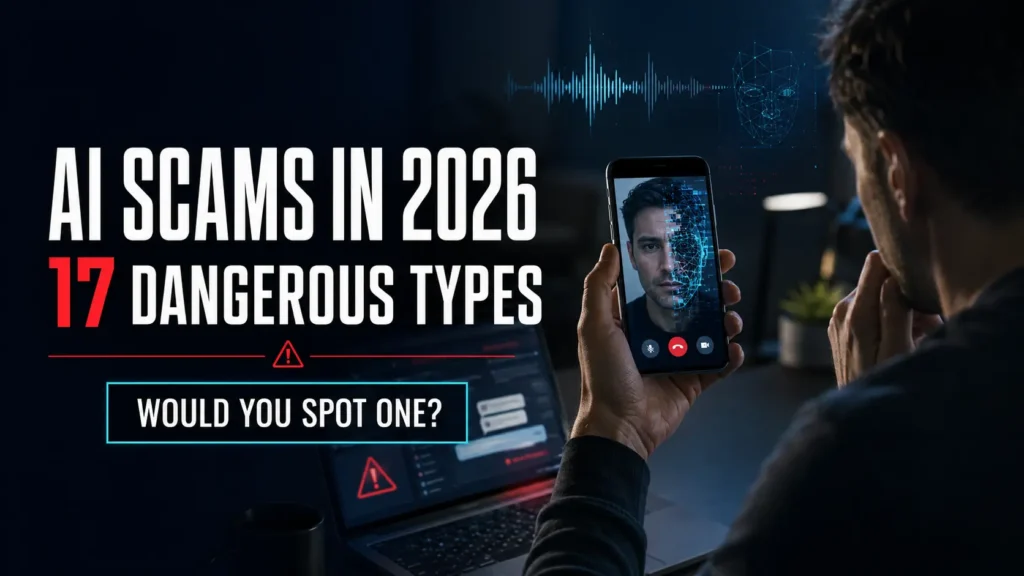
Your phone rings from an unfamiliar number.
When you answer, you hear the terrified voice of someone you love. They claim there has been an accident. A lawyer needs money immediately. You are told to keep the situation secret because calling anyone else could “make everything worse.”
The emotion sounds real. The voice is familiar. The emergency is fake.
This is what makes AI scams in 2026 so dangerous. Criminals can use artificial intelligence to imitate voices, manipulate live video, manufacture believable identities and write convincing messages without making the obvious mistakes that once exposed online fraud.
You could receive a professional email that was written by a scammer. You could see a familiar face during a video call without speaking to the real person. You could watch a respected celebrity promote an investment they have never heard of. Even a caller who knows your relatives, employer or recent activities may have collected those details from social media, public records or stolen data.
That sounds frightening, but AI does not make scammers unstoppable.
Every successful scam still needs you to do something. You must click the link, reveal the password, approve the login, transfer the money, install the application or trust an identity without verifying it independently.
This guide exposes 17 dangerous types of AI scams, explains how each one works and shows you the warning signs that matter more than polished grammar or realistic video. You will also learn a practical verification method, a family emergency protocol, business safeguards and the exact steps to take if you have already shared money or personal information.
Read carefully, because the most dangerous AI-powered scam may not look artificial at all.
First, here is the direct answer you may be looking for.
AI Scams at a Glance
AI scams use artificial intelligence to make fraud faster, more convincing, more personalized or easier to operate on a large scale.
| AI scam type | What makes it believable | What the scammer wants | What you should do first |
|---|---|---|---|
| Voice-cloning scam | A familiar voice | Emergency payment | Hang up and call the person directly |
| Deepfake video scam | A recognizable face | Money or confidential information | Verify through another channel |
| AI phishing scam | A polished, personalized message | Passwords or account details | Open the official app independently |
| AI romance scam | Consistent photos and affectionate conversations | Money or cryptocurrency | Stop paying and verify the identity |
| AI investment scam | Fake experts, profits and endorsements | Increasing deposits | Investigate the company independently |
| AI job scam | Professional interviews and documents | Fees, information or transfers | Contact the company through its real website |
| AI business impersonation | A manager’s voice or writing style | Wire transfers or confidential data | Use a second-person approval process |
| AI recovery scam | Official-looking documents and investigators | Upfront recovery fees | Report the approach without paying |
The central protection rule is simple: never allow a voice, face, message or document to become your only proof of identity.
That protection becomes much easier when you understand what artificial intelligence adds to an ordinary scam.
What Are AI Scams?
AI scams are fraudulent schemes that use artificial intelligence to create, improve, personalize or automate deception.
Artificial intelligence does not give criminals an entirely new motive. Scammers still want your money, personal information, account access or cooperation. AI simply helps them look more convincing while targeting more people in less time.
For example, criminals can use generative AI and synthetic-media tools to:
- Clone the voice of someone you know
- Manipulate a face during a video call
- Create realistic profile photographs
- Produce fake identification documents
- Write natural messages in several languages
- Copy someone’s tone and communication style
- Generate convincing product reviews
- Build fake websites and customer-support chats
- Personalize phishing messages with information about you
- Automate conversations with multiple potential victims
This completely changes the speed and scale of fraud.
In the past, a scam operation might have needed skilled writers, callers, designers and translators. Today, criminals can automate parts of that work. One person can maintain several fictional identities, respond at any hour and test different messages until someone takes the bait.
Official 2025 internet-crime reporting recorded 22,364 complaints involving artificial intelligence and nearly $893 million in reported losses. Those figures include only reported cases, so they cannot show the complete size of the problem.
What they do show is that AI-powered fraud is no longer a distant or theoretical threat. It is already targeting families, employees, investors, retirees and businesses.
You also need to understand that an AI scam may never mention artificial intelligence. You may simply receive a convincing bank call, attractive job offer, investment advertisement or romantic message.
That is why you should focus on what you are being asked to do, not merely how professional the communication appears.
Why AI-Powered Scams Are Harder to Detect in 2026
AI removes many of the weaknesses you may have relied on to identify fraud in the past.
Here is why the latest scams can feel unusually believable.
Bad Grammar Is No Longer a Reliable Warning Sign
You may have been taught that scam messages contain spelling mistakes, unnatural expressions and poor formatting.
Those warning signs still appear, but you cannot depend on them anymore.
Generative AI can produce polished messages within seconds. It can imitate a professional tone, translate naturally and adapt the wording to your age, occupation or location.
A message can be perfectly written and completely fraudulent.
Good grammar only proves that the message is well written. It does not prove who sent it.
Scammers Can Personalize Their Stories Around You
A scammer may already know your employer, hometown, relatives, recent vacation or favorite activities.
That information can come from your public social media posts, professional profiles, data breaches or people-search websites. AI can collect and organize those scattered details into a story designed specifically for you.
Imagine receiving a message that correctly names your bank, employer and manager. Those details may lower your suspicion, even though the sender has no legitimate connection to any of them.
One accurate fact can make several false claims feel credible.
Before responding, ask yourself a more useful question: does the person’s request make sense, and can you verify it through a trusted channel?
Fake Identities Can Remain Consistent
Traditional fake profiles often collapsed when you asked enough questions. Photographs did not match, timelines contradicted each other and personal details changed.
AI helps criminals avoid some of those errors.
A scammer can create multiple photographs of the same fictional person, generate a detailed life history and maintain consistent conversations. The false identity may appear to have a career, family, location and daily routine.
Consistency can create trust, but it does not prove the person exists.
If someone you met online repeatedly avoids an ordinary in-person meeting, refuses spontaneous verification or always has a new reason they cannot be reached, step back before emotions or money become involved.
Voices and Faces Can Be Manufactured
You naturally trust a familiar voice or recognizable face. Deepfake scams exploit that instinct.
A synthetic voice can sound frightened, affectionate, angry or authoritative. A manipulated video can appear to show your relative, employer or favorite celebrity making a request.
You may react before noticing any visual or audio inconsistency.
That is why “I heard their voice” or “I saw them on video” is no longer enough. You must verify the request through another method the scammer does not control.
Automated Conversations Can Continue for Weeks
AI chat systems can answer your questions, remember details and continue conversations at almost any hour.
This is especially useful in romance, investment and job scams, where trust develops over time. You may believe you are building a relationship with one attentive person while a criminal uses automation to manage several conversations at once.
Do not confuse availability with authenticity.
A person who messages every morning, remembers your birthday and asks about your family may still be using a carefully managed fictional identity.
AI Targets Your Emotions Before Your Logic
The most effective AI scams do not simply give you information. They create an emotional condition that makes careful thinking difficult.
Fear can push you into an emergency payment. Excitement can make a guaranteed investment feel irresistible. Loneliness can lower your guard in an online relationship. Hope can make an effortless remote job appear genuine. Shame can stop you from reporting the loss.
Whenever a message makes you feel frightened, excited, flattered or rushed, treat that emotional intensity as a signal to pause.
The technology may be new, but emotional manipulation remains the engine of the scam.
Now you can examine the individual schemes more closely.
17 Dangerous Types of AI Scams in 2026
Each AI-powered scam uses technology differently, but all 17 types attempt to stop you from verifying the truth before you act.
1. AI Voice-Cloning Family Emergency Scams
In an AI voice-cloning scam, criminals use recorded audio to imitate someone you know.
The recording may come from a social media video, podcast, voicemail greeting, online presentation or another public source. A criminal can then generate artificial speech that sounds like the person is frightened, injured or desperate.
You may receive a call claiming that:
- Your child has been injured in an accident.
- Your grandchild has been arrested.
- Your spouse has lost their phone while travelling.
- A relative needs emergency medical treatment.
- A family member has caused an accident and needs legal help.
The first voice may sound like your relative. A second caller may then pretend to be a lawyer, police officer or medical worker.
You are told that the situation must remain secret. Money is demanded through cash, wire transfer, gift card or cryptocurrency.
The secrecy is not a small detail. It is designed to stop you from contacting someone who could expose the lie.
If you receive this type of call, hang up and call your relative through a saved telephone number. If they do not answer, contact another family member who can verify their location.
You should also create a private family emergency word. Do not use a birthday, pet name, school or fact that someone could find online.
The safe word does not replace independent verification, but it creates another barrier the scammer may not expect.
2. AI Kidnapping and Ransom Scams
AI kidnapping scams are an extreme version of voice impersonation.
You may hear screaming, crying or a voice resembling someone you love. A criminal then claims the person has been kidnapped and demands immediate payment.
The caller may know the person’s name, workplace, school or travel plans. Those correct details are intended to increase your panic, but they do not prove that the kidnapping is real.
Watch for warning signs such as:
- The caller refuses to let you hang up.
- You are ordered to keep the call secret.
- The ransom must be paid through an unusual method.
- The alleged victim cannot answer a personal question.
- The caller discourages you from contacting police.
- The story changes when you ask for details.
If possible, use another phone to contact the alleged victim or ask someone nearby to do it. If you believe anyone could be in immediate danger, contact local emergency services.
Do not assume emotional audio proves that a real emergency is happening. Fear is exactly what the caller wants to control.
3. AI Bank Impersonation Scams
A call appears to come from your bank’s real number. The representative sounds calm, confident and professional.
The caller mentions a suspicious transaction, failed login or compromised debit card. Some details may be accurate because they were obtained through stolen data or an earlier phishing attack.
You are then asked to:
- Reveal a one-time verification code
- Confirm your password or PIN
- Install a security application
- Approve a login notification
- Share your card or account number
- Transfer your money into a “protected” account
The request is the real danger.
Your bank may contact you about suspicious activity, but you should never give an unexpected caller your password, PIN or one-time security code.
Hang up. Call the number printed on your bank card or open the official banking application yourself.
If there is a real problem, it will still appear inside your account or be confirmed by the legitimate fraud department.
No genuine bank employee needs you to transfer your savings into another account to keep them safe.
4. AI Government and Law-Enforcement Impersonation
Artificial intelligence can help criminals sound like government employees while producing official-looking letters, warrants, badges and case documents.
You may be accused of tax fraud, money laundering, missed jury duty, benefit misuse or involvement in a criminal investigation. The caller may already know your address or part of your Social Security number.
That information is used to frighten you into obeying.
The caller then demands payment or claims your money must be moved while an investigation continues. You may be instructed to buy cryptocurrency, withdraw cash, purchase gold or hand money to a courier.
Real agencies do not resolve criminal allegations through gift cards, cryptocurrency or secret transfers. A badge sent through a messaging app does not prove authority. Neither does a court document, caller ID or official-looking email.
End the conversation and locate the agency’s official website yourself. Call the published number and ask whether the case or employee exists.
Never use the contact details supplied by the person making the threat.
5. Deepfake Video Call Scams
Video calls once offered reassurance that an online contact was real. Deepfake technology has weakened that protection.
Criminals can manipulate prerecorded footage or use face-swapping tools during live communication. The person on your screen may appear to be:
- Your manager
- A company executive
- A bank employee
- A romantic partner
- A family member
- A police officer
- A celebrity
- An investment adviser
Some fake videos reveal inconsistencies such as unnatural blinking, delayed lip movement, distorted facial edges, strange lighting or background changes.
However, you cannot assume every deepfake will contain obvious visual defects.
Instead of relying on appearance, test the person’s identity and request.
Ask an unexpected question. End the call and reconnect through a known account. Contact the person using a saved number. If money or confidential business information is involved, require another trusted person to confirm the instruction.
A video call can support verification, but it should never become your entire verification process.
6. Celebrity Deepfake Investment Scams
You see a social media video featuring a famous entrepreneur, financial expert or television personality.
The person appears to recommend an investment platform, cryptocurrency opportunity or automated trading system. The video may resemble a legitimate news interview. The voice matches, the lips appear synchronized and the comments are filled with success stories.
Several parts of the promotion may be fake:
- The celebrity endorsement
- The news interview
- The trading platform
- The customer testimonials
- The profits displayed inside the account
- The support representatives
- The comments below the advertisement
You may be encouraged to begin with a small deposit. Your dashboard then shows rapid growth, tempting you to invest more.
The trap becomes clear when you attempt to withdraw. The platform demands taxes, verification charges, account upgrades or liquidity fees. Each payment produces another obstacle.
Never allow a celebrity’s face to replace proper investigation.
Check whether the company is registered, who operates it and whether the promised returns are realistic. No legitimate investment can guarantee large profits without risk.
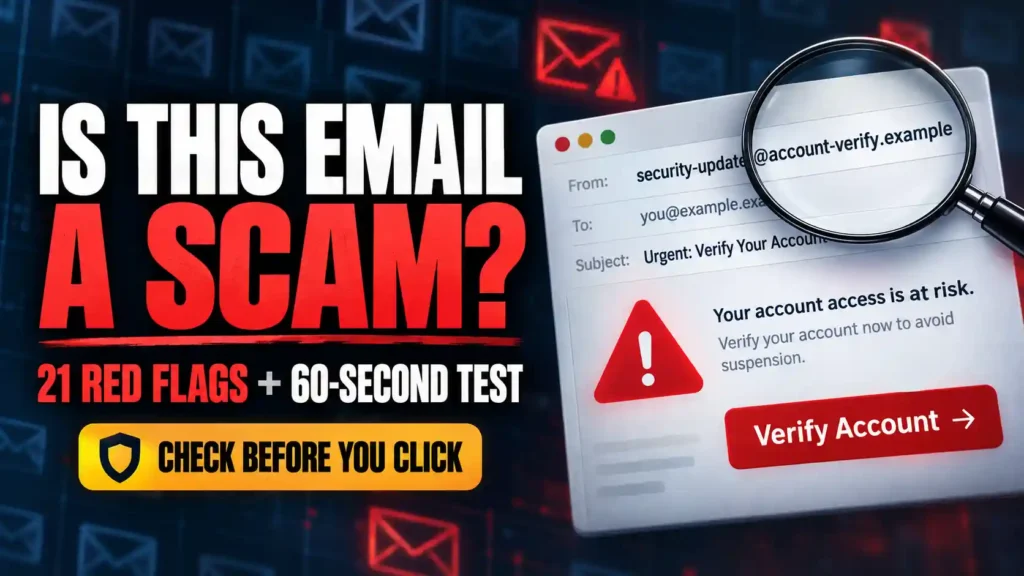
7. AI-Generated Phishing Emails
AI phishing emails can look polished, professional and personally relevant.
You may receive a message that appears to come from your bank, employer, delivery company, cloud-storage provider or government program. Instead of using a generic greeting, it may include your name, job title or recent activity.
The email usually tries to create one of five reactions:
- Fear about an account problem
- Curiosity about a document
- Urgency over a payment
- Excitement about a refund
- Obedience to an executive request
The link may lead to a fake login page, while the attachment could install malicious software on your device.
Do not judge the email only by its grammar. Examine the complete sender address, domain name, request and destination.
If you need a detailed email-verification process, read how to spot a phishing email before you click.
When an unexpected message claims there is a problem with your account, do not use the supplied link. Open the official application yourself or type the known website address directly into your browser.
8. AI Text Message and Wrong-Number Scams
You receive a text from an unfamiliar number.
It may mention an unpaid toll, failed delivery, job opening or suspicious bank transaction. In another version, the sender appears to have contacted you accidentally.
The conversation may begin with a simple question:
“Are we still meeting for dinner?”
When you explain that they have the wrong number, the stranger remains friendly. AI-assisted messaging can help the scammer maintain a natural conversation and remember what you have previously shared.
Days or weeks later, the conversation shifts toward cryptocurrency, an investment opportunity or a financial emergency.
The opening message may not have been an innocent mistake. It could have been a test designed to identify people willing to continue talking.
If you receive an unexpected text, do not use its link to access an account or pay a fee. Contact the organization independently through its official website or application.
You should also be suspicious when a new online friend quickly directs the conversation toward money.
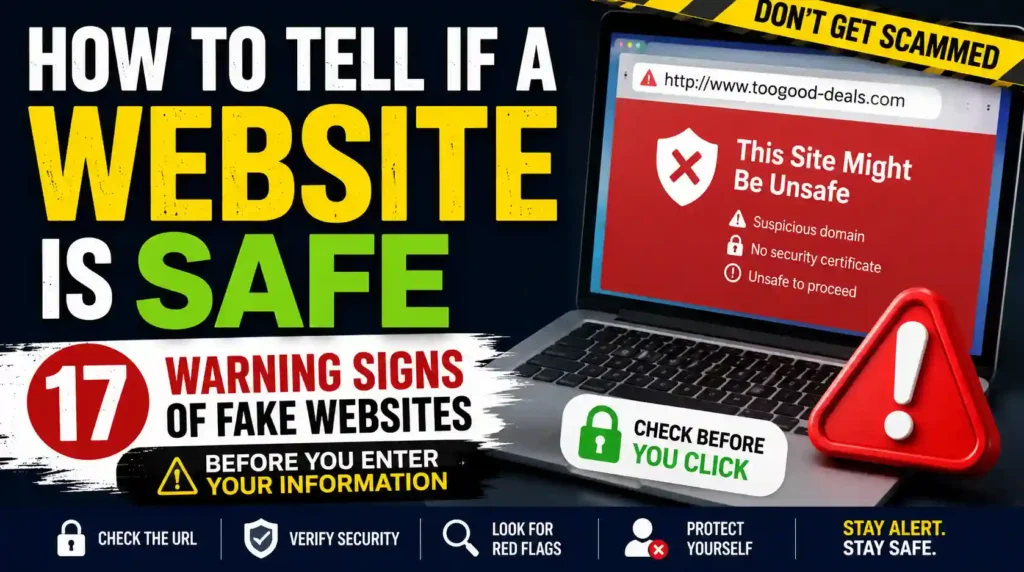
9. AI-Generated Fake Websites
Modern fake websites do not always look cheap or unfinished.
AI can generate persuasive sales copy, product descriptions, support conversations, policy pages and customer testimonials. Criminals can quickly create a copycat version of a bank, government agency, online store, cryptocurrency exchange or delivery company.
The website may be designed to:
- Capture your username and password
- Steal your payment-card information
- Collect copies of your identity documents
- Accept payment for products that do not exist
- Install malicious software
- Recruit you into a fraudulent investment
- Enrol you in an unwanted recurring subscription
A padlock symbol does not prove that the website is honest. It only means the connection between your browser and that website is encrypted.
If you are visiting an unfamiliar website, examine the complete domain name, company history, contact information and refund policy before entering your information. Search for independent reviews and complaints outside the website.
You should be especially careful when you see enormous discounts, countdown timers or claims that only a few items remain. Those features are designed to make you act before investigating.
If the website asks for your password, identity documents or payment details, pause and confirm that you reached the correct domain. One changed letter or added word can separate a legitimate website from a convincing copy.
10. AI Romance Scams
An AI romance scam can begin with a friendly message, a dating-app match or an unexpected follow request.
The person appears attractive, attentive and emotionally available. They remember what you tell them, send affectionate messages regularly and seem to understand exactly what you have been missing.
However, you may not be speaking to the person shown in the photographs.
A criminal can use artificial intelligence to create realistic profile pictures, write emotionally persuasive messages and maintain a detailed fictional identity. Voice-generation tools can support telephone calls, while deepfake technology may help the scammer appear briefly during a video chat.
The relationship often develops quickly. The person talks about love, marriage or a future together before you have met in person.
Eventually, they need money for:
- A medical emergency
- An airline ticket
- Visa or customs fees
- A frozen bank account
- A business crisis
- An important package
- A cryptocurrency investment
- An emergency involving a family member
You may be told that one payment will solve the problem. After you pay, another obstacle appears.
If someone you met online asks for money, cryptocurrency, gift cards or access to your bank account, stop the transaction. Do not allow affection to replace verification.
You should also be careful if the person encourages you to invest. Romance scammers increasingly combine emotional manipulation with fake investment platforms.
A video call does not automatically prove the person’s identity. If you are considering a serious relationship, insist on ordinary, repeated and spontaneous verification—not one brief video call controlled by the other person.
11. AI Investment and Cryptocurrency Scams
Some investment scams claim to use artificial intelligence to predict markets, eliminate risk or trade automatically.
The platform may look professional. You may see live charts, account balances, customer-support chats and testimonials from supposed investors. An AI-generated expert or celebrity might explain why the opportunity is different from ordinary investing.
You begin with a small deposit.
Soon, your account displays impressive profits. A support representative encourages you to deposit more before a limited opportunity disappears.
The numbers on your screen may be completely invented.
When you try to withdraw your money, you are told to pay:
- A withdrawal fee
- An account verification charge
- A tax
- An insurance deposit
- A liquidity fee
- An anti-money-laundering charge
- An account upgrade fee
Paying one fee does not release the money. It creates another demand.
You should never have to send more money to withdraw legitimate investment profits. You should also reject any platform that guarantees returns or claims its AI system has eliminated financial risk.
Before investing, verify the company through an independent regulator, investigate the people operating it and search for complaints outside the platform. Do not rely on testimonials, screenshots or account balances supplied by the promoter.
If someone you met through social media or an online relationship offers to teach you cryptocurrency investing, treat the offer as a serious warning sign.
12. AI Job and Task Scams
AI can help a fake employer create convincing job advertisements, interview questions, company documents and employment contracts.
You may complete a professional-looking interview through email, text or video. The recruiter may use the name of a real company and copy the identity of an actual employee.
After offering you the position, the supposed employer asks you to:
- Pay for training
- Purchase equipment from a specific vendor
- Deposit a check and return part of the money
- Provide banking information immediately
- Send copies of identity documents
- Receive and forward packages
- Transfer money between accounts
- Buy cryptocurrency to complete tasks
One common variation is the task scam.
You are offered easy online work, such as rating products, liking videos, reviewing images or “optimizing” an application. Your dashboard shows commissions increasing as you complete each task.
Then your account develops a negative balance. You are told to deposit your own money before you can continue or withdraw your earnings.
The balance is fake. The work is fake. The deposits are the real objective.
A legitimate employer pays you for your work. You should not have to transfer cryptocurrency, pay an activation fee or deposit personal funds to unlock your salary.
If a recruiter contacts you unexpectedly, visit the company’s official website and contact its human resources department directly. Do not use the telephone number or email address supplied by the recruiter.
13. AI Business Email Compromise
AI-powered scams do not target only individual consumers. They can also exploit employees and business owners.
In a business email compromise scheme, a criminal pretends to be an executive, supplier, attorney or trusted employee. AI can help the scammer copy that person’s writing style and create a request that fits the company’s normal operations.
You may receive an email asking you to:
- Pay an urgent invoice
- Change a supplier’s banking details
- Purchase gift cards for employees
- Send payroll records
- Update direct-deposit information
- Transfer money for a confidential acquisition
- Share customer or employee data
The message may mention real projects, coworkers and deadlines. A voice call or deepfake video can make the request even more convincing.
The safest defense is a payment-verification procedure that nobody can bypass, including senior executives.
If you receive changed banking instructions, call the supplier through a previously verified number. If an executive requests an unusual transfer, require confirmation from a second authorized employee.
Do not reply to the suspicious email to ask whether it is genuine. If the account has been compromised, you may simply be asking the scammer to confirm their own request.
14. AI Customer-Support and Chatbot Scams
You search online for help with a bank account, payment application, airline booking or technology problem.
A convincing advertisement or search result leads you to a fake support page. An AI chatbot answers your questions naturally and guides you through a professional-looking troubleshooting process.
The supposed agent may ask you to:
- Confirm your password
- Share a verification code
- Install remote-access software
- Download a security application
- Enter your payment details
- Move money into another account
- Pay a support or cancellation fee
Because the conversation feels helpful, you may not notice that every instruction gives the agent more control.
If you need customer support, open the company’s official application or type its known website address yourself. Do not trust a support telephone number simply because it appears near the top of a search page.
A legitimate support agent should not need your complete password or one-time security code. If someone asks to control your screen, understand exactly why before granting access.
If the request involves banking, cryptocurrency or a transfer, stop the session and contact the company independently.
15. AI-Generated Identity Document Scams
AI can help criminals create realistic driver’s licenses, employee badges, passports, court documents and professional certificates.
A scammer may send you an identification card to prove they are a police officer, bank investigator, military member, doctor or company employee.
The document may contain a real logo, official language and the name of a genuine organization. None of that proves the sender is connected to it.
You should not verify authority using evidence supplied entirely by the person making the claim.
If someone says they work for an organization, contact that organization through a telephone number or website you locate independently. Ask whether the employee, department or case exists.
You should also limit where you upload your own identification documents. A fake employer, lender, landlord or investment platform may collect your driver’s license and Social Security number before using them to impersonate you.
Before sending sensitive documents, verify:
- Why the information is required
- How it will be stored
- Who will have access
- Whether a less sensitive document can be used
- Whether the organization and website are legitimate
If you believe your personal information has already been exposed, learning how to protect yourself from identity theft can help you reduce the risk of new accounts being opened in your name.
16. AI Synthetic Identity Fraud
Synthetic identity fraud combines real information with invented details to create a new identity.
A criminal may use a real Social Security number with a different name, address and date of birth. The number could belong to a child, an older adult or someone who rarely checks their credit history.
The scammer may begin by opening a small account and making regular payments. Over time, the synthetic identity develops a stronger credit profile.
Once larger credit limits become available, the criminal borrows as much as possible and disappears.
You may not discover the fraud until:
- A debt collector contacts you.
- You receive a bill for an unfamiliar account.
- Your credit application is rejected.
- A child applies for student aid or their first credit card.
- A credit report shows an address or account you do not recognize.
- A government agency reports that your number is being used elsewhere.
Checking your credit reports regularly can help you identify suspicious activity. If you are not applying for new credit, a credit freeze can make it harder for someone to open an account using your information.
Parents should consider checking whether their child has a credit file. A young child normally should not have credit accounts, utility bills or loans in their name.
17. AI Sextortion and Fabricated Intimate Images
A criminal does not need a real intimate photograph to threaten you.
Generative AI can place your face into fabricated explicit content. The scammer may use a photograph taken from social media and send you a manipulated image or video that appears convincing.
You are then threatened with exposure. The criminal claims the content will be sent to your relatives, employer, school or social media contacts unless you pay.
Do not assume paying will end the threat.
Once you pay, the scammer knows that fear is working. They may demand more money or sell your information to other criminals.
If this happens to you:
- Do not send additional photographs.
- Do not pay or continue negotiating.
- Preserve the messages, usernames and payment demands.
- Block the account after saving the evidence.
- Report the profile to the platform.
- Tell someone you trust instead of handling the threat alone.
- Contact law enforcement when threats, extortion or safety risks are involved.
If the target is under 18, a trusted adult should be told immediately. The images should not be downloaded, copied or redistributed unnecessarily.
The criminal wants shame to keep you isolated. Asking for help takes away part of that control.
The technology may differ from one scheme to another, but the warning signs are surprisingly consistent.
How to Spot AI Scams: 15 Warning Signs You Should Never Ignore
You do not need to become a deepfake expert to protect yourself.
Instead, pay attention to the behavior, request and pressure surrounding the communication.
You Receive Unexpected Contact
Be cautious when someone contacts you without warning and quickly introduces money, account security, employment or an emergency.
The message may look legitimate, but you did not initiate the conversation.
You Are Pressured to Act Immediately
Scammers do not want you to think, investigate or ask someone else for advice.
You may be told that:
- Your account will close within minutes.
- A relative will remain in jail.
- An investment opportunity will disappear.
- Police will arrive at your home.
- Your benefits will be cancelled.
- Your supposed earnings will be lost.
A genuine problem can survive independent verification.
You Are Told to Keep the Situation Secret
Secrecy prevents other people from exposing the scam.
A caller may claim that a police investigation is confidential, a business transaction is sensitive or a relative would be embarrassed.
If someone tells you not to contact your family, bank, employer or police, treat that instruction as a major warning sign.
The Payment Method Is Unusual
You should be suspicious if someone demands payment through:
- Gift cards
- Cryptocurrency
- Wire transfers
- Cash couriers
- Gold bars
- Payment applications
- Prepaid cards
These methods can make your money difficult to recover.
You Are Asked to Move Money for “Protection”
A scammer may claim that your account has been compromised and your money must be transferred elsewhere.
Do not do it.
Contact your bank through the number printed on your card or inside its official application. If the caller is genuine, the bank can verify the situation without asking you to move your savings to an unfamiliar account.
Someone Requests Your Security Code
A one-time code is often the final barrier protecting your account.
If you share it, the scammer may use it to sign in, reset your password or authorize a payment.
Do not provide a security code to an unexpected caller, even if they claim to work for your bank.
The Offer Guarantees Investment Profits
Every real investment carries some level of risk.
If a person or platform guarantees daily profits, claims an AI system cannot lose or promises unusually high returns, step away.
The more certain the promise sounds, the more carefully you should investigate it.
An Online Romantic Interest Introduces Money
Someone who genuinely wants a relationship should not need you to pay medical bills, travel costs, customs charges or investment deposits.
If romance and money become connected, stop and verify the person’s identity before sending anything.
A Job Requires You to Pay
A legitimate employer should not require you to deposit money to unlock tasks, purchase equipment from a suspicious vendor or return part of a check.
If you must pay before you can work or withdraw your earnings, the job is probably the product being used to scam you.
The Person Avoids Independent Verification
A scammer may agree to a controlled video call but refuse anything unexpected.
They may avoid spontaneous questions, an in-person meeting or communication through an official company channel.
If someone becomes angry when you attempt to verify them, that reaction gives you another reason to stop.
The Story Keeps Changing
One emergency becomes another. A travel problem becomes a customs problem. A withdrawal fee becomes a tax.
When each payment creates a new obstacle, you are not solving the problem. You are feeding the scam.
You Are Told to Install Software
A fake support agent may ask you to download an application that gives them remote access to your phone or computer.
Once connected, they may view your screen, steal passwords or access your bank account.
Do not install software at the request of an unexpected caller.
The Message Contains Accurate Personal Details
This may feel reassuring, but criminals can collect information from social media, public records and data breaches.
Knowing your name, address, employer or relatives does not prove the person is legitimate.
A Face or Voice Is Treated as Final Proof
AI can imitate both.
Even if the person looks or sounds familiar, verify any unusual request through another channel.
You Feel Too Emotional to Think Clearly
Fear, excitement, loneliness and urgency can all weaken your judgment.
If a request makes your heart race, do not respond immediately. Put down the phone, step away from the screen and speak to someone you trust.
Once you recognize these warning signs, you need a simple response you can remember under pressure.
Use the STOP–LEAVE–VERIFY Method Against AI-Powered Fraud
You do not need complicated software to interrupt many AI scams. You need a repeatable process.
STOP Before You Click, Pay or Reply
Do not make a financial decision while someone is pressuring you.
Take a breath. Give yourself enough time to examine the request.
Ask:
- Was I expecting this contact?
- Why must I act immediately?
- Why is this payment method required?
- What happens if I verify the story first?
- Is the person discouraging me from asking for help?
A scammer may become aggressive when you pause. A legitimate organization should allow you to verify its request.
LEAVE the Communication Channel
Do not continue inside an environment controlled by the sender.
If you received a suspicious call, hang up. If you received an email, do not reply. If a social media account contacted you, do not use its links.
Leave the channel before verifying anything.
This prevents the scammer from guiding your next action or directing you to another fake contact.
VERIFY Through a Trusted Source
Call your relative through a saved number. Open your bank’s official application. Type the company’s known website address manually. Contact your manager through the usual workplace system.
Do not use the telephone number, email address or website supplied by the suspicious sender.
Verification works only when you choose the channel yourself.
The STOP–LEAVE–VERIFY method works best when you support it with protective habits before a suspicious message arrives.
How to Protect Yourself From AI Scams in 2026
You cannot control how quickly artificial intelligence develops, but you can control how you verify identities, approve payments and protect your information.
Create a Family Safe Word
Choose a private word or short phrase that every trusted family member can remember.
If someone calls claiming that your child, spouse, parent or grandchild needs emergency help, ask for the safe word. Do not choose information that appears on social media, such as:
- A pet’s name
- A birthday
- A school
- A favorite sports team
- A family nickname
- A hometown
- A relative’s middle name
Choose something unrelated to your public life.
You should also agree that no real family emergency will require secrecy. If someone claims your relative is in danger but tells you not to contact anyone else, treat that instruction as a warning sign.
A safe word should support verification, not replace it. Even if the caller knows the word, you should still call your relative through a trusted number.
Limit the Audio and Video You Share Publicly
You do not have to disappear from the internet, but you should understand what public content reveals.
A short video may provide a sample of your voice. A family post may expose names and relationships. A holiday photograph can reveal that you are away from home. A professional profile may identify your employer, manager and coworkers.
Review the privacy settings on your social media accounts. Limit who can see posts containing:
- Your children
- Your relatives
- Your workplace
- Your travel plans
- Your telephone number
- Your home address
- Your daily routine
- Your financial activities
Ask relatives before tagging them or sharing information about their location.
The less public information a scammer can collect, the harder it becomes to build a personalized story around you.
Use Unique Passwords for Important Accounts
If you reuse one password, a single breach can expose several accounts.
Create a different password for your email, bank, mobile carrier, social media and payment applications. A reputable password manager can generate and store long passwords so you do not have to remember each one.
Your email account deserves special protection because it may control password resets for almost everything else.
If a criminal enters your email, they may discover where you bank, which services you use and who your trusted contacts are.
Turn On Multifactor Authentication
Multifactor authentication adds another step to your login process.
Even if someone steals your password, they may still need a second form of verification before entering your account.
Whenever possible, use an authenticator application, security key or another strong option supported by the service. Text-message codes are better than relying only on a password, but your phone number can still be targeted through SIM-swap fraud.
Never approve a login notification you did not initiate.
If you receive repeated authentication requests, someone may already know your password. Reject the requests and change the password through the official application.
Never Share One-Time Security Codes
A caller may claim that a security code is needed to confirm your identity, cancel fraud or protect your account.
The opposite may be true.
That code might allow the caller to reset your password, approve a transfer or connect a new device to your account.
Read the complete message accompanying the code. Many legitimate security messages clearly warn you not to share it with anyone.
If an unexpected caller asks for the code, end the conversation.
Create Strict Payment Rules
Decide which payment requests you will never accept from an unexpected caller or online contact.
You should not send money through gift cards, cryptocurrency, cash, gold or wire transfer simply because someone creates an emergency.
Adopt rules such as:
- Never invest through an unsolicited message.
- Never send money to an online romantic interest.
- Never move savings to a “safe” account.
- Never buy gift cards to settle a debt.
- Never pay to unlock job earnings.
- Never pay a fee to recover money from a previous scam.
- Never change business payment details without independent confirmation.
When you create these rules before a crisis, you do not have to invent a response while frightened or pressured.
Use a Waiting Period for Unusual Payments
Give yourself time to investigate any unexpected financial request.
For example, you could decide that every unusual payment must wait at least 30 minutes and be discussed with a trusted person.
A scammer may claim that waiting will cause arrest, financial loss or harm to a relative. That pressure is exactly why you need the waiting period.
You should never allow another person’s deadline to override your security process.
Verify Investment Professionals and Platforms
A professional-looking website does not prove that an investment company exists.
Before sending money:
- Check whether the professional is registered.
- Confirm the company’s physical address.
- Investigate the domain independently.
- Search for regulatory warnings.
- Look for complaints outside the company’s website.
- Read the withdrawal terms carefully.
- Ask how the investment generates returns.
- Reject guaranteed profits.
Do not rely on screenshots, testimonials, group-chat success stories or celebrity videos. Those elements can all be manufactured.
If you do not understand how the investment works, do not allow embarrassment or fear of missing out to push you into depositing money.
Check Website Addresses Carefully
A fake website may differ from the real one by a single letter, hyphen or extra word.
Before entering your password or payment information:
- Read the complete domain name.
- Look for substituted or repeated letters.
- Be cautious with shortened links.
- Avoid login pages opened through unexpected messages.
- Type the known website address yourself.
- Use the company’s official application when possible.
A padlock icon shows that your connection is encrypted. It does not confirm that the website belongs to a legitimate organization.
Do Not Trust Caller ID
Caller ID can display the name or number of a real bank, government agency or local police department even when the call came from somewhere else.
If an unexpected caller requests money or sensitive information, hang up.
Find the organization’s official number independently and call it yourself. If the original contact was legitimate, the real organization can confirm the situation.
Do not press a number during a suspicious robocall to connect with an agent. End the call instead.
Protect Your Mobile-Carrier Account
Your phone number may be connected to email, banking and password-recovery services.
Ask your mobile carrier whether you can create an account PIN or port-out lock. This can make it harder for someone to transfer your number to another SIM card.
If your phone suddenly loses service without explanation, contact your carrier immediately. Do not assume it is an ordinary network problem, especially if you also receive account alerts.
Keep Your Devices Updated
Software updates often repair security weaknesses that criminals can exploit.
Turn on automatic updates for:
- Your phone
- Your computer
- Your browser
- Your banking applications
- Your security software
- Your router
Do not install applications through links supplied by unexpected callers. Use the official application store or the company’s verified website.
Treat AI-Detection Tools as Helpers, Not Final Judges
A deepfake detector, reverse-image search or link scanner may help you uncover suspicious content.
However, no tool can guarantee that a voice, image, video or website is genuine.
A scammer may use an authentic photograph while lying about everything else. A video may be real but taken out of context. A detection tool may fail to recognize newer manipulation.
Use technology to gather clues, but make your final decision through independent verification.
Ask Someone You Trust for a Second Opinion
Scammers try to isolate you because another person may notice what you have missed.
Before making an unusual payment or sharing sensitive information, explain the situation to a trusted relative, friend, colleague or financial professional.
Tell them the complete story, including anything that feels embarrassing.
You are not asking them to make the decision for you. You are giving yourself another perspective before taking an action that may be difficult to reverse.
Businesses face the same danger, but their protection must be built into company procedures.
How Businesses Can Protect Against AI-Powered Fraud
If you own or manage a business, you should assume that voices, videos, documents and emails can be fabricated.
Your employees need a verification system that applies to everyone, including executives.
Require Two-Person Approval for High-Risk Payments
One employee should not be able to approve an unusual wire transfer, payroll change or vendor update without another authorized person reviewing it.
This reduces the chance that one convincing message can move company money.
Verify Changes to Vendor Banking Details
If a supplier sends new banking instructions, do not confirm them by replying to the same email.
Call a known representative through a previously verified number. Compare the new instructions with earlier records and document the verification.
A compromised supplier account may continue responding to your emails, making the fraudulent change appear legitimate.
Establish a Known-Channel Rule
Decide how executives and employees will communicate urgent financial requests.
For example, your company may require payment changes to be confirmed through a specific internal system or in person.
A secret or urgent request made outside that system should not be processed.
Train Employees With Realistic Examples
Generic warnings about “suspicious emails” are no longer enough.
Show employees how modern scams may involve:
- Perfect grammar
- Real employee names
- Familiar writing styles
- Deepfake video calls
- Cloned executive voices
- Fake invoices
- Compromised supplier accounts
- Requests involving secrecy
Employees should know that refusing to bypass security procedures will not be punished, even when the request appears to come from senior leadership.
Protect Public Information About Your Team
Criminals can use company websites, press releases and professional profiles to map reporting lines and identify employees who control payments.
Avoid publishing unnecessary direct contact information. Review what your website reveals about executives, finance employees and suppliers.
You cannot hide every business detail, but you can avoid making the scammer’s research easier.
Create an Incident Response Plan
Your plan should identify:
- Who employees must contact
- Who can freeze payments
- How passwords will be reset
- How affected customers will be notified
- Which evidence must be preserved
- Which authorities or financial institutions must receive reports
When an incident happens, you should not waste the first hour deciding who has authority to act.
Even strong safeguards cannot prevent every mistake. If you have already interacted with a scammer, the next actions matter.
What to Do If You Have Already Responded to an AI Scam
Do not let embarrassment delay your response.
Scammers rely on silence because every minute gives them more time to move money, access accounts and contact you again.
If You Sent Money
Contact the company you used to make the payment immediately.
If you paid with a credit or debit card, contact the card issuer and ask whether the charge can be disputed or reversed.
If you sent a bank or wire transfer, tell the bank that the transfer was connected to fraud and ask whether it can be recalled.
If you used a payment application, report the transaction through the application and contact the bank or card connected to it.
If you paid with a gift card, contact the company that issued the card. Keep the card and receipt.
Cryptocurrency transactions are usually difficult to reverse, but you should still contact the exchange or service you used. Preserve the receiving wallet address, transaction hash, amount, date and time.
Do not pay anyone who guarantees they can recover the money. That person may be another scammer.
If You Shared a Password
Change the password immediately through the official website or application.
If you reused the same password elsewhere, change it on every affected account. Begin with your email, banking and payment services.
Turn on multifactor authentication and review recent login activity. Sign out of unfamiliar devices and remove recovery addresses or telephone numbers you do not recognize.
If You Shared a Security Code
Contact the affected company immediately.
The code may have allowed someone to enter your account, approve a transaction or add a new device.
Change the account password, review recent activity and ask the company whether any security settings were modified.
If You Shared Your Social Security Number
Review your credit reports and consider freezing your credit with each nationwide credit bureau.
A credit freeze can make it harder for someone to open new accounts in your name. You should also monitor existing financial accounts and watch for unfamiliar bills, addresses or applications.
Report identity misuse and follow the recovery steps that apply to the information you exposed.
If You Installed Remote-Access Software
Disconnect the device from the internet.
Do not continue banking or changing passwords on a device that may still be controlled by someone else.
Use a different, trusted device to change important passwords. Remove the remote-access program, update your security software and run a complete scan.
If you are unsure whether the device is safe, get help from a reputable local professional whom you contacted independently.
If You Clicked a Suspicious Link
Do not enter additional information.
Close the page and run an updated security scan. If you entered a username or password, change it through the legitimate service.
Monitor your accounts for unfamiliar activity. If the page collected financial or identity information, take the protective steps associated with that information.
If You Shared Personal Documents
Assume the information could be used for impersonation or identity theft.
Record exactly which documents you sent and what information they contained. Monitor your credit, financial accounts and government records for suspicious activity.
Contact the organization that issued the document if replacement or additional protection is available.
Preserve the Evidence
Save:
- Emails
- Text messages
- Usernames
- Profile links
- Website addresses
- Telephone numbers
- Receipts
- Payment instructions
- Cryptocurrency wallet addresses
- Transaction records
- Screenshots
- Documents sent by the scammer
- Dates and times of conversations
Do not edit the screenshots or delete the original messages before preserving them.
Create a simple timeline explaining how the contact began, what the person claimed, what information you shared and how you paid.
Report What Happened
Report the scam to the platform where the contact occurred, your financial institution and the appropriate fraud-reporting authority.
If the scam involves threats, extortion, a supposed kidnapping or immediate danger, contact local law enforcement.
Reporting may not guarantee that your money will be recovered, but it creates a record, supports investigations and may help prevent other people from being targeted.
If you need a complete response plan, follow what to do immediately after being scammed before the damage has time to spread.
Watch for a Second Scam
Your information may be sold or shared with other criminals after the first scam.
You may receive a message from someone claiming to be:
- A lawyer
- A private investigator
- A government agent
- A cryptocurrency recovery specialist
- A consumer-protection organization
- A bank representative
They claim your money has been found, but you must pay a fee before it can be returned.
Do not pay.
A legitimate authority will not ask you to buy gift cards, send cryptocurrency or pay a release charge to recover stolen funds.
After protecting your money and accounts, you may still have questions about what AI can fake and which warning signs deserve the most attention.
Frequently Asked Questions About AI Scams
These answers address the practical questions you may have when a voice, video, message or online identity does not feel right.
What Are the Most Common AI Scams in 2026?
The most common AI scams include voice-cloning calls, deepfake videos, AI-generated phishing messages, fake investment platforms, romance scams, job scams and business impersonation.
You may also encounter AI-generated shopping advertisements, fake customer-support agents, synthetic identities and fraudulent recovery services.
The technology varies, but the scam usually attempts to make you send money, reveal personal information or provide access to an account.
How Can You Tell If Someone Is Using AI to Scam You?
You may notice strange pauses, unnatural facial movements, inconsistent background details or unusually polished messages. However, those clues are not always present.
Pay closer attention to what the person wants you to do.
If you are pressured to send money, reveal a security code, install software, keep a secret or act before verifying the story, you should treat the communication as suspicious.
Can a Scammer Clone Your Voice?
Yes. A scammer can use recordings of your voice to create synthetic speech that resembles you.
Those recordings may come from public videos, podcasts, voicemail greetings, online meetings or social media posts.
You can reduce your exposure by limiting who can access recordings of you and by asking your family to verify emergency calls independently.
How Much Audio Does a Scammer Need to Clone a Voice?
The amount depends on the technology and the quality of the recording.
A longer, clearer sample may help produce a more convincing imitation, but you should not assume that a short public recording is harmless.
Instead of trying to calculate how much audio is safe, treat anything you post publicly as material that another person could copy, edit or misuse.
Can an AI Voice Sound Frightened or Emotional?
Yes. AI-generated speech can imitate fear, urgency, affection, anger or authority.
The emotion may sound convincing enough to make you react immediately.
If a familiar voice calls with an emergency, hang up and contact the person through a trusted number. Do not treat emotion as proof of identity.
Can a Live Video Call Be a Deepfake?
Yes. A scammer may manipulate prerecorded footage or use face-swapping technology during a live video conversation.
You may notice delayed lip movement, strange lighting or distorted facial edges, but a sophisticated video may not show obvious defects.
Ask an unexpected question, request a spontaneous action and verify the person through another communication channel.
How Can You Spot a Deepfake Video?
Look for inconsistencies in lip movement, blinking, reflections, lighting, skin texture, facial edges, hands and background details.
Listen for unnatural pauses, unusual breathing or audio that does not match the environment.
These clues can help, but none of them gives you certainty. You should verify the identity and request independently instead of relying only on visual inspection.
Can a Phishing Email Have Perfect Grammar?
Yes. AI can produce clear, polished and professional phishing messages.
You should not trust an email simply because it contains no spelling mistakes.
Check the complete sender address, inspect the request and avoid using links or attachments in unexpected messages. If the message concerns an account, open the official application yourself.
Can Scammers Copy Someone’s Writing Style?
Yes. If enough writing is publicly available or stolen from an account, AI may help imitate a person’s vocabulary, tone and sentence patterns.
A message that sounds like your manager or relative is not necessarily genuine.
If the request involves money, confidential data or an unusual action, verify it through a known telephone number or separate workplace channel.
Can Caller ID Be Faked During an AI Scam?
Yes. Caller ID can display the name or telephone number of a real bank, business or government agency.
Do not rely on the displayed number as proof.
If the caller requests money or sensitive information, hang up and contact the organization using a number from its official website, application or your bank card.
Will Your Bank Ask for a One-Time Security Code?
A legitimate bank may send you a code when you initiate an action, but you should not give that code to an unexpected caller.
The code may allow someone to reset your password, access your account or approve a transaction.
Read the security message carefully. If it tells you not to share the code, follow that warning regardless of what the caller says.
Will a Bank Ask You to Move Money to Protect It?
You should treat any unexpected instruction to move your savings into a “safe,” “secure” or “protected” account as a scam warning.
Hang up and contact your bank independently.
If there is a genuine security problem, the bank can investigate it without asking you to transfer money to an unfamiliar account.
Does a Family Safe Word Stop AI Voice Scams?
A family safe word can make emergency verification stronger, but it should not be your only protection.
If the caller knows or guesses the word, you still need another way to confirm the situation.
Use the safe word, hang up, call your relative directly and contact another family member when necessary.
Can AI Create a Completely Fake Person?
Yes. AI can generate photographs, voice messages, personal histories and conversations for someone who does not exist.
A scammer can use that fictional identity on a dating app, professional network or social media platform.
Consistent photographs and detailed stories do not prove that the person is real. Independent verification remains necessary.
How Can You Tell If an Online Romantic Partner Is an AI Scammer?
Be cautious if the person becomes emotionally attached very quickly, avoids meeting in person and repeatedly invents reasons they cannot communicate normally.
The strongest warning appears when money enters the relationship.
Does a Video Call Prove an Online Romantic Partner Is Real?
No. A short or controlled video call is no longer conclusive proof.
The scammer may use prerecorded footage, face-swapping technology or another person during the call.
If the relationship is serious, you should expect ordinary, repeated and spontaneous communication—not one carefully managed video that appears only when the other person chooses.
Are AI Investment Platforms Always Scams?
No. Legitimate financial companies may use artificial intelligence for research, customer service or risk analysis.
The warning signs are guaranteed returns, secret trading systems, unclear ownership, unregistered professionals and withdrawal fees that appear after you deposit money.
You should investigate the company and professional independently before investing.
Are AI Trading Bots Legitimate?
Some legitimate trading tools use automation, but no bot can guarantee profits or remove investment risk.
Be suspicious if a promoter claims their AI trading bot wins every day, requires cryptocurrency deposits or offers returns that seem far above normal market performance.
You should understand what you are buying, who operates it and how withdrawals work before committing any money.
How Can You Recognize an AI Job Scam?
Watch for an unexpected recruiter, text-only interview, immediate job offer or salary that seems unusually high for simple work.
You should also leave if the employer asks you to pay for training, deposit money to unlock tasks, buy equipment with a check or transfer funds for the company.
A real employer should pay you. You should not have to pay to receive your earnings.
Can a Fake Employer Steal Your Identity?
Yes. A fake employer may collect your Social Security number, driver’s license, bank information and home address through convincing onboarding documents.
Before sending sensitive employment information, contact the company through its official website and confirm that the recruiter and vacancy exist.
Do not assume an employment contract or video interview proves legitimacy.
How Can You Check Whether an AI-Generated Website Is Safe?
Read the complete domain name and look for extra words, substituted letters or unusual endings.
Check when the company appeared online, whether it provides verifiable contact information and what independent sources say about it.
Do not rely on the design, customer testimonials or padlock icon. A fraudulent website can look professional and still use an encrypted connection.
Can a Reverse-Image Search Expose an AI Scam?
A reverse-image search may reveal that a photograph was stolen from another person or previously appeared under different names.
However, a completely AI-generated image may not have appeared online before.
Use reverse-image searching as one clue. You still need to verify the person’s identity, history and requests independently.
Are AI-Detection Tools Reliable?
AI-detection tools can help identify suspicious audio, images, videos or text, but they can make mistakes.
New synthetic media may escape detection, while authentic content may be incorrectly flagged.
Do not base a financial or security decision entirely on one detector. Combine technical checks with independent identity and transaction verification.
Should You Delete Your Social Media Accounts to Avoid AI Scams?
You do not have to delete every account, but you should reduce unnecessary public exposure.
Review who can see your videos, family photographs, telephone number, location and workplace information.
You should also avoid publicly announcing travel plans or sharing details that someone could use to create a convincing emergency story.
Who Is Most Vulnerable to AI Scams?
Anyone can be targeted.
Older adults may be targeted because of savings, isolation or unfamiliarity with newer technology. Younger people may face job, shopping, social media and sextortion schemes. Employees may receive executive impersonation requests, while investors may encounter fake trading platforms.
Your vulnerability often depends less on intelligence and more on timing, emotion and the information available about you.
How Can You Help an Older Relative Avoid AI Scams?
Speak respectfully and avoid making them feel incapable.
Create a family safe word, agree on a verification process and encourage them to call you before making unusual payments.
You can also help them activate transaction alerts, strengthen account passwords and identify a trusted contact at their financial institution.
How Can You Protect Your Children From AI Scams?
Teach your children that voices, photographs and videos can be manipulated.
Explain that they should never send money, private photographs, passwords or security codes to someone they met online.
Keep communication open. Your child is more likely to ask for help if they believe you will respond calmly instead of immediately blaming or punishing them.
What Should You Do After Clicking an AI Scam Link?
Close the page and do not enter additional information.
Update your security software and scan the device. If you entered a username or password, change it through the official website or application.
Review the affected account for unfamiliar logins, security changes and transactions. If you shared financial or identity information, take additional protective steps immediately.
Can You Recover Money Sent Through an AI Scam?
Recovery depends on how you paid and how quickly you respond.
Contact your card issuer, bank, wire-transfer service, payment application or gift-card company immediately. Explain that the payment was connected to fraud and ask whether it can be stopped, recalled or disputed.
Do not delay because you feel embarrassed. Speed can affect the available options.
Can Cryptocurrency Sent to an AI Scammer Be Recovered?
Cryptocurrency transactions are usually difficult to reverse.
You should still contact the exchange or service used to send the payment. Preserve the receiving wallet address, transaction hash, amount, date and time, then include those details in your report.
Be cautious of anyone who guarantees cryptocurrency recovery in exchange for an upfront fee.
Where Should You Report an AI Scam?
Report the scam to the bank, card issuer or payment company involved.
You should also report the account to the social media platform, dating application, job website or marketplace where the contact began.
Online fraud can be reported through the appropriate consumer-protection and internet-crime reporting channels. If you face threats, extortion or immediate danger, contact local law enforcement.
Should You Feel Embarrassed After Falling for an AI Scam?
No.
Modern scammers use professional technology, stolen information and psychological pressure. Intelligent and experienced people can make mistakes when they are frightened, emotionally involved or rushed.
Blaming yourself will not recover your money or protect your accounts. Acting quickly, preserving evidence and asking for help will.
The lesson is not that every digital interaction is fake. The lesson is that trust now requires a stronger process.
The Best Protection From AI Scams Is Independent Verification
AI scams in 2026 are dangerous because they imitate the signals you naturally associate with trust.
You may recognize the voice. You may see the face. The message may contain perfect grammar. The website may look professional. The caller may know personal details about you.
None of those things proves the request is genuine.
You do not need to become an artificial-intelligence expert or identify every technical imperfection. You need to interrupt the scam before it controls your next action.
Stop before you click, pay or reply.
Leave the communication channel controlled by the sender.
Verify the identity and request through a source you chose yourself.
If the person is genuine, independent verification will not ruin the emergency, relationship, job or investment. If the person becomes angry, refuses to cooperate or increases the pressure, you have learned something important before losing more.
Artificial intelligence can imitate a voice, face, writing style or official document. It cannot stop you from hanging up, checking independently and refusing to be rushed.
Pingback: AI Kidnapping Scam: How to Verify the Terrifying “Mom, I’m in Trouble” Call - SafeGuard Press
Pingback: How to Spot an AI Scam: 13 Warning Signs You Should Never Ignore - SafeGuard Press