The recruiter knew your name, profession and employment history. Their email carried a familiar company logo. During the video interview, a well-dressed hiring manager discussed the position, salary and benefits while looking directly into the camera.
Everything appeared legitimate.
Then the company offered you the job and requested your Social Security number, banking information or payment for home-office equipment.
You later contacted the real company and learned the truth: it had never interviewed you.
The person you saw may have been a scammer using artificial intelligence to impersonate a real recruiter. Their face, voice, background and company documents may all have been fabricated or stolen.
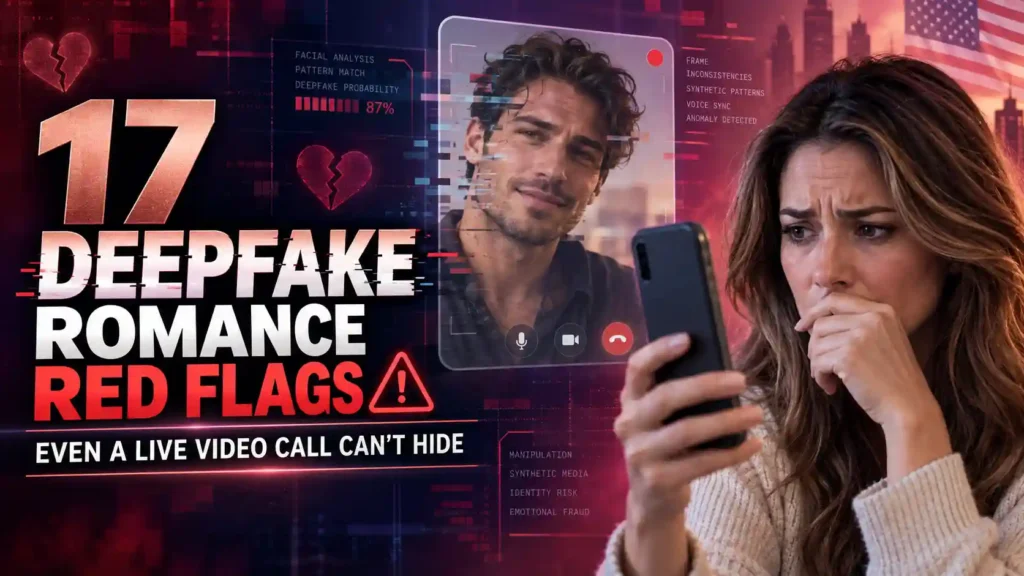
Deepfake job scams are more dangerous than ordinary employment fraud because they attack one of the verification methods people trust most: seeing someone live on camera. Criminals can now imitate recruiters, hiring managers and executives during video interviews. Other fraudsters reverse the scheme by using synthetic identities to apply for real remote jobs.
A convincing face is no longer enough. A realistic voice is not confirmation. Even a live video conversation can be manipulated.
This guide focuses specifically on AI-powered recruitment impersonation, deepfake interviews and fake remote candidates. For traditional fake listings, reshipping jobs, task scams and work-from-home fraud, your broader job-scams guide should remain the main resource.
What to Do If a Suspicious Recruiter Is Contacting You Now
Do not send money, identity documents, banking information or security codes until you verify the opportunity independently.
Take these steps immediately:
- Pause the interview or onboarding process.
- Do not click another link supplied by the recruiter.
- Do not call any telephone number in their message or offer letter.
- Open the company’s official website independently.
- find the company’s published human resources or general contact information.
- Ask whether the person and vacancy are legitimate.
- Preserve the job advertisement, messages, email addresses, documents and payment instructions.
- Contact your bank immediately if you have already sent money or deposited a check.
Do not warn the recruiter about every inconsistency you found. That can help a criminal improve the scheme or manufacture explanations.
Verification must take place outside the communication channel the suspected recruiter controls.
What Are Deepfake Job Scams?
Deepfake job scams use artificially generated or manipulated faces, voices, images, documents or identities to deceive people during recruitment.
A criminal may use AI to:
- Impersonate a real recruiter
- Pretend to be a hiring manager
- Clone an executive’s voice
- Alter their appearance during a video call
- Create a nonexistent employee
- Generate a professional headshot
- Build a convincing résumé or employment history
- Produce realistic offer letters
- Imitate a job applicant
- Feed answers to someone during an interview
- Replace one candidate with another after hiring
The technology is only part of the deception. Most successful schemes still rely on familiar human pressures: an attractive salary, an urgent deadline, fear of losing the opportunity and reluctance to question someone who appears authoritative.
That combination makes deepfake recruitment fraud a particularly dangerous form of deepfake scams.
Deepfake Job Scams and Ordinary Job Scams Are Not the Same
You have already written a general article about job scams, so this new article must not repeat the same search intent.
A broad job-scams article should cover fraudulent employment opportunities such as:
- Task and optimization scams
- Reshipping schemes
- Mystery-shopping scams
- Fake-check jobs
- Work-from-home fraud
- Pyramid schemes
- Advance-fee employment offers
- Money-mule recruitment
- Package-forwarding jobs
This article has a narrower purpose. It addresses recruitment fraud in which AI-generated or manipulated identities make the employer, interviewer or applicant appear real.
The distinction matters for SEO and readers:
| Article | Primary purpose |
|---|---|
| General job-scams article | Identify fraudulent jobs and employment schemes |
| Deepfake job-scams article | Verify whether the recruiter, interviewer or candidate is the person they claim to be |
Both subjects overlap, but they answer different questions. Your existing article can link to this guide when discussing fake recruiters, AI interviews or identity impersonation.
The Three Main Types of Deepfake Job Fraud
Deepfake recruitment fraud does not always target the job seeker. Understanding the three major variations will help you recognize what the criminal wants.
A Fake Recruiter Targets a Job Seeker
The criminal pretends to represent a legitimate company. They advertise an attractive position or contact a suitable candidate directly.
The scam eventually attempts to obtain:
- An upfront payment
- Money from a fraudulent check
- Banking information
- Identity documents
- Tax information
- Account credentials
- One-time security codes
- Access to the victim’s computer
- Participation in money laundering
A deepfake video interview makes the nonexistent opportunity appear more credible.
A Fake Interviewer Creates a False Sense of Legitimacy
Some operations involve several supposed company representatives.
The victim may meet a recruiter, department manager and onboarding officer. These identities could be controlled by the same person, a criminal team or a combination of stolen video and AI-generated voices.
The apparent presence of multiple employees does not confirm legitimacy if every introduction and communication channel comes from the original scammer.
A Fake Candidate Targets a Real Employer
The criminal applies for a legitimate remote position using a stolen or invented identity.
They may employ:
- Face-swapping software
- Voice modification
- Fabricated qualifications
- Stolen identity documents
- AI-generated résumés
- Hidden interview assistance
- Another person to complete technical assessments
- A local intermediary who receives company equipment
After being hired, the impostor may collect wages, steal data, install malware or gain access to sensitive systems.
How a Deepfake Recruiter Builds the Deception
Most deepfake job scams are not spontaneous. The criminal carefully assembles the illusion before contacting the target.
Step 1: The Scammer Selects a Real Company
Recognizable companies create immediate trust. The criminal copies the organization’s branding, vacancy descriptions and employee information.
Smaller companies can also be exploited because applicants may be less familiar with their genuine recruitment process.
Step 2: The Scammer Steals a Recruiter’s Identity
The criminal searches professional profiles, company pages, interviews and social media for a suitable employee.
They may copy the person’s:
- Name
- Photograph
- Job title
- Professional history
- Email signature
- Biography
- Public voice recordings
- Video appearances
When the victim searches for the recruiter, they find a real person matching the claimed identity. The search appears to confirm the story, but it only confirms whose identity was stolen.
Step 3: A Similar Company Domain Is Created
The scammer may register a web address differing from the real company’s domain by one character, word or symbol.
For example:
company.combecomescompany-careers.comcompany.combecomescompanyjobs.com- A lowercase “l” is replaced with an uppercase “I”
- A letter is repeated or removed
- A different domain ending is used
On a phone screen, the difference may be difficult to notice.
Step 4: The Victim Receives a Personalized Offer
Information from a public résumé or professional profile allows the scammer to mention the victim’s actual skills and experience.
The message may claim:
- A manager recommended the victim
- The résumé was found in a recruitment database
- The company is expanding its remote team
- The applicant was selected for a confidential vacancy
- Immediate hiring is necessary
Personalization does not prove that someone has genuinely evaluated you.
Step 5: The Interview Is Carefully Controlled
The criminal chooses a platform, camera angle and interview length that reduce the chance of exposure.
They may blame weak internet service for:
- Low video resolution
- Delayed audio
- A frozen face
- Short camera appearances
- Sudden disconnections
- Refusal to move closer to the camera
- Switching to text communication
The interviewer may follow a script and avoid spontaneous discussion.
Step 6: The Job Offer Creates Excitement
Once the victim believes the interview was legitimate, the scammer sends an impressive offer letter and onboarding package.
Excitement becomes the weapon. The victim is encouraged to think about the salary, new career and financial relief instead of examining the process.
Step 7: The Criminal Makes the Real Request
The fake job was never the product. It was the explanation for requesting something valuable.
The criminal may ask for:
- A payment
- A copy of an identity document
- A bank account number
- A tax identification number
- Remote access to a device
- A deposited check
- Cryptocurrency
- Gift cards
- Login credentials
- A security code
Once the victim complies, the recruiter may disappear or invent another fee.
A Realistic Deepfake Recruiter Scenario
Imagine that Maria publishes an “open to work” notice on a professional networking platform.
Two days later, a recruiter claiming to represent a large healthcare company contacts her about a remote administrative position. The recruiter’s name, photograph and job title match a real employee.
Maria attends a short video interview. The interviewer’s camera freezes several times, but the person apologizes for having a weak connection. Later that afternoon, Maria receives an offer paying considerably more than expected.
The company says it will provide a laptop and home-office equipment. Maria receives a check and is instructed to deposit it, keep a small amount for herself and send the rest to the company’s equipment supplier.
The funds appear in her account, so she pays the vendor.
Several days later, her bank determines that the check is fraudulent and removes the deposit. The vendor was part of the scam, and Maria is responsible for the money she sent.
The video interview did not make the job legitimate. It merely made Maria comfortable enough to deposit the check.
Why Seeing Someone on Camera Is No Longer Proof
People are trained to distrust anonymous messages but trust live human interaction. Deepfake technology exploits that habit.
A criminal can potentially use:
- A synthetic face generated by AI
- Real-time face replacement
- A prerecorded video
- A virtual camera
- Cloned or modified audio
- Lip-synced speech
- A stolen video feed
- An accomplice appearing on camera
- AI-generated answers delivered through an earpiece
Some manipulated videos contain visible defects. Others look convincing, particularly on a small screen or unstable connection.
Therefore, the best question is not:
“Does this face look fake?”
The better question is:
“Can I confirm this person’s identity outside the communication channel they control?”
Visual inspection may raise suspicion, but independent verification should decide whether you proceed.
15 Signs Your Recruiter or Video Interview May Be Fake
One unusual detail does not automatically prove fraud. However, several warning signs appearing together should stop the process.
1. You Are Offered an Exceptional Job Without Applying
Legitimate recruiters sometimes approach qualified candidates. The warning sign is an unsolicited opportunity combined with an unusually high salary, vague duties or immediate hiring.
Ask why you were selected and what specific experience attracted the recruiter.
A scammer who copied basic information from your profile may respond with generic praise rather than a meaningful explanation.
2. The Recruiter Uses an Unofficial or Lookalike Email Address
Check the entire email address character by character.
Do not trust the display name, company logo or professional signature. All three can be copied.
Watch for:
- Free email services
- Added words such as “careers” or “recruitment”
- Missing or repeated letters
- Extra hyphens
- Different domain endings
- Characters designed to resemble other letters
Do not click the company link inside the email to compare it. Find the real website independently.
3. The Recruiter Is Real, but Their Contact Information Is Wrong
This is more sophisticated than inventing a nonexistent employee.
A criminal uses the name and photograph of a genuine recruiter. Searching the name produces legitimate results, which appears reassuring.
However, the criminal’s telephone number, email address or messaging account does not belong to that employee.
Confirm the communication method—not merely the person’s existence.
4. The Job Is Missing From the Official Careers Page
An unlisted job is not automatically fraudulent. Companies sometimes use external recruiters or fill roles privately.
However, the absence of the vacancy means you need direct confirmation.
Contact the company and ask:
“I received an invitation to interview for the position of [job title] from someone named [recruiter’s name]. Can you confirm that the vacancy exists and that this person is authorized to recruit for it?”
Do not call a number supplied by the recruiter.
5. The Interviewer’s Face or Voice Behaves Strangely
Possible deepfake clues include:
- Delayed lip movements
- Unnatural blinking
- Distorted facial edges
- Flickering around glasses or hair
- Skin texture that changes suddenly
- Earrings or teeth that briefly disappear
- Lighting that affects the face and room differently
- A voice without natural emotional variation
- Expressions that do not match the conversation
- Facial features that shift when the head turns
These signs are not conclusive. Poor cameras, compression and unstable internet connections can create similar defects.
Use them as reasons to investigate—not as your only test.
6. The Person Keeps Their Face Small, Dark or Motionless
A scammer may reduce the chance of visual glitches by controlling how their face appears.
They may:
- Sit far from the camera
- Use heavy backlighting
- Keep the head facing forward
- Avoid touching their face
- Disable the camera after introductions
- Claim the platform does not support better video
- Refuse to join through the company’s normal system
A genuine person can have technical problems. What matters is whether they cooperate with reasonable alternatives.
7. The Interview Feels Rehearsed
The interviewer may speak convincingly until you interrupt the expected sequence.
Warning signs include:
- Ignoring your question
- Giving an answer unrelated to what you asked
- Repeating prepared statements
- Taking strange pauses before simple responses
- Avoiding follow-up questions
- Refusing to explain the team’s work
- Knowing the advertisement but not the actual role
Ask specific questions about reporting lines, current projects, performance expectations and daily responsibilities.
8. The Interview Is Conducted Mostly Through Text
Some employers use written screening questions, but text-only recruitment makes impersonation easier.
Be suspicious if the entire hiring process occurs through:
- Instant messages
- A private chat application
- Text messages
- Email questionnaires
- An unfamiliar interview platform
The danger increases when the company refuses a properly verified telephone or video conversation through an official channel.
9. You Receive an Offer Without Serious Evaluation
A legitimate employer normally needs to determine whether you can perform the job.
Question an offer made without:
- Role-specific questions
- Discussion of your work history
- A skills assessment when appropriate
- Explanation of the responsibilities
- Introduction to relevant team members
- Confirmation of your availability
- A credible selection process
Scammers want to reach the payment or identity request quickly. Evaluating your ability is unnecessary because there is no job.
10. The Salary Is Far Above the Normal Range
An unusually generous salary encourages the victim to overlook inconsistencies.
Compare the offer with similar positions requiring the same experience, location and responsibilities.
Be especially cautious when basic data-entry, administrative or customer-service work promises senior professional compensation with flexible hours and no meaningful requirements.
11. You Must Pay Before You Can Start
A supposed employer may request money for:
- Training
- Equipment
- Software
- Background checks
- Certifications
- Insurance
- Administration
- Account activation
- Security clearance
- Shipping
- Immigration processing
Some professions require qualifications that applicants obtain independently. That is different from a recruiter demanding payment to a particular account, wallet or vendor to release a job.
Never send gift cards or cryptocurrency to an employer.
12. The Employer Sends You a Check for Equipment
This is one of the most damaging job-scam variations.
The recruiter sends a check for a computer or home-office setup and instructs you to purchase from an approved vendor. Your bank may initially display the money, but that does not mean the check is genuine.
When the bank later reverses the fraudulent deposit, you remain responsible for the real money sent to the fake vendor.
Never move an employer’s money through your personal bank account.
13. Sensitive Information Is Requested Too Early
Real employers eventually require information for identity verification, taxes and payroll. The timing, recipient and method matter.
Be suspicious if a recruiter requests the following before you have independently verified the company and accepted a genuine offer:
- Social Security or national identification number
- Passport
- Driver’s license
- Bank account information
- Payment-card details
- Online banking credentials
- Complete tax forms
- A selfie holding your identity document
- One-time security codes
Never send passwords or authentication codes to an employer.
14. The Recruiter Sends You to an Unfamiliar Onboarding Portal
A fake portal can copy a legitimate company’s logo and design while collecting identity and banking information.
Before using an onboarding website:
- Confirm the offer through the company’s official contact details.
- Check the entire web address.
- Ask human resources to confirm the portal.
- Avoid entering through a link in an unexpected message.
- Do not ignore browser security warnings.
A polished website can still be a credential-stealing page.
15. The Recruiter Resists Independent Verification
This is the most important warning sign.
A scammer may:
- Become angry when questioned
- Threaten to withdraw the offer
- Claim the position is confidential
- Say the company cannot accept incoming calls
- Give you another number controlled by the scheme
- Send a verification link
- Introduce an accomplice as an HR representative
- Demand immediate completion of onboarding
- Insist that verification shows a lack of trust
A legitimate recruiter should understand reasonable precautions. Pressure is not proof by itself, but it is a strong reason to stop.
Use the H.I.R.E. Test Before Trusting a Recruiter
The H.I.R.E. test provides a simple process for evaluating remote recruitment.
Do not skip a step merely because the person looked convincing on video.
H — Hunt for the Official Record
Look for the vacancy on the organization’s official careers page.
Check whether the job title, location, salary, department and responsibilities match the recruiter’s description.
Search the supposed recruiter’s name, but remember that finding a matching employee profile does not prove you are communicating with that person.
I — Inspect the Identity Independently
Leave the original email, message or video platform.
Find the company’s official contact details yourself and ask whether:
- The recruiter works there
- The recruiter is hiring for this position
- The vacancy exists
- The interview invitation is genuine
- The onboarding portal belongs to the company
Use this script:
“Hello, I received a job offer from someone claiming to be [full name] for the position of [job title]. The message came from [email address]. Can you confirm that this person is authorized to recruit for this vacancy?”
R — Refuse Payments and Premature Data Requests
Do not pay for a job. Do not deposit a company check and forward the proceeds. Do not purchase equipment from a recruiter-selected vendor.
Protect sensitive personal information until the company, vacancy and onboarding process have been independently confirmed.
E — Exit the Recruiter’s Communication Channel
A scammer should never control both the claim and its verification.
The following do not count as independent confirmation:
- Calling a number supplied by the recruiter
- Clicking their verification link
- Contacting another person they introduced
- Trusting a copied professional profile
- Replying to another email address they provided
- Searching only for the recruiter’s name
- Accepting an additional video call as proof
For a more detailed examination process, use the 90-second test in deepfake video call scams before obeying any financial or security-sensitive instruction.
Questions That Can Disrupt a Scripted Fake Interview
A single unusual request cannot reliably expose every deepfake. However, spontaneous questions can reveal inconsistencies in the person’s story.
Ask:
- What made you contact me specifically?
- Who would I report to?
- How large is the immediate team?
- What would success look like during the first 90 days?
- What project would I work on first?
- Why is the position currently open?
- Which official careers-page listing corresponds to this role?
- Can I call the company’s published number and ask for you?
- Which department should confirm this interview?
- Can you send the invitation from the company’s established domain?
Do not demand random movements as if they provide perfect proof. Sophisticated manipulation can survive simple movement tests, while an innocent person may find the request confusing.
Identity must still be confirmed independently.
Can Scammers Record Your Interview to Impersonate You?
Yes. A fraudulent interview can serve two purposes.
First, the scammer may attempt to steal your money or information. Second, the conversation may provide material containing your face, voice and personal history.
That material could potentially be misused to:
- Create impersonation content
- Open fraudulent profiles
- Target your contacts
- Bypass weak identity checks
- Apply for jobs under your name
- Produce more convincing social-engineering messages
This does not mean you should refuse every video interview. Instead:
- Verify the employer before sharing sensitive details.
- Avoid displaying identity documents on an unverified call.
- Do not repeat security phrases or authentication codes.
- Do not install unfamiliar interview software.
- Be cautious about unusual requests for specific phrases or head movements.
- Ask how interview recordings are stored and used.
- Leave if the supposed employer refuses basic verification.
What Employers Need to Know About Deepfake Candidates
Employers face the opposite version of the same problem: an apparently qualified candidate may not be the person represented by the application.
A deepfake candidate may use a stolen identity, manipulated face, modified voice or hidden assistant to pass a remote interview.
Why Criminals Apply for Real Remote Jobs
The objective may be more serious than obtaining an undeserved salary.
A fraudulent employee may attempt to:
- Access confidential company information
- Steal customer or employee data
- Obtain proprietary code
- Install malicious software
- Enter financial systems
- Commit payroll fraud
- Divert business payments
- Extort the company after obtaining information
- Hide the worker’s true location
- Send wages to a prohibited organization
- Use company credentials for additional attacks
Remote technology positions can be particularly attractive because they may provide extensive access without requiring the worker to enter a physical office.
Signs of a Potentially Fake Candidate
Employers should investigate when:
- The résumé appears perfect but lacks verifiable detail.
- The candidate cannot explain projects listed on the résumé.
- Answers are polished but shallow.
- Speech patterns change during the interview.
- The face behaves unnaturally on video.
- Professional profiles were created recently.
- Employment dates differ across documents.
- The person avoids spontaneous questions.
- Another voice can be heard providing answers.
- Technical assessments do not match interview performance.
- Equipment must be sent to an unrelated person or address.
- Identity or payment information changes after hiring.
- The person appearing during onboarding differs from the interviewee.
- Logins originate from unexplained locations.
- The employee immediately requests access unrelated to the role.
None of these factors should automatically establish guilt. Employers must use consistent, lawful procedures and investigate several signals together.
How Employers Can Reduce Deepfake Hiring Fraud
Looking for strange blinking is not an adequate security strategy.
The hiring process should verify competence, identity and continuity separately.
Verify Skills With Unscripted Follow-Up Questions
Ask candidates to explain:
- Why they made a specific decision
- What alternatives they rejected
- What went wrong during a project
- How they measured results
- What they would change now
Memorized or AI-fed answers become harder to maintain through detailed follow-up questions.
Verify Employment Independently
Do not rely only on contact details listed on the résumé.
Where lawful, obtain the previous employer’s contact information independently and confirm the candidate’s role and employment history.
Confirm Identity Through Approved Procedures
Use lawful identity-verification and background-check procedures appropriate to the position and jurisdiction.
A video interview should support the process, not replace formal identity verification.
Maintain Identity Continuity
Confirm that the same individual:
- Submitted the application
- Attended the interviews
- Completed assessments
- Supplied identity documents
- Signed the offer
- Received company equipment
- Completed onboarding
- Began performing the work
A criminal may use one person for the interview and another after the offer.
Verify Equipment Addresses
Investigate requests to ship a laptop to:
- A third party
- A commercial forwarding service
- An address unrelated to the employee
- A location inconsistent with hiring records
- An address receiving devices for multiple employees
Do not ship sensitive equipment merely because the request appears in a legitimate-looking email.
Restrict New-Employee Access
Give new workers only the accounts and information needed for their duties.
Increase access gradually. Monitor requests for confidential repositories, payroll systems, customer databases and administrative permissions.
Protect Payroll Changes
Bank-account changes should require verification through a trusted second channel.
An email or video conversation should not be sufficient when payment details change unexpectedly.
These controls also help prevent CEO deepfake scams in which criminals impersonate senior leaders to authorize transfers or disclose confidential information.
What to Do If You Sent Money to a Fake Employer
Speed matters. Contact the payment provider immediately.
Contact Your Bank or Payment Service
Explain that the transaction was connected to employment fraud.
Ask whether the institution can:
- Stop the payment
- Recall a transfer
- Freeze the receiving account
- Dispute a card transaction
- Flag your account for fraud
- Preserve transaction records
Recovery is not guaranteed, but delays reduce the chance of success.
Report a Deposited Check
If you deposited a check from the employer, contact your bank even if the money currently appears available.
Do not spend the funds or send additional payments. Explain that you believe the check may be fraudulent and follow the bank’s instructions.
Avoid Recovery Scammers
After losing money, you may be contacted by someone claiming to be an investigator, hacker, lawyer or recovery specialist.
Do not pay an upfront fee to recover stolen money. Criminals frequently target previous victims because they know those people are desperate to reverse the loss.
What to Do If You Shared Personal Information
Your next steps depend on what the scammer received.
If You Shared a Password
Change it immediately from a trusted device.
Also change any account using the same or a similar password. Enable multifactor authentication and review active sessions, recovery addresses and connected devices.
If You Shared Banking Information
Contact the bank’s fraud department. Ask whether the account should be monitored, restricted or replaced.
Review transactions regularly.
If You Shared an Identity Document
Record exactly what you sent and when.
Consider placing a fraud alert or credit freeze through the appropriate credit-reporting services in your country. Watch for unfamiliar accounts, applications and collection notices.
If You Shared a Social Security or National Identification Number
Follow your country’s identity-theft procedures. Monitor your credit records and government accounts for unauthorized activity.
In the United States, victims can use IdentityTheft.gov to obtain a recovery plan.
If You Installed Software
Disconnect the device from sensitive networks and accounts.
Use a different trusted device to change important passwords. Have the affected computer examined by a qualified security professional.
Do not assume that deleting the visible application removes every component.
If You Shared a Security Code
Contact the relevant account provider immediately. The code may have allowed the criminal to sign in, reset a password or authorize a transaction.
Check for modified recovery details, unfamiliar devices and forwarding rules.
How to Report a Deepfake Job Scam
Preserve the evidence before blocking the scammer.
Save:
- The job listing
- Email messages and headers
- Chat histories
- Recruiter profiles
- Telephone numbers
- Usernames
- Interview invitations
- Meeting links
- Offer letters
- Payment instructions
- Check images
- Website addresses
- Cryptocurrency wallet addresses
- Transaction receipts
- Screenshots of the video call
Report the scheme to:
- The impersonated company
- The job board or professional platform
- The email or messaging provider
- Your bank or payment service
- Local law enforcement when appropriate
- Your country’s consumer-protection agency
- The relevant national cybercrime reporting service
In the United States, reports can be submitted through ReportFraud.ftc.gov and IC3.gov.
Do not continue communicating merely to collect more evidence. Once you have preserved what already exists, protect your accounts and stop engaging.
Frequently Asked Questions About Deepfake Job Scams
These answers address specific questions job seekers and employers may have about synthetic recruiters, manipulated interviews and remote-hiring fraud.
Can deepfakes be used during live job interviews?
Yes. Face-swapping, virtual-camera and voice-modification technology can operate during live calls. Scammers may also combine real-time interaction with prerecorded material.
Does seeing a recruiter on video prove the job is legitimate?
No. Video confirms only that an image appeared on your screen. Verify the recruiter through contact information found independently on the company’s official website.
Can a fake recruiter impersonate a real employee?
Yes. Using a real employee’s name, photograph and history makes the deception more convincing. Finding that person online does not confirm who contacted you.
Are all unsolicited recruiter messages fraudulent?
No. Legitimate recruiters contact qualified candidates. However, unexpected offers require verification, particularly when the salary is unusually high or the hiring process is rushed.
Can scammers spoof a real company email address?
Some email messages can be made to display misleading sender information. Examine the full address and independently confirm important messages with the company.
Can a fake recruiter use a legitimate job advertisement?
Yes. A criminal can copy a genuine vacancy and pretend to control the recruitment process. Apply through the official careers page whenever possible.
Is a verified social-media profile proof that a recruiter is genuine?
No. Accounts can be copied, compromised or misrepresented. Confirm the recruiter through the employer’s independently obtained contact information.
Is a text-only job interview always a scam?
No, but it deserves caution. The risk is much higher when the employer refuses voice or video contact and quickly requests money or sensitive information.
Why would a recruiter’s video keep freezing?
It may result from a genuine technical problem. However, scammers can also use poor connectivity as an explanation for deepfake glitches or short camera appearances.
Can I identify a deepfake by asking the person to turn their head?
Not reliably. Movement may reveal defects in weaker systems, but sophisticated manipulation may remain convincing. Independent identity verification is stronger.
Can a scammer record my face during an interview?
Yes. Any video-call participant may be able to record the conversation. Verify the organization and avoid displaying sensitive documents during an unconfirmed interview.
Why would a fake recruiter ask me to repeat a phrase?
The request could help collect a clean sample of your voice. Ask why unusual recordings are necessary and verify the employer before cooperating.
Can my interview recording be used to clone my voice?
Potentially. Voice-cloning systems can use recorded speech to imitate aspects of a person’s voice. Limit unnecessary recordings and protect personal details that could strengthen an impersonation.
Should I provide my Social Security number before an interview?
No legitimate reason normally exists to provide it merely to receive an interview. Sensitive information should be submitted only during a verified and secure stage of hiring.
When should I provide direct-deposit information?
After confirming the employer, accepting a genuine offer and entering the company’s verified onboarding process.
Should I pay for a background check?
Do not send money to an unfamiliar recruiter or designated vendor without independent confirmation. Requests for upfront recruitment payments are major warning signs.
Is an emailed check safe when the money appears in my account?
No. A bank may make funds temporarily available before discovering that the check is fraudulent. The deposit can later be reversed.
Why do fake employers ask applicants to buy equipment?
The equipment story gives them a reason to request payment or make the victim forward money from a fraudulent check.
Can a fake job appear on a respected employment platform?
Yes. Well-known platforms can contain fraudulent listings, copied vacancies and compromised recruiter accounts.
What is a deepfake candidate?
It is an applicant who uses manipulated media, identity substitution or stolen information to conceal who is attending the interview or accepting the position.
Why would someone use a fake identity to obtain a real job?
Possible motives include wage fraud, hiding the worker’s location, stealing data, gaining system access, installing malware or obtaining intellectual property.
What is candidate substitution?
Candidate substitution occurs when one person completes the interview or assessment while another person performs the job after hiring.
What is a laptop farm?
It is a location where company computers assigned to supposedly remote employees are physically maintained and accessed on their behalf. An employee may appear to work from one country while remotely controlling a device somewhere else.
Should employers reject candidates because of video glitches?
No. Video defects can result from ordinary technical problems. Employers should use consistent identity and employment verification instead of treating appearance alone as proof.
What is the fastest way to verify a suspicious recruiter?
Stop using the recruiter’s contact information. Find the company’s official website independently and ask its human resources department to confirm the person and vacancy.
Final Warning
Deepfake job scams do not succeed because every manipulated face is technically perfect. They succeed because people want the opportunity to be real.
A desirable salary creates excitement. A recognizable company creates trust. A video interview appears to remove doubt. Then urgency prevents careful verification.
Do not rely on appearance when money, identity documents or account access are involved.
Use the H.I.R.E. test:
- Hunt for the official record.
- Inspect the identity independently.
- Refuse payments and premature information requests.
- Exit the original channel before verifying.
A real employer can survive a reasonable verification check. A scam depends on preventing one.