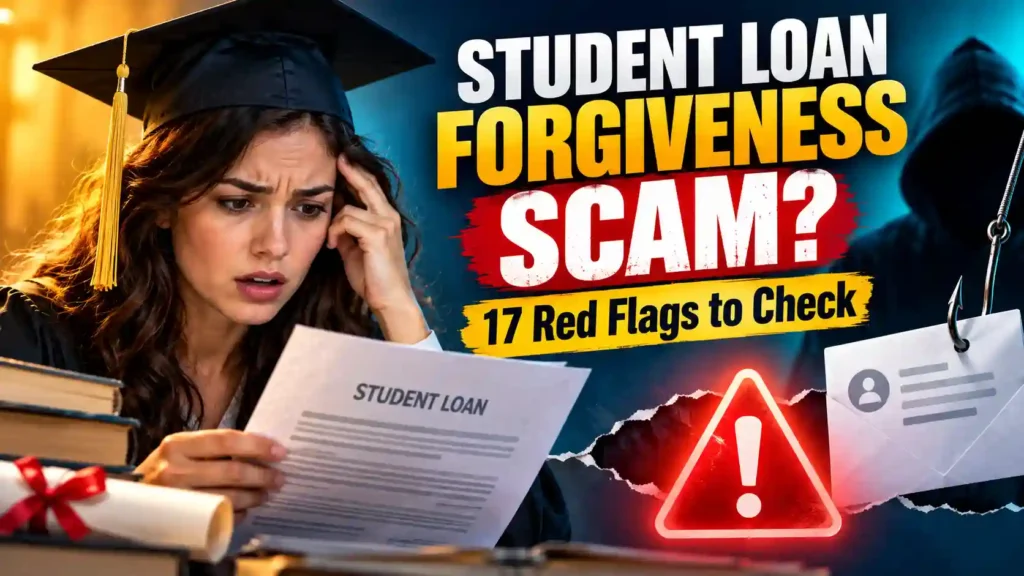
The message looks official. It mentions your student loan balance, uses a government-style seal and warns that you have only 24 hours to claim forgiveness. The caller may even know your name, school or loan servicer.
Then comes the catch: You must pay an “enrollment fee,” share your Federal Student Aid login or move your monthly payments to a new company.
Stop right there.
Student loan forgiveness scams are designed to reach you when you are worried, confused or desperate for relief. Criminals take advantage of changing repayment rules, political announcements and forgiveness news to make fake offers sound timely and believable. Some steal a few hundred dollars. Others take thousands, redirect monthly loan payments or use borrowers’ personal information to commit identity theft.
Knowing how to identify student loan forgiveness scams can protect more than your bank account. It can prevent missed payments, damaged credit, unauthorized account changes and years of financial trouble.
The good news is that most of these scams reveal themselves if you know which details to examine. Here are 17 warning signs you should never ignore.
What Is a Student Loan Forgiveness Scam?
A student loan forgiveness scam is a scheme in which a person or company falsely promises to reduce, cancel, consolidate or manage your student loans in exchange for money, account access or personal information.
The scammer may pretend to represent:
- The U.S. Department of Education
- Federal Student Aid
- Your federal loan servicer
- A government-approved forgiveness center
- A law firm
- A nonprofit organization
- A private debt-relief company
- A special program connected to the president or Congress
Some scammers collect an upfront fee and disappear. Others charge borrowers monthly for submitting forms that are available free of charge. The most damaging operators take control of borrowers’ accounts, change contact details and redirect payments away from the real loan servicer.
Recent enforcement actions show how expensive these operations can become. In one major case, operators were accused of taking more than $45.9 million from consumers through an illegal student loan debt-relief operation. Another alleged scheme collected at least $8.8 million while charging upfront monthly fees as high as $1,400. Federal enforcement details
How to Identify Student Loan Forgiveness Scams
A professional website or knowledgeable caller does not prove that an offer is legitimate. Examine what the company wants you to do, what it promises and how it responds when you ask questions.
1. They Contact You Without Warning
An unexpected call, email, text message or social media advertisement promising student loan cancellation should immediately make you cautious.
The message may say:
- “You have been preapproved for forgiveness.”
- “Your student loan account has been flagged for relief.”
- “Final notice: Complete your discharge application.”
- “Your payments may be reduced to $0.”
- “You have unclaimed student debt benefits.”
These statements are often written to make you believe the sender has reviewed your account. In reality, the same message may have been sent to thousands of people.
Do not continue the conversation simply because the caller knows your name or estimated balance. Personal information can be obtained from data breaches, credit records, public sources or lists sold by dishonest marketers.
2. They Promise Immediate or Guaranteed Forgiveness
No private company can guarantee that your student loans will be forgiven.
Legitimate forgiveness and discharge programs have specific requirements. Depending on the program, eligibility may depend on your loan type, employer, repayment history, disability, school conduct or years of qualifying payments.
A company cannot erase those requirements because it has a “special relationship” with the government.
Be suspicious of claims such as:
- “Everyone qualifies.”
- “Your balance will disappear in 30 days.”
- “We guarantee approval.”
- “You have already been approved.”
- “We can remove 100% of your loans.”
- “Your income does not matter.”
- “We found a legal loophole.”
An honest representative should explain that eligibility must be reviewed. A scammer gives you certainty before examining the facts.
3. They Demand an Upfront Fee
An upfront fee is one of the clearest warning signs of a student loan debt-relief scam.
The company may call it an:
- Application fee
- Processing fee
- Enrollment fee
- Document-preparation fee
- Legal fee
- Certification charge
- Account activation fee
- Forgiveness deposit
The label does not change what is happening. You are being pressured to pay before receiving meaningful help.
Your federal student loan servicer can help you explore repayment plans, consolidation, deferment, forbearance and eligible forgiveness programs without charging an enrollment fee. Companies that demand payment before providing debt-relief services may be violating federal law. Current borrower warning signs
4. They Ask for Your Federal Student Aid Password
Never share your StudentAid.gov username, password or account recovery code with another person or company.
Your Federal Student Aid account can contain highly sensitive information, including:
- Your Social Security number
- Date of birth
- Loan balances
- Contact details
- Loan-servicer information
- Repayment-plan information
- Financial aid history
- Submitted forms
Someone who controls your account may change your email address, telephone number or repayment plan without your knowledge. They could also use the information to impersonate you elsewhere.
A legitimate helper may guide you while you log in yourself. That person does not need to know your password.
5. They Ask You to Pay Them Instead of Your Loan Servicer
This is not a small warning. It is a sign that your loan could be heading toward delinquency or default.
Some companies tell borrowers to send monthly payments to them, promising to forward the money to the actual servicer. Instead, they may keep the payments or deduct large fees.
Meanwhile, the borrower assumes everything is fine. Months later, the real account may be past due, interest may have increased and the borrower’s credit could be damaged.
Your required student loan payment should go through your verified loan servicer’s official payment system. Do not redirect payments based on instructions received through an unsolicited call, text or email.
6. They Pressure You to Act Immediately
Scammers do not want you to slow down, check the offer or speak with your loan servicer.
Therefore, they invent deadlines:
- “Forgiveness enrollment closes tonight.”
- “This is your final notice.”
- “Your benefits expire in 24 hours.”
- “You must apply before the new administration ends the program.”
- “Only 50 applications remain.”
- “If you hang up, you will lose your eligibility.”
Real programs can have deadlines, but you should be able to verify them independently on an official government website.
Never let a caller’s countdown become your decision-making clock. Hang up, type StudentAid.gov directly into your browser and confirm the information yourself.
7. They Claim to Be “Government Approved”
Terms such as “government approved,” “federally authorized” and “Department certified” can sound impressive without having a clear legal meaning.
A company may also choose a name that includes words such as:
- Federal
- National
- American
- Student Aid
- Loan Assistance
- Forgiveness Center
- Education Services
- Relief Department
A government-sounding name does not make a private business part of the government.
Ask for the company’s full legal name, physical address and website. Then independently verify whether it is listed as your federal loan servicer or an official government agency.
8. Their Website Looks Official but Does Not End in .gov
Scammers can copy colors, logos, seals and page layouts from legitimate websites. They may use web addresses that differ from official addresses by only one letter or word.
Examples of suspicious address patterns might include:
- studentaid-relief.com
- federal-loan-help.net
- ed-forgiveness.org
- studentloan-gov.com
The presence of “gov” inside a commercial web address does not make it a government website. In the United States, an official federal website generally ends in .gov.
Do not use a website address sent by an unknown company. Type StudentAid.gov into your browser yourself.
9. They Want Your Social Security Number Before Explaining the Service
A scammer may claim your Social Security number is needed to “check eligibility.” However, providing it can expose you to identity theft.
Before sharing sensitive information, you should know:
- Who is requesting it
- Why it is necessary
- How it will be protected
- Whether the organization is legitimate
- What service is actually being provided
Be particularly cautious if the request comes through an unexpected phone call, text message, email, online advertisement or social media conversation.
A legitimate organization should not become hostile when you refuse to disclose sensitive information immediately.
10. They Ask You to Sign a Power of Attorney
A power of attorney or third-party authorization can allow a company to communicate with your loan servicer and take certain actions for you.
These documents are not automatically fraudulent. Attorneys and legitimate representatives sometimes use them for valid reasons. Nevertheless, a debt-relief company should not pressure you to sign one without explaining every permission you are granting.
A dishonest company might use the authorization to:
- Change your account contact information
- Submit forms without your understanding
- Prevent the servicer from communicating directly with you
- Change your repayment plan
- Redirect correspondence
- Hide missed payments
- Keep you dependent on its monthly service
Never sign a document you have not read. If the company refuses to give you time to obtain independent advice, walk away.
11. They Tell You to Stop Communicating With Your Servicer
A scammer benefits when you cannot discover what is happening to your real account.
The company may say:
- “Your servicer does not want you to know about this program.”
- “Do not answer calls from your servicer.”
- “We now manage your account.”
- “Send every letter to us.”
- “Your servicer cannot help because your case has been transferred.”
Those statements are designed to isolate you.
Even if you hire a legitimate professional, you should maintain access to your account, receive official correspondence and understand every action being taken.
12. They Guarantee a Special Low Monthly Payment
Income-driven federal student loan payments are generally calculated using established rules. A private debt-relief company does not create a secret payment formula.
A scammer may promise a $0 or unusually low monthly payment without asking enough questions about your income, family size, loan type or repayment eligibility.
In some cases, the company may submit false information to obtain a lower payment. That can create serious consequences for you because the application is submitted in your name.
A $0 payment can be legitimate for an eligible borrower under certain circumstances. However, it must result from accurate information and an authorized repayment plan—not a salesperson’s guarantee.
13. They Promise to Remove Legitimate Loans From Your Credit Report
No company can lawfully erase accurate student loan debt from your credit report merely because you pay a fee.
Legitimate errors can be disputed. Fraudulent accounts may be challenged through identity-theft procedures. However, accurate information generally cannot be removed simply because it is inconvenient or damaging to your score.
Be suspicious of anyone who promises to:
- Delete student loan defaults overnight
- Create a new credit identity
- Remove accurate late payments
- Hide legitimate federal debt
- Guarantee a specific credit-score increase
The company may be selling an impossible service or asking you to participate in fraud.
14. The Payment Method Is Difficult to Reverse
Scammers prefer payment methods that are fast, hard to trace or difficult to recover.
Walk away if you are told to pay through:
- Gift cards
- Cryptocurrency
- Wire transfers
- Cash deposits
- Prepaid debit cards
- Peer-to-peer payment apps sent to an individual
- An unfamiliar overseas payment service
A demand for gift cards or cryptocurrency is not how a legitimate federal student loan program collects an application fee.
Even when the company accepts a regular credit or debit card, the offer can still be fraudulent. The payment method is one clue, not the only test.
15. The Message Contains Strange Grammar or Inconsistent Details
Spelling and grammar mistakes do not automatically prove that a message is fraudulent. However, they become important when combined with financial pressure and requests for sensitive information.
Look for:
- Incorrect capitalization
- Missing words
- Awkward sentences
- Different company names in the same message
- Inconsistent phone numbers
- A sender address that does not match the company
- A reply-to address different from the displayed sender
- Blurry government seals
- Unprofessional attachments
- Links with misspelled domain names
Also watch for formatting designed to imitate an official notice, including fake case numbers, barcodes and “final notice” stamps.
16. The Caller Knows Your Loan Details and Uses Them as Proof
A knowledgeable caller can still be a scammer.
Criminals and dishonest marketers may obtain your information from:
- Data breaches
- Public records
- Credit-related marketing lists
- Earlier scam forms
- Social media
- Stolen mail
- Previous phishing messages
Therefore, the caller’s knowledge of your approximate balance, graduation year or servicer does not establish legitimacy.
Do not confirm additional details. End the call and contact your servicer through the number displayed in your verified account.
17. They Become Aggressive When You Ask Questions
A legitimate professional should be able to explain:
- The company’s legal name
- The specific service being offered
- The total cost
- The cancellation policy
- The program for which you may qualify
- Why sensitive information is needed
- Whether you can complete the same process yourself
- What happens if your application is denied
Scammers often respond differently. They may avoid the question, repeat a scripted promise, threaten to close your case or accuse you of making a costly mistake.
If asking reasonable questions creates hostility, end the conversation.
How Legitimate Student Loan Forgiveness Works
Federal student loan forgiveness is not something a private company can invent or negotiate as a secret deal.
Real forgiveness or discharge may be available through programs connected to:
- Public-service employment
- Certain teaching service
- Income-driven repayment
- Total and permanent disability
- School closure
- Borrower defense
- Death
- Other qualifying circumstances established by law
Each program has eligibility conditions and an official application or review process. Some programs require years of qualifying payments. Others require specific evidence.
You can review federal programs and manage your account through StudentAid.gov. Your official loan servicer can also discuss repayment and relief options without charging you an upfront enrollment fee.
Private student loans follow different rules. Federal forgiveness programs generally do not cancel private loans. If a company promises access to “federal forgiveness” for a private loan, demand a clear written explanation and verify it directly with the lender.
A 60-Second Test for a Student Loan Forgiveness Offer
Before trusting an offer, ask these seven questions:
- Did I initiate the contact?
- Is the company asking for money before providing help?
- Is it promising guaranteed or immediate forgiveness?
- Does it want my Federal Student Aid password?
- Is it pressuring me to decide today?
- Does it want payments sent somewhere other than my verified servicer?
- Can I confirm the offer independently on StudentAid.gov?
One suspicious answer may justify a pause. Several suspicious answers mean you should end the conversation immediately.
What to Do If You Receive a Suspicious Forgiveness Call or Message
Do not argue with the sender or try to expose the scam yourself. Protect your information first.
End the Conversation
Hang up the call. Do not click links, open attachments or reply to the message.
Contact Your Loan Servicer Independently
Log in through StudentAid.gov to confirm who services your federal loans. Use the contact information inside your verified account, not the number provided by the suspicious sender.
Save the Evidence
Keep:
- Screenshots
- Emails
- Text messages
- Voicemails
- Phone numbers
- Website addresses
- Company names
- Payment instructions
- Contracts
- Receipts
This information can help investigators and financial institutions respond.
Block the Sender
Block the telephone number, email address or social media account. Remember that scammers can change numbers and use caller-ID spoofing, so continue watching for related messages.
Report the Attempt
Student loan debt-relief scams can be reported at ReportFraud.ftc.gov. You can also notify your state attorney general and your loan servicer. Official reporting guidance
What to Do If You Already Paid a Student Loan Scammer
Act quickly. Recovery is not guaranteed, but waiting reduces your options.
Contact the Payment Provider
If you paid by credit card, debit card, bank transfer or payment app, contact the provider immediately. Explain that the transaction was connected to a scam and ask whether it can be stopped, disputed or reversed.
If you paid with a gift card, contact the gift card issuer using the number printed on the card or listed on its official website. Keep the card and receipt.
If you sent cryptocurrency, contact the exchange you used. Cryptocurrency transactions are difficult to reverse, but the exchange may be able to flag the receiving account.
Stop Future Payments
Cancel recurring charges and revoke payment authorization. Ask your bank whether you need a new account number or card.
Do not assume that blocking one charge will prevent every future withdrawal.
Contact Your Real Loan Servicer
Ask the servicer to review your account for:
- Changed contact information
- Unauthorized repayment-plan changes
- Submitted forms
- New forbearances
- Missed payments
- Redirected correspondence
- Third-party authorizations
- Unknown bank details
Tell the servicer that no one else should be permitted to make changes without additional identity verification.
Change Your Account Credentials
Change your StudentAid.gov password and the password for the email account connected to it. Use different, strong passwords and enable multifactor authentication where available.
If you reused the same password elsewhere, change it on those accounts too.
Protect Your Credit
If you shared your Social Security number or other sensitive information, consider placing a fraud alert or security freeze with the major credit bureaus.
A credit freeze can make it more difficult for an identity thief to open new accounts in your name.
Review your credit reports for unfamiliar accounts, hard inquiries or incorrect addresses.
Report the Scam
Submit reports even if you believe the amount lost is small. Your complaint may help investigators connect your experience to a larger operation.
Include the company name, phone numbers, website, payment amount, dates and copies of communications.
Frequently Asked Questions About Student Loan Forgiveness Scams
These answers address the common questions borrowers ask after receiving an unexpected forgiveness offer.
1. Are all student loan forgiveness offers scams?
No. Legitimate federal forgiveness and discharge programs exist. The danger comes from individuals and companies that misrepresent those programs, guarantee approval or demand money and account access.
2. Will the government call me about student loan forgiveness?
You may receive legitimate communications about your loans, but you should never trust a caller solely because the person claims to represent the government. End the call and verify the information through StudentAid.gov or your confirmed servicer.
3. Can a private company guarantee student loan forgiveness?
No. A private company cannot guarantee approval because eligibility is determined by the requirements of the relevant program.
4. Do I need to pay to apply for federal student loan forgiveness?
You do not need to pay a private company to access or apply for a federal forgiveness program. Official applications and help from your servicer are available without an upfront enrollment fee.
5. Is a forgiveness offer legitimate if the caller knows my balance?
Not necessarily. Scammers may obtain loan and identity information from data breaches, marketing lists or stolen records.
6. Should I share my Federal Student Aid password with a consultant?
No. Your Federal Student Aid login belongs to you. Never give the username, password or account recovery code to another person.
7. What if the company says it needs my password to submit forms?
Do not provide it. You can submit official forms yourself or have a legitimate professional guide you while you remain in control of the account.
8. Can a company charge for student loan advice?
A legitimate professional may charge for certain advisory or legal services. However, charging a fee does not give that person special access to forgiveness, and demanding upfront debt-relief fees is a major warning sign.
9. Is a $0 student loan payment always a scam?
No. Some borrowers can qualify for a legitimate $0 payment under an income-driven repayment plan. However, a salesperson cannot guarantee that result without reviewing accurate eligibility information.
10. Can scammers change my repayment plan?
Yes, especially if you give them your account credentials or legal authority to act for you. Review your account immediately if you shared access.
11. Why would a scammer place my loans in forbearance?
Placing loans in forbearance may temporarily hide the fact that payments are not reaching your servicer. Meanwhile, interest may continue to grow and the scammer may keep collecting money.
12. Should I pay a company that promises to consolidate my loans?
Federal Direct Consolidation is available through the official federal system without paying a private company an enrollment fee. Verify whether consolidation is appropriate before proceeding.
13. Can federal forgiveness cancel my private student loans?
Federal forgiveness programs generally apply to eligible federal loans, not private student loans. Contact your private lender directly to discuss available options.
14. Is an official-looking seal proof that a letter is legitimate?
No. Logos, seals, case numbers and government-style designs can be copied easily.
15. Are student loan forgiveness advertisements on social media trustworthy?
An advertisement’s presence on a major platform does not prove the advertiser is legitimate. Verify the program independently.
16. What should I do if a caller pressures me to decide immediately?
End the call. Real opportunities can be independently verified, and legitimate representatives should allow you to review the information.
17. Can a student loan scam damage my credit?
Yes. Your credit may be damaged if a scammer redirects payments, changes your account or causes your real loan to become delinquent.
18. What if I signed a third-party authorization?
Contact your servicer and ask how to revoke it. Request confirmation that the company can no longer access or manage your account.
19. Can I recover money paid to a forgiveness scammer?
Recovery is not guaranteed. Contact your bank, card issuer or payment provider immediately and request a reversal or dispute.
20. Should I close my bank account after a scam?
Your bank can advise whether blocking the company, replacing your card or closing the account is necessary. Act quickly if you provided account and routing numbers.
21. Where should I report a student loan forgiveness scam?
Report it at ReportFraud.ftc.gov, notify your state attorney general and tell your loan servicer.
22. What should I do if I shared my Social Security number?
Consider freezing your credit, checking your credit reports, monitoring financial accounts and reporting identity theft if you detect misuse.
23. How can I find my legitimate federal loan servicer?
Log in directly at StudentAid.gov and review your loan details. Do not rely on contact information supplied by an unsolicited caller.
24. Can a scammer use a real company name?
Yes. Scammers can impersonate legitimate businesses and government agencies. Verify the phone number and website independently.
25. What is the safest response to an unexpected forgiveness offer?
Do not pay, click or share information. End the contact, log in to StudentAid.gov independently and speak with your verified loan servicer.
Conclusion
Student loan forgiveness scams work because they mix a real financial problem with a false promise of immediate relief.
The scammer may know your name, quote your balance and use an official-looking logo. None of that proves the offer is genuine. What matters is what the person asks you to do.
Guaranteed forgiveness, upfront fees, password requests, manufactured deadlines and redirected loan payments are not small concerns. They are reasons to stop the conversation.
When an offer arrives unexpectedly, do not let fear or excitement rush your decision. Verify the program through StudentAid.gov, contact your actual loan servicer and keep control of your account.
A legitimate forgiveness program will still exist after you take the time to confirm it. A scammer’s offer usually falls apart the moment you slow down and start asking questions.