The scam that reaches you next may not look suspicious.
It could arrive as a court notice containing your real address, a call from your bank’s genuine telephone number or a voice message that sounds exactly like someone in your family.
The spelling may be perfect. The website may look legitimate. The person may know private details you never remember sharing.
That is what makes scam alerts in 2026 so important.
Criminals are combining old manipulation tactics with artificial intelligence, cloned voices, realistic documents, QR codes and remote-access tools. Instead of relying on one obvious lie, they create a complete experience that makes the safest-looking action lead directly to financial loss.
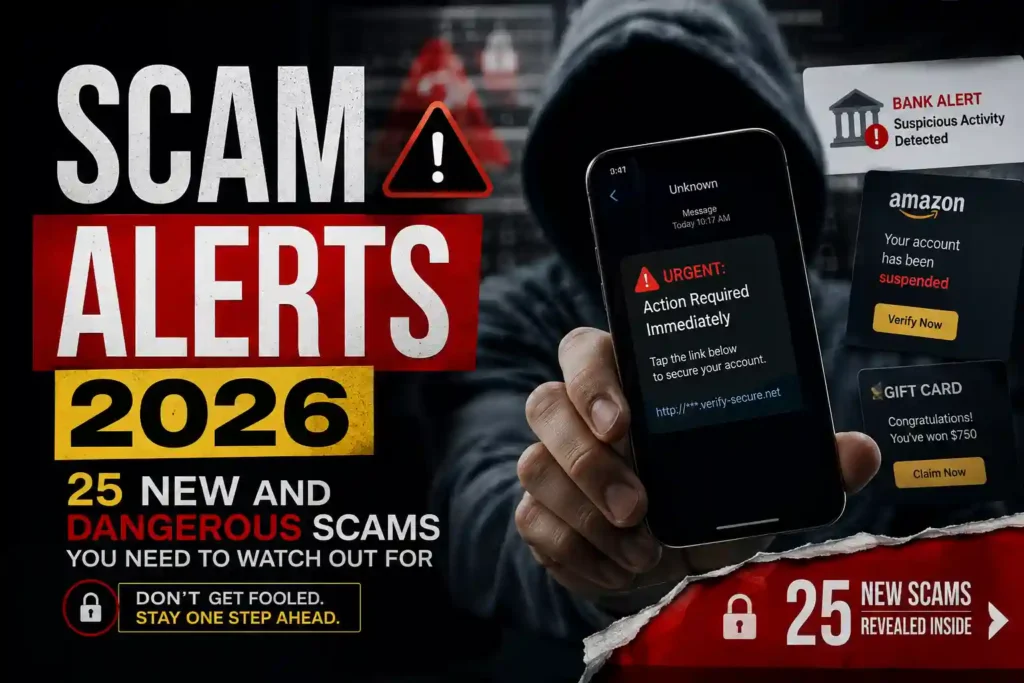
This guide reveals 25 dangerous scams currently targeting consumers in 2026. You will learn how each one begins, what the criminal wants and which detail can expose the trap before you pay, click or share information.
Do not skim only for scam names you recognise. The unfamiliar variation is often the one that gets through.
Why Scam Alerts Matter in 2026
Scammers adapt when people learn their old methods.
Once consumers become suspicious of poor grammar, criminals use artificial intelligence to improve their writing. When people learn to check photographs, scammers generate new images. When families begin requesting video calls, criminals experiment with manipulated video and cloned voices.
The story may change, but most scams still need you to do at least one of these things:
- Act immediately
- Keep the situation secret
- Trust an unverified identity
- Share account information
- Install software
- Move money
- Approve a login
- Ignore a warning
- Use a payment method that is difficult to reverse
You do not need to understand every new technology. You need to recognise when someone is controlling the urgency, verification process and solution.
How to Use These Scam Alerts
For each scam, focus on three details:
The Opening
How does the criminal get your attention?
The Pressure
Which emotion makes the request feel urgent?
The Exit
What action transfers your money, identity or account access?
Recognising that pattern helps you spot variations that use a different company name or story.
25 New and Dangerous Scams to Watch in 2026
These alerts include newer schemes and fast-growing versions of familiar fraud.
1. Gold Bar and Cash Courier Scams
A pop-up, email or telephone call warns that your bank account or computer has been compromised.
The person claims to represent:
- Your bank
- A government agency
- Law enforcement
- A technology company
- A fraud investigation team
They say criminals are preparing to steal your savings. Moving the money electronically would supposedly be unsafe, so you must withdraw cash or purchase gold.
A courier arrives at your home to collect it for “safekeeping.”
The courier may provide a password or reference number to make the collection feel official.
Once the cash or gold leaves your hands, it disappears.
Your bank, police or government will not send someone to collect your savings or precious metals.
If a caller instructs you to:
- Withdraw a large amount
- Buy gold bars
- Hide the reason from bank employees
- Keep the investigation secret
- Hand valuables to a courier
End the call immediately.
Contact your bank through the number printed on your card and tell someone you trust.
2. Real-Time Bank Coaching Scams
A scammer remains on the telephone while you visit your bank, transfer money or make a large withdrawal.
They tell you exactly how to answer questions from bank employees.
You may be instructed to say that the money is for:
- Home repairs
- A vehicle
- A family gift
- Travel
- An investment you researched yourself
- A personal purchase
The scammer may warn that bank staff are involved in the fraud or that revealing the investigation will place your money at risk.
In reality, the bank employee’s questions may be your strongest opportunity to stop the loss.
Never lie to your bank about why you are moving money.
If someone is speaking to you through a phone or earpiece during the transaction, tell the employee privately.
A genuine investigator does not need you to defeat your bank’s fraud protections.
3. Call-Forwarding Bank Impersonation Scams
A caller claims your bank or mobile account requires activation, verification or urgent security repair.
They instruct you to dial a short code containing symbols and a telephone number.
The code may activate call forwarding.
Once enabled, your incoming calls can be redirected to the scammer’s number. They may then intercept verification calls and gain greater control of your financial accounts.
Do not dial unfamiliar codes because an incoming caller tells you to do so.
If you already followed the instructions:
- Contact your mobile provider.
- Ask whether call forwarding was activated.
- Disable unauthorised changes.
- Secure your mobile account.
- Contact your bank.
- Change exposed passwords.
Use a separate device if your phone service behaves unusually.
4. Fake CAPTCHA and “Click to Fix” Scams
A website displays a verification page that looks like a normal test to prove you are human.
Instead of selecting images, it instructs you to:
- Press several keyboard keys
- Open a command window
- Paste copied text
- Run a verification command
- Install a browser update
- Disable security software
Following those instructions may install malware.
The malicious program can steal passwords, cryptocurrency, personal files and banking information.
A genuine CAPTCHA will not require you to run system commands or paste code.
Close the page immediately.
If you followed the instructions, disconnect the device from the internet. Use another trusted device to change your email, banking and financial passwords.
Running an ordinary security scan may not identify every change. Consider having the device professionally examined.
5. Fake Court Notice and Legal Document Scams
You receive an official-looking court notice, fine or legal document by email, messaging application or social media.
The document may contain:
- Court-style letterhead
- A case number
- Official language
- Your personal information
- A judge’s or lawyer’s name
- A payment deadline
You are warned that failing to pay will lead to arrest, additional fines or a damaging court decision.
Another version begins when you hire a supposed lawyer through social media. After accepting payment, the person sends fabricated court documents and demands more money.
Do not verify a legal notice through the telephone number or lawyer named inside it.
Contact the court directly using independently confirmed information. Search for the case through the official system where available.
6. AI Family Emergency Voice Scams
You receive a call or voice message that sounds like your child, spouse, parent or grandchild.
They are crying, frightened or speaking quickly.
The supposed relative claims to have been:
- Arrested
- Injured
- Kidnapped
- Stranded
- Involved in an accident
- Robbed
- Trapped overseas
Another person may take over the call and pose as a lawyer, police officer, doctor or kidnapper.
Artificial intelligence can reproduce a familiar voice using short audio samples collected from public videos or previous calls.
Do not trust the voice alone.
Ask for your family’s private verification phrase. Then end the call and contact the relative through a telephone number you already know.
Do not let the caller stop you from hanging up.
A genuine emergency should survive independent verification.
7. Deepfake Celebrity and Public-Figure Scams
A video appears to show a celebrity, business leader or public figure promoting an investment, giveaway, product or assistance program.
The person’s face, voice and mannerisms appear convincing.
The video may direct you to:
- A cryptocurrency platform
- A private investment group
- A giveaway page
- A messaging account
- A special membership
- A limited financial opportunity
Another version begins when a supposed celebrity contacts you privately and develops a romantic relationship.
You may be asked to pay for fan verification, a private meeting, travel, marriage documents or a charitable project.
Do not assume a moving, speaking face proves endorsement.
Verify the promotion through the person’s established official channels. Search for independent evidence that the product or program exists.
A celebrity will not need gift cards or cryptocurrency to arrange a secret relationship with you.
8. Cryptocurrency ATM Protection Scams
A caller claims your bank account, identity or computer has been compromised.
They instruct you to withdraw cash and deposit it into a cryptocurrency ATM.
The scammer may send a QR code that directs the purchased cryptocurrency into a wallet they control.
You could be told that the transaction will:
- Protect your savings
- Pay a government fine
- Stop an arrest
- Secure a compromised account
- Reverse fraudulent activity
- Verify your identity
A cryptocurrency ATM cannot place money into a government-protected account.
No legitimate bank, police officer or government employee requires you to transfer savings through one.
If someone remains on the phone while directing you through an ATM transaction, stop.
Do not scan their QR code. Leave the machine and contact the organisation independently.
9. Utility Barcode and QR Code Payment Scams
A caller or message claims your electricity, gas or water service will be disconnected within minutes.
Instead of requesting a normal online payment, the scammer sends you:
- A QR code
- A retail barcode
- A cryptocurrency wallet
- A payment-app username
- Gift card instructions
You may be told to visit a shop, show the barcode to the cashier and make the payment there.
The unusual method is explained as an emergency payment system that restores your account immediately.
Do not pay.
Open your utility account through its official application or website. Check whether a balance or disconnection notice appears there.
If you remain concerned, call the telephone number printed on your regular bill.
A genuine utility company will not require cryptocurrency, gift cards or a retail barcode sent by an unexpected caller.
Be suspicious of anyone who refuses to let you verify the balance before the supposed disconnection deadline.
10. Missed Jury Duty and Arrest Warrant Scams
A caller claims you failed to appear for jury service and now face arrest.
They may impersonate:
- A police officer
- A court clerk
- A sheriff
- A government lawyer
- A court investigator
The caller knows your name and address. They may give you a badge number, court location or fake case reference.
You are told that resolving the warrant requires immediate payment through:
- Gift cards
- Cryptocurrency
- A wire transfer
- A payment application
- Cash
Another version sends an official-looking warrant or court notice by text or email.
Do not pay.
Courts do not resolve missed jury service through gift cards or cryptocurrency. A caller will not cancel an arrest warrant because you send money during the conversation.
End the call and contact the court or local law-enforcement office through independently verified information.
Do not visit the location provided by the caller until you confirm that it is legitimate.
11. Toll, Parking and Traffic-Fee Text Scams
A text says you have an unpaid road toll, parking charge or traffic fee.
The amount is small, but the consequences sound serious.
You may be threatened with:
- Additional penalties
- Vehicle-registration problems
- Licence suspension
- Collection activity
- Legal action
The link opens a fake payment page that asks for card and personal information.
Criminals can send large numbers of these messages, including to people who never used the road or parking service.
In some attacks, specialised equipment can send fraudulent texts to nearby phones while making the message appear more credible.
Do not tap the link.
Visit the official toll or parking website independently and search for the charge using your vehicle information.
A small fee is not harmless when the payment page collects enough information for larger fraud.
12. Package Delivery and Address Correction Scams
A message says a package cannot be delivered because your address is incomplete or a small fee remains unpaid.
The timing may feel perfect because you recently ordered something.
The link leads to a page requesting:
- Your name
- Home address
- Telephone number
- Card information
- A redelivery payment
The page may copy the colours, logo and tracking format of a real delivery service.
Do not assume the message is genuine because you are expecting a package. Scammers send these texts widely and eventually reach people with active orders.
Open the retailer or delivery company’s official application. Enter the tracking number there instead.
Be careful if the message’s tracking number works only through the supplied link.
The real goal may not be the small fee. It may be collecting your card and personal information for later fraud.
13. Job Interview Malware Scams
A recruiter contacts you about a position that closely matches your experience.
The employer and vacancy may both be real, but the person contacting you is an impersonator.
You are asked to download:
- Interview software
- A coding assessment
- A video-meeting application
- A job description
- An employee portal
- A project file
The download installs malware that may steal your passwords, cryptocurrency or workplace information.
Another version directs you to a fake career page where you enter identity and banking details.
Before installing anything:
- Find the vacancy on the company’s official career page
- Verify the recruiter independently
- Check the email domain
- Confirm which interview software the company uses
- Download applications only from trusted sources
Do not disable security settings because a recruiter says they interfere with the assessment.
A legitimate company should understand why you want to verify an unfamiliar download.
14. Task and Product Optimisation Scams
An unexpected message offers easy remote work completing online tasks.
You may be asked to:
- Rate products
- Like videos
- Review hotels
- Test applications
- Click advertisements
- Optimise listings
- Confirm orders
You create an account and complete several tasks. Your dashboard displays commissions.
The platform may even allow one small withdrawal.
Then a premium task creates a negative balance. To continue or withdraw your earnings, you must deposit your own money.
After paying, another negative balance appears.
The amounts grow until you stop.
The displayed earnings are controlled by the scammers. They do not prove that real money is waiting.
A genuine job pays you. It does not require you to deposit cryptocurrency or transfer money to unlock your wages.
15. AI Pet Sale and Lost-Pet Scams
A convincing advertisement offers a popular puppy, kitten or exotic pet at an attractive price.
The seller provides photographs, videos, registration papers and detailed answers.
Artificial intelligence and stolen content can make an animal that does not exist look real.
After you pay a deposit, additional charges appear for:
- Shipping
- A special crate
- Insurance
- Vaccinations
- Quarantine
- Temperature-controlled transport
- Emergency veterinary treatment
You never receive the pet.
A related scam targets people who post about a missing animal.
The scammer claims they found your pet and demands money before revealing the location. They may ask for a security code supposedly needed to prove ownership.
Never share that code. It could be used to take over one of your accounts.
Before purchasing a pet:
- Meet the animal safely
- Verify the breeder or rescue
- Request current, interactive video
- Examine the address
- Refuse gift card or cryptocurrency payments
- Be suspicious of delivery-only arrangements
If someone claims to have found your pet, ask for a photograph containing a specific object or request details not visible in the public post.
16. Fake Rental Listings and Deepfake Property Tours
A beautiful apartment or holiday rental appears at a price below similar properties.
The supposed landlord explains that demand is high and you must send a deposit before viewing.
They may provide:
- A lease
- Identity documents
- Property records
- Video tours
- Keys by courier
- References
- A convincing website
The property may be real, but the scammer does not own or manage it.
Videos can be copied from previous listings, while artificial tools can create or alter property tours.
Never send a deposit based only on photographs, documents or a virtual tour.
Verify:
- The property address
- The owner or authorised agent
- Local rental prices
- Whether the listing appears elsewhere
- The payment recipient
- The viewing process
Tour the property in person when possible. If you cannot, ask a trusted local person or established professional to verify it.
Be cautious if the landlord claims to be abroad, refuses live access or pressures you to pay before another applicant takes the property.
17. Fake Subscription Renewal and Refund Scams
An email or invoice claims that an expensive subscription has renewed automatically.
The charge may supposedly cover:
- Antivirus software
- Cloud storage
- Technical support
- A streaming service
- Cryptocurrency trading
- Device protection
- Business software
The amount is deliberately high enough to make you react immediately.
Instead of directing you to a login page, the message provides a telephone number for cancellations and refunds.
When you call, a fake billing representative asks you to install remote-access software. They claim they need to connect to your device to process the refund.
You may then be instructed to open your banking account.
The scammer manipulates what appears on your screen and claims they accidentally refunded too much. You are pressured to return the excess through cryptocurrency, gift cards or a bank transfer.
The original subscription charge never existed.
Do not call a telephone number contained in an unexpected invoice.
Open your account through the provider’s official application or website and look for the charge. If no matching subscription exists, report and delete the message.
A legitimate company does not need remote access to your device or banking account to cancel a subscription.
18. Fake Social-Media Customer Support Scams
You post publicly about a locked account, delayed payment, missing order or technical problem.
A support profile replies within minutes and offers to help.
The account uses the company’s logo and a familiar name, but it may be controlled by a scammer monitoring public complaints.
The supposed representative asks you to continue through a private message.
They may request:
- Your username
- Email address
- Telephone number
- Card information
- Password
- Security code
- Cryptocurrency recovery phrase
Another version sends you a link to a fake support portal or refund page.
Do not trust an account because it knows what problem you reported. Your public post provided that information.
Access customer support through the company’s official application or website.
Check the complete username carefully. A fake account may add an underscore, replace one letter or include words such as “care,” “help” or “support.”
Never share a password, card PIN or security code with a social-media support account.
19. Wrong-Number Investment Scams
An apparently innocent text reaches you by mistake.
The sender may ask whether you are meeting for dinner, attending a business appointment or expecting a delivery.
After you explain that they have the wrong number, the person continues the conversation.
They appear:
- Friendly
- Attractive
- Successful
- Financially knowledgeable
- Interested in your life
Over time, they introduce an investment strategy involving cryptocurrency, gold, foreign exchange or artificial-intelligence trading.
You are directed to a professional-looking platform. Your first deposit displays a profit, and you may be allowed to withdraw a small amount.
That early withdrawal creates trust.
The person encourages you to invest much more. When you try to withdraw, the platform demands taxes, insurance or verification fees.
The original wrong-number message was not accidental. It was the opening of a long-term relationship and investment scam.
Do not invest through a platform introduced by an unexpected contact.
20. Private Stock Group and Ramp-and-Dump Scams
You are invited to an online investment group where a supposed expert shares profitable stock recommendations.
The group may include dozens of enthusiastic members posting screenshots of successful trades.
Some or all of those members may be fake accounts.
The administrator promotes a low-priced or lightly traded stock and claims:
- A major announcement is coming
- Insiders are buying
- An acquisition is imminent
- Artificial intelligence detected an opportunity
- The price will multiply
- Members must buy immediately
As group members purchase the stock, the price rises.
The organisers then sell the shares they bought earlier. Once they exit, the promotion stops and the price collapses.
Do not treat a busy group chat as proof of independent enthusiasm. One criminal operation can control several accounts.
Research the company, trading volume and promoter independently. Ask why strangers are pressuring you to buy before you have time to investigate.
21. AI Romance and Deepfake Video Scams
Someone you meet through a dating application or social-media platform builds an intense emotional connection.
They send photographs, voice messages and video calls that appear to confirm their identity.
Artificial intelligence can help criminals generate consistent messages, cloned voices and manipulated video.
The relationship may lead to:
- Medical emergency payments
- Travel fees
- Marriage documents
- Fan membership cards
- Cryptocurrency investments
- Customs charges
- Business assistance
Do not treat a video call as complete proof.
Verify the person’s employer, location and identity independently. Search their photographs and examine whether their social-media history looks natural.
Never send money to someone you have not independently verified and met.
Genuine affection should not require secrecy, repeated emergencies or payments to unrelated accounts.
22. AI Sextortion and Fabricated Image Scams
A stranger begins a flirtatious conversation and asks for private photographs or video.
Once they receive something, they threaten to send it to your family, employer or friends unless you pay.
In another version, the criminal creates artificial intimate content using an ordinary photograph taken from your social-media profile.
The image may be fake, but the threat and embarrassment feel real.
Do not pay.
Payment rarely ends the blackmail. It proves that fear can be used to collect more money.
Take these steps:
- Preserve the threats.
- Save the profile and payment instructions.
- Stop responding.
- Secure your accounts.
- Restrict access to your contacts.
- Report the profile and content.
- Tell someone you trust.
If you are under 18, involve a trusted adult immediately.
The criminal is responsible for creating or misusing the content. Shame should not prevent you from getting help.
23. Scam Recovery and Cryptocurrency Tracing Scams
After losing money, you receive a message from someone claiming they can recover it.
They may pose as:
- A lawyer
- A government investigator
- A hacker
- A blockchain expert
- A financial recovery company
- Another victim
They know accurate details about the original scam.
That information may have been shared or sold by the first criminals.
The recovery service claims your funds were located, but you must pay:
- A tracing fee
- Legal costs
- Taxes
- A wallet activation charge
- A security deposit
- A percentage in advance
Do not pay.
No legitimate professional can guarantee cryptocurrency recovery, reverse a confirmed blockchain transaction through secret access or promise to retrieve every dollar before investigating the case.
Verify professional licences, business history and fees independently.
Never reveal your wallet’s recovery phrase.
24. Fake Government Relief, Refund and Grant Scams
A message claims you qualify for a government refund, hardship payment, tariff relief, grant or financial assistance.
The offer may be connected to:
- Rising living costs
- Energy bills
- Taxes
- Education
- Housing
- Medical expenses
- Business support
- Retirement
You must click a link, complete a form or pay a processing fee.
The page requests your identity and banking information.
Another version appears to come from a friend whose social-media account was hacked. They claim they already received the grant and recommend contacting a particular agent.
Do not pay money to receive free government funds.
Visit the relevant department’s official website independently and check whether the program exists.
A certificate, approval letter or official logo is not proof. Those materials can be generated quickly.
25. Fake Charity and Disaster Donation Scams
A natural disaster, war, medical crisis or tragic event creates an urgent appeal for donations.
The request may arrive through:
- Social media
- Crowdfunding
- Text messages
- Messaging applications
- Door-to-door collection
Criminals may copy photographs and stories from real victims or create artificial images.
Before donating:
- Verify the organisation
- Search for its official website
- Check how funds will be used
- Examine the payment recipient
- Avoid gift cards and cryptocurrency demands
- Be cautious with newly created crowdfunding pages
- Contact the organiser independently
Do not allow emotional urgency to bypass verification.
A legitimate charity should be able to explain who it is, what it does and how your contribution will be handled.
17. Fake Subscription Renewal and Refund Scams
An email or invoice claims that an expensive subscription has renewed automatically.
The charge may supposedly cover:
- Antivirus software
- Cloud storage
- Technical support
- A streaming service
- Cryptocurrency trading
- Device protection
- Business software
The amount is deliberately high enough to make you react immediately.
Instead of directing you to a login page, the message provides a telephone number for cancellations and refunds.
When you call, a fake billing representative asks you to install remote-access software. They claim they need to connect to your device to process the refund.
You may then be instructed to open your banking account.
The scammer manipulates what appears on your screen and claims they accidentally refunded too much. You are pressured to return the excess through cryptocurrency, gift cards or a bank transfer.
The original subscription charge never existed.
Do not call a telephone number contained in an unexpected invoice.
Open your account through the provider’s official application or website and look for the charge. If no matching subscription exists, report and delete the message.
A legitimate company does not need remote access to your device or banking account to cancel a subscription.
18. Fake Social-Media Customer Support Scams
You post publicly about a locked account, delayed payment, missing order or technical problem.
A support profile replies within minutes and offers to help.
The account uses the company’s logo and a familiar name, but it may be controlled by a scammer monitoring public complaints.
The supposed representative asks you to continue through a private message.
They may request:
- Your username
- Email address
- Telephone number
- Card information
- Password
- Security code
- Cryptocurrency recovery phrase
Another version sends you a link to a fake support portal or refund page.
Do not trust an account because it knows what problem you reported. Your public post provided that information.
Access customer support through the company’s official application or website.
Check the complete username carefully. A fake account may add an underscore, replace one letter or include words such as “care,” “help” or “support.”
Never share a password, card PIN or security code with a social-media support account.
19. Wrong-Number Investment Scams
An apparently innocent text reaches you by mistake.
The sender may ask whether you are meeting for dinner, attending a business appointment or expecting a delivery.
After you explain that they have the wrong number, the person continues the conversation.
They appear:
- Friendly
- Attractive
- Successful
- Financially knowledgeable
- Interested in your life
Over time, they introduce an investment strategy involving cryptocurrency, gold, foreign exchange or artificial-intelligence trading.
You are directed to a professional-looking platform. Your first deposit displays a profit, and you may be allowed to withdraw a small amount.
That early withdrawal creates trust.
The person encourages you to invest much more. When you try to withdraw, the platform demands taxes, insurance or verification fees.
The original wrong-number message was not accidental. It was the opening of a long-term relationship and investment scam.
Do not invest through a platform introduced by an unexpected contact.
20. Private Stock Group and Ramp-and-Dump Scams
You are invited to an online investment group where a supposed expert shares profitable stock recommendations.
The group may include dozens of enthusiastic members posting screenshots of successful trades.
Some or all of those members may be fake accounts.
The administrator promotes a low-priced or lightly traded stock and claims:
- A major announcement is coming
- Insiders are buying
- An acquisition is imminent
- Artificial intelligence detected an opportunity
- The price will multiply
- Members must buy immediately
As group members purchase the stock, the price rises.
The organisers then sell the shares they bought earlier. Once they exit, the promotion stops and the price collapses.
Do not treat a busy group chat as proof of independent enthusiasm. One criminal operation can control several accounts.
Research the company, trading volume and promoter independently. Ask why strangers are pressuring you to buy before you have time to investigate.
21. AI Romance and Deepfake Video Scams
Someone you meet through a dating application or social-media platform builds an intense emotional connection.
They send photographs, voice messages and video calls that appear to confirm their identity.
Artificial intelligence can help criminals generate consistent messages, cloned voices and manipulated video.
The relationship may lead to:
- Medical emergency payments
- Travel fees
- Marriage documents
- Fan membership cards
- Cryptocurrency investments
- Customs charges
- Business assistance
Do not treat a video call as complete proof.
Verify the person’s employer, location and identity independently. Search their photographs and examine whether their social-media history looks natural.
Never send money to someone you have not independently verified and met.
Genuine affection should not require secrecy, repeated emergencies or payments to unrelated accounts.
22. AI Sextortion and Fabricated Image Scams
A stranger begins a flirtatious conversation and asks for private photographs or video.
Once they receive something, they threaten to send it to your family, employer or friends unless you pay.
In another version, the criminal creates artificial intimate content using an ordinary photograph taken from your social-media profile.
The image may be fake, but the threat and embarrassment feel real.
Do not pay.
Payment rarely ends the blackmail. It proves that fear can be used to collect more money.
Take these steps:
- Preserve the threats.
- Save the profile and payment instructions.
- Stop responding.
- Secure your accounts.
- Restrict access to your contacts.
- Report the profile and content.
- Tell someone you trust.
If you are under 18, involve a trusted adult immediately.
The criminal is responsible for creating or misusing the content. Shame should not prevent you from getting help.
23. Scam Recovery and Cryptocurrency Tracing Scams
After losing money, you receive a message from someone claiming they can recover it.
They may pose as:
- A lawyer
- A government investigator
- A hacker
- A blockchain expert
- A financial recovery company
- Another victim
They know accurate details about the original scam.
That information may have been shared or sold by the first criminals.
The recovery service claims your funds were located, but you must pay:
- A tracing fee
- Legal costs
- Taxes
- A wallet activation charge
- A security deposit
- A percentage in advance
Do not pay.
No legitimate professional can guarantee cryptocurrency recovery, reverse a confirmed blockchain transaction through secret access or promise to retrieve every dollar before investigating the case.
Verify professional licences, business history and fees independently.
Never reveal your wallet’s recovery phrase.
24. Fake Government Relief, Refund and Grant Scams
A message claims you qualify for a government refund, hardship payment, tariff relief, grant or financial assistance.
The offer may be connected to:
- Rising living costs
- Energy bills
- Taxes
- Education
- Housing
- Medical expenses
- Business support
- Retirement
You must click a link, complete a form or pay a processing fee.
The page requests your identity and banking information.
Another version appears to come from a friend whose social-media account was hacked. They claim they already received the grant and recommend contacting a particular agent.
Do not pay money to receive free government funds.
Visit the relevant department’s official website independently and check whether the program exists.
A certificate, approval letter or official logo is not proof. Those materials can be generated quickly.
25. Fake Charity and Disaster Donation Scams
A natural disaster, war, medical crisis or tragic event creates an urgent appeal for donations.
The request may arrive through:
- Social media
- Crowdfunding
- Text messages
- Messaging applications
- Door-to-door collection
Criminals may copy photographs and stories from real victims or create artificial images.
Before donating:
- Verify the organisation
- Search for its official website
- Check how funds will be used
- Examine the payment recipient
- Avoid gift cards and cryptocurrency demands
- Be cautious with newly created crowdfunding pages
- Contact the organiser independently
Do not allow emotional urgency to bypass verification.
A legitimate charity should be able to explain who it is, what it does and how your contribution will be handled.
The Warning Signs These 2026 Scams Share
The stories change, but the pressure techniques remain surprisingly consistent.
The Contact Is Unexpected
You receive a call, message, invoice or opportunity you did not request.
Unexpected contact does not automatically prove fraud, but it means the sender has not earned your trust.
You Must Act Immediately
The scammer says waiting will cause:
- Arrest
- Account closure
- Financial loss
- Service disconnection
- A missed opportunity
- Additional fees
- Public embarrassment
Urgency prevents you from checking the story.
The Person Controls the Verification
They provide the website, telephone number, documents and supposed supervisor used to prove their identity.
Verification is meaningless when the person making the claim controls every source.
You Must Keep the Situation Secret
You are warned not to speak with your bank, relatives, employer or police.
Secrecy separates you from people who might recognise the scam.
The Payment Is Difficult to Reverse
The person insists on:
- Cryptocurrency
- Gift cards
- Cash
- Gold
- A wire transfer
- A payment application
- A cryptocurrency ATM
The unusual method is chosen for the scammer’s benefit, not yours.
You Are Told to Ignore Normal Procedures
A supposed employer avoids interviews. A bank investigator asks for your security code. A police officer requests gift cards.
The story may sound urgent, but the requested process does not match how the organisation normally operates.
The Story Changes After You Pay
A second fee appears because:
- The first transfer failed
- A new tax is required
- The package remains blocked
- The account needs upgrading
- The refund needs verification
The final payment never arrives. Each payment creates another demand.
How to Protect Yourself From New Scams
You do not need to memorise every scam alert. Build habits that remain effective when the story changes.
Create a Mandatory Pause Rule
Decide that you will not send money, reveal security codes or install software during an incoming call.
End the conversation and verify independently.
Use a Separate Verification Channel
Contact the organisation through:
- Its official application
- A number printed on your card
- A trusted statement
- A website you entered yourself
- A saved contact
Do not use the information inside the suspicious message.
Never Share Security Codes
A one-time code may approve a login, transfer, new device or password change.
No incoming caller needs you to read it aloud.
Do Not Move Money for Protection
Your bank or government will not ask you to transfer savings into a secure account, cryptocurrency wallet or gold.
If someone claims your money is unsafe, end the call and contact your bank independently.
Refuse Remote Access
Do not install remote-access software because an unexpected caller says your device or account has a problem.
A genuine technician does not need access to your online banking.
Verify Payment Changes Verbally
If a supplier, manager or professional sends new account details, contact them through a known number.
Do not use the telephone number contained in the same email announcing the change.
Create a Family Verification Phrase
Choose a private phrase that family members can use during an emergency call.
Do not base it on information available online.
Discuss Large Payments
Before moving savings, buying cryptocurrency or making a large transfer, explain the situation to someone you trust.
A second person may notice contradictions that emotion makes difficult to see.
What to Do If One of These Scams Reaches You
Receiving a scam message does not mean the criminal has succeeded.
Your response depends on what you did.
If You Did Not Respond
Report and delete the message.
Block the sender where appropriate.
If You Clicked a Link
Close the page and check whether anything downloaded.
Run a security scan and update your device.
If You Entered a Password
Change it immediately from a trusted device.
Change it anywhere else you reused it and secure your email first.
If You Shared a Security Code
Contact the account provider.
Review active sessions, transactions, trusted devices and recovery details.
If You Installed Software
Disconnect the device from the internet.
Use another trusted device to secure your accounts. Remove the software and arrange a complete security examination if necessary.
If You Sent Money
Contact the bank, card issuer, payment application, wire provider, gift card issuer or cryptocurrency exchange immediately.
Ask whether the payment can be stopped, recalled, reversed or frozen.
If You Shared Identity Documents
Monitor for identity theft, review your credit and contact the issuing authority.
Consider stronger restrictions on new credit.
If You Sent Intimate Content
Do not pay blackmail demands.
Preserve the threats, secure your accounts, restrict access to your contacts and report the profile.
How to Stay Informed About Current Scam Alerts
Scam awareness should be useful without making you afraid of every message.
Enable Alerts From Your Financial Providers
Banks and card providers may send warnings about active impersonation and payment scams.
Read the alert through the official application rather than clicking an unexpected link.
Follow Trusted Fraud Updates
Use established consumer-protection, financial and law-enforcement websites relevant to your country.
Do not depend entirely on viral social-media posts. Some warnings exaggerate risks or recycle outdated information.
Discuss New Scams With Your Family
Share the method, not only the story.
For example:
“A scammer may clone a relative’s voice. Always call back using a saved number and ask for our family phrase.”
That lesson remains useful even when the emergency story changes.
Review Your Protection Plan Regularly
Check whether:
- Account alerts still work
- Recovery information is current
- Your family remembers the verification phrase
- Important passwords remain unique
- Transfer limits are appropriate
- Trusted contact numbers are available
Awareness without action creates false confidence.
Scam Alert Checklist
Before responding to an unexpected request, ask:
- Did I expect this contact?
- Am I being pressured to act immediately?
- Is someone threatening arrest or financial loss?
- Am I being told to keep the situation secret?
- Did the sender provide every verification method?
- Does the payment involve cryptocurrency, gift cards, cash or gold?
- Am I being asked to move money for protection?
- Does the caller want remote access?
- Am I being asked for a security code?
- Did payment details suddenly change?
- Is a guaranteed investment involved?
- Can I verify the claim through an official application?
- Have I spoken with someone I trust?
- Would the request still make sense without the emotional pressure?
If several warning signs appear, stop.
A legitimate request should remain legitimate after independent verification.
Frequently Asked Questions About Scam Alerts in 2026
These answers address common questions about recognising and responding to current scams.
1. What Are the Most Dangerous Scams in 2026?
Bank impersonation, gold courier, cryptocurrency ATM, investment, AI voice, romance and account-takeover scams can cause severe losses.
The most dangerous scam for you is the one that matches your current fear, need or opportunity.
2. What New Scam Should You Watch Most Closely?
Be especially careful with anyone telling you to move savings for protection.
A bank, police officer or government official will not direct you to a safe account, cryptocurrency wallet or gold courier.
3. Are AI Scams Common in 2026?
Artificial intelligence is increasingly used to create convincing messages, images, voices and videos.
Do not rely on writing quality, photographs or a familiar voice as complete proof.
4. Can Scammers Clone a Family Member’s Voice?
Yes.
Short audio samples can be used to imitate a familiar voice. Call the relative back and use a private verification phrase.
5. Can a Live Video Call Be Fake?
Yes.
Artificial tools, prerecorded footage and face-changing technology can create convincing video interactions.
Verify the person’s broader identity and claims independently.
6. What Is a Gold Bar Scam?
A scammer claims your savings are unsafe and instructs you to buy gold.
A courier then collects it for supposed protection. The gold goes directly to the criminals.
7. What Is a Cryptocurrency ATM Scam?
A caller directs you to deposit cash into a cryptocurrency ATM and scan their QR code.
The cryptocurrency is transferred into a wallet the scammer controls.
8. What Is a Fake CAPTCHA Scam?
A fraudulent verification page tells you to open a command window, paste code or install software.
A genuine CAPTCHA does not require you to run system commands.
9. What Is a Call-Forwarding Scam?
A scammer instructs you to dial a code that redirects your calls.
They may then intercept verification calls or gain access to other accounts.
10. Are Court Notices Sent Through Messaging Applications?
A court process varies by location, but an unexpected payment demand through social media or messaging should be verified directly.
Contact the court using independently confirmed information.
11. Will a Court Demand Gift Cards or Cryptocurrency?
No.
Gift cards and cryptocurrency are not normal methods for paying court fines or resolving arrest warrants.
12. Are Unpaid Toll Texts Real?
Some legitimate services send digital notices, but fraudulent toll texts are widespread.
Do not tap the message’s link. Check through the official service independently.
13. How Can You Identify a Fake Package Message?
Be suspicious of small redelivery fees, urgent address corrections and unfamiliar links.
Check the order through the retailer or delivery company’s official application.
14. Can a QR Code Steal Your Information?
A QR code can direct you to a phishing page or malicious download.
Inspect the destination before entering information or installing anything.
15. What Is a Task Scam?
A fake job pays or appears to pay you for simple online tasks.
You later have to deposit money to continue working or withdraw your displayed earnings.
16. Can a Real Job Listing Be Used in a Scam?
Yes.
A criminal may copy a real vacancy and impersonate the recruiter.
Apply through the employer’s official career page.
17. How Can You Avoid Rental Scams?
Verify the owner or agent, inspect the property and refuse pressure to send a deposit before viewing.
A virtual tour and lease do not prove control of the property.
18. Can Pet Videos Be Generated or Stolen?
Yes.
Videos and photographs may be copied, manipulated or artificially generated.
Meet the animal and verify the seller before paying.
19. What Is a Wrong-Number Investment Scam?
An apparently accidental text develops into friendship or romance.
The person later introduces a fraudulent cryptocurrency or investment platform.
20. How Do Private Stock Group Scams Work?
Organisers promote a lightly traded stock while fake members post successful results.
The organisers sell at the inflated price, leaving later buyers with losses.
21. Is a Celebrity Investment Video Reliable?
Not automatically.
The video may be manipulated or taken out of context. Confirm the promotion through established official channels.
22. What Should You Do if Someone Threatens to Share Private Images?
Do not pay.
Save the threats, secure your accounts, report the profile and tell someone you trust.
23. Can Scam Recovery Services Be Fraudulent?
Yes.
Be cautious when someone contacts you unexpectedly and guarantees recovery for an upfront fee.
24. Will the Government Charge a Fee to Release a Grant?
An unexpected demand to pay money before receiving free government funds is a strong scam warning.
Verify the program through an official website.
25. How Can You Verify a Charity?
Find the organisation independently, examine how funds are used and confirm the payment recipient.
Do not let emotional urgency bypass verification.
26. What Payment Methods Do Scammers Prefer?
Scammers frequently request cryptocurrency, gift cards, wire transfers, cash, gold and payment applications.
These methods can be quick and difficult to reverse.
27. What Should You Do After Sending Money to a Scammer?
Contact the payment provider immediately and ask whether the transaction can be stopped, recalled or disputed.
Then secure your accounts, preserve evidence and report the scam.
28. What Is the Best Way to Stay Safe From New Scams?
Pause and verify through a separate channel.
Do not use the website, telephone number or documents provided by the person making the claim.
Final Thoughts on Scam Alerts in 2026
The newest scams do not always use completely new stories.
They improve the disguise.
A fake court notice looks more official. A family emergency sounds more familiar. A fraudulent investment platform feels more professional. A support representative already knows your problem.
Do not ask only, “Does this look real?”
Ask:
- Did I expect this?
- Am I being rushed?
- Can I verify it independently?
- Why must I use this payment method?
- Why must the situation remain secret?
Those questions interrupt the pressure before it becomes a payment.
Scam alerts will continue changing as criminals test new technologies and stories. Your protection should not depend on memorising every version.
Pause. Verify. Discuss. Then decide.
The scammer controls the story. You control whether the story gets access to your money, identity or trust.