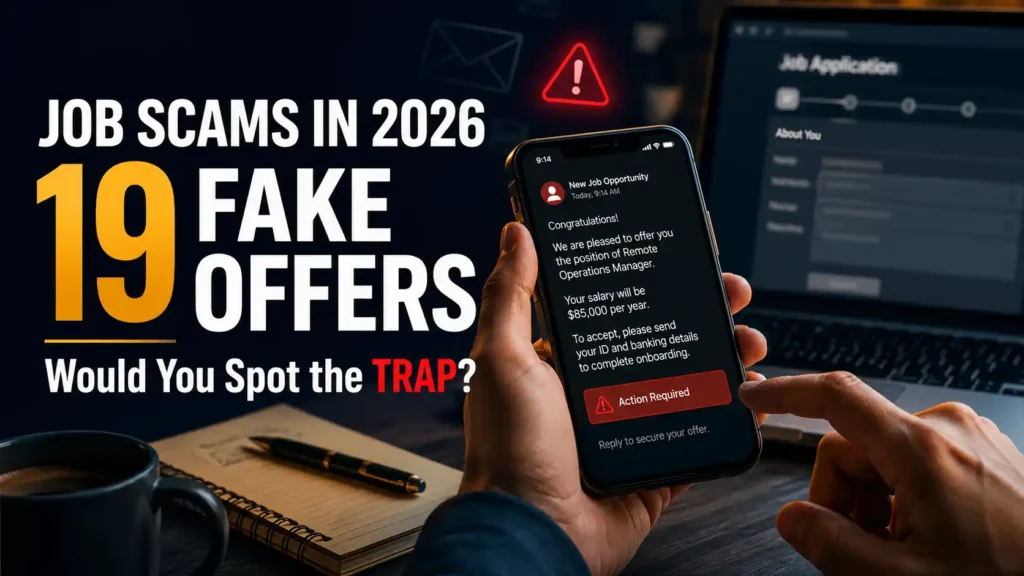
The message arrives when you need hope most.
A recruiter claims they found your résumé online and believes you are perfect for a remote position. The salary is generous, the hours are flexible and the company appears legitimate.
You complete a brief interview through text messages. Less than an hour later, you are hired.
It feels like your job search has finally paid off.
Then the recruiter asks for your identification, banking information or a small payment for equipment. Because you already believe the job is real, the request does not immediately feel dangerous.
That is the moment the opportunity becomes a trap.
Job scams in 2026 are more polished, personal and difficult to recognise. Criminals can copy real job listings, impersonate genuine recruiters, build convincing career websites and use artificial intelligence to conduct realistic interviews.
Some fake job offers are designed to steal money. Others collect personal information for identity theft, recruit you into money laundering or trick you into handling stolen goods. In the most dangerous cases, a fraudulent overseas job can place your physical safety at risk.
This guide reveals 19 fake job offers targeting job seekers in 2026. You will learn how each scam works, which warning signs appear before the loss and how to verify an opportunity without destroying your chance of landing a legitimate job.
Your search should lead to a paycheck—not an empty bank account or a stolen identity.
What Is a Job Scam?
A job scam is a fraudulent employment opportunity designed to steal your money, personal information, account access or labour.
The scammer may pretend to represent:
- A well-known company
- A recruitment agency
- A government department
- A small business
- A wealthy individual
- A new technology company
- A charity
- A university
- A real recruiter whose identity was copied
The position may be completely fictional, or the scammer may copy a genuine vacancy and replace the real application details with their own.
A fake employer might try to make you:
- Pay an application or training fee
- Deposit a counterfeit check
- Buy equipment from a fake supplier
- Receive and reship stolen merchandise
- Transfer money through your account
- Purchase cryptocurrency
- Reveal your identification number
- Send copies of identity documents
- Provide banking details before you are hired
- Complete unpaid work they intend to keep
- Travel to an unsafe location
- Install malware or remote-access software
A legitimate employer pays you for your work. A job scam finds a believable reason for you to pay first.
Why Fake Job Offers Are Harder to Spot in 2026
The absence of spelling mistakes no longer proves that a recruiter is genuine.
Artificial intelligence can help criminals write professional messages, create realistic employee profiles and tailor an offer to your work history. A scammer may mention your real qualifications because those details are visible on a professional networking profile or résumé database.
They can also:
- Copy a real company’s career page
- Clone a recruiter’s profile
- Create fake interview questions
- Generate employment contracts
- Produce convincing company logos
- Use deepfake video during interviews
- Spoof telephone numbers
- Register a website differing from the real one by one letter
- Build fake employee-review pages
- Translate messages into natural-sounding English
This means you cannot judge an opportunity by presentation alone.
A polished contract can still be fake. A professional interview can still be staged. A recruiter who knows your employment history can still be an impersonator.
You must verify the people, company and vacancy independently.
Why Job Seekers Are Attractive Targets
Searching for work creates a combination of emotions scammers know how to exploit.
You may feel:
- Anxious about bills
- Tired of submitting applications
- Excited by a quick response
- Flattered that a recruiter selected you
- Afraid of losing an opportunity
- Relieved by an immediate offer
- Embarrassed to question the employer
A scammer turns those emotions into urgency.
They may tell you the position must be filled today, equipment needs to be ordered immediately or your onboarding documents will expire.
A genuine employer may have deadlines, but it should still give you enough information to verify the company and understand what you are accepting.
Needing a job does not mean you should ignore the hiring process. The more urgently you need income, the more carefully you should examine an opportunity that appears unusually easy.
How to Tell If a Job Offer Is Fake
A single unusual detail does not always prove fraud. However, several warning signs appearing together should make you stop.
Be careful when:
- You never applied for the position
- The salary is far above the normal range
- The duties are vague
- The recruiter uses a personal email address
- The interview happens only through text
- You are hired immediately
- The job is missing from the company’s career page
- The recruiter refuses a video or telephone conversation
- You must pay before starting
- You receive a check for equipment
- You are asked to transfer money
- The employer requests sensitive information too early
- The company’s website was recently created
- The recruiter pressures you to keep the offer private
- Communication suddenly moves to an encrypted messaging app
- The employer will not provide a physical address
- You are asked to install unfamiliar software
Do not let one correct detail erase five suspicious ones.
A scammer may copy a real company name, office address and employee profile. Your job is to verify whether the person contacting you actually belongs to that organisation.
19 Common Job Scams to Avoid in 2026
These fake jobs use different stories, but they share one objective: extracting value from you before you discover that no genuine employment exists.
1. Fake Remote Job Offers
Remote work gives legitimate employers access to talent anywhere. It also gives scammers a believable reason to avoid meeting you.
A recruiter contacts you about a remote position in:
- Data entry
- Customer service
- Administration
- Payroll
- Information technology
- Social-media management
- Project coordination
- Virtual assistance
The pay is attractive, and little experience is required. After a short text-based interview, you receive an offer.
The recruiter may send an employment contract and ask for your banking information, tax details or identity documents.
Another version requires you to purchase a computer, software or home-office equipment before starting.
Remote work itself is not a warning sign. The danger comes from a hiring process that avoids genuine human interaction and moves unusually fast.
Before accepting:
- Find the vacancy on the company’s official career page
- Contact the company using independently verified information
- Confirm that the recruiter works there
- Examine the sender’s complete email address
- Ask for a live telephone or video conversation
- Compare the salary with similar positions
- Read the job responsibilities carefully
Do not rely on the recruiter’s profile link. Search for the employee yourself and contact them through an established channel.
2. Fake Recruiter Impersonation Scams
A criminal copies the name, photograph and employment history of a real recruiter.
They may know your qualifications, current employer and previous roles. Their message feels personal because they collected those details from your public profile.
The scammer may use an email address that closely resembles the company’s real domain.
For example, the genuine address might end with:
@northbridgeconsulting.com
The fake address could use:
@northbrldgeconsulting.com
The capital “I” has been replaced with a lowercase “l,” making the difference easy to miss.
The criminal may also create a new profile using the recruiter’s photograph and connect with genuine employees to appear credible.
Verify the recruiter by:
- Visiting the company’s website independently
- Checking whether the vacancy appears there
- Comparing the email domain letter by letter
- Calling the company’s main number
- Contacting the real recruiter through an established profile
- Examining when the recruiter’s profile was created
- Checking whether their employment history is consistent
Do not send identity documents because the person knows accurate details about you. Publicly available information is not proof of identity.
3. Task and “App Optimisation” Job Scams
You receive a text offering easy online work. The job involves completing simple tasks such as:
- Rating products
- Liking videos
- Clicking advertisements
- Reviewing applications
- Optimising products
- Boosting hotel listings
- Testing websites
- Confirming online orders
You create an account on a work platform and complete several tasks. Your dashboard shows commissions accumulating.
At first, you may receive a small payment. That money builds trust and convinces you the platform is genuine.
Then you encounter a “premium task,” “combination order” or negative account balance. To continue working or withdraw your earnings, you must deposit your own money.
The platform promises that the deposit and commission will be returned after you finish the task.
Instead, another negative balance appears. Each payment unlocks a larger demand until you refuse or run out of money.
The earnings displayed on the screen are controlled by the scammer. They do not prove you have earned withdrawable money.
A real job pays you for completing work. It does not require you to deposit increasing amounts to unlock your wages.
If an online task requires cryptocurrency, a payment-app transfer or personal deposit, stop immediately.
4. Fake Check and Equipment Purchase Scams
A supposed employer hires you for a remote position and sends a check to purchase a computer, printer, software or office furniture.
After depositing it, your account appears to show the money. The employer instructs you to buy the equipment from an approved supplier.
That supplier is controlled by the scammer.
You send real money, but the equipment never arrives. Several days or weeks later, the check is discovered to be counterfeit.
Your bank removes the deposit, leaving you responsible for the money sent to the fake supplier.
For example, the scammer sends a $4,500 check. They tell you to spend $3,800 on equipment and keep the remainder as a signing bonus.
When the check fails, the entire $4,500 credit disappears. The $3,800 you transferred came from your real account.
Do not assume a check has cleared because the funds appear available. Banks may release money before completing the full verification process.
A genuine employer may provide equipment directly or use an established purchasing system. It will not send you a check and order you to transfer part of it to an unfamiliar vendor.
5. Reshipping and Package Handler Scams
You are hired as a logistics coordinator, shipping inspector, quality-control agent or package-processing assistant.
Your job is to receive products at home, inspect them, replace the shipping label and forward them to another address.
The work appears simple, and the employer promises a monthly salary plus payment for every package.
The goods may have been purchased using stolen cards or compromised accounts. Your name and home address become part of the delivery record, while the criminals remain hidden.
You may unknowingly handle:
- Electronics
- Luxury products
- Gift cards
- Mobile phones
- Computer equipment
- Stolen merchandise
The company often promises to pay you after a month of work. When payday arrives, the website disappears and your supervisor stops responding.
You are left unpaid—and your address is connected to stolen goods.
Receiving and forwarding packages for an unknown remote employer is not normal logistics work. Genuine shipping operations use commercial facilities, documented inventory systems and established carrier accounts.
Do not send a package onward if you suspect the goods were obtained fraudulently. Preserve the shipping information and report what happened.
6. Money Mule Job Scams
A job advertisement offers you work as a payment processor, financial agent or accounts assistant.
Your responsibility is to receive money into your personal account and transfer it elsewhere. You are allowed to keep a percentage as commission.
The employer may claim it needs your help because:
- It is expanding into your country
- Its international account is temporarily unavailable
- Customers prefer local payments
- A technical issue affects its banking
- You are testing its payment system
The money may come from hacked bank accounts, stolen cards, fraudulent invoices or other scam victims.
When you transfer it, you help criminals hide the trail.
Even if you did not know the money was stolen, your name appears on the receiving account. Your bank may freeze or close your account, and you could face serious legal questions.
No legitimate employer needs to route company revenue through your personal bank account.
Do not accept a position that requires you to:
- Receive money for strangers
- Withdraw cash for a supervisor
- Convert company funds into cryptocurrency
- Purchase gift cards
- Forward transfers to multiple people
- Keep a percentage of incoming payments
If you already received suspicious money, do not forward or spend it. Contact your bank’s fraud department and explain the situation.
7. Fake Data Entry Jobs
Data entry is attractive to job seekers because it appears accessible, flexible and suitable for remote work.
Scammers advertise extremely high pay for basic typing, form completion or spreadsheet work. The description may promise guaranteed income without experience, interviews or fixed hours.
After applying, you are asked to pay for:
- Registration
- Training
- Software
- Access to assignments
- Background checks
- Certification
- A work portal
- An employee identification card
In another version, the job exists only to collect your identity documents and banking details.
The scammer may create a dashboard showing completed assignments and unpaid earnings. When you try to withdraw your wages, you must pay a release or account-verification fee.
Do not pay for access to ordinary data-entry assignments.
Check whether the salary makes sense for the skill level and location. A company offering unusually high wages for simple work should be able to explain why.
Ask specific questions about:
- The data you will handle
- Your supervisor
- Performance expectations
- Working hours
- Payment schedule
- Employment status
- Data-security procedures
A fake recruiter often struggles to provide detailed, consistent answers because the work itself does not exist.
8. Mystery Shopping Job Scams
Getting paid to shop, eat at restaurants or evaluate customer service sounds like an enjoyable side job.
A supposed mystery-shopping company hires you quickly and sends instructions for your first assignment. You may be asked to evaluate:
- A supermarket
- A gift card display
- A money-transfer service
- A bank
- A restaurant
- A retail shop
- A cryptocurrency ATM
The company sends you a check to cover your expenses and payment. You deposit it, keep your supposed fee and use the remaining money for the assignment.
The task may require you to buy gift cards and send photographs of the numbers. Another version asks you to transfer money and report on the customer service.
The check eventually fails, but the gift card balance or transferred money has already reached the scammer.
Genuine mystery-shopping work may exist, but a legitimate company will not ask you to deposit a large check and immediately send most of the money elsewhere.
You should never pay for:
- A mystery-shopping certification
- Guaranteed assignments
- Access to a secret job directory
- Priority membership
- Special training from an unknown recruiter
Research the company independently and confirm how shoppers are paid. If the central assignment involves sending irreversible payments, it is not a genuine evaluation—it is a method of stealing your money.
9. Fake Personal Assistant Jobs
A stranger offers you flexible work as a personal assistant, administrative assistant or errand coordinator.
They may claim to be a busy executive, consultant, academic, entrepreneur or traveller who needs help managing local responsibilities.
Your first tasks seem harmless:
- Schedule appointments
- Research products
- Organise a calendar
- Purchase supplies
- Make charitable donations
- Pay a vendor
- Send gifts to clients
The employer then sends a counterfeit check or transfers stolen funds into your account. You are instructed to purchase gift cards, send money or pay a third party.
Because the task is described as part of your job, the transaction may feel legitimate.
The scammer may even tell you to keep a generous amount as your first salary.
Do not use your personal account to manage an unknown employer’s money. A genuine executive can pay suppliers directly through a company-controlled account.
Be particularly careful when you receive a personal-assistant offer through your school email, social media or an unsolicited text. Criminals may impersonate a professor, business owner or community member whose name you recognise.
Confirm the position by contacting that person through an independently verified address or telephone number.
10. Fake Nanny, Caregiver and Pet-Sitting Jobs
A family claims it is moving into your area and needs a nanny, elder-care assistant or pet sitter.
The job offers good pay and a convenient schedule. The person may share detailed stories and photographs to make the family feel real.
Before arriving, they send you a check. It supposedly covers your first salary plus money for:
- A wheelchair
- Children’s toys
- Pet supplies
- Groceries
- Furniture
- Medical equipment
- Payment to a delivery company
You must deposit the check and send part of the money to a preferred supplier.
That supplier is the scammer.
The check later bounces, and no family arrives.
Do not handle advance purchases for someone you have never met and independently verified. A genuine family can buy its own equipment or pay a real supplier directly.
Arrange a live conversation and verify the address before accepting the position. If the person claims they cannot speak because of travel, illness or hearing difficulties, do not let the explanation eliminate the need for verification.
Never assume photographs prove the family exists. Images can be copied from social media or generated artificially.
11. Government Job Scams
A website or recruiter promises access to government employment, postal work, civil-service positions or public-sector examinations.
You are told that vacancies are limited and paying a fee gives you:
- Guaranteed placement
- Priority consideration
- Exam answers
- Application processing
- Special training
- Security clearance
- Access to hidden vacancies
- Direct contact with a hiring manager
The website may copy official colours, emblems and language. Its address may differ from a genuine government website by only a few characters.
A scammer may also send a fake appointment letter and demand money for uniforms, identification cards, medical examinations or background checks.
Do not assume a position is genuine because the letter contains an official seal or signature. Those details are easy to copy.
Find the government department’s official recruitment website independently. Confirm:
- Whether the position exists
- How applications are submitted
- Which fees, if any, are officially required
- Whether the recruiter is authorised
- Where examinations take place
- How successful applicants are contacted
Do not pay an individual who promises to place your name on a hiring list. A legitimate public-sector recruitment process should not depend on a private payment to an unofficial representative.
12. Fake Recruitment Agency and Placement Fee Scams
A recruitment agency claims it has employers waiting to hire someone with your background.
Before sharing the opportunities, it demands a registration, placement or membership fee.
The agency may operate from a real office and conduct convincing interviews. You could receive receipts, application forms and an identification card.
Those details do not guarantee that genuine jobs exist.
Some fake agencies make money entirely from applicants. They advertise attractive vacancies, collect fees and then provide excuses:
- The position has been filled
- Your interview was postponed
- Another certificate is required
- You must pay for additional training
- Your background check is incomplete
- A new employer will contact you soon
Other agencies send you to interviews that were never arranged.
Before paying, ask:
- Which employer has the vacancy?
- Is the agency paid by the employer or applicant?
- Is placement guaranteed?
- What exactly does the fee cover?
- Is the payment refundable?
- Can every promise be provided in writing?
- Can the employer confirm the relationship?
Be suspicious if the agency refuses to identify the employer until after you pay.
A genuine recruitment firm should be able to explain its services and fee structure clearly. It should not guarantee that an employer will hire you before the employer completes its selection process.
13. Work-From-Home Starter Kit Scams
An advertisement promises a complete home-based business or remote-income system.
You are told that anyone can earn substantial money by:
- Stuffing envelopes
- Assembling products
- Processing rebates
- Posting advertisements
- Completing forms
- Selling digital products
- Typing documents
- Running an automated online store
You only need to purchase a starter kit, training course, software licence or membership.
After paying, you may receive generic information that does not lead to real employment. The instructions might simply tell you to advertise the same program to other people.
Another version requires you to assemble products at home. When you submit the completed work, the company rejects it for failing an unclear quality standard and refuses to pay.
Ask exactly how the income is generated.
If the answer depends mainly on recruiting other buyers, purchasing upgrades or reselling the same opportunity, you are not being offered a normal job.
Look for written information explaining:
- The actual work
- The average earnings
- Every cost
- The refund policy
- How and when you are paid
- Whether customers exist outside the program
- Why you must pay before working
Screenshots of earnings are not proof. Testimonials may be fabricated, purchased or posted by participants trying to recover their own fees.
14. Fake Freelance Project Scams
A client contacts you through a freelance platform, professional network or online portfolio. They offer a well-paid project and appear impressed by your work.
The client may request:
- A writing sample
- A logo
- A website design
- A translation
- A marketing plan
- A software feature
- A video
- A business proposal
Some fake clients steal your work without paying. Others move the conversation away from the freelance platform and introduce a financial scam.
You may be sent more money than agreed and asked to refund the difference. The original payment later fails.
Another client sends a file containing the project requirements. Opening it installs malware that steals your passwords, cryptocurrency or business information.
You could also be told to purchase software through a specific link before beginning the project.
Protect yourself by:
- Keeping communication and payment on the platform
- Refusing overpayments
- Using milestone payments
- Watermarking unpaid samples
- Scanning unexpected files
- Avoiding unfamiliar software
- Limiting free work
- Confirming the client’s identity
A legitimate client may request evidence of your ability, but they should not need a complete unpaid project.
Define the scope, revisions, ownership and payment schedule before beginning. If the client repeatedly expands the assignment without changing the payment, stop and renegotiate.
15. Cryptocurrency Salary and Payroll Scams
A company offers to pay your salary in cryptocurrency or asks you to create a digital wallet for payroll.
Cryptocurrency payment alone does not automatically prove a scam. However, the arrangement becomes dangerous when you must deposit your own money or transfer funds for the employer.
The recruiter may claim you need to:
- Activate the payroll wallet
- Pay a blockchain verification fee
- Purchase cryptocurrency before receiving your salary
- Unlock an international transfer
- Upgrade your employee account
- Cover a temporary network charge
- Convert company payments for clients
A fake platform may display your salary but prevent withdrawal until you pay a fee.
Do not send money to receive wages you have already earned.
The company should provide clear written terms explaining:
- The payment amount
- The cryptocurrency being used
- The exchange rate
- The payment schedule
- Tax responsibilities
- Transaction fees
- Your right to choose another payment method
Never share your wallet’s recovery phrase or private key. Anyone with that information can control your assets.
If the recruiter sends a wallet application, browser extension or trading program, verify it independently before installing anything.
16. Fake Sales and Commission Jobs
A job advertisement promises unlimited earning potential, rapid promotion and the freedom to work your own hours.
During the interview, the recruiter focuses heavily on lifestyle, motivation and future wealth but provides little information about the actual work.
You may discover that:
- There is no base salary
- You must buy inventory
- You pay for your own training
- You are expected to recruit friends
- Leads are not provided
- Expenses are not reimbursed
- Returns are restricted
- Most earnings depend on recruitment
- The job title hides door-to-door or commission-only sales
A commission-based job is not automatically fraudulent. Many legitimate sales positions use commissions.
The problem is misrepresentation.
Before accepting, ask for the compensation plan in writing. Confirm:
- Whether a base salary exists
- How commissions are calculated
- When commissions are paid
- Whether returns cancel your commission
- Which expenses you must cover
- Whether you are an employee or independent contractor
- Whether you must purchase products
- Whether income depends on recruiting others
Do not resign from your current job based on verbal income claims.
Ask what a typical new representative earns after expenses—not what the highest performer supposedly made.
17. Social-Media Influencer and Brand Ambassador Scams
A brand contacts you through social media and offers payment, free products or an ambassador position.
The message may come from an account that resembles a genuine company. It praises your content and claims you were specially selected.
The scam may require you to:
- Pay shipping for a free product
- Purchase a starter package
- Provide card details
- Enter your login information
- Pay for an ambassador membership
- Promote counterfeit products
- Deposit a fake sponsorship check
- Share a security code
In one version, the link leads to a cloned website that steals your card information.
Another scammer asks you to connect your social-media account to a campaign platform. The permission you grant allows them to take over your profile.
Before accepting, contact the brand through its official website. Ask whether the campaign, employee and social-media account are genuine.
Check the account’s history, previous usernames and engagement. A large follower count does not prove legitimacy because followers can be purchased.
Read the partnership terms carefully. A genuine gift should not require an excessive delivery fee, and a paid collaboration should not begin with you sending money.
18. Fake Overseas Job and Visa Scams
A recruiter offers you a high-paying position in another country. The employer supposedly provides accommodation, transportation, visa sponsorship and an attractive salary.
The opportunity may involve:
- Hospitality
- Construction
- Security
- Healthcare
- Information technology
- Customer service
- Domestic work
- Casino employment
- Sales
- Warehouse operations
Before travelling, you must pay for visa processing, medical examinations, work permits, insurance, accommodation deposits or airline reservations.
The recruiter may send an employment contract, immigration forms and photographs of the workplace. However, those documents can be copied, altered or completely fabricated.
In the most dangerous version, the job is connected to forced labour or a criminal operation. After arriving, your passport may be confiscated, and you could be pressured or forced to participate in online scams.
Before accepting an overseas job:
- Contact the employer independently
- Confirm the recruiter’s authority
- Verify the visa process with the destination country’s official immigration channel
- Examine the workplace address
- Speak with current employees
- Request a live video tour
- Share your travel plans with people you trust
- Keep control of your passport
- Avoid travelling on an inappropriate visa
- Refuse unexplained payments to personal accounts
Do not rely solely on a recruiter’s documents. Verify every important detail through a separate channel.
A legitimate employer should not discourage you from contacting an embassy, immigration service or existing employee.
If the recruiter tells you to keep the opportunity secret, travel immediately or surrender your passport after arrival, do not proceed.
19. AI-Generated Recruiter and Deepfake Interview Scams
A recruiter conducts a professional video interview and appears to answer your questions in real time.
You assume the opportunity must be genuine because you have seen and spoken with a real person.
In 2026, that assumption is no longer safe.
A criminal can use artificial intelligence to create a synthetic recruiter, alter their appearance or imitate a real employee. Pre-recorded answers, face-swapping tools and cloned voices can make a fraudulent interview feel convincing.
The scammer may impersonate:
- A human-resources manager
- A company executive
- A recognised recruiter
- A business owner
- A department supervisor
- A potential client
Some deepfake interviews contain subtle warning signs:
- The mouth and voice are slightly out of sync
- Facial movements look unnatural
- The person avoids turning their head
- Their hands or glasses distort
- The lighting around their face changes strangely
- Their answers sound rehearsed
- They refuse to answer unexpected questions
- The call ends when you request additional verification
However, visual flaws may disappear as the technology improves. You should not depend on spotting a distorted face.
Verify the interview outside the call.
Visit the company’s official website, contact its main office and confirm that the interviewer works there. Check whether the vacancy appears on the genuine career page.
Ask specific questions about:
- The department
- The reporting structure
- Current projects
- Performance expectations
- The remaining hiring stages
- The company’s onboarding process
A convincing video cannot prove that a job exists. Independent confirmation can.
Warning Signs of a Fake Job Offer
Job scams use different titles and stories, but their pressure tactics are remarkably similar.
You Receive an Offer Without Applying
A legitimate recruiter may contact you about an unadvertised position. However, an unexpected offer deserves additional verification.
Ask how the recruiter found you, why your background fits the role and where the vacancy is listed.
Be suspicious if the recruiter cannot explain the connection or uses a generic message unrelated to your experience.
You Are Hired Without a Meaningful Interview
A legitimate hiring process may move quickly, but the employer should still want to understand your skills, experience and availability.
An immediate offer after a few text questions is a serious warning sign—especially when the salary is high or the role involves sensitive information.
The Salary Does Not Match the Work
Compare the compensation with similar positions in the same location.
A company paying several times the normal rate for basic data entry, package handling or online tasks should provide a credible explanation.
Scammers use high salaries to make you afraid of losing the opportunity.
The Job Description Is Vague
A genuine job description should explain what you will do, who you report to and which skills are required.
Be careful when the description repeatedly promises flexibility and income but says little about the actual work.
Communication Happens Only Through Text
Text interviews are fast and convenient for criminals. They allow a scammer to avoid showing their face, answering spontaneous questions or revealing their location.
Request a live telephone or video conversation. Then independently verify the person who appears.
The Recruiter Uses a Personal Email Address
A personal email account does not always prove fraud, particularly with small businesses or independent recruiters.
However, a person claiming to represent a large company should normally communicate through an authorised domain.
Check the complete address carefully. One altered letter can redirect you to a criminal.
The Vacancy Is Missing From the Company’s Website
Scammers often copy expired or genuine listings from job boards.
Search the employer’s official career page. If the position is absent, contact the company and ask whether it is still recruiting.
Do not use contact information supplied by the recruiter.
You Must Pay Before You Can Work
Application, equipment, training, visa and registration fees are common scam tactics.
Some legitimate careers involve certifications or licensing costs. However, you should verify those requirements independently and pay the authorised provider directly.
Never send money to an individual recruiter to guarantee employment.
You Receive a Check and Must Send Money Elsewhere
This is one of the clearest signs of a fake job.
Do not deposit the check, purchase equipment, buy gift cards or pay a supposed supplier.
A genuine employer can pay its vendors directly.
You Must Use Your Personal Account for Company Transactions
Your personal bank account should not process customer payments, payroll funds or company transfers.
The money may be stolen, and your account could become part of the criminal trail.
Sensitive Information Is Requested Too Early
An employer may eventually need tax, identity and banking details after formally hiring you.
It does not need your banking password, security code, card PIN or cryptocurrency recovery phrase at any stage.
Before providing onboarding information, verify the company, recruiter and employment offer.
The Recruiter Creates Extreme Urgency
You must accept today, purchase equipment within an hour or send documents before the opportunity disappears.
Urgency limits verification.
A genuine employer should understand that you need time to read the contract and confirm important details.
You Are Asked to Keep the Job Secret
A recruiter may claim the project is confidential or the vacancy has not been announced.
Confidentiality can exist in legitimate hiring, but it should not prevent you from confirming the employer’s identity or discussing the offer with a trusted adviser.
The Website Looks New or Incomplete
A polished homepage can be created quickly.
Look beyond the design. Examine whether the site contains:
- Consistent contact information
- A genuine history
- Named leadership
- Detailed services
- Legal policies
- Current vacancies
- Working telephone numbers
A website is evidence to investigate—not proof to trust.
How to Verify Whether a Job Is Legitimate
Do not ask the recruiter to verify themselves using information they control. Build your own path back to the real company.
Find the Official Company Website Yourself
Type the company name into your browser and examine the genuine website carefully.
Do not click the recruiter’s link.
Compare the website address with the sender’s email domain, letter by letter.
Check the Official Career Page
Search for the exact job title and location.
If the vacancy is missing, contact the human-resources department and ask whether the listing is genuine.
An unlisted role is not automatically fraudulent, but it requires stronger confirmation.
Contact the Company Through a Trusted Channel
Use the telephone number or email address published on the official website.
Ask whether:
- The recruiter works there
- The department is hiring
- The vacancy exists
- The interview process is correct
- The requested documents are normal
- The company sent the offer
Do not call the number inside the suspicious email.
Examine the Recruiter’s Digital History
Check whether the profile has:
- A realistic employment history
- Long-standing activity
- Genuine professional connections
- Consistent photographs
- Relevant posts and interactions
- Contact details matching the employer
A new profile with hundreds of connections can still be fake.
Search the Exact Email Address and Telephone Number
A search may reveal warnings from other job seekers.
However, the absence of complaints does not prove legitimacy. The scammer may be using a new account or number.
Inspect the Website Domain
Look for:
- Misspelled company names
- Added words
- Unusual endings
- Recently created pages
- Missing contact information
- Broken links
- Copied text
- Inconsistent branding
A secure connection symbol does not prove the company is genuine. Fraudulent websites can also use encryption.
Ask Detailed Questions
Request specific information about:
- Your daily responsibilities
- Your supervisor
- The team
- Working hours
- Performance measures
- Pay schedule
- Benefits
- Employment status
- Equipment
- Onboarding
- The next interview stage
Scammers often provide vague or inconsistent answers because the workplace does not exist.
Request the Offer in Writing
Read the complete employment agreement before signing anything.
Check that it includes:
- The employer’s legal name
- Your role
- Salary or hourly rate
- Start date
- Work location
- Benefits
- Employment terms
- Contact information
- Authorised signatures
A written contract can still be fake, so verify it with the company independently.
Verify Every Payment Request
If a legitimate cost exists, confirm it with the official provider and pay that provider directly.
Do not send money to a recruiter’s personal bank account, cryptocurrency wallet or payment-app username.
Trust the Process, Not the Excitement
A fake opportunity can feel perfect because it was designed around what you want.
Ask yourself:
- Did I earn this offer through a realistic process?
- Does the salary match the responsibility?
- Has the company confirmed the vacancy?
- Am I being rushed?
- Have I been asked to pay?
- Does the recruiter avoid independent verification?
If the opportunity collapses when you ask reasonable questions, it was not a safe opportunity.
How to Protect Your Personal Information During a Job Search
Your résumé and application materials contain information that criminals can use to target you.
Limit the Information on Your Résumé
Your résumé generally does not need to display your:
- Full home address
- Identification number
- Date of birth
- Marital status
- Banking information
- Passport number
- Driver’s licence
- Personal identification documents
A city and region may be enough for location.
Use a Separate Job-Search Email
A dedicated email address can separate recruitment messages from your financial and personal accounts.
Protect it with a unique password and strong login verification.
Avoid Publishing Sensitive Documents
Do not upload identity records, certificates containing private numbers or tax documents to a public portfolio.
Redact unnecessary information before sharing professional documents.
Verify Before Completing Onboarding Forms
Tax and banking details may be required after a genuine hiring decision.
Before submitting them, confirm:
- The company
- The recruiter
- The offer
- The onboarding portal
- The privacy policy
- How the information will be stored
A digital form is not automatically secure because it looks professional.
Keep Communication on Trusted Platforms
Moving immediately to an encrypted messaging app can remove the protections and records offered by a job platform.
Keep early communication within the original platform whenever possible.
Do Not Install Interview Software Without Checking It
Scammers may send an application that supposedly supports interviews, assessments or employee onboarding.
Verify the program through the company’s official website or a trusted application store.
Do not disable your security software because the recruiter claims it interferes with the installation.
What to Do If You Responded to a Job Scam
Your response should depend on what you shared or paid.
If You Sent Money
Contact your bank, card issuer, payment application or transfer provider immediately.
State clearly that you sent the payment because of a fraudulent job offer. Ask whether it can be stopped, recalled or disputed.
Preserve the transaction details and receiving account information.
If You Deposited a Check
Contact your bank before spending or forwarding any money.
Explain that you suspect the check is counterfeit. Do not assume the funds belong to you because they appear in your available balance.
If You Shared Identity Documents
Treat the incident as potential identity theft.
Monitor your credit files, consider placing a credit freeze and watch for unfamiliar accounts, tax activity or benefit claims.
If You Shared Banking Details
Contact your bank and explain what information was exposed.
Ask whether the account should be restricted, monitored or replaced.
Change your online banking password and remove unfamiliar devices.
If You Shared a Password
Change it immediately.
If you reused it elsewhere, change every affected account. Secure your email first because it may control password recovery for other services.
If You Installed Software
Disconnect the device from the internet and remove the suspicious application.
Use another trusted device to change important passwords. Consider having the affected device professionally examined if the scammer had remote access.
If You Reshipped Packages
Stop sending the packages.
Preserve labels, receipts, messages and tracking information. Report the situation and explain that you may have unknowingly participated in a fraudulent reshipping operation.
If You Transferred Money for the Employer
Do not move any additional funds.
Contact your bank’s fraud department and explain the arrangement fully. Do not spend money that remains in your account because it may have been stolen.
Report the Fake Listing
Report the advertisement, recruiter and account to every platform involved.
Save screenshots before the listing disappears.
Your evidence should include:
- The job advertisement
- Email addresses
- Telephone numbers
- Profile links
- Website addresses
- Contracts
- Payment instructions
- Bank account details
- Cryptocurrency wallets
- Chat histories
Frequently Asked Questions About Job Scams
These answers address the questions that often arise when an opportunity feels suspicious.
1. How Can You Tell Whether a Job Offer Is Fake?
Check whether the employer can be verified independently, whether the vacancy appears on its official website and whether the hiring process is realistic.
Requests for money, fake checks, personal-account transfers and immediate hiring are major warning signs.
2. Can a Legitimate Recruiter Contact You Without an Application?
Yes.
Recruiters sometimes contact qualified candidates directly. However, they should be able to explain how they found you, why you fit the role and which employer they represent.
Verify them independently before sharing sensitive information.
3. Is a Text-Message Interview Always a Scam?
No, but an entire hiring process conducted only through text is suspicious.
A genuine employer should normally offer meaningful human interaction and answer detailed questions about the position.
4. Do Real Employers Use Messaging Apps?
Some do, particularly for scheduling or international communication.
The application itself does not prove fraud. The warning signs are secrecy, lack of verification, payment requests and refusal to communicate through official channels.
5. Do Real Employers Send Checks for Equipment?
A legitimate employer might reimburse approved expenses, but sending a large check and directing you to an unfamiliar supplier is a classic scam pattern.
Do not forward money from a check you recently deposited.
6. Can a Check Appear in Your Account and Still Be Fake?
Yes.
Your bank may make funds available before completing the verification process. If the check later fails, the deposit can be removed from your account.
7. Should You Ever Pay to Get a Job?
You should not pay a recruiter to guarantee employment.
Some legitimate professions involve licensing, equipment or training costs, but verify those requirements independently and pay the authorised provider directly.
8. Can a Job Scam Steal Your Identity?
Yes.
A fake employer may collect your identification number, passport, bank details and tax information under the excuse of onboarding.
Verify the employer before submitting sensitive documents.
9. Is It Safe to Give an Employer Your Bank Details?
A genuine employer may need limited banking information after hiring you to process salary payments.
Do not provide it during an unsolicited first interview, and never share your password, PIN or security code.
10. Why Do Job Scammers Ask for Your Identification?
They may use it to open accounts, file fraudulent claims, create synthetic identities or support other scams.
The request may appear inside a realistic onboarding form, so verify the company and portal first.
11. Are All Remote Jobs Suspicious?
No.
Remote work is legitimate and widespread. You should judge the employer, vacancy, hiring process and requests—not the work location alone.
12. What Is a Task Scam?
A task scam pays or appears to pay you for simple online actions. You later have to deposit money to continue or withdraw your earnings.
A real job does not require you to fund your assignments.
13. What Is a Reshipping Scam?
You receive packages at home and forward them to another address as part of a supposed job.
The goods may have been purchased with stolen payment information, leaving your name connected to the shipments.
14. What Is a Money Mule Job?
A money mule job asks you to receive and transfer money through your personal account.
The funds may come from fraud victims or hacked accounts. Do not forward the money.
15. Are Mystery-Shopping Jobs Real?
Some are genuine, but legitimate work should not require you to deposit a large check, buy gift cards or transfer money.
Verify the company independently before accepting an assignment.
16. Can a Fake Recruiter Use a Real Company Name?
Yes.
Scammers frequently impersonate real companies and employees. Verify the recruiter through contact information you find yourself.
17. Can a Fake Job Appear on a Legitimate Job Board?
Yes.
A reputable platform can still contain a fraudulent listing. Treat the platform as a place to find opportunities, not a guarantee that every employer is genuine.
18. How Do You Check a Recruiter’s Email Address?
Examine the full domain after the “@” symbol.
Compare it with the company’s official website. Watch for substituted letters, extra words, hyphens and unusual endings.
19. Can AI Be Used in Job Scams?
Yes.
Criminals can use artificial intelligence to write messages, create profiles, conduct fake interviews and imitate real recruiters.
Independent verification remains more reliable than appearance.
20. What Should You Do If You Paid a Fake Employer?
Contact the payment provider immediately and request a reversal or recall.
Then preserve the evidence, report the scam and protect any financial or personal information you disclosed.
21. What Should You Do If You Sent Your Passport?
Report the exposure to the issuing authority and ask what protective or replacement steps are available.
Monitor for identity theft and preserve evidence showing where the document was sent.
22. Can You Get Your Money Back From a Job Scam?
Recovery depends on the payment method, timing and where the funds went.
Contact the provider immediately, but do not trust anyone who guarantees recovery for an upfront fee.
23. Should You Confront the Fake Recruiter?
Preserve the evidence first, then stop communicating.
Confrontation rarely recovers money and may give the scammer another opportunity to manipulate or threaten you.
24. How Can You Protect Your Résumé From Scammers?
Remove unnecessary personal details, use a dedicated job-search email and limit where your résumé is publicly visible.
Do not include identity numbers, banking details or your full home address.
25. How Can You Verify an Overseas Job?
Contact the employer and immigration authority independently. Confirm the visa, workplace, recruiter and employment contract.
Do not travel if essential details cannot be verified.
26. Should an Employer Ask You to Buy Gift Cards?
No.
Purchasing gift cards for a manager, client or assignment is a strong sign of a job scam.
27. Can a Commission-Based Job Be Legitimate?
Yes, but the compensation structure must be explained clearly.
Confirm whether a base salary exists, which expenses you pay and whether earnings depend mainly on recruiting others.
28. What Is the Safest Rule for Avoiding Job Scams?
Never send money, move company funds or reveal sensitive information until you have independently verified the employer, recruiter and vacancy.
A genuine opportunity should survive reasonable questions.
Final Thoughts on Avoiding Job Scams in 2026
A fake job offer is dangerous because it arrives disguised as relief.
The recruiter may say exactly what you want to hear: excellent pay, flexible hours, immediate employment and no complicated hiring process.
Do not allow excitement to replace verification.
Before accepting any position, confirm the company, recruiter and vacancy through channels you find independently. Refuse checks that require you to send money elsewhere. Never use your personal bank account for company transfers, and do not pay someone who promises guaranteed employment.
Most importantly, pay attention to how the opportunity makes you feel.
If you are being rushed, flattered or frightened into acting before you can investigate, stop.
A real employer may want to hire you quickly, but it should not need you to ignore obvious safety questions. The right job will pay you for your skills—it will not demand your money, identity or freedom first.

Pingback: Online Scams: Common Types, How to Spot Them, and What to Do Next - SafeGuard Press
Pingback: How to Tell If a Text Message Is From a Scammer: Check It Before You Click or Reply - SafeGuard Press