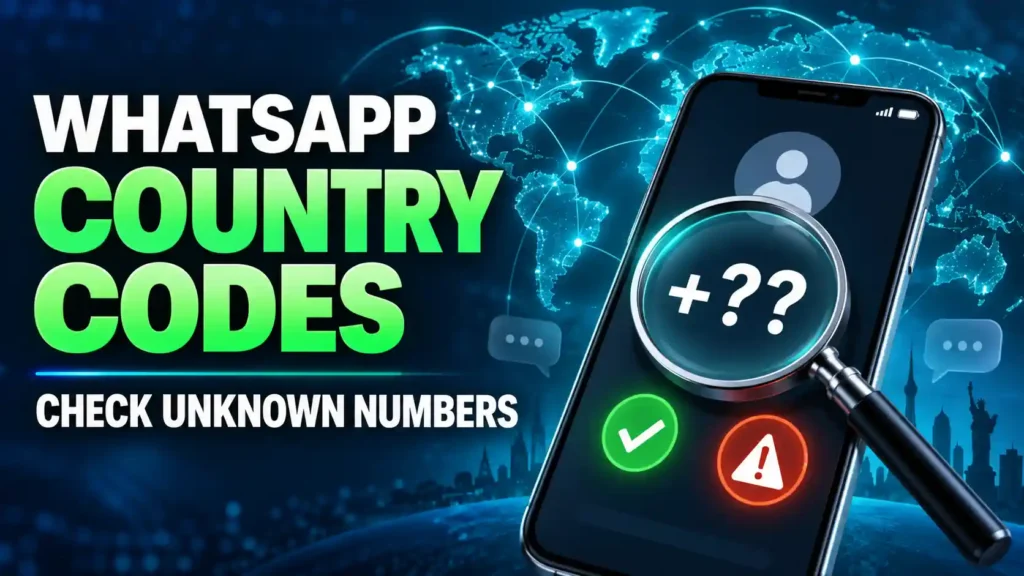
An unfamiliar WhatsApp number appears on your phone. It begins with +44, +92, +234, +91 or another international prefix you do not recognize.
Your first question is probably:
“Which country is this number from, and is it a scam?”
The country code can tell you where the telephone number was issued, but it cannot tell you whether the person using it is honest. A genuine customer, relative or business may contact you from another country. A scammer can also use a legitimate SIM, virtual number, stolen account or number registered by an accomplice.
Quick answer: An unfamiliar WhatsApp country code is a reason to pause, not proof of fraud. Identify the country, inspect the message, verify the sender independently and judge the request before replying, clicking or paying.
This guide provides a WhatsApp country code list, explains which international numbers deserve additional investigation and shows you exactly how to check an unknown contact.
What Is a WhatsApp Country Code?
A country code is the international prefix at the beginning of a telephone number. It normally appears after a plus sign.
Examples include:
- +1 for the United States, Canada and several Caribbean countries and territories
- +33 for France
- +44 for the United Kingdom
- +91 for India
- +92 for Pakistan
- +234 for Nigeria
WhatsApp accounts are registered using telephone numbers. When someone uses a number issued through a particular country’s numbering system, its international country code usually appears at the beginning.
However, the country code does not necessarily reveal:
- The sender’s current location
- The sender’s nationality
- The identity of the account user
- Whether the number is physical or virtual
- Whether the account was stolen
- Whether the profile information is genuine
- Whether the message is safe
Treat the country code as one clue—not a complete background check.
WhatsApp Country Code List
The table below covers country codes that frequently appear in international WhatsApp conversations.
| Country code | Country or region |
|---|---|
| +1 | United States, Canada and parts of the Caribbean |
| +7 | Russia and Kazakhstan |
| +20 | Egypt |
| +27 | South Africa |
| +30 | Greece |
| +31 | Netherlands |
| +32 | Belgium |
| +33 | France |
| +34 | Spain |
| +36 | Hungary |
| +39 | Italy |
| +40 | Romania |
| +41 | Switzerland |
| +43 | Austria |
| +44 | United Kingdom |
| +45 | Denmark |
| +46 | Sweden |
| +47 | Norway |
| +48 | Poland |
| +49 | Germany |
| +51 | Peru |
| +52 | Mexico |
| +53 | Cuba |
| +54 | Argentina |
| +55 | Brazil |
| +56 | Chile |
| +57 | Colombia |
| +58 | Venezuela |
| +60 | Malaysia |
| +61 | Australia |
| +62 | Indonesia |
| +63 | Philippines |
| +64 | New Zealand |
| +65 | Singapore |
| +66 | Thailand |
| +81 | Japan |
| +82 | South Korea |
| +84 | Vietnam |
| +86 | China |
| +90 | Türkiye |
| +91 | India |
| +92 | Pakistan |
| +93 | Afghanistan |
| +94 | Sri Lanka |
| +95 | Myanmar |
| +98 | Iran |
| +212 | Morocco |
| +213 | Algeria |
| +216 | Tunisia |
| +218 | Libya |
| +220 | The Gambia |
| +221 | Senegal |
| +223 | Mali |
| +225 | Côte d’Ivoire |
| +226 | Burkina Faso |
| +227 | Niger |
| +228 | Togo |
| +229 | Benin |
| +230 | Mauritius |
| +231 | Liberia |
| +232 | Sierra Leone |
| +233 | Ghana |
| +234 | Nigeria |
| +237 | Cameroon |
| +243 | Democratic Republic of the Congo |
| +254 | Kenya |
| +255 | Tanzania |
| +256 | Uganda |
| +260 | Zambia |
| +263 | Zimbabwe |
| +351 | Portugal |
| +352 | Luxembourg |
| +353 | Ireland |
| +354 | Iceland |
| +355 | Albania |
| +356 | Malta |
| +357 | Cyprus |
| +358 | Finland |
| +359 | Bulgaria |
| +370 | Lithuania |
| +371 | Latvia |
| +372 | Estonia |
| +373 | Moldova |
| +374 | Armenia |
| +375 | Belarus |
| +380 | Ukraine |
| +381 | Serbia |
| +385 | Croatia |
| +386 | Slovenia |
| +420 | Czech Republic |
| +421 | Slovakia |
| +502 | Guatemala |
| +503 | El Salvador |
| +504 | Honduras |
| +505 | Nicaragua |
| +506 | Costa Rica |
| +507 | Panama |
| +509 | Haiti |
| +591 | Bolivia |
| +593 | Ecuador |
| +595 | Paraguay |
| +598 | Uruguay |
| +670 | Timor-Leste |
| +855 | Cambodia |
| +880 | Bangladesh |
| +971 | United Arab Emirates |
| +972 | Israel |
| +973 | Bahrain |
| +974 | Qatar |
| +975 | Bhutan |
| +976 | Mongolia |
| +977 | Nepal |
| +992 | Tajikistan |
| +993 | Turkmenistan |
| +994 | Azerbaijan |
| +995 | Georgia |
| +996 | Kyrgyzstan |
| +998 | Uzbekistan |
This list identifies countries and numbering regions. It is not a list of fraudulent countries.
Are Some WhatsApp Country Codes More Likely to Be Scams?
No country code is inherently fraudulent.
Scams can come from:
- Your own country
- A neighboring country
- A country where you have business contacts
- A country thousands of miles away
- A number that looks local
- A number associated with a respected financial centre
It is dangerous to assume that a familiar number is safe or that every foreign number is fraudulent.
Criminals deliberately use numbers that appear credible. A scam targeting British victims may use +44. A scam targeting Americans may use +1. Someone pretending to offer a Dubai job may use +971.
The more important question is whether the sender’s identity, story and request can be independently verified.
When Should an International WhatsApp Number Concern You?
An unfamiliar country code deserves investigation when the contact is unexpected. It becomes significantly more suspicious when other warning signs appear.
| Lower-risk characteristics | Higher-risk characteristics |
|---|---|
| You expected the message | The contact is completely unexpected |
| The sender identifies themselves clearly | The opening message is vague |
| You share a genuine connection | The sender cannot explain how they found you |
| The purpose is specific and reasonable | The sender introduces money or employment |
| Claims can be independently verified | Every verification route is controlled by the sender |
| No sensitive information is requested | The sender asks for codes or documents |
| There is no pressure | You are rushed or threatened |
| Normal payment procedures are used | Payment must be made through crypto or gift cards |
Several high-risk characteristics appearing together are enough to stop the conversation.
Why Am I Receiving WhatsApp Messages From Foreign Numbers?
An international message does not automatically mean that your device was hacked. Your number may have reached the sender through ordinary or dishonest data-collection methods.
Your number is publicly available
Your telephone number may appear on:
- A business website
- Social media
- A classified advertisement
- An online marketplace
- A professional directory
- A résumé
- A public group
- An old forum account
Business owners and freelancers are especially likely to receive international messages because their contact information is intentionally public.
Your number appeared in a data breach
A website, application or organization may have exposed customer data. Criminals can combine leaked telephone numbers with names, email addresses and other information.
The sender knowing your name does not prove that the contact is legitimate.
Someone collected it from a WhatsApp group
Participants in some groups may be able to see other members’ numbers. An unknown person may save your number and contact you privately.
You submitted it through an online form
Fake job applications, surveys, giveaways and promotional pages are sometimes created to collect personal information.
A contact’s account was compromised
A criminal controlling another person’s account may obtain access to messages, group memberships or stored contact details.
The sender is testing active numbers
Some operations send generic messages to large lists. They continue communicating only with people who respond.
Messages used to test numbers include:
- “Hello”
- “Hi, are you free?”
- “Can we discuss something?”
- “Is this Sarah?”
- “Are you interested in remote work?”
- “I have an opportunity for you.”
Even a one-word response confirms that your number is active.
Someone genuinely made a mistake
Wrong-number messages happen. A genuine sender usually apologizes and leaves.
A scammer may pretend to have entered the wrong number and then continue the conversation. After gaining your trust, the person introduces romance, investing or an online business opportunity.
How to Check an Unknown WhatsApp Country Code
Follow this process before replying to an unexplained international number.
Step 1: Separate the country code from the rest of the number
The plus sign is normally followed by a one-, two- or three-digit country code.
Do not assume that the first three digits always represent the country. For example, +1 is shared by the North American Numbering Plan, while +44 identifies the United Kingdom.
Use a reliable country-code directory when you are uncertain.
Step 2: Ask whether you have a legitimate connection to that country
Consider whether you:
- Have relatives there
- Recently applied for a job there
- Ordered something from a business there
- Advertised a product internationally
- Work with customers in that country
- Joined an international group
- Expected a call from a company there
If there is no plausible connection, treat the message cautiously.
Step 3: Examine the opening message
A legitimate sender should provide enough context for you to understand why they contacted you.
Compare these examples:
More credible:
“Hello, my name is David Cole. I am contacting you regarding the quotation you submitted to ABC Company yesterday.”
More suspicious:
“Hello. Are you free for a profitable opportunity?”
Specific context does not guarantee honesty, but a vague opening gives you no reason to trust the person.
Step 4: Inspect the WhatsApp profile
Review:
- The profile name
- Photograph
- About information
- Business category
- Website
- Email address
- Catalogue
- Previous name-change alerts, if displayed
Look for contradictions. A company logo with no official website, a personal payment account or a name that changes during the conversation deserves additional scrutiny.
A WhatsApp business profile is not automatic proof that the business is legitimate.
Step 5: Search the complete number
Search the number in quotation marks. Also search:
- The number plus “scam”
- The number plus “WhatsApp”
- The sender’s name plus “fraud”
- The company name plus “complaints”
- Exact sentences copied from the message
- The supplied website address
Search results may reveal copied scripts, impersonated companies or previous reports.
However, no results do not mean the number is safe. It may be new, disposable, recently reassigned or previously unreported.
Step 6: Verify through a separate channel
If the sender claims to represent a company, bank, courier or government office:
- Stop communicating through WhatsApp.
- Find the organization’s official website yourself.
- Use a telephone number or email address published there.
- Ask whether the sender and request are genuine.
- Confirm payment details separately.
Do not use the website, telephone number or “verification officer” introduced by the suspicious sender.
Step 7: Identify the real request
Friendly conversation can distract you from the sender’s objective.
Ask what the person ultimately wants you to do.
Stop immediately if the request involves:
- Sending money
- Sharing a verification code
- Revealing a password
- Providing banking information
- Sending identity documents
- Installing an application
- Granting remote access
- Scanning a QR code
- Moving money through your account
- Keeping the conversation secret
15 Warning Signs an International WhatsApp Number May Be a Scammer
Country codes vary, but scam behavior remains surprisingly consistent.
1. The opening message is vague
The sender does not provide a name, organization or specific reason for contacting you.
2. The person avoids explaining how your number was obtained
Answers such as “from our database” or “online” are not sufficient when no further details are provided.
3. The country code conflicts with the story
A mismatch does not automatically establish fraud. People travel and use foreign numbers. However, a person claiming to work in your local bank while using an unexplained foreign number should be independently verified.
4. The profile photograph appears stolen
The image may belong to a model, executive, military officer, doctor or social media user.
A reverse-image search may help, although failing to find a match does not prove authenticity.
5. You receive an unsolicited job offer
The job promises high pay, immediate acceptance or simple tasks without a proper interview.
6. You must deposit money to perform tasks
Fake task platforms may pay a small amount first and then require increasingly large deposits.
7. The sender guarantees investment returns
No legitimate investment can guarantee large, risk-free profits.
8. An unexpected prize requires a fee
The supposed winner must pay shipping, tax, insurance, customs or processing fees before receiving the prize.
9. The sender creates a family emergency
The criminal impersonates a relative who supposedly lost a phone, was arrested or needs urgent medical assistance.
10. You are asked for a verification code
A one-time password or WhatsApp registration code may allow the criminal to access an account or authorize a transaction.
11. The message contains an unfamiliar link
The website may imitate a bank, courier, employer, cryptocurrency exchange or government portal.
12. You must install an application
The sender may supply an Android application file or remote-access tool. Installing it could expose information or allow another person to control the device.
13. Payment must use a difficult-to-reverse method
Cryptocurrency, gift cards, wire transfers and payments to unrelated personal accounts are common warning signs.
14. The sender demands secrecy
You are discouraged from consulting your bank, family, employer or the organization supposedly represented.
15. The person becomes threatening when questioned
Anger, intimidation and changing explanations indicate that the sender wants compliance rather than verification.
What Do Common WhatsApp Country Codes Mean?
Several prefixes frequently cause concern because recipients do not recognize them or have seen warnings online.
+1 WhatsApp numbers
+1 covers the United States, Canada and several Caribbean countries and territories. You usually need more digits to identify the specific numbering area.
A +1 number is not necessarily American, and it is not automatically safe because it appears familiar.
Scams using +1 numbers may involve:
- Fake employment
- Government impersonation
- Romance
- Debt collection
- Package delivery
- Bank alerts
- Cryptocurrency investments
+44 WhatsApp numbers
+44 belongs to the United Kingdom.
British mobile numbers often begin with 07 domestically and appear with +44 7 internationally after the leading zero is removed.
Unexpected +44 contacts may involve fake UK jobs, visa sponsorship, banking alerts, parcel messages or investment schemes. Read this detailed investigation of a +44 country code on WhatsApp before trusting an unexplained British number.
+91 WhatsApp numbers
+91 belongs to India.
India has an enormous number of legitimate WhatsApp users and businesses. The country code alone should not be treated as evidence of fraud.
Investigate unexpected job offers, technical-support claims, task platforms, loan offers and payment requests.
+92 WhatsApp numbers
+92 belongs to Pakistan.
A Pakistani number may be completely legitimate. However, an unexpected +92 message deserves caution when the sender offers employment, impersonates police, requests a security code or demands payment.
Use this guide to determine whether a +92 country code on WhatsApp belongs to a genuine contact or a potential scammer.
+234 WhatsApp numbers
+234 belongs to Nigeria.
Legitimate Nigerian individuals and businesses use +234 numbers every day. It is inaccurate and unfair to assume that every Nigerian number is fraudulent.
At the same time, you should investigate unexpected messages involving romance, investments, inheritance, advance payments, jobs or account verification.
Your dedicated article on a 13-digit +234 WhatsApp number should explain the correct number format and how to assess an unexpected Nigerian contact.
+27 WhatsApp numbers
+27 belongs to South Africa.
Potential scams may involve jobs, loans, fake customer orders, investment platforms and account impersonation. Verify the sender rather than judging the country code.
+62 WhatsApp numbers
+62 belongs to Indonesia.
Unexpected messages may involve online tasks, investment groups, gambling promotions, account verification or supposed customer-support agents.
+63 WhatsApp numbers
+63 belongs to the Philippines.
Be cautious with unsolicited employment, lending, romance, investment and account-recovery messages. Genuine Filipino contacts should still be evaluated fairly and independently.
+971 WhatsApp numbers
+971 belongs to the United Arab Emirates.
Fraudsters may use the attraction of employment in Dubai or elsewhere in the UAE to promote fake jobs, visas, accommodation and recruitment services.
A +971 number does not prove that the sender is an authorized UAE employer or recruiter.
+880 WhatsApp numbers
+880 belongs to Bangladesh.
As with every other country code, the number may belong to a genuine user or dishonest sender. Examine the message and request instead of making a decision based on nationality.
Can Scammers Use Numbers From Countries Where They Do Not Live?
Yes.
A person may communicate through a number associated with another country because of:
- International travel
- Relocation
- Dual residency
- A foreign business line
- A virtual telephone service
- Remote access to a SIM
- A stolen WhatsApp account
- A number supplied by an accomplice
This is why “the number is from the UK” does not necessarily mean “the sender is in the UK.”
It is also why a number matching your own country does not prove safety.
Can a WhatsApp Business Account Still Be Fake?
Yes.
A WhatsApp business account may display a company name, logo, catalogue, email address and website. Those features can make a profile look professional, but they do not automatically prove every claim.
Check whether:
- The business exists independently
- The website is the official company website
- The email uses the genuine corporate domain
- The company recognizes the telephone number
- The payment recipient matches the business
- The physical address is genuine
- The website has existed long enough to support the claimed history
A profile created by the sender should never be the only evidence used to verify the sender.
Can Answering an International WhatsApp Call Hack Your Phone?
Answering an ordinary WhatsApp call does not normally give the caller automatic access to your messages, photographs, contacts or bank accounts.
The greater risk is what the caller convinces you to do afterward.
The person may instruct you to:
- Share your screen
- Install a remote-access application
- Read out a verification code
- Scan a QR code
- Link another device
- Open a malicious website
- Approve a transaction
- Reveal private information
Keep WhatsApp and your phone’s operating system updated because software vulnerabilities can occur.
If you answered but shared nothing, clicked nothing, installed nothing and approved no request, the immediate risk is much lower.
Can Replying to an Unknown WhatsApp Number Get You Hacked?
Sending a simple text reply does not normally compromise your device.
However, replying can:
- Confirm that your number is active
- Encourage more messages
- Give the sender an opportunity to manipulate you
- Help the sender learn your language and time zone
- Show when you are normally online
- Lead to more targeted fraud attempts
When there is no legitimate reason for the contact, ignoring, reporting and blocking the number is safer.
What to Do Before Replying to an International Number
Use this checklist:
- Identify the country code.
- Decide whether you have a genuine connection to that country.
- Examine whether the message contains specific context.
- Search the complete number.
- Search exact wording from the message.
- Investigate the profile photograph.
- Verify the company independently.
- Refuse to share codes, passwords or documents.
- Avoid every unexpected link or download.
- Do not send money before verification.
If the sender is genuine, reasonable verification should not destroy the opportunity.
How to Block and Report an Unknown WhatsApp Number
The wording can differ slightly depending on the phone and WhatsApp version, but the usual process is:
- Open the conversation.
- Tap the number or profile name at the top.
- Scroll down the contact-information page.
- Select “Block” or “Report.”
- Confirm the action.
If the person threatened you, requested money or sent fraudulent payment instructions, preserve evidence before blocking.
Save:
- The complete number
- Profile name
- Profile photograph
- Messages
- Links
- Payment instructions
- Account or wallet details
- Transaction receipts
- Dates and times
Do not continue talking merely to gather more evidence.
How to Reduce Messages From Unknown International Numbers
You cannot prevent every stranger from discovering your number, but you can reduce your exposure.
Restrict profile visibility
Limit who can see your photograph, about information, status and last-seen details.
Silence unknown callers
Use WhatsApp’s privacy option to silence calls from unknown numbers. Silenced calls may still appear in your call history.
Restrict group additions
Adjust who can add you to groups. This reduces exposure to unwanted investment, job and promotional groups.
Enable two-step verification
Create a private WhatsApp PIN and add a secure recovery email address if the option is available.
Review linked devices
Remove any browser, computer or device you do not recognize.
Avoid publishing your primary number unnecessarily
Business owners may consider separating public business communication from sensitive personal and financial accounts.
What If You Already Replied?
Do not panic. A simple response does not automatically expose your phone.
If you only asked who the sender was:
- Stop responding.
- Block and report the account.
- Watch for messages from other numbers.
- Ignore threats claiming that you created an obligation by replying.
If you disclosed information, consider how it could be used.
Change any password you revealed. Secure affected accounts. Inform your bank if financial details were exposed.
If you shared a WhatsApp code or approved a linked device, inspect your account immediately and remove every device you do not recognize.
What If You Clicked a Link?
Close the page and do not enter additional information.
Then:
- Check whether anything was downloaded.
- Remove unfamiliar applications.
- Review application permissions.
- Update your device.
- Change passwords entered on the page.
- Replace reused versions of those passwords.
- Monitor email and financial accounts.
- Contact your bank if you entered payment details.
If you installed remote-access software, remove it and secure important accounts from another trusted device.
What If You Sent Money?
Act immediately.
- Contact your bank, card issuer, payment platform or cryptocurrency provider.
- Explain that the transaction resulted from suspected fraud.
- Ask whether it can be stopped, recalled, disputed or traced.
- Secure every connected financial account.
- Change exposed passwords.
- Preserve conversations and payment records.
- Report the incident to the appropriate authority where you live.
- Warn contacts if your WhatsApp account was compromised.
Do not pay a supposed investigator or hacker who guarantees recovery. Victims are frequently targeted again by people pretending to recover lost money.
Frequently Asked Questions About WhatsApp Country Codes
These answers address common concerns about international WhatsApp numbers.
1. What is a country code on WhatsApp?
It is the international prefix attached to the telephone number used to register the WhatsApp account.
2. Can WhatsApp tell me where a number is from?
The country code can identify the numbering country or region, but it does not prove the sender’s current physical location.
3. Does an international number mean it is a scam?
No. Many legitimate people and businesses communicate internationally.
4. Is there an official list of scam country codes?
No reliable country-code list can determine who is a scammer. Fraudulent and genuine accounts can use the same prefixes.
5. Which WhatsApp country code is +1?
+1 covers the United States, Canada and several Caribbean countries and territories.
6. Which country uses +44?
The United Kingdom uses +44.
7. Which country uses +91?
India uses +91.
8. Which country uses +92?
Pakistan uses +92.
9. Which country uses +234?
Nigeria uses +234.
10. Which country uses +27?
South Africa uses +27.
11. Which country uses +62?
Indonesia uses +62.
12. Which country uses +63?
The Philippines uses +63.
13. Which country uses +971?
The United Arab Emirates uses +971.
14. Can a scammer use a number from my country?
Yes. A familiar or local-looking number is not proof of safety.
15. Can someone use WhatsApp from outside the number’s country?
Yes. People can travel, relocate or access numbers remotely. Criminals may also use virtual, stolen or accomplice-controlled numbers.
16. Can I identify a scammer from the number alone?
No. The number is only one part of the investigation.
17. Is a WhatsApp business account automatically verified?
No. A business profile does not automatically establish that every claim made by its owner is genuine.
18. Should I answer an unknown international WhatsApp call?
If you are not expecting the call, allowing it to go unanswered is safer. Verify the identity first.
19. Can answering a WhatsApp call hack my phone?
Answering an ordinary call does not usually grant automatic access. Risk increases when you follow instructions, install software or reveal information.
20. Can replying “hello” get me hacked?
A simple reply does not normally compromise your phone. It confirms that your number is active and may encourage further contact.
21. Why do scammers send “wrong number” messages?
It provides a natural excuse to begin a conversation and build trust before introducing money, romance or investing.
22. Should I search the number online?
Yes, but treat the results as one piece of evidence. No public complaints do not prove that the number is safe.
23. What if the stranger knows my name?
Your name may have come from a public profile, data breach, contact list, group or online form. It does not prove legitimacy.
24. Should I block every foreign number?
No. Block numbers that are unexplained, suspicious, abusive or irrelevant. Do not assume that every foreign contact is dishonest.
25. What is the safest response to an unexplained international message?
Do not click, pay or share information. Verify the sender independently. If no legitimate connection exists, report and block the account.
Final Verdict: Should You Trust an Unknown WhatsApp Country Code?
A WhatsApp country code can tell you where a telephone number was issued. It cannot tell you whether the person using that number is genuine.
Do not trust a contact merely because:
- The number looks British or American
- The profile displays a company logo
- The account is labelled as a business
- The sender knows your name
- The person speaks professionally
- The number has no online complaints
- The sender appears during a video call
Trust the contact only when the identity and request can be verified through a channel the sender does not control.
If the message is unexpected and involves money, employment, investments, identity documents, passwords, verification codes, application downloads or secrecy, stop before taking action.
The country code identifies a number. Verification identifies the person.