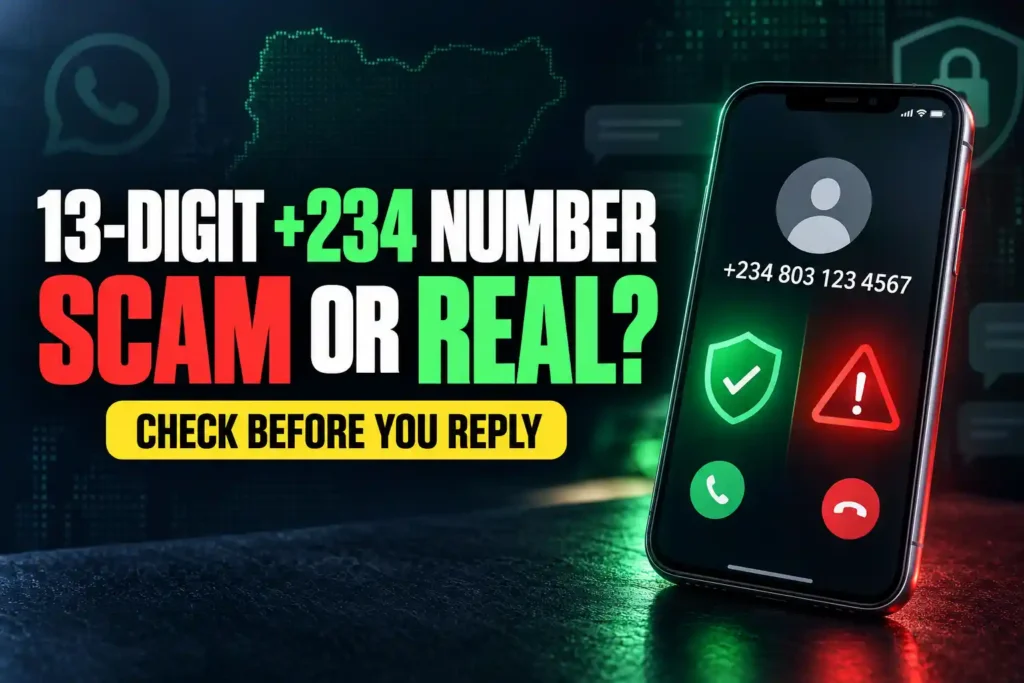
You open WhatsApp and find a message from an unfamiliar 13-digit number beginning with +234.
The sender might say:
“Hello, is this David?”
“Are you available?”
“I found your number in my contacts.”
“Sorry, I believe I messaged the wrong person.”
Because the number looks unusually long and comes from another country, your first instinct may be to assume it belongs to a scammer. That conclusion would be premature.
A +234 WhatsApp number is a telephone number registered with Nigeria’s international country code. When a standard Nigerian mobile number is converted from local to international format, it can contain 13 numerical digits. Therefore, the length and country code alone do not prove fraud.
However, an unexpected +234 message can still be dangerous if the sender hides their identity, manufactures an emergency, introduces an investment, offers suspicious online work, requests a verification code or pressures you to send money.
The safest decision is neither blind trust nor automatic accusation. It is verification.
Quick Answer: Why Does the WhatsApp Number Begin With +234?
The +234 prefix is Nigeria’s international calling code. A 13-digit WhatsApp number beginning with 234 is usually a Nigerian number written in international format. The format can be completely legitimate and does not prove that the sender is a scammer.
Nevertheless, the number does not confirm the sender’s name, location or intentions. You must examine the message, verify the claimed identity independently and refuse any request involving money, passwords, codes or sensitive information until the sender has been confirmed.
| What you notice | What it may mean | How concerned should you be? |
|---|---|---|
The number begins with +234 | It uses Nigeria’s country code | Not suspicious by itself |
| The number contains 13 digits | It may be correctly written internationally | Not suspicious by itself |
| The sender clearly explains who they are | It may be a genuine contact or business inquiry | Verify normally |
| The sender says “wrong number” but continues talking | It may be a deliberate conversation starter | Suspicious |
| The sender offers easy online work | It may be a task scam | High risk |
| The sender recommends guaranteed investments | It may be an investment scam | High risk |
| The sender asks for a WhatsApp code | It may be an account-takeover attempt | Extreme risk |
| The sender creates an emergency | It may be impersonation fraud | High risk |
| The sender refuses independent verification | The claimed identity may be false | High risk |
What Does +234 Mean on WhatsApp?
The +234 prefix identifies a telephone number associated with Nigeria’s numbering system.
WhatsApp accounts are registered using telephone numbers. When a Nigerian number is displayed internationally, WhatsApp may show +234 before the rest of the number.
For example, consider this fictional local Nigerian mobile number:
0801 234 5678
In international format, the opening zero is removed and +234 is added:
+234 801 234 5678
Nothing about that conversion is suspicious. It is simply the international way of writing the number.
However, +234 does not prove that the person messaging you is currently in Nigeria. Someone can continue using a Nigerian WhatsApp account while travelling, studying, working or living abroad. A criminal could also gain control of another person’s account or use misleading profile information.
The country code tells you about the telephone number. It does not verify the human being controlling the account.
Why Does a +234 WhatsApp Number Have 13 Digits?
A Nigerian mobile number is commonly written with 11 digits in local format, including the first zero.
When the number is converted to international format:
- The first zero is removed.
- Nigeria’s three-digit country code,
234, is added. - The remaining ten digits follow the country code.
The result contains 13 numerical digits:
234 + ten remaining digits = 13 digits
The plus sign is a dialing symbol and is not counted as a numerical digit.
This means a 13-digit phone number beginning with 234 can be correctly formatted. Its length is not evidence that the number was generated by a scammer.
You should investigate further when:
- The number contains an unusual number of digits.
- The sender gives you a different contact number later.
- The telephone number changes during the conversation.
- The payment account belongs to an unrelated person.
- The number does not match the organization being impersonated.
- The sender claims to be local but refuses to explain the international number.
- The story surrounding the number keeps changing.
Formatting can tell you whether a number looks plausible. It cannot tell you whether the sender is honest.
Is Every +234 WhatsApp Number a Scam?
No. A Nigerian telephone number is not evidence of criminal activity.
Millions of legitimate individuals, families, employees, students, professionals and businesses use Nigerian WhatsApp numbers. Someone may contact you from +234 because they are:
- A customer
- A business owner
- A supplier
- A job applicant
- A student
- A relative
- A former colleague
- A member of an international group
- Someone who received your number legitimately
- A person who entered the wrong number accidentally
Scammers also use numbers from Nigeria, the United States, the United Kingdom, Canada, India, Pakistan and many other countries. Some deliberately use local-looking numbers because people are more likely to trust them.
Therefore, judging a message by its country code is a weak safety strategy.
A more useful question is:
Can this person prove their identity without asking me to take an unnecessary risk?
A legitimate sender should be able to explain why they contacted you, provide verifiable information and allow you enough time to confirm the story.
A scammer is more likely to create pressure, resist verification and move the conversation toward money, account access or personal information.
Why Is a Nigerian Number Messaging Me on WhatsApp?
An unexpected message can have an innocent explanation or form part of a calculated scam. Examine the conversation before deciding which explanation fits.
The person genuinely knows you
The sender could be a relative, customer, colleague or former acquaintance whose number you never saved.
Ask the person to identify themselves without giving them hints. Do not ask, “Is this Michael?” because a dishonest sender can simply agree.
A legitimate contact should be able to explain how you know each other and provide details that can be verified.
Your telephone number is publicly available
If you publish your number on a website, marketplace, directory, advertisement or social-media profile, people from different countries may contact you.
A public business number can receive genuine inquiries and fraudulent messages. Treat unexpected requests cautiously without assuming every international contact is criminal.
Someone added you from a WhatsApp group
Members of a shared group may be able to see your number and message you privately.
Ask which group the person found you in and why they contacted you. Check the group independently rather than trusting a screenshot provided by the sender.
The person entered the wrong number
Typing errors happen. A genuine sender may apologize and end the conversation after learning they contacted the wrong person.
The situation becomes suspicious when the stranger refuses to end the exchange and starts asking about your name, age, job, location, family or financial situation.
The sender is testing whether your number is active
Some scammers begin with vague messages because they do not know who owns the number.
Common openings include:
“Hello.”
“Are you free?”
“Can we talk?”
“Is this the travel agent?”
“I saw your number in my contacts.”
When you respond, you confirm that a real person monitors the account. The sender can then introduce a more carefully prepared story.
Someone is impersonating a person you know
A scammer may copy a relative’s or colleague’s photograph and claim:
“This is my new number.”
“My old phone stopped working.”
“Please save this number instead.”
The conversation may remain harmless until an urgent financial problem appears. The person then requests a transfer, airtime, gift card, loan or bill payment.
Contact the real individual using a number or account you trusted before the suspicious message arrived.
A genuine WhatsApp account has been compromised
A message can come from a real account and still be fraudulent.
A criminal may gain access after obtaining the owner’s verification code, taking control of the SIM card or linking an unauthorized device to the account.
This is why even familiar accounts should be questioned when they make unusual requests.
Eleven Warning Signs a +234 WhatsApp Message May Be a Scam
The Nigerian country code is not the main warning sign. The sender’s behaviour reveals far more.
The country code identifies a numbering region, not the sender’s honesty. These WhatsApp scammer warning signs explain what to check before you trust the message.
1. The sender refuses to introduce themselves properly
A genuine stranger with a legitimate reason to contact you should normally state their name and purpose.
Be cautious when the person sends vague messages, asks you to guess their identity or avoids explaining how they obtained your number.
2. A supposed wrong number continues the conversation
A classic opening begins with an apparently innocent mistake.
After you explain that the sender has the wrong person, they may respond:
“You seem kind. Can we still be friends?”
“Maybe this mistake happened for a reason.”
“I hope I didn’t disturb you. Where are you from?”
This can be a deliberate attempt to build a relationship before introducing an investment, romance or financial emergency.
3. The sender becomes personally interested too quickly
Within a short time, the stranger wants to know:
- Your age
- Relationship status
- Occupation
- Location
- Income
- Family situation
- Investment experience
- Daily routine
These questions can help a scammer determine whether you are a profitable target and how best to manipulate you.
4. The sender appears unusually wealthy or successful
The profile may feature luxury vehicles, expensive meals, designer clothing, large houses or screenshots of profitable trades.
These images can be stolen or staged. Their purpose may be to create authority before the sender introduces a supposed money-making opportunity.
Lifestyle photographs are not financial evidence.
5. The sender promises guaranteed investment returns
No genuine investment can guarantee high profits without meaningful risk.
Be extremely careful if the person recommends:
- Cryptocurrency trading
- Foreign-exchange trading
- Gold investments
- Artificial intelligence trading
- Copy trading
- Private investment groups
- Secret trading signals
- A relative with inside knowledge
- A platform you cannot independently verify
The account dashboard may display invented profits that cannot actually be withdrawn.
6. The sender offers easy online work but demands a deposit
A supposed recruiter may offer money for:
- Liking videos
- Following accounts
- Reviewing hotels
- Rating products
- Completing orders
- Optimizing applications
- Performing “merchant tasks”
The victim may receive a small payment initially. Later, the system demands a deposit to unlock better tasks, correct a negative balance or release accumulated earnings.
A legitimate employer pays you. It does not require you to deposit money to receive your wages.
7. An emergency appears suddenly
The sender claims that someone is sick, stranded, arrested or unable to access their bank account.
You may be told that the payment must happen immediately and that contacting anyone else will make the situation worse.
Real emergencies can happen. Nevertheless, urgency should increase verification—not eliminate it.
8. The sender asks for a verification code
Never give anyone a WhatsApp registration code, one-time password or two-step verification PIN.
A person asking for one of these codes may be attempting to register your account on another device.
The sender may pretend that:
- The code was sent to you accidentally.
- It is needed to confirm your identity.
- It will unlock a prize.
- It is part of a group invitation.
- WhatsApp support requires it.
- A friend needs it to recover their account.
None of these explanations makes sharing the code safe.
9. The sender wants you to install an application
Do not install software because a stranger tells you it is required for work, investment, account verification or technical support.
The application may steal information, display fake investment results or give another person remote access to your device.
Download applications only from trusted stores and only after independently confirming the developer and purpose.
10. The payment recipient does not match the sender
The person claims to represent a company but instructs you to pay:
- A personal bank account
- A cryptocurrency wallet
- A different person
- A foreign account
- A newly created payment profile
- A gift-card code
A mismatch does not always prove fraud, but it demands independent verification before payment.
11. The sender becomes hostile when you verify the story
A scammer may respond to reasonable questions with anger, guilt or threats:
“Why don’t you trust me?”
“You are wasting my time.”
“If you delay, you will lose everything.”
“Do not tell anyone about this.”
A legitimate person can usually tolerate a short verification process. A criminal needs you to act before the lie collapses.
The Five-Minute +234 WhatsApp Number Check
No single test can guarantee that a stranger is trustworthy. However, this process can reveal contradictions before you expose your money, identity or account.
Step 1: Stop and read the request again
Do not click, download, pay or call immediately.
Identify exactly what the sender wants:
- A reply
- Personal information
- Money
- An account code
- A document
- An application installation
- A link click
- A private conversation
- Secrecy
The request often reveals more than the profile.
Step 2: Inspect the complete number
Look at the actual number rather than the displayed profile name.
Confirm whether the number remains consistent across the profile, conversation, payment instructions and any website or email the sender provides.
Correct formatting means only that the number looks possible. It does not verify the user.
Step 3: Search the number in several formats
Search the complete number inside quotation marks.
For a fictional number, you might search:
"+2348012345678""+234 801 234 5678""08012345678"
Look for connections to genuine businesses, professional profiles, public directories and fraud reports.
A clean search result does not prove safety. A recently activated, recycled or compromised number may have no searchable history.
Step 4: Search a distinctive sentence from the message
Scammers frequently reuse scripts.
Copy the most unusual sentence from the message and search it inside quotation marks. A specific job description, investment promise or emergency explanation may appear in other fraud reports.
Do not expect useful results from generic phrases such as “Hello” or “How are you?”
Step 5: Examine the profile photograph
Run a reverse-image search when the person’s identity matters.
Warning signs include:
- The photograph belongs to a public figure.
- The same face appears under several names.
- The image comes from a catalogue or stock-photo website.
- The background contains strange distortions.
- Facial details appear unnatural.
- The account’s name and photograph do not match.
No result does not prove the photograph is genuine. Private stolen images and artificially generated faces may not appear elsewhere online.
Step 6: Verify the claimed identity independently
If the sender claims to represent a company, locate the organization’s official website yourself and use its published contact information.
If the sender claims to be someone you know, call that person on a previously saved number or contact a trusted mutual acquaintance.
Do not use a verification number, link or second person introduced by the suspicious sender. A coordinated scammer can control every contact they provide.
Step 7: Observe how the person responds
The sender’s reaction can expose the deception.
Be extremely cautious if the person:
- Refuses a normal call
- Avoids direct questions
- Changes important details
- Demands secrecy
- Becomes threatening
- Introduces another person as proof
- Sends more screenshots instead of verifiable evidence
- Pressures you to act before checking
Verification should reduce uncertainty. If it produces more confusion, stop.
Legitimate +234 Message vs Suspicious Message
The difference is usually not the country code. It is the conduct of the sender.
| More likely legitimate | More likely suspicious |
|---|---|
| Clearly states a name and reason for contacting you | Begins vaguely and hides the purpose |
| Explains how they obtained your number | Avoids explaining where the number came from |
| Accepts independent verification | Becomes angry when questioned |
| Gives you time to decide | Creates an artificial deadline |
| Uses an official business payment process | Requests payment to an unrelated person |
| Does not ask for private codes | Requests a verification code or PIN |
| Provides evidence you can check independently | Provides only screenshots they control |
| Ends an accidental wrong-number conversation | Turns a wrong number into friendship or investment talk |
| Respects normal security procedures | Asks you to bypass established procedures |
| Makes realistic claims | Promises guaranteed profit or easy money |
One suspicious detail does not prove fraud. Several connected warning signs can justify ending the conversation.
Can You Find a +234 Number on a WhatsApp Scammer List?
You may find reports connected to a particular number, but there is no complete and permanently accurate public directory of every WhatsApp scammer.
Numbers can be:
- Newly activated
- Recycled
- Abandoned
- Temporarily rented
- Registered using false information
- Connected to compromised accounts
- Used for only a short campaign
- Incorrectly reported by another person
A number appearing in several credible fraud reports is a serious warning. However, the absence of reports does not prove that the sender is trustworthy.
Similarly, one anonymous accusation does not automatically establish guilt. The number could have changed owners or been compromised.
Use number reports as one clue. Combine them with profile checks, message analysis, independent identity verification and an examination of the sender’s request.
Can the Sender Really Be Somewhere Other Than Nigeria?
Yes.
A +234 number tells you that the account uses a Nigerian-format telephone number. It does not provide reliable proof of the sender’s current physical location.
The user may be:
- Travelling
- Living abroad
- Using international roaming
- Accessing WhatsApp through Wi-Fi
- Studying or working in another country
- Controlling a compromised account remotely
Do not assume the person is physically in Nigeria simply because the number begins with +234.
Conversely, do not trust a person merely because their number appears to come from your own country. Fraudsters can use local numbers, virtual numbers and compromised accounts.
Can a +234 WhatsApp Business Account Still Be Fake?
Yes. A professional-looking business profile does not automatically prove that a company is real.
A suspicious account may display:
- A business name
- A logo
- Opening hours
- A catalogue
- A website address
- Customer-service language
- A convincing profile description
Before paying, verify the business outside WhatsApp.
Check whether:
- The official website lists the same number.
- The website domain matches the email address.
- The business has a verifiable physical presence.
- The payment recipient matches the legal business name.
- The offer appears on the company’s official website.
- The company confirms the representative independently.
A polished profile is easy to create. A verifiable business history is much harder to fake.
What Not to Do With a Suspicious +234 Message
Curiosity can create unnecessary risk.
Do not:
- Click unfamiliar links.
- Download unexpected files.
- Install applications.
- Share verification codes.
- Send identification documents.
- Reveal bank or card information.
- Give the sender your address.
- Send a small test payment.
- Buy gift cards.
- Transfer cryptocurrency.
- Allow remote access to your device.
- Trust screenshots as final proof.
- Move to another platform under pressure.
- Call a verification number supplied by the sender.
- Publicly accuse the number’s owner without reliable evidence.
You do not need to prove that the person is a scammer before protecting yourself. You only need enough uncertainty to refuse a risky request.
What to Do If You Already Replied
Replying to a message does not normally give the sender control of your phone or WhatsApp account.
However, the response may confirm that your number is active. The sender could continue contacting you or share the number with other scammers.
Take these steps:
- Stop responding if the conversation becomes suspicious.
- Do not reveal additional information.
- Avoid every link and attachment.
- Save screenshots and relevant evidence.
- Report the account.
- Block the number.
- Review your WhatsApp privacy settings.
- Enable two-step verification.
- Check linked devices.
- Warn anyone being impersonated.
Be cautious if another number contacts you with a related story. The second account may belong to the same operation.
What to Do If You Clicked a Link
Opening a page does not always mean your device or account has been compromised. The risk becomes greater if you entered information, downloaded a file or installed software.
Act according to what happened.
If you entered a password:
- Change it through the legitimate website or application.
- Change it anywhere else you reused it.
- Enable multi-factor authentication.
- Review active sessions.
If you entered card or bank information:
- Contact the financial institution.
- Review recent transactions.
- Lock or replace the affected card when advised.
- Monitor the account closely.
If you installed an application:
- Disconnect the device from sensitive accounts.
- Remove the application if it is safe to do so.
- Review its permissions.
- Run trusted security checks.
- Seek qualified technical assistance when necessary.
Do not revisit the suspicious link to investigate it yourself.
What to Do If You Shared a WhatsApp Verification Code
Treat this as an attempted account takeover.
Immediately:
- Open WhatsApp and confirm that you still have access.
- Register your number again if you were signed out.
- Enable two-step verification.
- Review linked devices.
- Remove every device you do not recognize.
- Warn your contacts about suspicious messages.
- Contact your mobile provider if you suspect SIM theft.
- Secure the email account connected to your recovery options.
Your contacts may trust messages sent from your genuine account. Warn them before the criminal can request money or codes in your name.
What to Do If You Sent Money
Contact the payment provider immediately.
Depending on the payment method, this may include:
- Your bank
- Card issuer
- Mobile-money provider
- Money-transfer company
- Cryptocurrency exchange
- Payment application
State clearly that the transaction was connected to suspected fraud.
Provide:
- The amount
- Date and time
- Transaction reference
- Recipient information
- Telephone number
- Wallet address
- Screenshots
- Relevant messages
- An explanation of how you were deceived
Ask whether the transaction can be stopped, recalled, disputed, frozen or traced.
Then secure every account whose information you shared and file the appropriate fraud report in your country.
Be prepared for recovery scams. Fraud victims are frequently contacted by supposed investigators, lawyers or hackers who promise to recover everything for an upfront fee.
No honest recovery professional can guarantee that stolen money will be returned.
How to Report and Block a +234 Number on WhatsApp
Save the evidence you may need before deleting anything.
Open the suspicious conversation and tap the contact’s name or telephone number. Scroll to the available options for reporting and blocking the account. The wording and placement may vary slightly by device and application version.
Report the incident elsewhere when it involves:
- Financial loss
- Blackmail
- Threats
- Identity theft
- Stolen accounts
- Impersonation
- Malicious software
- Compromised bank information
Appropriate reporting points may include your financial institution, mobile provider, the impersonated company, your national fraud-reporting service and local law enforcement.
How to Prevent Similar WhatsApp Scams
You cannot stop every stranger from obtaining your number, but you can reduce the damage an unknown contact can cause.
- Enable two-step verification.
- Never share registration codes.
- Review linked devices regularly.
- Restrict who can see your profile photograph.
- Limit access to your About information.
- Control who can add you to groups.
- Silence calls from unknown numbers where available.
- Avoid publishing your personal number unnecessarily.
- Use a separate business number when appropriate.
- Confirm unusual financial requests through another channel.
- Create a private family verification word.
- Teach relatives that photographs and voices can be copied.
- Keep your device and applications updated.
- Use unique passwords for important accounts.
The strongest protection is not memorizing every suspicious country code. It is refusing to trust an unverified request.
Frequently Asked Questions About 13-Digit +234 WhatsApp Numbers
These answers address the questions people commonly ask after receiving an unexpected Nigerian WhatsApp message.
1. What country uses +234 on WhatsApp?
The +234 international country calling code is assigned to Nigeria. A WhatsApp account beginning with +234 uses a Nigerian-format telephone number.
2. Why does the +234 WhatsApp number contain 13 digits?
The opening zero from the local Nigerian number is removed and the three-digit 234 country code is added. The result can contain 13 numerical digits.
3. Is a 13-digit +234 WhatsApp number valid?
It can be. A correctly formatted Nigerian mobile number can contain 13 digits when written internationally. Valid formatting does not prove that the sender is trustworthy.
4. Is every +234 WhatsApp number a scam?
No. Legitimate people and businesses use Nigerian numbers. Judge the sender’s request and behaviour—not the country code alone.
5. Why is a Nigerian number messaging me unexpectedly?
The sender may know you, have found your number publicly, share a group with you, entered the wrong number or be attempting to start a scam conversation.
6. Can someone outside Nigeria use a +234 WhatsApp number?
Yes. A user may continue using the number while travelling, studying, working or living in another country.
7. Does +234 prove that the sender is physically in Nigeria?
No. The number’s country code does not reliably establish the user’s present physical location.
8. Can a scammer use a genuine +234 number?
Yes. A criminal can use a real SIM card, recycled number, virtual service or compromised WhatsApp account.
9. Can the WhatsApp profile name be fake?
Yes. A user can enter a misleading name. The displayed name should not be treated as verified identification.
10. Can the profile photograph be stolen?
Yes. Scammers frequently copy photographs from social media, business websites and dating profiles.
11. Is it safe to reply “Who is this?”
That reply does not normally surrender your account, but it confirms that the number is active. You are not required to respond to an unknown contact.
12. Can someone hack my phone just by messaging me?
Receiving an ordinary message does not normally give the sender control of your phone. The danger increases when you click links, install software, share codes or reveal credentials.
13. Why does the sender want my WhatsApp verification code?
The person may be trying to register your number on another device and take over your account. Never share the code.
14. What is a +234 wrong-number scam?
It is a conversation in which someone pretends to have contacted you accidentally, continues talking and gradually introduces romance, investment or another financial scheme.
15. What is a WhatsApp task scam?
It is a fake job scheme offering payment for simple online activities. Victims are eventually required to deposit their own money to continue or withdraw supposed earnings.
16. Can receiving a small payment prove the job is genuine?
No. Scammers sometimes send a small initial payment to earn trust before demanding a much larger deposit.
17. Can a video call prove the sender’s identity?
Not completely. The caller could use another person, stolen footage, prerecorded video or manipulated media. Important requests still require independent verification.
18. Is a WhatsApp Business account automatically safe?
No. A professional-looking business profile can still be false or compromised. Confirm the business outside WhatsApp before paying.
19. Can I track the sender’s precise location?
An ordinary WhatsApp user generally cannot determine another person’s exact location from the telephone number alone. Services promising guaranteed tracking may create additional risks.
20. Can I discover the sender’s real name from the number?
Searches may reveal public associations, but they cannot guarantee that the current user is the person named in the result.
21. What if the number has no scam reports?
That does not prove safety. The number may be new, recycled, compromised or used temporarily.
22. What if the number appears on a scam-reporting website?
Treat the report as a warning, not automatic proof. Compare multiple clues and focus on what the sender is asking you to do.
23. Should I call the unknown +234 number?
You do not need to call a suspicious stranger. If the person claims to represent someone you know or a company, verify the claim through a contact method you found independently.
24. Should I publish the number online as a scammer?
Avoid making unsupported public accusations. Numbers can be recycled, compromised or falsely reported. Submit evidence through appropriate reporting channels.
25. What is the safest response to an unexpected +234 WhatsApp message?
Do not click, pay or disclose information. Verify the sender independently. If there is no credible reason for the contact or the person resists verification, report and block the account.
Final Thoughts
A 13-digit WhatsApp number beginning with +234 can be a correctly formatted Nigerian telephone number. The prefix and number length do not prove fraud.
But correct formatting does not prove honesty either.
The sender’s behaviour matters far more than the country code. A stranger who hides their identity, creates urgency, promises easy profits, requests private codes or refuses independent verification presents a serious risk—regardless of which country appears in the number.
Do not accuse someone simply because they use a Nigerian number. At the same time, do not allow politeness, curiosity or fear to override basic verification.
Stop. Examine the request. Verify the person through a channel you control. Refuse to send money, codes or sensitive information until every important detail has been confirmed.
A genuine contact can tolerate five minutes of verification.
A scammer needs you to act before those five minutes are over.
Pingback: WhatsApp Scammer List: Check a Suspicious Number, Profile or Message - SafeGuard Press
Pingback: WhatsApp Country Code List: How to Check an Unknown International Number - SafeGuard Press