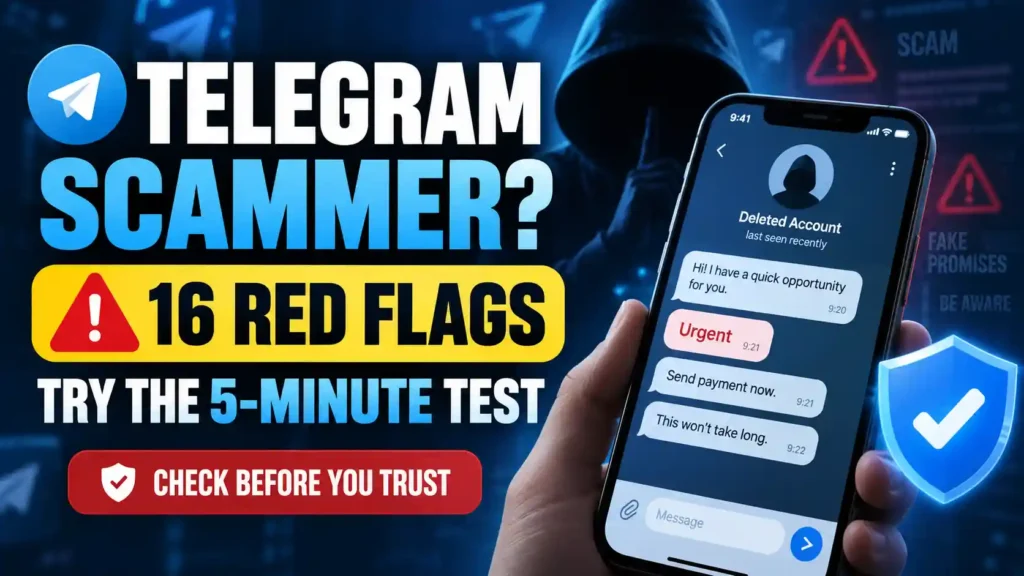
The Telegram message arrives without warning:
“Hello. I noticed your comment in the investment group. Are you interested in earning guaranteed daily profits?”
The sender looks legitimate. Their profile photograph is professional. Their biography says “Financial Analyst.” The channel they recommend has thousands of subscribers, confident market predictions and screenshots from members celebrating successful withdrawals.
Then the opportunity becomes urgent.
You must deposit cryptocurrency today, connect your wallet or speak privately with an “account manager” before registration closes.
Everything appears convincing because it was carefully designed to look convincing.
Learning how to identify a scammer on Telegram requires more than checking a profile picture. Scammers can copy display names, create lookalike usernames, clone channels, impersonate administrators, operate fake bots and manufacture entire conversations between accounts they control.
The strongest Telegram scammer red flags are an identity you cannot verify independently, unsolicited financial contact, guaranteed profits, suspicious links, requests for login codes or wallet access and pressure to act before you can investigate.
This guide reveals 16 red flags, realistic scam-message examples, a five-minute verification test, a ten-point risk score and the exact actions to take before clicking, investing or sharing sensitive information.
How to Identify a Scammer on Telegram Quickly
A Telegram account may belong to a scammer when the person:
- Contacts you unexpectedly
- Uses a username that almost matches a genuine account
- Claims to be Telegram support or a group administrator
- Sends links or QR codes for “verification”
- Requests your login code or two-step verification password
- Adds you to an unknown investment or job group
- Promises guaranteed or risk-free profits
- Uses screenshots and group testimonials as evidence
- Asks you to connect a cryptocurrency wallet
- Sends an unexpected application or installation file
- Requests an upfront fee to release earnings or prizes
- Insists on gift cards, cryptocurrency or another difficult-to-reverse payment
- Refuses independent identity checks
- Uses urgency, secrecy, guilt or threats
- Creates additional fees whenever you try to withdraw
- Directs you to another supposed expert who continues the scheme
One unusual detail does not prove fraud. A genuine person can have a limited Telegram profile or prefer communicating through a username instead of revealing a telephone number.
However, the risk becomes serious when identity problems, unrealistic promises and requests for money or account access appear together.
Genuine Telegram Contact vs. Telegram Scammer
Before trusting an unfamiliar account, compare its behavior with the following pattern.
| What to examine | More likely genuine | More likely fraudulent |
|---|---|---|
| First contact | Gives a specific, verifiable reason | Sends a vague greeting or unsolicited offer |
| Username | Exactly matches an independently confirmed account | Contains subtle extra letters, numbers or symbols |
| Identity | Can be verified outside Telegram | Depends on evidence sent inside the chat |
| Support | Uses established official channels | Contacts you privately without being asked |
| Investment | Explains risks and allows research | Guarantees profits or claims there is no risk |
| Payment | Uses an accountable, recognizable process | Demands cryptocurrency, gift cards or a personal account |
| Login code | Never asks for it | Requests a code delivered privately to you |
| Wallet | Never requests recovery words | Asks for a seed phrase, private key or suspicious connection |
| Links | Can be confirmed independently | Uses shortened, misspelled or unfamiliar addresses |
| Files | Sends expected files through trusted processes | Sends unexpected applications or executable files |
| Verification | Accepts reasonable questions | Becomes evasive, angry or defensive |
| Withdrawal | Follows disclosed rules | Invents new taxes, deposits or unlocking fees |
| Privacy | Allows you to consult others | Insists that the arrangement remain secret |
A polished profile is not proof. On Telegram, the exact username, independent business records and behavior surrounding money matter far more than a name or photograph.
16 Red Flags That Can Reveal a Telegram Scammer
Telegram scams exploit the platform’s usernames, bots, channels, groups and file-sharing features. Although the stories change, the underlying pressure tactics remain remarkably predictable.
Watch for these 16 signs before you reply, click or pay.
1. An Unknown Person Contacts You Without a Clear Reason
Many Telegram scams begin with an unsolicited private message:
“Hello.”
“Are you available?”
“I saw your username in the group.”
“Can I share a profitable opportunity with you?”
“Have you started earning with cryptocurrency?”
A stranger contacting you is not automatically a criminal. Nevertheless, vague messages are frequently used to discover which accounts are active and responsive.
Once you answer, the sender may introduce an investment, job, romance, giveaway or technical problem.
Do not reveal personal information while trying to discover what the person wants. Someone with a legitimate reason for contacting you should be able to state it clearly.
2. The Display Name Looks Right, but the Username Is Different
A Telegram display name is not unique. Multiple accounts can use the same visible name and profile photograph.
A criminal impersonating an administrator called David Carter could use:
- Genuine:
@DavidCarter - Impostor:
@DavidCarter1 - Impostor:
@DavldCarter - Impostor:
@David_CarterSupport - Impostor:
@DavidCarterOfficialHelp
The difference may be one letter, added number, underscore or visually similar character.
Open the profile and inspect the complete @username. Confirm it through the organization’s real website or another independently verified public channel.
Telegram can display traditional verification for notable accounts and verification assigned through approved third parties. Open the profile and examine what the symbol means and who provided it.
A verification symbol can support an account’s stated affiliation, but it does not make an unexpected payment or investment request automatically safe.
3. The Profile Is Empty, Inconsistent or Recently Reworked
Telegram profiles often reveal less than Facebook profiles, so limited information alone does not prove fraud.
However, several inconsistencies appearing together should concern you:
- No biography
- A generic or overly polished photograph
- A username unrelated to the display name
- A job title you cannot verify
- A supposed company account using a personal identity
- Different names in the messages and payment details
- A profile picture belonging to someone else
- Sudden changes in the account’s name or photograph
Search the username outside Telegram. Use reverse-image search on the profile photograph when appropriate.
A professional-looking profile proves very little. The important question is whether you can connect it to a real person or organization without depending on information supplied inside the chat.
4. A Supposed Administrator or Support Agent Messages You First
Scammers monitor public groups for people asking questions. Shortly after you request help, a fake administrator may contact you privately.
The person writes:
“I am an admin. I saw your complaint in the group.”
“Your wallet is not synchronized. I can help you validate it.”
“Telegram security detected a problem with your account.”
“Send your code so I can restore access.”
The timing makes the contact feel genuine. However, a copied photograph and the word “Admin” do not establish authority.
Return to the original group and inspect its administrator list. Compare the exact usernames character by character. When money, passwords or wallets are involved, contact the organization through another verified channel.
A genuine support representative should never need your Telegram login code, two-step verification password, cryptocurrency recovery phrase or private key.
5. The Group or Channel Is a Convincing Copy
A fraudulent Telegram channel can copy:
- A genuine name
- Logo
- Description
- Pinned messages
- Administrator profiles
- Previous announcements
- Market updates
- Customer testimonials
- Links to other social accounts
The cloned channel’s username may differ from the real one by only one character.
It may also have thousands of supposed subscribers. That number does not prove legitimacy. Subscribers can be purchased or generated, while the same criminal operation may control the accounts leaving positive comments.
Find the organization’s real website independently and follow its published Telegram link. If the official site does not mention the channel, do not assume the channel represents the business.
6. You Are Added to an Investment Group Without Asking
You open Telegram and discover that you have been added to a group filled with trading tips, profit screenshots and messages such as:
“Thank you, professor. My withdrawal arrived!”
“I made $8,400 in three days.”
“I wish I had joined earlier.”
“Only two VIP positions remain.”
The activity may be staged.
Some fraudulent groups restrict normal members from posting. The administrators then use accounts they control to create an uninterrupted performance of success.
Do not treat subscriber numbers, reactions or group testimonials as independent evidence.
Leave unsolicited financial groups and adjust who can add you to groups and channels. Never transfer money because strangers appear to be making profits inside a space controlled by the person selling the opportunity.
7. The Investment Guarantees Extraordinary Returns
No legitimate investment can guarantee large profits without risk.
A Telegram scammer may promise:
- Fixed daily returns
- Doubled deposits
- Guaranteed cryptocurrency profits
- Zero-risk trading
- Secret signals
- Artificial intelligence trading
- Automatic mining income
- Insider information
- An exclusive token presale
- A managed account that never loses
Typical messages include:
“Deposit $500 and receive $5,000 within 48 hours.”
“Our trades are 100% accurate.”
“You cannot lose because our algorithm controls the market.”
“The company covers every loss.”
The promise makes caution feel like a missed opportunity.
Some groups also run pump-and-dump schemes. Administrators quietly acquire a low-value token and then tell members that its price is about to explode. Once members begin buying and the price rises, the organizers sell first. Everyone else is left holding an asset that rapidly loses value.
Secret timing, coordinated hype and claims of inside information are serious warning signs.
Never invest through a platform introduced by an unverified Telegram contact. A number displayed on a trading dashboard is not proof that real money exists.
8. Screenshots and Testimonials Are Their Main Evidence
A scammer may show you photographs of:
- Profitable trades
- Successful withdrawals
- Bank balances
- Cryptocurrency wallets
- Customer conversations
- Business certificates
- Identification documents
- Awards
- News coverage
Screenshots can be edited, fabricated or stolen.
Testimonials inside the seller’s group are equally weak. The supposed investors may be accounts created or controlled by the same people operating the scheme.
Be especially suspicious when direct questions receive more screenshots instead of verifiable answers.
Do not ask, “Can you show me another withdrawal?”
Ask:
“Can I verify this person, company, license and investment through sources you do not control?”
If the answer is no, do not deposit money.
9. A Bot Asks You to Verify or Connect Your Wallet
Telegram bots can perform legitimate functions, but criminals also use them to automate fraud.
A fake bot may claim that you must:
- Verify your identity
- Synchronize a wallet
- Connect an account
- Restore missing tokens
- Claim an airdrop
- Approve a transaction
- Validate ownership
- Correct a technical error
- Unlock a withdrawal
- Confirm group membership
The bot may direct you to a website requesting wallet permissions or recovery information.
Never disclose a cryptocurrency seed phrase, recovery phrase or private key. Anyone who receives that information may gain control of the wallet.
Do not approve a wallet connection unless you understand the website, requested permissions and proposed transaction.
If your wallet appears to have a problem, open the provider’s official application or independently verified website. Do not follow instructions from a bot recommended by a stranger.
10. They Request Your Login Code or Two-Step Verification Password
A Telegram login code is a key—not an ordinary message.
A scammer may say:
“I accidentally sent my code to your number.”
“Send the code to confirm you are not a bot.”
“The group requires telephone verification.”
“I am from Telegram security. We need the code to stop a login.”
“Share the code so I can add you to the premium channel.”
Never send it.
A code delivered privately to your device is intended for you. Telegram support does not need you to forward it through a private conversation.
If someone requests your two-step verification password, they may already possess another piece of information needed to access your account.
Stop communicating, check your active sessions and secure the account immediately.
11. They Send an Unfamiliar Link or QR Code
The person claims that you must visit a page to:
- Prevent account deletion
- Appeal a ban
- Verify your identity
- Join a private channel
- Vote in a competition
- Receive Telegram Premium
- Claim cryptocurrency
- View an investment
- Recover your account
- Complete a job application
The website may copy Telegram’s logo, colors and login screen. However, the address belongs to the criminal.
A QR code makes the destination harder to inspect. It may also be used to make you approve access from another device.
Never scan or approve a Telegram login QR code because an unknown person tells you to do so.
Inspect web addresses carefully. Misspelled domains, added words, shortened links and unfamiliar endings deserve suspicion.
If a message claims that something is wrong with your Telegram account, open the official application directly and check there.
12. They Send Unexpected Applications or Files
Telegram makes sharing files easy. Scammers use that convenience to distribute dangerous software.
A file may be presented as:
- A payment receipt
- A work document
- A trading application
- A wallet update
- A photograph
- A security tool
- A cryptocurrency program
- A premium application
- An employee onboarding package
- A compressed collection of documents
The file may contain software designed to steal passwords, session information, financial data or cryptocurrency.
Be especially cautious with installation packages, executable programs, scripts and compressed archives.
A believable filename does not make a file safe.
If a genuine company requires software, reach its official website independently and confirm the correct download source. Do not install applications sent unexpectedly by private Telegram accounts.
13. A Job or Task Offer Requires Your Money
A supposed recruiter offers easy remote work with unusually attractive daily earnings.
The tasks might involve:
- Liking videos
- Reviewing hotels
- Rating products
- Following social accounts
- Processing orders
- Optimizing applications
- Completing surveys
- Receiving and forwarding payments
At first, the platform may pay a small amount. That payment is bait.
Next, you must deposit money to unlock premium tasks, correct a negative balance or qualify for a larger commission.
The fake dashboard continues showing earnings, but withdrawals remain blocked.
You may be told:
“Complete one final prepaid task to release your salary.”
“Your account is frozen because the task sequence is incomplete.”
“Deposit $300 to restore your credit score.”
This is not employment. A genuine employer pays you for work; it does not require you to finance the tasks.
Review these job scam examples that look real before accepting a Telegram job offer.
14. A Giveaway, VIP Group or Prize Requires Payment
A channel announces that you won cryptocurrency, a valuable product, Telegram Premium or access to a private opportunity.
However, you must first pay:
- Tax
- Network fees
- Processing
- Verification
- Insurance
- Shipping
- Wallet activation
- Membership charges
Be cautious when:
- You do not remember entering
- A private account announces the prize
- The channel copies a public figure
- The offer promises to multiply cryptocurrency
- A countdown creates urgency
- Comments are disabled
- Winners must contact an unofficial agent
Some channels also advertise a one-time VIP membership but later introduce recurring charges for signals, mentorship, premium access or withdrawals.
Confirm the complete price, renewal terms and cancellation process outside Telegram before providing payment information.
Never send unexpected money to receive promised money.
15. Friendship or Romance Quickly Leads to Money
Not every Telegram scam starts with an obvious financial offer.
A stranger may spend days or weeks building a friendship or romantic relationship. They communicate regularly, remember personal details and make you feel understood.
Eventually, money enters the relationship.
The person may:
- Need emergency assistance
- Introduce an investment
- Request travel expenses
- Ask for medical help
- Offer to teach you cryptocurrency trading
- Ask to use your bank account
- Request intimate photographs
- Insist that the relationship remain secret
Your emotions may be genuine even when the identity is false.
Repeatedly cancelled meetings, refusal to video-call, inconsistent personal details and financial requests create a dangerous pattern.
Do not invest, receive money, forward packages or share intimate content with someone you cannot verify independently.
Read these romance scammer red flags before trusting an online relationship.
16. Withdrawing Your Money Requires Another Payment
You deposit money. The platform shows a profit. When you attempt to withdraw, a new obstacle appears.
You must pay:
- Withdrawal tax
- Security deposit
- Account upgrade
- Wallet validation
- Insurance
- Commission
- Currency-conversion charges
- Anti-money-laundering fees
- A minimum-balance adjustment
- A penalty for delayed verification
The account manager promises that this is the final payment.
It rarely is.
After you pay, another fee appears. The operation uses the money already lost to pressure you into sending more. You want the next transfer to release everything.
That is the trap.
A legitimate service should disclose its rules and handle valid charges through an accountable process. It should not demand escalating cryptocurrency payments to personal wallets before releasing your funds.
Stop paying. Preserve the evidence and contact the service you used to send the money.
The 5-Minute Telegram Scammer Verification Test
You do not need to become a private investigator. Set a five-minute timer and perform these checks without allowing the suspected scammer to control the process.
Minute One: Check the Exact Username
Open the profile and examine every character in the @username.
Look for:
- Added numbers
- Extra underscores
- Replaced letters
- Misspellings
- Words such as “support,” “help” or “official”
- Differences between the username and display name
If the person claims to be an administrator, compare the account with the administrator list in the original group.
Minute Two: Search Outside Telegram
Search the username, display name, telephone number, business and profile photograph outside Telegram.
Look for:
- Scam complaints
- Conflicting identities
- Photographs used under different names
- A company website showing another Telegram account
- Missing registrations
- Public impersonation warnings
An account producing no search results is not automatically safe. It may simply be new.
Minute Three: Verify the Organization Independently
If the person represents a company, investment platform or exchange:
- Find the official website yourself.
- Check that the domain is genuine.
- Locate its published contact details.
- Ask whether the Telegram account belongs to it.
- Confirm its official channel or bot address.
Do not use a website, email address or telephone number supplied by the suspicious contact.
Minute Four: Test the Claim
Ask direct questions:
- Where is the company legally registered?
- Which authority regulates the investment?
- Where are the fees publicly disclosed?
- Why must payment go to a private wallet?
- Why is the profit guaranteed?
- Why are you contacting me privately?
- Can your employer confirm your identity?
- Why must I pay before withdrawing?
A scammer may avoid the questions, send more screenshots or accuse you of wasting time.
That reaction is evidence.
Minute Five: Examine the Requested Action
What does the person actually want you to do?
Do they want you to:
- Send money?
- Share a login code?
- Reveal a password?
- Connect a wallet?
- Enter recovery words?
- Install a file?
- Scan a QR code?
- Visit an unfamiliar website?
- Move money for someone else?
- Keep everything secret?
- Act immediately?
If the identity remains unverified and the requested action could expose your money, account or device, stop.
The Telegram Scam Risk Score
Give the conversation one point for every “yes.”
- Did the person contact you unexpectedly?
- Does the username differ from the expected account?
- Can the identity only be verified with evidence they supplied?
- Are profits, prizes or earnings guaranteed?
- Are screenshots or testimonials the main proof?
- Does the person want money or wallet access?
- Did they request a code, password or recovery phrase?
- Did they send an unfamiliar link, QR code or file?
- Are they using urgency, secrecy, guilt or threats?
- Does withdrawing money require another payment?
| Score | Risk level | What to do |
|---|---|---|
| 0–1 | No clear conclusion | Remain cautious and continue independent checks |
| 2–3 | Significant concern | Do not click, connect, install or pay |
| 4–6 | High risk | Stop communicating and preserve evidence |
| 7–10 | Extremely high risk | Report, block and secure affected accounts |
The score is a decision tool, not a legal verdict. Its purpose is to interrupt pressure before you take an irreversible action.
Common Telegram Scam Messages and What They Mean
Knowing the language criminals use can help you recognize the pattern quickly.
“I am an administrator. I saw that you need help.”
Possible meaning: Someone monitored the group and copied an administrator’s identity.
What to do: Compare the exact username with the official administrator list.
“Send me the code Telegram just sent you.”
Possible meaning: Someone is attempting to access your account.
What to do: Never send the code. Review active sessions and enable two-step verification.
“Connect your wallet to correct the synchronization error.”
Possible meaning: A malicious site may request dangerous wallet permissions or recovery information.
What to do: Close the link and use the wallet provider’s official application.
“Our trading system guarantees 20 percent every week.”
Possible meaning: An impossible promise is being used to obtain your deposit.
What to do: Refuse the investment and verify the company independently.
“Pay the tax before your withdrawal can be released.”
Possible meaning: The displayed profits may be fictional.
What to do: Stop sending money and save the transaction history.
“Complete one final task to unlock your salary.”
Possible meaning: You are inside a task scam designed to obtain repeated deposits.
What to do: Do not pay an employer to receive wages.
“Do not speak to your bank.”
Possible meaning: The scammer wants to prevent trained fraud staff from stopping the payment.
What to do: End the conversation and contact the bank directly.
Are All Telegram Messages End-to-End Encrypted?
No.
Telegram’s standard private conversations and group chats are cloud chats that synchronize across your devices. End-to-end encryption is available through Secret Chats, which must be started separately and remain tied to particular devices.
More importantly, encryption cannot protect you when you voluntarily:
- Send money
- Share a login code
- Reveal a recovery phrase
- Install dangerous software
- Connect a wallet
- Approve an unfamiliar login
- Trust a fake identity
A protected communication channel does not make the person using it trustworthy.
How to Report a Scammer on Telegram
Preserve evidence before reporting because accounts, messages and channels can disappear.
Telegram’s menus can vary slightly by device and application version, but reporting is generally available through the message, profile, group or channel menu.
Report a Suspicious Message
- Open the conversation.
- Select or press and hold the suspicious message.
- Find the reporting option.
- Choose the most accurate reason.
- Add details if a text field appears.
- Submit the report.
Report a Suspicious Account
- Open the person’s profile.
- Select the menu.
- Choose “Report.”
- Select scam, impersonation or the closest available category.
- Submit the report.
- Block the account.
Report a Group or Channel
- Open the group or channel.
- Open its information page.
- Select the menu.
- Choose “Report.”
- Select the appropriate category.
- Leave after preserving evidence.
Evidence to Save
Keep:
- Screenshots
- Exact usernames
- Profile links
- Group and channel addresses
- Bot usernames
- Payment instructions
- Bank details
- Wallet addresses
- Transaction identifiers
- Website links
- QR codes
- Filenames
- Receipts
- Dates and times
Create a short timeline showing how the contact began, what the person promised and what you sent.
What to Do If Your Telegram Account May Be Compromised
If you shared a code, approved an unfamiliar login or noticed suspicious activity, act immediately.
Review Active Sessions
Open Telegram and go to:
Settings → Devices
Review every active session. Terminate access from devices, locations or applications you do not recognize.
If you are uncertain, end all other sessions and log in again only on devices you control.
Enable Two-Step Verification
Go to:
Settings → Privacy and Security → Two-Step Verification
Create an additional password that you do not use elsewhere. Add a secure recovery email and protect that email account with its own strong password and two-factor authentication.
Hide Your Telephone Number
Go to:
Settings → Privacy and Security → Phone Number
Consider limiting who can see your number and who can find you through it. The exact options may depend on your account and application version.
Restrict Group Invitations
Go to:
Settings → Privacy and Security → Groups & Channels
Limit who can add you to groups where the available settings allow it.
Create an Application Passcode
Use Telegram’s passcode-lock option to protect conversations if someone gains physical access to your unlocked device.
Warn Your Contacts
If someone accessed your account, they may have sent fraudulent messages while pretending to be you.
Warn contacts through another trusted channel. Tell them not to click recent links, send money or share verification codes.
What to Do If You Sent Money to a Telegram Scammer
Stop every payment.
Do not send another amount to:
- Release a withdrawal
- Pay taxes
- Verify a wallet
- Complete a task
- Unlock an account
- Hire a recovery expert
- Correct a previous transfer
Contact the financial service used for the payment immediately.
For bank transfers, ask the fraud department whether the transfer can be recalled, frozen or traced.
For card payments, report the transaction and ask whether a dispute is available.
For gift cards, contact the issuer and keep the cards and receipts.
For cryptocurrency, contact the exchange used to purchase or send the funds. Provide the wallet address, transaction identifier, amount, time and relevant messages.
Recovery is not guaranteed, but waiting reduces your remaining options.
Follow these five urgent steps after being scammed before the damage becomes worse.
Beware of Telegram Recovery Scammers
After losing money, you may receive messages from supposed hackers, investigators, blockchain experts or recovery companies.
They promise to:
- Trace a wallet
- Freeze the scammer’s funds
- Hack the trading platform
- Recover your Telegram account
- Retrieve cryptocurrency
- Work with law enforcement
- Return everything within hours
Then they request an upfront fee.
Do not pay.
The “recovery specialist” may be the original scammer using another account. Your information may also have been shared with other criminals.
No stranger can guarantee recovery. Use verified financial institutions, legitimate legal channels and official reporting processes.
Frequently Asked Questions About Telegram Scammers
These answers address the most important concerns about suspicious Telegram accounts, groups, bots and offers.
How do I know if someone is a scammer on Telegram?
Look for an unverifiable identity, a lookalike username, unsolicited financial contact, guaranteed profits, suspicious links, requests for codes and pressure to act immediately.
How can I identify a fake Telegram account?
Compare the exact username with an independently confirmed account. Search the name, photograph and business outside Telegram rather than trusting evidence supplied by the person.
Can two accounts use the same Telegram display name?
Yes. A display name is not unique proof of identity. Examine the exact @username.
Can a scammer copy a Telegram username?
They cannot use an identical username while the genuine account controls it, but they can create a visually similar version using extra characters, numbers or substituted letters.
Does a large Telegram channel mean it is legitimate?
No. Subscriber counts can be inflated, and fake accounts can produce testimonials and reactions.
Can a Telegram administrator message me privately?
Yes, but the message does not prove the sender is genuine. Compare the exact account with the official administrator list.
Will Telegram support ask for my login code?
Never share a code sent privately to your device. A person requesting it may be trying to access your account.
Is every Telegram bot dangerous?
No. Many legitimate services use bots. However, no bot should receive your login password, recovery phrase, private key or verification code.
Can a QR code compromise my Telegram account?
A QR code can lead to a fraudulent website or authorize an action you do not understand. Never scan one because an unknown person calls it mandatory verification.
Is Telegram safe for cryptocurrency trading?
Telegram is a communication platform, not evidence that an investment or trader is legitimate. Verify everything independently.
Are Telegram investment groups legitimate?
Some legitimate communities exist, but unsolicited groups offering guaranteed profits deserve extreme caution.
Why do task scammers pay a small amount first?
The early payment creates trust and encourages the victim to deposit a much larger amount later.
What should I do if a Telegram trader will not release my money?
Stop paying new fees. Preserve all messages and transactions, then contact the bank, payment provider or cryptocurrency exchange used.
Can Telegram recover money lost to a scammer?
Reporting an account does not automatically reverse a transaction. Contact the relevant financial provider immediately.
What if I sent someone my Telegram code?
Review active sessions, terminate unfamiliar access, enable two-step verification and secure your recovery email.
Can receiving a Telegram message hack my account?
Receiving a normal message alone does not usually surrender your account. Risk increases when you click dangerous links, install files, share codes or approve logins.
Should I confront a Telegram scammer?
Usually, no. Save the evidence, report the account and block it. Confrontation can trigger threats or cause evidence to disappear.
Does a verification symbol make a Telegram account safe?
No. Examine what the symbol represents and continue to verify unexpected financial or security requests independently.
Can a Telegram romance scammer make a video call?
Yes. Someone can show their real face while lying about their name, job, location and intentions.
Why do Telegram scammers prefer cryptocurrency?
It can be transferred quickly and may be difficult to recover after reaching a criminal-controlled wallet.
Are Telegram recovery agents legitimate?
Treat unsolicited recovery offers as another potential scam. Never pay a stranger who guarantees recovery.
Is Telegram itself a scam?
No. Telegram is a legitimate messaging platform. Criminals abuse its accounts, groups, channels, bots and file-sharing tools.
Is every Telegram chat end-to-end encrypted?
No. End-to-end encryption applies to Secret Chats, not automatically to every standard cloud chat or group.
How do I stop strangers adding me to groups?
Review the Groups & Channels section under Telegram’s privacy settings and restrict invitations where possible.
What is the most important Telegram safety rule?
Never allow an urgent Telegram message to make an important financial or security decision for you. Pause and verify before clicking, connecting, installing, sharing or paying.
Final Thoughts: Verify the Account, Claim and Requested Action
The most dangerous Telegram scam may not look careless.
The account can use a professional photograph. The channel may have thousands of subscribers. Members may post successful withdrawals. A dashboard may show rapidly growing profits.
None of those things proves that a genuine person, legitimate company or real investment exists behind the screen.
Before trusting any Telegram contact, verify three things:
- The account: Is this the exact person, administrator or organization claimed?
- The claim: Can the job, prize, emergency or investment be confirmed independently?
- The action: Could clicking, connecting, installing, paying or sharing give someone access to your money or accounts?
If any part fails, stop.
Do not make another payment to release money already lost. Do not share a private code to prove that you are genuine. Do not connect a wallet because a stranger says it needs synchronization.
Pause. Verify independently. Preserve the evidence. Report suspicious activity. Secure your account.
That five-minute delay may protect money and information that took years to build.
Pingback: Romance Scams: 17 Romance Scammer Red Flags Before You Trust the Wrong Person - SafeGuard Press
Pingback: Telegram Scammer List: Check a Suspicious Username, Group or Channel Before You Pay - SafeGuard Press