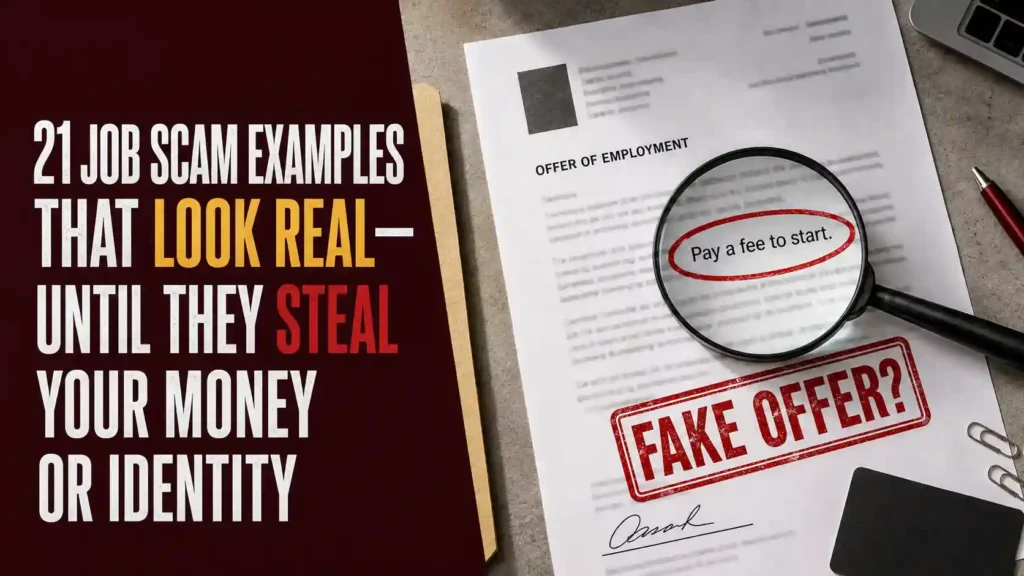
The message arrives at exactly the right moment: “We reviewed your résumé and would like to offer you a remote position.” The salary is attractive. The hours are flexible. The recruiter sounds professional. There is even a company logo, an interview and an official-looking offer letter.
Then comes the trap.
Perhaps the “employer” needs a payment for training. Maybe a check arrives for office equipment. Or the recruiter requests a Social Security number, bank details or a photograph of an ID before anyone has verified the job. What looked like a career opportunity suddenly becomes a fast route to financial loss or identity theft.
The most dangerous job scams do not look ridiculous anymore. They copy real vacancies, impersonate genuine recruiters and move candidates through convincing hiring steps. That is why recognizing specific job scam examples is more useful than relying on vague advice such as “trust your instincts.”
This guide explains 21 common employment scams, shows how each one works, identifies the warning signs hidden inside realistic messages and provides a practical verification process. Read to the end for the exact steps to take after sending money or personal information—because acting quickly can limit the damage.
AI Voice Scams: How to Tell When a Familiar Voice Is Fake
First, it helps to understand the deception behind the offer.
What Are Job Scams and What Do Fake Recruiters Want?
A job scam is a false employment opportunity designed to extract money, personal information, financial access or unpaid labor from a job seeker. Some scams advertise a position that does not exist. Others misuse the name of a real company, recruiter or job platform.
The supposed job is only the bait. The real objective usually falls into one of four categories:
- Stealing money through application, training, equipment or registration fees
- Collecting sensitive information for identity theft or account takeover
- Moving stolen money or goods through the victim
- Obtaining valuable work without paying for it
A legitimate employer may request tax and banking information after a verified offer, usually through a secure onboarding system. The timing and method matter. A stranger requesting the same information through text, email or an online form before a proper interview is a serious warning sign.
Now, look at the schemes candidates are most likely to encounter.
21 Common Job Scam Examples and How They Work
These fake job examples can appear on legitimate job boards, social media, messaging apps, search ads and cloned company websites. No platform is automatically scam-free.
1. The Fake Remote Data Entry Job
An advertisement promises unusually high pay for basic data entry, no experience and complete control over working hours. Almost everyone qualifies. After a short text interview, the candidate must pay for software, training or a “refundable” registration.
The problem is not that remote data entry jobs never exist. It is that real employers define the work, required accuracy, software, schedule and selection criteria. A vague role paying far above the market rate is designed to attract as many targets as possible.
2. The Recruiter Impersonation Scam
A scammer copies the name, photograph and employment history of a real recruiter. The message may link to the real company, making a quick search appear reassuring. However, the sender uses a look-alike email address or moves the conversation to WhatsApp, Telegram or Signal.
Never verify a recruiter using the contact details that recruiter supplied. Find the company’s official website independently, contact its human resources department and ask whether the person and vacancy are genuine.
3. The Fake Check for Office Equipment
After “hiring” a remote worker, the employer sends a check to buy a laptop, printer or software. The candidate deposits it and is told to purchase equipment from an approved vendor or return the excess money.
The bank may show the funds before discovering that the check is fraudulent. By then, the candidate has sent real money to the scammer. The deposit is reversed, but the purchase or refund is not.
The decisive rule is simple: a legitimate employer does not send a new employee a check and instruct that person to forward part of the money elsewhere.
4. The Advance-Fee Employment Scam
The applicant is asked to pay for a background check, application, work permit, security clearance, medical examination or administrative processing. The scammer may describe the fee as small and refundable to lower resistance.
Some genuine roles require credentials, but payment should not be sent to an unknown recruiter or personal account. Verify the requirement and service provider independently before paying anything.
5. The Task or “Product Optimization” Scam
A stranger offers easy online work: rating products, clicking listings, boosting hotel rankings or “optimizing” apps. The dashboard initially shows commissions, and the worker may even receive a small payment.
Soon, the account displays a negative balance or a special bundle. The worker must deposit money—often cryptocurrency—to continue or withdraw the earnings. Each payment creates another obstacle, such as a tax, verification charge or account-unlocking fee.
This is not employment. A worker is paid for completing tasks; a worker does not fund the tasks.
6. The Reshipping or Package Inspector Scam
The victim receives parcels at home, inspects or repackages them and forwards them using prepaid labels. The packages may contain goods bought with stolen cards. The promised salary never arrives, while shipping records point to the victim’s address.
Titles such as “quality control agent,” “package processing assistant” and “logistics coordinator” can disguise this scheme. Be suspicious whenever a home-based job mainly involves receiving and forwarding merchandise.
7. The Money Mule Job
The “financial assistant” receives funds in a personal bank account, keeps a commission and transfers the rest. The employer may claim that international payment restrictions make this necessary.
In reality, the money may be stolen. Moving it can freeze the victim’s account and create serious legal problems. No legitimate business needs a new employee’s personal bank account to route company funds.
8. The Mystery Shopper Check Scam
The candidate is hired to evaluate a store, money-transfer service or gift-card display. A check arrives with instructions to deposit it, keep a fee and use the remaining amount for the assignment.
The target sends gift-card numbers or transfers funds before the fake check is rejected. Genuine mystery shopping work does not require a worker to distribute money received through an unsolicited check.
9. The Gift Card Purchasing Job
A new “manager” urgently asks the employee to buy gift cards for clients, staff rewards or a company event. The candidate pays personally and sends photographs of the card numbers and PINs.
Once those details are shared, the money can disappear immediately. Urgency, secrecy and a promise of later reimbursement are central to this employment scam.
10. The Fake Government Job
A website advertises public-sector vacancies and charges for applications, exam answers, priority placement or guaranteed interviews. It may copy official colors, emblems and job descriptions.
Confirm the vacancy through the government department’s independently located careers page. A polished website is not proof of authorization, and nobody can guarantee selection for a genuine competitive role.
11. The Guaranteed Job Placement Scam
An agency promises a job after payment for résumé distribution, exclusive vacancy access or placement services. The candidate may receive recycled listings, useless materials or nothing at all.
A real recruiter is usually paid by the employer, while a legitimate career service clearly describes the service being sold without guaranteeing employment. “Pay now and start Monday” is not a credible hiring process.
12. The Fake Training or Certification Job
The employer says the position is secured, but the candidate must purchase a specific course or certificate first. The training portal belongs to the scammer, and the job disappears after payment.
Before buying anything, ask whether the credential is recognized outside that company. Check the awarding organization independently and confirm that the vacancy appears on the employer’s official site.
13. The Personal Assistant Scam
An alleged executive traveling abroad hires a personal assistant without a video interview. Early tasks involve depositing checks, buying supplies, paying charities or sending gifts.
The story creates distance and explains why normal contact is impossible. A genuine assistant role involves careful screening and clear duties—not immediate access to financial transactions.
14. The Fake Interview Platform
The applicant receives a link to install an unfamiliar interview app, browser extension or meeting program. It may request login credentials, identity documents or remote control of the device.
The file can contain malware, while the form may collect information for identity theft. Verify the interview through the company’s published contact channel and avoid installing software that is not available through a trusted source.
15. The Social Media Influencer or Brand Ambassador Scam
A supposed brand offers free products, sponsorship income or an ambassador position. To participate, the creator must pay shipping, purchase a starter pack or surrender account login details.
Some ambassador programs are merely poor deals; others are direct theft. Review the payment terms, search for the campaign on the brand’s official channels and never share a social media password or one-time code.
16. The Fake Freelance Project
A client offers a large writing, translation, design or coding assignment, often with little discussion. The freelancer completes extensive work and then encounters a payment fee, a fake escrow site or endless requests for revisions.
Use a trusted payment method, define milestones and request a deposit for substantial work. A client who insists on an unknown payment portal may be trying to steal card details as well as labor.
17. The Commission-Only Job Disguised as a Salary
The listing promises a stable salary, but the agreement reveals that payment depends entirely on sales, recruitment or purchases by the worker. In worse cases, candidates must buy inventory before earning.
Not every commission role is fraudulent. The deception is the bait-and-switch. Read the written compensation terms and ask what happens if no sales are made. If the answer contradicts the advertisement, leave.
18. The Pyramid Recruitment “Job”
The position focuses less on selling a real product and more on recruiting additional participants who also pay to join. Income claims dominate the presentation, while actual duties, customers and market demand remain unclear.
A job pays for productive work. An opportunity that requires workers to finance the organization and recruit more paying members deserves intense scrutiny.
19. The Caregiver, Nanny or Rental Overpayment Scam
Someone relocating to the area hires a caregiver, tutor or housekeeper before arrival. A check includes the worker’s pay plus extra money for a wheelchair, rental deposit or third-party supplier. The candidate must forward the extra amount.
This is the fake-check method wrapped in a personal story. Emotional details do not make the payment safe.
20. The Identity-Harvesting Job Application
A convincing vacancy exists only to collect résumés, addresses, birth dates, identity documents, bank details or tax identification numbers. The scammers may create a cloned careers page and send professional follow-ups.
A résumé already contains useful material for targeted fraud. Remove unnecessary details such as a full home address, identification numbers and date of birth. Provide sensitive onboarding data only after independently verifying the employer and receiving a genuine offer.
21. The Job Offer That Hijacks an Account
The recruiter asks the candidate to “verify” an email, payroll or job-platform account by reading back a code. That code may actually authorize a password reset or new login.
One-time codes are keys, not identity checks. Never send one to a recruiter. If a code arrives unexpectedly, stop the conversation and secure the related account.
These examples differ, but their warning signs repeat.
Warning Signs of a Fake Job Offer
One odd detail does not always prove fraud. Several connected red flags, however, should end the process until the employer is verified.
- The recruiter contacts the candidate unexpectedly and cannot explain where the résumé was found.
- The salary is far above the normal rate for simple work.
- The description is vague, yet the hiring decision is immediate.
- There is no real conversation about experience, skills or references.
- The interview occurs only through text or chat.
- The sender uses a free email account or a subtly misspelled company domain.
- The job cannot be found on the organization’s official careers page.
- The recruiter creates artificial urgency or discourages questions.
- Money, cryptocurrency, gift cards or a check becomes part of the hiring process.
- The applicant must buy equipment from a named vendor.
- Sensitive personal or banking information is requested too early.
- The recruiter asks for a password, login code or remote access to a device.
Poor grammar used to be an obvious clue. It is no longer reliable. Scam messages can be polished, logos can be copied and video calls can be manipulated. Verification matters more than appearance.
For a deeper safety check, see How to Spot a Fake Job Offer Before Sharing Personal Information.
Next, compare the language used in a typical approach.
A Realistic Fake Job Offer Example
Hello, your résumé has been reviewed for our Remote Administrative Assistant vacancy. The position pays $38 per hour with flexible scheduling. Your interview will be conducted by chat today. After selection, the company will email a check for purchasing equipment from our approved supplier. Please reply “YES” within 30 minutes to continue.
This message may feel flattering, but it combines several danger signals:
- It does not explain where the résumé was obtained.
- The role and duties are not specific.
- The pay is unusually high for a general entry-level position.
- The interview is restricted to chat.
- The deadline creates pressure.
- The check and approved supplier set up an equipment-payment scam.
Do not judge a job message by how professional it sounds. Break it into claims and verify each claim separately.
That raises the most important practical question.
AI Voice Scams: How to Tell When a Familiar Voice Is Fake
How to Check If a Job Is Legitimate Before Applying
1. Leave the Message and Find the Company Independently
Do not click the supplied website, call the listed number or rely on the recruiter’s profile. Search for the company independently and open its official site.
2. Compare the Vacancy
Look for the exact title, location and description on the official careers page. A scammer may copy an old or real vacancy, so matching text alone is not enough.
3. Inspect the Email Domain Carefully
Compare every character after the @ symbol with the official company domain. Watch for added words, swapped letters, hyphens and unfamiliar endings. A display name can say anything; the actual address matters.
4. Contact the Employer Through a Published Channel
Ask whether the recruiter works there and whether the vacancy is active. Use contact information found independently, not details inside the suspicious message.
5. Check the Hiring Process
Ask who the manager is, whom the role reports to, what the first 30 days involve and how performance is measured. Scammers favor speed and vagueness; genuine hiring teams can normally discuss the work.
6. Search Distinctive Phrases
Copy a sentence from the message and search it in quotation marks. Identical scripts, complaints or unrelated company names can expose mass-produced fraud.
7. Refuse Financial Transactions
Do not deposit a check, receive company money, buy gift cards, forward packages or transfer funds. Do not pay to release earnings from an online dashboard.
Use this step-by-step job offer verification checklist before accepting any remote position.
Even careful people can be caught during an urgent job search. The response matters.
What to Do If You Responded to a Job Scam
If Money Was Sent
Contact the bank, card issuer, payment service or cryptocurrency platform immediately. Ask whether the transaction can be stopped, recalled or disputed. Preserve receipts, wallet addresses, usernames and messages. Do not pay a “recovery agent” who promises guaranteed results; scammers frequently target victims a second time.
If a Check Was Deposited
Tell the bank’s fraud department that the check may be fraudulent. Do not spend the displayed balance or send any portion elsewhere. Availability of funds does not mean the check has cleared permanently.
If Personal Information Was Shared
Change affected passwords, beginning with the email account. Use unique passwords and enable multifactor authentication. Monitor financial accounts and credit reports. Where available, place a fraud alert or credit freeze and report exposed identity documents to the appropriate issuing authority.
If a Password or Verification Code Was Shared
Reset the account immediately, sign out other sessions and review recovery email addresses, phone numbers and forwarding rules. Contact the platform’s security team if access has already been lost.
If Software Was Installed
Disconnect the device from the internet, remove remote-access tools and run a trusted security scan. From a different, clean device, change important passwords. Professional technical help may be necessary if the device handled banking, work or sensitive records.
Report and Preserve the Evidence
Save the job advertisement, full email headers, phone numbers, website addresses, payment records and screenshots. Report the profile or listing to the platform where it appeared, then report the fraud to the relevant consumer protection, cybercrime or law-enforcement authority.
For a complete response plan, check What to Do After Being Scammed: The First 24 Hours.
Finally, use one rule that cuts through nearly every variation.
The Simplest Rule for Avoiding Employment Scams
A real job is supposed to pay the worker. It should not require the worker to finance company purchases, unlock commissions, move money, forward goods or surrender account access.
That rule catches many scams, but not every one. Identity-harvesting schemes may never request payment. For that reason, combine the money rule with independent verification: confirm the vacancy, recruiter, domain and hiring process through contact details the recruiter did not provide.
Scammers succeed when excitement and urgency replace verification. A promising salary can wait long enough for a call to the company. A genuine recruiter will understand reasonable caution. A scammer will push, threaten or disappear.
The safest response to doubt is not immediate trust or immediate rejection. It is a pause followed by independent proof. That brief pause can protect a bank account, identity, device and months of recovery work.
Frequently Asked Questions About Job Scam Examples
What is the most common job scam?
Fake remote-work offers are among the most common formats. They often lead to advance fees, fake checks, task deposits or identity theft. The job title changes, but the request for money or sensitive information remains the real objective.
How can someone tell if an online job is fake?
Verify the opening on the employer’s official careers page, check the sender’s full email domain and contact the organization through independently found details. Stop if the recruiter requests money, gift cards, cryptocurrency, check deposits, package forwarding or login codes.
Can a job scam appear on a legitimate job website?
Yes. Screening systems reduce fraud but cannot eliminate it. Scammers can use false business details, compromised employer accounts or copied postings. The platform hosting an advertisement should never be the only proof that a vacancy is genuine.
Is a text-only interview always a scam?
Not always, but hiring someone after a brief chat-only interview is a major warning sign, especially when combined with unusually high pay, urgency or financial requests. Ask for a video conversation and verify the interviewer independently.
Do legitimate employers send checks for equipment?
Legitimate employers may provide equipment or reimburse approved expenses, but an instruction to deposit a check and buy from a specific vendor is a classic scam pattern. Confirm any arrangement directly with the verified employer before acting.
Why do job scammers ask for identification?
Identity documents can be used to open accounts, bypass verification checks, impersonate the victim or make later scams more convincing. Genuine employers also need documents during onboarding, which is why verifying the company and timing is essential.
What should someone do after paying a fake employer?
Contact the payment provider immediately, request a recall or dispute, preserve all evidence, secure exposed accounts and report the fraud. Fast action improves the chance of limiting further damage, although recovery is never guaranteed.
Can job scammers use real company names and real employees?
Yes. They frequently copy genuine job descriptions, logos and recruiter profiles. Confirmation must come from the company through an official channel found independently—not from the website, phone number or contact person supplied in the suspicious offer.

Pingback: How to Identify a Scammer on Telegram: 16 Red Flags and a 5-Minute Verification Test - SafeGuard Press
Pingback: WhatsApp Scammer List: Check a Suspicious Number, Profile or Message - SafeGuard Press