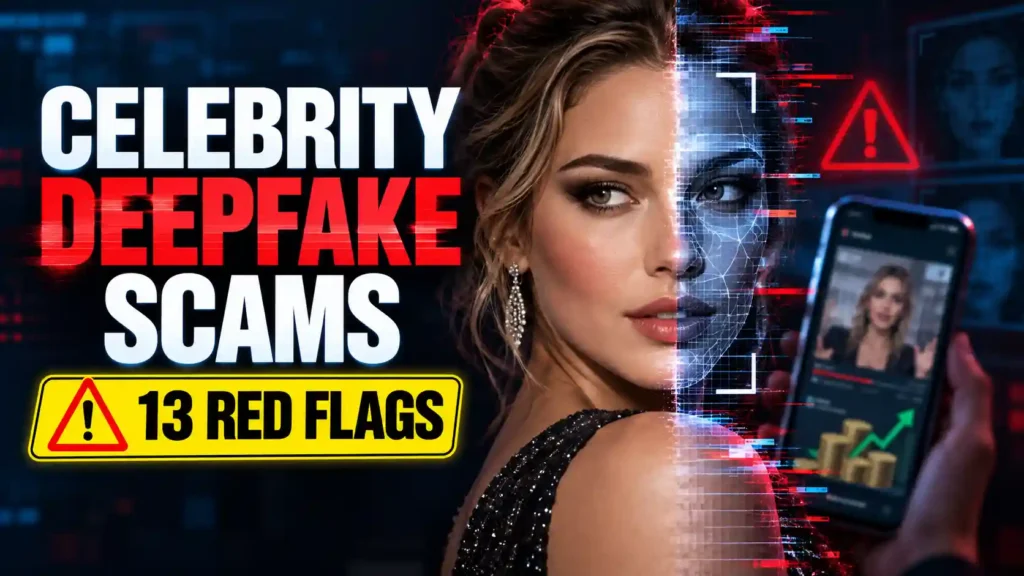
The celebrity looks directly into the camera.
They claim to have discovered an investment platform, health product, giveaway or money-making opportunity that ordinary people can finally access.
You recognize the face. The voice sounds convincing. The video appears to come from a television interview, podcast or livestream.
Below it, hundreds of comments describe incredible results.
It feels real because nearly every familiar trust signal is present: a famous person, professional video, recognizable logos, convincing testimonials and a simple offer.
But the celebrity may never have said a single word about the product.
Scammers can use artificial intelligence to manipulate genuine recordings, clone voices, animate photographs and make public figures appear to promote offers they have never seen. These videos are then placed inside paid social media advertisements, fake news stories and fraudulent websites.
The deepfake is only the bait.
Once you click, the scam may move through a registration form, private messaging group, telephone call, fake investment dashboard or checkout page. That is where the criminal collects your information and money.
Fortunately, you do not need to prove exactly how the video was created before protecting yourself. Even when a celebrity deepfake looks flawless, the account, advertiser, website, payment process and requested action can expose the fraud.
If you are viewing a celebrity promotion now: Do not click the advertisement’s link. Open the celebrity’s official website or established social account separately, search for the exact product and investigate the company before entering any information.
This guide explains how celebrity deepfake scams work, 13 red flags to examine, real examples and the C.L.E.A.R. test you can use before you click, buy or invest.
What Are Celebrity Deepfake Scams?
Celebrity deepfake scams use AI-generated or digitally manipulated media to falsely suggest that a recognizable person endorses a product, investment, business or opportunity.
The person being impersonated might be:
- An actor
- A musician
- An athlete
- An entrepreneur
- A television presenter
- A financial expert
- A doctor
- A journalist
- A politician
- An influencer
- A religious leader
- A member of a royal family
The fake celebrity endorsement may appear in:
- A social media advertisement
- A short video
- A podcast clip
- A television interview
- A fake news report
- A livestream
- A private message
- A product-review page
- A video call
- A messaging group
Not every fake celebrity endorsement uses advanced artificial intelligence. Some criminals use stolen photographs, edited interviews, false captions, dubbed audio or imitation accounts.
You do not need to identify the production method before taking precautions. If the endorsement cannot be confirmed independently, do not trust it.
Celebrity impersonation is one branch of a much wider threat. The complete guide to deepfake scams explains how criminals also imitate relatives, romantic partners, employers and authority figures.
How Celebrity Deepfake Scams Work
The celebrity video is usually the beginning of a longer funnel.
Its job is to get your attention and transfer the celebrity’s credibility to an unfamiliar offer.
Stage One: The Familiar Face Stops You
While scrolling through social media, you see someone you instantly recognize.
The celebrity may appear inside a television studio, podcast set or conference. Because the surroundings look familiar, you assume the footage came from a genuine interview.
Stage Two: The Video Introduces the Offer
The apparent celebrity recommends:
- A cryptocurrency platform
- An automated investment system
- A health or weight-loss product
- A giveaway
- A money-making application
- A discounted product
- A government-backed program
- A private business opportunity
- A subscription service
The claim may be spectacular. However, smarter scammers use modest promises because restrained language can sound more believable.
Stage Three: The Advertisement Sends You Elsewhere
The link may lead to:
- A fake news article
- A copied company website
- A registration form
- A product checkout page
- A private messaging group
- A false investment dashboard
The new page continues the illusion with logos, customer reviews, celebrity photographs and countdown timers.
Stage Four: A Representative Contacts You
After you submit your name, telephone number or email address, a supposed adviser may contact you.
The person might introduce themselves as:
- An account manager
- An investment adviser
- A customer-service employee
- A giveaway administrator
- A medical consultant
- A celebrity assistant
They may speak confidently and already know which advertisement you saw.
Stage Five: A Small Commitment Becomes a Larger Loss
The first payment is often deliberately affordable.
You may be asked for:
- A small investment deposit
- A shipping fee
- A registration charge
- A refundable verification payment
- A low-cost product trial
Once you pay, larger demands can follow.
A fake investment dashboard may display profits. A checkout page may hide recurring charges. A giveaway may require additional insurance, customs or processing fees.
The celebrity video earns your trust. The rest of the operation turns that trust into money.
A Genuine Celebrity Endorsement Does Not Prove the Offer Is Safe
There are two separate questions:
- Did the celebrity genuinely endorse this offer?
- Is the offer itself legitimate, suitable and accurately advertised?
Confirming the first does not settle the second.
Even when an endorsement is authentic:
- The product may not work for everyone.
- The investment may be extremely risky.
- The celebrity may not be an expert.
- The advertisement may exaggerate the person’s statement.
- The seller may be unauthorized.
- A scammer may copy a real endorsement and redirect it to a fake website.
- The terms may include hidden charges.
- The opportunity may be unsuitable for your circumstances.
Never use fame as a substitute for examining the product, company, risks and payment conditions.
Real Examples of Celebrity Deepfake Scams
Understanding documented patterns makes future advertisements easier to recognize.
These examples are not included as celebrity gossip. Each reveals a different way borrowed fame can be weaponized.
Fake Taylor Swift Giveaways
Manipulated advertisements have used Taylor Swift’s likeness to promote supposedly free cookware.
The victim is attracted by the celebrity connection and valuable giveaway. The catch is a small shipping charge requiring card information.
The lesson is clear: a low initial payment can be more dangerous than the advertised “free” product. It may expose payment details or hide recurring charges.
Fake Tom Hanks Health Advertisements
Tom Hanks has publicly warned about unauthorized AI-generated advertisements using his image to promote health-related products and services.
Health scams are especially dangerous because victims may trust a familiar celebrity while ignoring the absence of reliable medical evidence.
The lesson: a recognizable patient, actor or television personality is not a medical authority.
Fake Warren Buffett Investment Videos
Manipulated Warren Buffett videos have been used to promote investment and cryptocurrency opportunities.
His reputation for financial caution gives the scam borrowed authority. However, the supposed recommendation may contradict his established public views.
The lesson: compare the claim with the person’s known behavior and independently verify the company.
Fake Elon Musk Investment Promotions
Elon Musk’s face and voice have repeatedly appeared in false cryptocurrency and investment advertisements.
Scammers exploit his connection to technology and business to make unfamiliar platforms appear innovative and credible.
The lesson: the celebrity is selected because their public image fits the scam—not because they support the offer.
Genuine Celebrity Advertisement or Deepfake Scam?
Examine the whole promotion rather than trusting one impressive element.
| What you notice | Possible legitimate explanation | Why it may be suspicious |
|---|---|---|
| The celebrity appears in a sponsored advertisement | Genuine commercial partnership | The endorsement is absent from official channels |
| The clip comes from an interview | Authorized promotional footage | The original interview discusses another subject |
| The offer expires soon | Real limited promotion | The countdown restarts when the page reloads |
| The price is unusually low | Introductory offer | Important charges appear only after payment |
| Every comment is positive | Satisfied customers | Comments use repetitive language or promote an adviser |
| The website uses known logos | Authorized seller | The address does not belong to the real company |
| A small deposit is required | Normal account funding | Larger deposits are requested immediately |
| The account has a badge | Genuine verified account | The symbol may be copied or the account compromised |
| The celebrity denies the promotion | Genuine public warning | The “denial” may also be a fake repost |
One clue may have an innocent explanation. Several connected problems indicate that you should stop.
13 Red Flags of Celebrity Deepfake Scams
A technical defect can expose a fake video, but sophisticated deepfakes may look convincing.
The advertiser, website, offer and requested action often provide more reliable evidence.
1. The Endorsement Is Missing From Official Channels
This should be one of your first checks.
If a celebrity genuinely supports a significant product, giveaway or investment, the promotion may appear on:
- Their official website
- Established social media accounts
- The genuine company website
- Official management pages
- Public interviews
- Credible announcements
Search independently. Do not follow the advertisement’s link to what it claims is the official page.
The absence of a promotion does not prove fraud in every situation. However, you should not proceed until the endorsement can be confirmed.
2. The Advertisement Uses a Cropped Interview
Scammers often start with genuine footage because the studio, clothing and body movements already look natural.
They may replace the voice, manipulate the mouth or add false captions.
Watch for:
- No clear beginning or ending
- Missing interviewer questions
- Frequent cuts around important claims
- The celebrity never touching the product
- A logo covering part of the screen
- Abrupt changes in audio quality
- Captions making stronger claims than the speech
- A call to action appearing only as added text
Search for the complete interview. The original may concern a completely unrelated subject.
3. The Mouth, Voice or Expression Feels Wrong
Watch and listen separately.
Possible clues include:
- Lips moving before or after the words
- Teeth changing between frames
- Facial edges flickering
- Flat or metallic speech
- Missing breaths
- Unnatural pauses
- A jaw that barely moves
- Emotion that does not reach the eyes
- Mispronounced names
- Vocabulary the person does not normally use
Technical defects justify investigation, but their absence does not prove authenticity.
For a systematic inspection process, use the guide on how to spot a deepfake video.
4. The Celebrity Makes an Uncharacteristic Claim
Compare the statement with the person’s established behavior.
Be suspicious when:
- A cautious investor promises guaranteed profits
- A respected doctor promotes a miracle cure
- A politician recommends an unknown private platform
- A journalist suddenly sells a trading system
- A celebrity reveals a supposed secret loophole
- Someone known to avoid endorsements promotes multiple unrelated products
Scammers choose a face that makes the offer appear plausible.
Do not ask only, “Does this look like the celebrity?”
Ask, “Is this something the person would realistically say?”
5. The Advertisement Claims Powerful People Are Hiding It
Common headlines include:
- “Watch before this is deleted”
- “Banks do not want you to see this”
- “The interview they tried to ban”
- “The celebrity was sued for revealing this”
- “The government wants this removed”
- “This broadcast disappeared minutes later”
These stories provide an excuse for why the supposed announcement cannot be found on legitimate channels.
They also pressure you to act before investigating.
A genuine secret suppressed by powerful institutions is unlikely to be available through an ordinary paid advertisement linked to a registration form.
6. The Page Imitates a Trusted News Organization
The landing page may copy the colors, fonts, logo and layout of a recognized publication.
Inspect more than the design.
Check:
- The exact domain
- Whether menu links work
- The author’s identity
- Publication date
- Other articles
- Contact information
- Privacy and legal pages
- Spelling and formatting
- Whether the page exists on the publication’s genuine website
Some fake news pages contain only one article. Every button may lead to the same registration form.
Professional design is not proof of legitimate journalism.
7. The Advertiser Is Unrelated to the Celebrity or Product
The person shown in the video is not necessarily the person or company paying for the advertisement.
Check the advertiser or page responsible for the promotion.
Warning signs include:
- An unrelated business name
- A recently created page
- Several versions featuring different celebrities
- A page that previously published unrelated content
- No legitimate company information
- Advertisements targeting different countries with identical wording
- A landing-page domain that does not match the displayed brand
- A supposed local company with no local contact information
If a celebrity appears to represent a famous brand, the advertisement should normally come from the brand or an identifiable authorized partner.
8. The Link Leads to an Imitation or Unrelated Domain
The advertisement may display one brand while sending you to an unrelated website.
Look for:
- Misspelled brand names
- Added hyphens
- Extra words such as “official” or “secure”
- Unfamiliar domain endings
- Link-shortening services
- Long addresses designed to hide the main domain
- Numbers replacing letters
- Domains registered for a different business
If the company is genuine, open a new browser tab and type its official address yourself.
Never assume a website is safe because it contains a recognizable logo.
9. The Offer Guarantees Easy or Consistent Results
Celebrity deepfake scams often remove ordinary risk from the story.
The offer may promise:
- Guaranteed investment returns
- Daily passive income
- Automated cryptocurrency profits
- Effortless weight loss
- A cure for a serious condition
- Free expensive products
- Guaranteed government payments
- Earnings without experience
- A system that never loses
Sophisticated scammers may avoid ridiculous figures and promise more moderate results.
Ask whether the seller clearly explains risks, limitations, eligibility, total cost and the possibility of loss.
A legitimate investment does not become risk-free because a famous face appears beside it.
10. The Comments and Testimonials Look Manufactured
Fake social proof reassures victims who would otherwise hesitate.
Warning signs include:
- Similar sentence structures
- Repeated profit claims
- Comments posted close together
- Generic profiles
- No difficult questions
- Replies directing users to an adviser
- Testimonials containing contact details
- Comments unrelated to the offer
- People repeating the same amount earned
- Disabled comments on other posts
Do not assume thousands of likes prove legitimacy. Engagement can be purchased, automated or copied.
Also be careful with negative comments that recommend a specific recovery expert. Those can lead to another scam.
11. A Small Payment Leads to Larger Charges
The first request may appear harmless.
You may be asked for:
- A small deposit
- A delivery charge
- A trial payment
- A processing fee
- A refundable verification payment
- An inexpensive membership
The initial amount lowers resistance and may expose your payment information.
Later demands can include:
- Larger investments
- Withdrawal fees
- Taxes
- Customs charges
- Insurance
- Account upgrades
- Recurring subscriptions
- Identity documents
Read the complete checkout terms. Search the company and domain separately before entering card information.
12. You Are Moved Into a Private Conversation
After clicking the advertisement, you may be directed to a messaging application, private group or telephone call.
A supposed adviser then provides personalized instructions.
This movement serves several purposes:
- It removes public scrutiny.
- It allows repeated pressure.
- It helps the scammer build a relationship.
- It makes the victim feel specially selected.
- It separates the victim from independent information.
Legitimate companies may use messaging applications for customer support. However, investment decisions should not depend on secret instructions from an unverified stranger.
13. Independent Verification Is Discouraged
This is the strongest red flag.
A supposed representative may tell you:
- The opportunity is confidential.
- Banks will try to stop you.
- Negative reviews come from competitors.
- Regulators do not understand the technology.
- The celebrity cannot discuss it publicly.
- You will lose your place if you delay.
- Your family will not understand.
- Only the assigned adviser can help.
A legitimate business should survive reasonable investigation.
When the seller tries to control where you obtain information, stop communicating.
The C.L.E.A.R. Celebrity Endorsement Test
Use this process before trusting any online celebrity promotion.
C — Confirm the Celebrity’s Official Channels
Visit the celebrity’s established website and social accounts independently.
Search for the exact:
- Product
- Company
- Giveaway
- Investment
- Charity
- Application
Do not trust another repost that simply claims the endorsement is genuine.
L — Locate the Original Video
Search for the complete interview, podcast, speech or livestream.
Take screenshots from the suspicious clip and perform reverse-image searches.
Choose frames showing:
- The celebrity
- Studio background
- News banner
- Interviewer
- Clothing
- Logo
- On-screen text
Search distinctive spoken sentences inside quotation marks.
Compare the suspected advertisement with the original:
- Audio
- Captions
- Duration
- Context
- Mouth movements
- Advertised product
- Call to action
A criminal may have altered only a few seconds.
E — Examine the Advertiser and Website
Investigate who paid for the advertisement—not only who appears in it.
Check:
- Exact account name
- Account history
- Page creation date
- Previous content
- Other active advertisements
- Domain name
- Contact information
- Company address
- Refund terms
- Privacy policy
- Payment methods
- Business registration
A professionally designed website can be created quickly. Verify the organization behind it.
A — Analyze the Offer Without the Celebrity
Imagine the same offer being presented by an unknown person.
Would you trust it?
Ask:
- Are results guaranteed?
- Are genuine risks explained?
- Are all fees disclosed?
- Why is immediate action necessary?
- Is the seller properly authorized?
- Can money be withdrawn without further payment?
- Is the health claim supported by credible evidence?
- Does the business explain who holds customer funds?
- Why is a celebrity required to make the offer persuasive?
Removing the famous face often exposes how weak the underlying proposition is.
R — Refuse Until Independently Verified
Do not provide information, deposit money or install anything while serious questions remain.
A legitimate promotion will survive verification.
A scam depends on stopping it.
How to Verify a Celebrity Investment Offer
Investment promotions require more than confirming the celebrity.
Identify the Legal Company
Find the company’s full legal name. A trading name alone may be insufficient.
Check the Financial Register
Use the official financial regulator serving your country or region.
Confirm:
- Whether the company is registered
- Which activities it is authorized to perform
- Whether its license is current
- Whether warnings have been issued
- Which website and telephone numbers are officially listed
Match Every Detail
Compare the regulator’s information with the advertiser.
Check:
- Website address
- Physical address
- Email domain
- Telephone number
- Company number
- Payment-account name
Scammers sometimes copy the name and registration number of a genuine company while using different contact details.
Contact the Registered Company Independently
Use the information published on the official register—not the advertisement or adviser.
Ask whether the company owns the website and promotion.
Examine Who Receives the Money
Do not send investment funds to:
- A personal bank account
- An unrelated company
- A cryptocurrency wallet controlled by an adviser
- An account in a different country without a clear explanation
- A beneficiary name that does not match the registered business
The upcoming guide to deepfake investment scams will explain how fake endorsements, account managers and fabricated trading dashboards work together.
A Celebrity Denial Can Also Be Faked
You find another video in which the celebrity apparently denies the promotion.
That settles the question—right?
Not necessarily.
A criminal could create a fake denial, place false text over a genuine recording or use another impersonation account. The denial may then redirect you toward a different fraudulent offer.
Confirm any warning through:
- The celebrity’s established official account
- Their genuine website
- Authorized representatives
- The relevant company
- A reliable public announcement
Do not trust a denial simply because it contains the same familiar face.
Common Types of Celebrity Deepfake Scams
Fake endorsements can support several fraud models.
Investment and Cryptocurrency Scams
A celebrity appears to promote automated trading, cryptocurrency or a secret financial system.
After registration, an adviser encourages deposits. A dashboard displays profits, but withdrawals require additional payments.
Giveaway Scams
A celebrity supposedly offers cookware, electronics, gift cards, tickets or luxury items.
The prize is described as free, but card details are required for delivery. Hidden charges or unwanted subscriptions may follow.
Health Product Scams
A fabricated endorsement may promote:
- Weight-loss products
- Diabetes remedies
- Pain treatments
- Anti-aging supplements
- Skin products
- Memory formulas
Do not use celebrity advertising as medical evidence. Consult an appropriately qualified professional before changing treatment.
Celebrity Romance Scams
A criminal creates a private relationship with a fan while pretending to be a public figure.
Fake photographs, cloned voices and manipulated videos may support requests for travel expenses, medical bills, legal fees, gift cards or cryptocurrency.
Fake Charities
A deepfake may show a celebrity requesting donations after a tragedy or disaster.
Visit the charity’s official website independently and verify the person’s genuine involvement.
Business and Money-Making Programs
A celebrity or influencer appears to recommend an application, course, franchise or work-from-home system.
The initial fee may reveal additional purchases, subscriptions or coaching charges later.
What to Do If You Clicked a Celebrity Deepfake Advertisement
Respond according to what happened after the click.
If You Only Visited the Website
Close it without downloading files or entering information.
Check whether anything downloaded automatically or whether the website received notification permission.
If You Provided Contact Details
Expect follow-up calls, texts and emails.
Do not continue the conversation. Block the contact and watch for related phishing attempts.
If You Entered a Password
- Change it immediately.
- Change it anywhere else you reused it.
- Secure your email account first.
- Sign out unfamiliar sessions.
- Enable multifactor authentication.
- Check recovery information.
If You Provided Card or Banking Details
Contact the bank or card issuer immediately.
Monitor transactions and ask whether the account or card needs additional protection.
If You Installed an Application
Disconnect the device from the internet if you suspect remote-access or malicious software.
Use a different trusted device to change important passwords. Contact an appropriately qualified security professional.
If You Sent Money
Contact the payment provider immediately and ask whether the transaction can be stopped, recalled or disputed.
Preserve:
- Receipts
- Account details
- Wallet addresses
- Messages
- Telephone numbers
- Websites
- Advertisements
- Screenshots
Do not send more money to release supposed profits or recover your original payment.
How to Report the Entire Scam Funnel
Reporting only the celebrity video may leave the rest of the operation active.
Report each component separately.
Report the Paid Advertisement
Use the platform’s category for scams, fraud, impersonation or manipulated media.
Report the Advertiser’s Page
The same account may be running several advertisements using different celebrities.
Report the Cloned Celebrity Profile
Impersonation accounts may contact people privately even after the original advertisement disappears.
Report the Landing-Page Domain
Report the website to the platform, hosting provider or relevant security service when possible.
Report the Messaging Account
Block and report the WhatsApp, Telegram or other private account used by the adviser.
Report the Payment Destination
Provide the bank, card company or cryptocurrency exchange with the beneficiary details.
Notify the Celebrity or Brand
Use an official contact channel. Their representatives may be tracking related campaigns.
File an Official Fraud Report
In the United States, online fraud can be reported through ReportFraud.ftc.gov and IC3.gov. Readers elsewhere should contact the appropriate national fraud-reporting center.
Save evidence before reporting, but avoid sharing the deceptive advertisement unnecessarily.
How Celebrities, Influencers and Brands Can Respond
The impersonated person also faces reputational damage.
Preserve the Complete Campaign
Save the advertisement, account, landing page, messaging details and payment instructions.
Publish a Precise Warning
Explain:
- Which promotion is fraudulent
- Which companies are not endorsed
- Where genuine announcements appear
- How followers can report copies
Report Every Component
Removing one video will not dismantle the campaign if the website, advertiser and private accounts remain active.
Prepare Customer-Support Teams
Victims may contact the legitimate celebrity or brand seeking refunds.
Support teams need clear, compassionate instructions without implying that the legitimate organization operated the scam.
Monitor for New Versions
Search for altered names, copied advertisements, imitation domains and videos using different captions.
Frequently Asked Questions About Celebrity Deepfake Scams
Celebrity impersonation methods will continue evolving. Independent verification remains your strongest protection.
What is a celebrity deepfake scam?
It is a scam using AI-generated or manipulated media to falsely suggest that a famous person endorses a product, investment, giveaway or opportunity.
How can I identify a fake celebrity endorsement?
Check the celebrity’s official channels, locate the original footage, investigate the advertiser and verify the company independently.
Do celebrity deepfakes always contain visible mistakes?
No. High-quality deepfakes may contain no obvious facial defect. The source, website and requested action often provide stronger evidence.
Does a sponsored label mean the advertisement was verified?
No. It generally means someone paid to distribute the content. It does not guarantee that the endorsement or offer is legitimate.
Can a verified account publish a scam?
Yes. An account may be compromised, misleading or unrelated to the celebrity. A badge should never replace independent verification.
Can a genuine celebrity video be used fraudulently?
Yes. Scammers can steal real footage and add false audio, captions, links or claims.
How do I find the original video?
Take several screenshots, reverse-search them and search distinctive spoken phrases. Look for the complete interview on established channels.
Why do fake articles say the interview was deleted?
The story explains why no genuine coverage exists and pressures the reader to act before investigating.
Can the positive comments be fake?
Yes. Scammers can create comments, purchase engagement, copy testimonials and remove criticism.
Are all celebrity investment endorsements scams?
No. However, even a genuine endorsement does not prove an investment is safe, suitable or accurately advertised.
What if the promised return appears realistic?
Moderate claims can still support fraud. Verify the company, authorization, risks, fees and withdrawal rules.
Why does my investment dashboard show profits?
The numbers may be fabricated. A displayed balance does not prove that real assets exist or can be withdrawn.
Should I pay a fee to withdraw my profits?
Do not send additional money merely because a platform claims it will release your balance. Verify the company independently.
Can celebrity giveaway advertisements be genuine?
Yes, but fake giveaways may collect card information, charge recurring fees or steal personal data. Confirm the promotion through official channels.
Why does a free prize require my card?
The seller may claim it needs a shipping fee. Read the terms and verify the business before providing payment details.
Can celebrity deepfakes promote health products?
Yes. A manipulated video may falsely connect a public figure or medical professional to an unproven product.
Would a real celebrity contact a fan privately?
Be highly suspicious of unsolicited celebrity contact, especially when money, secrecy, gift cards or cryptocurrency enters the conversation.
Can a fake celebrity denial video exist?
Yes. Confirm denials through the person’s established official channels rather than trusting another repost.
How do I investigate the advertiser?
Check the exact page name, creation date, content history, other advertisements, company identity and landing-page domain.
Can a scammer copy a real company’s registration?
Yes. Criminals may copy genuine registration details while using different websites, telephone numbers and payment accounts.
What should I do if I clicked the advertisement?
Stop before entering information, close the page and check for unexpected downloads. Investigate the offer independently.
What should I do if I entered my password?
Change it immediately, secure your email account, review active sessions and enable multifactor authentication.
What should I do if I sent money?
Contact the payment provider immediately, preserve evidence and file a fraud report.
Should I share the deepfake to warn others?
Avoid redistributing it unnecessarily because engagement may increase its reach. Share a clearly marked screenshot or official correction.
What is the safest celebrity-endorsement test?
Use the C.L.E.A.R. test: Confirm official channels, Locate the original video, Examine the advertiser and website, Analyze the offer, and Refuse until independently verified.
Final Thoughts
Celebrity deepfake scams succeed because a recognizable face makes an unfamiliar offer feel safe.
Remove that face from the decision.
Examine the business, website, payment process, promised result and requested action as though the offer came from a complete stranger.
Would you still trust it?
Before clicking, buying or investing, remember the C.L.E.A.R. test:
- Confirm the celebrity’s official channels
- Locate the original video
- Examine the advertiser and website
- Analyze the offer
- Refuse until independently verified
A familiar face is not proof. A professional video is not proof. A news logo is not proof. Thousands of comments are not proof.
Independent confirmation is proof.