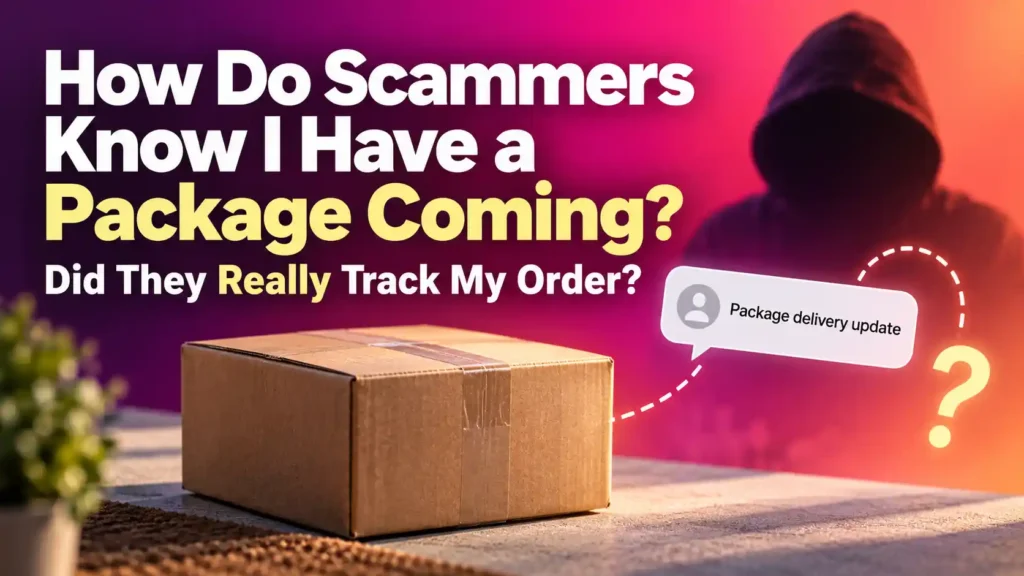
You ordered something online yesterday. Today, a text says your package cannot be delivered until you confirm your address.
The timing is unnerving. You really are waiting for a package, so how did the sender know?
In many cases, they did not know. Scammers send vague delivery messages to large numbers of people. Some recipients happen to be expecting a parcel, and the coincidence makes the text feel personal.
There is an important exception. If a message contains accurate details about your specific order, someone may have obtained shipment information. That deserves a closer look—but even then, the message does not prove how they got it or that its link is safe.
Do this first: Leave the text alone. Open the retailer account where you placed the order, find its tracking number, and check the carrier through a website or app you reach independently. You can investigate the real delivery without clicking the message.
How Do Scammers Know I Have a Package Coming?
Scammers often do not know that you have a package coming. They send fake delivery messages to large numbers of people, hoping some recipients are waiting for an order. When a message arrives shortly after you buy something, the timing can make a random scam feel personal.
In other cases, criminals may have access to information about you or your purchase. The key is to separate what the message actually proves from what it makes you assume.
They Send Messages And Rely On Coincidence
A message saying “Your package could not be delivered” can apply to almost anyone who shops online. Scammers do not need your order history to send it.
For example, you order shoes on Monday and receive a delivery text on Wednesday. You naturally connect the two events. But if the text contains no verifiable details about your order, the timing alone does not prove that the sender tracked your purchase.
Vague wording such as “your shipment,” “your parcel,” or “your recent order” lets the same message work on thousands of recipients.
They May Have Your Personal Information
Your name, phone number, email address, or home address may have been exposed through a data breach, obtained from public records, or collected through an earlier scam.
Those details can make a fake delivery message look convincing. However, knowing your name or address is different from knowing that you placed an order.
A scammer could address you by name and still be guessing about the package.
They May Have Access To An Account Or Order Details
If someone gains access to your email or shopping account, they may be able to see order confirmations, delivery addresses, and tracking information. Information stolen from a retailer or another business involved in an order could also expose purchase details.
Treat a message containing accurate, nonpublic order information more seriously—but do not assume that it proves an account was hacked. Check your email and shopping accounts for unfamiliar sign-ins, unexpected password changes, or orders you did not place.
If you find suspicious activity, change the affected password, enable two-factor authentication, and sign out unfamiliar sessions.
You May Have Shared Delivery Information Publicly
A photo of a shipping label, an order confirmation, or a tracking update can reveal more than you intended. Depending on what is visible, it may expose your name, address, retailer, tracking number, or delivery date.
Before sharing a purchase online, cover personal details, tracking numbers, barcodes, and QR codes. Scammers can use visible information to make a later message sound credible.
How Can You Check Whether The Message Matches Your Real Order?
Open the retailer’s app or website yourself and check your order there. If necessary, copy the tracking number from your genuine order confirmation and enter it on the carrier’s official website.
Then compare the information:
- Does your order show an actual delivery problem?
- Does the carrier match the one handling your purchase?
- Does the tracking number match your order?
- Does the official tracking page support the message’s claim?
A matching detail can make a message more convincing, but it does not automatically make its link safe. If the message demands payment, account details, or urgent action, verify the request through the retailer or carrier using contact information you obtain independently.
The safest response is simple: check the order through a channel you already trust before acting on the message.
Did the Scammer Know About Your Package—or Was It a Guess?
The fastest way to judge the message is to ask what it actually knows.
| What the message says | What you can conclude |
|---|---|
| “Your package could not be delivered” | It may be a message sent widely. There is no demonstrated knowledge of your order. |
| It includes your name or city | The sender has some personal information, but that does not prove access to the shipment. |
| It names the correct retailer or delivery date | The match deserves checking in your original order account. |
| It gives the correct item, order number, and tracking number | Specific shipment details may have been exposed. Preserve the message and investigate the relevant accounts. |
Timing is not an order detail. A text arriving an hour after you buy something can still be a coincidence. On the other hand, a message with several accurate, nonpublic details deserves more attention than one that says only “parcel on hold.”
Neither situation makes the text’s link trustworthy. Verify its claim somewhere else.
Why Do Fake Delivery Texts Arrive When You Are Expecting Something?
A scammer does not need a perfect list of shoppers to make a delivery story work. People order groceries, clothing, medicine, gifts, and household items throughout the year. A message sent widely will reach some people at exactly the wrong moment.
Consider this text:
“We attempted to deliver your parcel. Your address is incomplete. Update it today to prevent return.”
It never says what you bought, where you bought it, or which verified tracking number belongs to you. Yet if you are waiting for a delivery, your mind supplies the missing details. That is what makes the message persuasive.
There are also cases where a sender has more information. Perhaps order details appeared in an account, email, or message someone else could access. Perhaps information about a delivery was shared elsewhere. A single suspicious text cannot identify the source.
So avoid both easy conclusions: “They definitely hacked my account” and “It is definitely just random.” Check how specific the message is, then look for independent evidence.
How to Check Your Real Delivery Without Using the Text
Start from the purchase you know you made. The suspicious message should not be the starting point for tracking your order.
Open the retailer account directly
Use the retailer’s app or type its web address yourself. Find the order and note:
- The carrier named in the order.
- The tracking number supplied by the retailer.
- The delivery address.
- The latest shipping status.
- Any request for action shown inside the account.
If the order has not shipped, a text claiming the carrier already attempted delivery does not match the retailer’s record. If it has shipped, continue to the carrier.
Check the carrier through an official channel
Reach the carrier from the retailer’s order page or through the carrier’s app or website that you open yourself. Enter the tracking number from the original order, not one supplied only in the text.
Look for the problem the message claims exists. Does the tracking page show a failed attempt, address issue, or payment request? If it does not, do not “fix” the delivery through the text’s link.
If the records are unclear, contact the retailer or carrier using contact information on its official site. A genuine delivery problem can be resolved there.
Keep the message if it contains accurate private details
Take a screenshot showing the sender, wording, link, and time. Then review your retailer and email accounts for unfamiliar sign-ins, changed addresses, new forwarding rules, or order changes you did not make.
Accurate details warrant an investigation. They do not establish that the sender represents the carrier.
What Does a Package Scam Text Usually Look Like?
The message often presents a small obstacle between you and something you already want: your parcel. It may say:
- The delivery address is incomplete.
- The driver could not reach you.
- Postage or customs charges remain unpaid.
- The parcel will be returned unless you act today.
- You must pay a small fee to choose a new delivery date.
Some genuine shipments can involve delays, address corrections, or legitimate charges. The warning sign is the unexpected message directing you to its own link, number, or payment page before you have confirmed the issue elsewhere.
A polished logo, familiar company name, or professional-looking page does not settle the question. Neither does a secure-looking padlock in the browser: it does not verify that a site belongs to the carrier it imitates.
The consumer guidance on package delivery texts recommends looking up shipping information in the retailer account rather than using an unsolicited message’s link.
For a broader check of suspicious wording, senders, and links, read how to tell if a text message is from a scammer.
What If the Text Knows My Name, Address, or Tracking Number?
Each detail means something different. Do not treat them as equally strong evidence.
Your name or address
Those details make a message feel targeted, but they do not prove that the sender saw your current order. The sensible response is to verify the shipment through your account and avoid providing any additional information.
A tracking number
A long tracking number looks convincing. First, compare it with the number in your original order. A number appearing in the text could be incorrect, unrelated to your package, or taken from a real shipment.
Even if it matches, that confirms the sender has a detail worth investigating. It does not confirm that the sender controls the carrier’s website or has authority to collect a fee.
The item and order number
An exact item and order number are a stronger reason to check account security. Preserve the message, review the retailer and email accounts, and contact the retailer through its official support page. Ask whether your order or delivery instructions changed.
There may be several ways information reached the sender. The text cannot tell you which one occurred. Look for account evidence before describing it as a breach.
Can Someone Track My Package Using Only My Phone Number?
Your phone number alone does not automatically give a stranger access to every package you expect. Delivery services and retailers handle notifications and tracking differently, so there is no reliable answer that applies to every shipment.
A fake text also does not prove anyone tracked a package at all. If it says only “your parcel,” the sender may be guessing.
If you are concerned about a particular delivery, ask a narrower question: Does this person know the genuine tracking number or something else unique to my order? Then check whether your retailer or carrier account shows unauthorized changes.
That evidence is more useful than trying to infer the sender’s technical access from the timing of one message.
What Are They Trying to Get You to Do?
The claimed delivery problem is usually the hook. The requested action tells you more about the risk.
Pay a small redelivery fee
A small amount can seem harmless compared with losing an important parcel. But a fake payment page may collect your card number, expiration date, security code, and billing information.
If you entered card details, contact your card issuer promptly through its official app or the number on your card. Explain what happened and follow its instructions. The SafeguardPress guide to credit card fraud and what to do immediately covers other warning signs to monitor.
Enter a retailer or carrier password
A link may open a page that looks like an account login. If you entered your password, go to the genuine service independently and change it. Check account activity, sign out of unfamiliar sessions where possible, and change the password anywhere else you reused it.
Share a one-time code
A person may claim that a code sent to your phone will confirm the delivery. Read the code message carefully. It may actually authorize a sign-in or account change.
Do not give a one-time code to someone who contacted you unexpectedly. If you already did, secure the account named in the code message and contact that provider through its official support channel.
Download an app or grant access
A delivery page might tell you to install software or approve a permission before tracking the parcel. Stop there. Your original retailer and carrier accounts should let you check the shipment without following instructions from a stranger’s text.
The postal inspection guidance on package tracking text scams also warns about unsolicited delivery messages with unfamiliar links.
I Clicked the Link. What Should I Do Now?
Do not treat every click as the same event. Respond to the information or access you actually gave away.
| What happened | What to do now |
|---|---|
| You opened the page but entered nothing | Close it. Do not approve downloads or permissions. Check whether anything installed unexpectedly. |
| You entered a password | Change it on the genuine site or app, review account activity, and change it anywhere you reused it. |
| You entered card details | Contact your card issuer promptly through an official channel and review transactions. |
| You shared a one-time code | Secure the account named in the code message and contact that provider. |
| You installed software or granted access | Stop using the suspicious software, seek trusted device help, and secure sensitive accounts from a trusted device if needed. |
Simply reading the text is different from visiting its link. Visiting the link is different from entering card details. Knowing what happened helps you act quickly without assuming the worst.
If the sequence is confusing, how to know if you are scammed can help you sort the evidence and choose the next action.
What If the Delivery Problem Turns Out to Be Real?
A real shipping problem does not authenticate the text that mentioned it. You can be expecting a parcel and receive a fake message about a parcel.
Resolve the issue inside the retailer account or through the carrier’s official support channel. If a legitimate charge is due, confirm the amount and payment method there. Do not return to the text’s link simply because the carrier also reports a delay.
Keep the original order number, tracking number, and any support case number. If the package is redirected or the delivery address changes without your permission, report that separately to the retailer and carrier.
What If I Receive an Actual Package I Never Ordered?
That is a different problem. This article concerns a message about a package you are expecting. A physical parcel that arrives in your name when you ordered nothing raises questions about an unfamiliar order, payment, gift, mistake, or brushing scam.
Do not use a fake delivery text to explain an unexpected parcel—or assume an unexpected parcel proves the text was genuine. Check the two events separately.
Received a Package You Didn’t Order With Your Name on It? Do This Immediately
Frequently Asked Questions
If a delivery message has left you wondering how scammers found you or whether your order is safe, these answers can help you decide what to do next.
Why did I get a fake delivery text right after ordering?
The timing may be a coincidence. Compare what the text actually says with your original order record. Timing alone does not demonstrate that the sender saw your purchase.
Does a delivery scam text mean my retailer account was hacked?
No. Look for unfamiliar sign-ins, orders, address changes, or payment activity before reaching that conclusion. A generic text provides no evidence of account access.
What if the text has my real tracking number?
Preserve the message and compare the number with your retailer account. Verify the status on the carrier’s official site and review relevant account activity. A correct number does not make the text’s link or fee request safe.
Should I reply and ask which package they mean?
No. Your retailer account can answer that question more reliably. Replying gives the sender another opportunity to ask for information or pressure you.
Is it safe to open the text message?
Reading a text does not mean you gave away an account. The concern grows if you follow a link, enter information, share a code, download software, or grant access.
Can a real carrier ask for a delivery fee?
Some legitimate shipments can involve charges. Verify any fee and handle it through a carrier or retailer channel you reached independently. A demand in an unexpected text is not proof that payment is due.
What if I am not expecting a package at all?
Do not follow the link. If the message names a retailer account you use, check that account directly for unfamiliar orders. Otherwise, report or block the suspicious message using your phone’s available options.
The Answer to the Question That Brought You Here
A delivery text arriving at the perfect moment usually does not prove scammers know about your package. Its contents matter more than its timing.
A vague “parcel on hold” message may have been sent to thousands of people. A message with accurate order details deserves careful investigation, but its link still should not be trusted.
Open your original order. Check its tracking number with the real carrier. Act on what those records show. That way, the sender cannot turn a coincidence—or a piece of stolen information—into your next mistake.
Pingback: eBay Fake Tracking Scam: Delivered but Nothing Arrived? - SafeGuard Press
Pingback: eBay Scams for Buyers: How to Check Sellers and Listings Before You Pay - SafeGuard Press