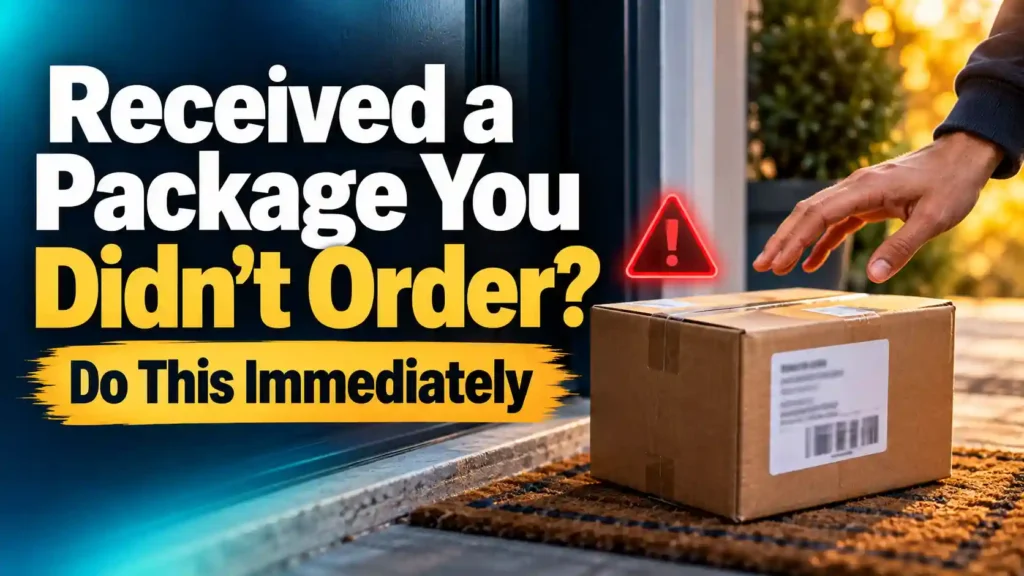
Your name is on the label. Your address is correct. But you did not order the package sitting at your door.
That can feel more disturbing than a random scam text. Someone had enough information to send an item to your home. The natural questions come quickly: Was my account hacked? Did someone use my card? Is it safe to open this?
First, check whether an order or charge was made in your name. Do not scan a QR code inside the package or contact a sender using details printed on an unfamiliar note. Take a photo of the label, ask whether anyone in your household recognizes the delivery, and check your shopping and payment accounts through their official apps or websites.
A parcel you did not order could be a gift, a delivery mistake, an unauthorized purchase, or a brushing scam. The package itself cannot tell you which. Here is how to find out without giving a stranger more information.
First, Do These Five Things
Work through these steps in order. They separate an odd delivery from a problem that needs immediate action.
1. Photograph the package and keep the packaging
Take clear pictures of the shipping label, tracking number, return address if there is one, and any note inside. Keep the box and packing slip while you investigate.
Those details may help a retailer trace the shipment. They may also help you explain the situation if an unfamiliar charge appears later.
Keep the photos private. A full shipping label can reveal your address and other personal details.
If the parcel is leaking, damaged in a concerning way, or contains an unknown substance, stop handling it. Contact the carrier or an appropriate local authority for guidance. An unusual item should be assessed as a physical safety issue before you investigate a possible shopping scam.
2. Check whether someone you know sent it
Ask people who live with you whether they placed an order. Then consider anyone who might have sent a gift.
Also check for a replacement, delayed shipment, subscription delivery, or order made under another household member’s account. A quick conversation may solve the mystery.
If no one recognizes it, do not jump straight to “I’ve been hacked.” Move to the evidence that matters most: your orders and your money.
3. Review shopping accounts and payment activity
Open your shopping apps directly, or type the retailer’s web address yourself. Check recent orders, archived orders, subscriptions, saved addresses, and account messages. Then review your bank and card transactions.
Look for three things:
- An order you do not remember placing.
- A charge you do not recognize, even if it is small.
- A change to your account, such as an unfamiliar address, payment method, or sign-in alert.
If you find an unauthorized charge, contact your bank or card issuer promptly using its official app or the number on your card. The SafeguardPress guide to credit card fraud and what to do immediately explains the other warning signs to check.
4. Leave any QR code alone
A note may say, “Scan to find out who sent your gift” or “Scan to start a return.” That is a tempting shortcut when you want an answer. It may instead open a fake page asking for your password, card details, or other personal information.
You do not need the code to investigate the parcel. Use the retailer’s official app or website, or the carrier’s official tracking page, without following instructions inside the mystery package. Consumer guidance warns specifically about QR codes placed in unexpected packages.
5. Contact the retailer through a channel you find yourself
If the label identifies a marketplace or retailer, find its support page independently. Tell them:
“A package addressed to me arrived today, but I did not place this order. The tracking number is [number]. Can you investigate whether it is connected to my account and whether an unauthorized order or review was created?”
Ask for a case number. If there is a charge, contact your payment provider as well; do not wait for the retailer’s investigation to finish.
Do not call a number printed only on an unfamiliar card inside the box. Likewise, do not give a caller or message sender a one-time code to “verify the delivery.”
Why Did I Receive a Package I Didn’t Order With My Name on It?
A correct name and address make the shipment look deliberate. They do not reveal the sender’s reason for sending it.
There are several plausible explanations, and they require different responses.
A gift or ordinary ordering mistake
Someone may have sent a present without a gift note. A family member may have ordered something and forgotten to mention it. A seller might have shipped a duplicate, replacement, or wrong item.
That is why the household and order checks come first. They can prevent unnecessary panic while still leaving room to catch a real problem.
A brushing scam
In a brushing scam, a seller sends an unordered item to a real person. The delivery may then be used to make a sale appear genuine or to support a fake product review. The item may be cheap and seemingly random.
This is more than an annoying delivery. Someone has used your name and address without your involvement. However, a brushing package does not automatically mean the sender has your password or card number. Check your accounts for evidence rather than assuming what information was exposed. Recent consumer guidance describes both the fake-review scheme and the possible QR code variation.
An unauthorized purchase
This possibility calls for faster action. If the order appears in your shopping account or a matching charge appears on your card, someone may have used an account or payment method without permission.
The fact that the item was shipped to your real address does not make the order legitimate. The question is whether you authorized it.
A delivery or labeling error
A merchant or carrier can make a mistake. Check whether the label truly bears your name, whether there is a recognizable order number, and what the official retailer or carrier says about the tracking number.
Do not rely on the package appearance alone. A familiar retailer’s box can be reused, and a printed sender name does not independently verify who arranged the shipment.
Is an Unexpected Package a Sign of Identity Theft?
It can be a warning sign, but it is not proof. Your name and address on a package do not establish that someone accessed your bank account, stole your identity documents, or opened an account in your name.
The next findings are more useful:
| What you find | What it means for your next step |
|---|---|
| A friend confirms it was a gift | Confirm there are no unrelated charges; the delivery may be resolved. |
| No order or charge appears | A gift, mistake, or brushing scam remains possible; report the unexplained shipment to the identifiable retailer. |
| An unfamiliar order appears in your account | Secure that account and report the order to the retailer. |
| An unfamiliar bank or card charge appears | Contact the payment provider promptly and report it. |
| An unfamiliar account or other identity misuse appears | Begin an identity theft recovery process through the appropriate official service in your country. |
One unexplained parcel should prompt checks, not a verdict. If several suspicious events are happening together, how to know if you are scammed can help you examine the full sequence.
How Does a Brushing Scam Work?
Imagine a seller wants its product to look popular. Sending a low-cost item to a real address creates a shipment and delivery record. The seller may then try to use that transaction to make its sales or reviews look more credible.
The recipient did not request the item and may have no connection to the seller. That is why the package can arrive with a correct name even though no order appears in the recipient’s own account.
Some packages add another step: a card that invites the recipient to scan a code to identify the sender, claim a gift, or arrange a return. That changes the risk. The physical parcel gets your attention; the code tries to move you to a website where you might hand over sensitive information.
A package without a QR code can still be part of a brushing scam. A package with a QR code is not automatically fraudulent. In both cases, verify the shipment independently and do not enter private details merely to satisfy your curiosity.
Can You Keep a Package You Didn’t Order?
In the United States, companies cannot send unordered merchandise and then demand payment. You are not required to return merchandise you truly did not order simply because a sender demands it. The consumer guidance on unordered products explains that right.
There is an important distinction: a parcel bearing someone else’s name is a possible misdelivery. Contact the carrier or retailer about it. Do not treat another person’s shipment as a free gift.
For a parcel addressed to you, preserve its details and complete your account checks before throwing away the packaging. If you choose not to keep the item, consider what it contains. Food, cosmetics, supplements, electronics, and unknown substances may not be safe to use or donate simply because they arrived sealed.
If you live outside the United States, check the consumer rules that apply where you live before relying on U.S. merchandise law.
What If You Already Scanned the QR Code?
Take a breath. Scanning a code, entering a password, and entering card details are different events. What you did after the scan determines the response.
You opened the page but entered nothing
Close it. Do not install an app, accept a download, grant permissions, or return to the page to complete a supposed delivery process.
Check whether anything downloaded or installed. If you approved a permission or installed unfamiliar software, review the device and seek trusted technical help if needed. Opening a page alone does not prove that a criminal took over your phone.
You entered a password or security code
Go to the genuine account through its app or a web address you enter yourself. Change the password immediately. Change it anywhere else you reused it, and turn on two-factor authentication if available.
If you entered a one-time security code, contact that account provider through its official support channel. Review recent sign-ins, connected devices, and changes to the account.
You entered card or bank information
Call your bank or card issuer using the number on the card or in its official app. Explain exactly what you entered and ask what steps it recommends to secure the account. Review transactions and report anything unfamiliar.
If the code was followed by a text asking for a small delivery fee, the guide to telling whether a text message is from a scammer shows how to check the message without trusting its link.
What If an Unfamiliar Charge Matches the Package?
Prioritize the payment problem. Record the charge date, amount, and merchant description. Confirm that nobody in your household made the purchase. Then contact your bank or card issuer promptly.
Next, secure the shopping account if the order appears there. Change its password, review saved payment methods and addresses, and check for unfamiliar sessions or account changes. Save screenshots of the order and your support conversations.
Be precise when reporting it:
“An item I did not order arrived at my address, and I found a charge I did not authorize. I need to report the transaction and check whether my account was accessed.”
A seller may point to a delivery confirmation. That confirms the parcel reached an address; it does not settle whether you approved the purchase.
What If Someone Calls and Demands a Return or Payment?
Do not settle the issue with the caller. A person who arranged a shipment may know your name, address, item, and tracking number. Repeating those details does not prove they represent a real retailer.
End the call or message. Contact the retailer through the app or website you find independently and ask whether it has a legitimate case concerning the parcel. If a return is appropriate, arrange it through that retailer’s official process so you have a record.
Never provide a password, verification code, card number, or payment to “release,” “cancel,” or “return” an item you did not order.
What If the Package Has Your Address but a Different Name?
This is a separate issue from a package addressed to you. It may belong to a previous resident, neighbor, or another customer.
Check the label without opening a parcel addressed to someone else. Contact the carrier or retailer using its official contact details and ask how to handle a misdelivery. Do not scan a code or follow return instructions from an unknown insert.
The distinction matters because advice about keeping unordered merchandise addressed to you should not be stretched to cover another person’s package.
Should You Report the Package?
Report it to the identifiable retailer or marketplace if nobody you know ordered it, especially if the item appears linked to an online seller. Give support the tracking number and ask it to investigate any order or review associated with your details.
If there is an unauthorized charge, report that separately to the payment provider. If you discover wider identity misuse, use the official identity theft reporting and recovery service for your country.
Keep a simple record: photographs, tracking number, dates, charges, the support case number, and what each company told you. That record is more useful than trying to prove a scam from the package alone.
Frequently Asked Questions
I received a package I didn’t order with my name and address. Am I in danger?
The delivery alone does not establish that you are in danger or that an account was hacked. Check for unauthorized orders, charges, and suspicious instructions inside the package. Handle unknown or concerning physical contents cautiously.
Why would a scammer send me something for free?
A seller may use a real delivery to make its sales or reviews appear genuine. Another sender might use the parcel and a QR code to entice you onto a phishing site. The item is sometimes only the first step.
Does a brushing scam mean my shopping account was hacked?
Not necessarily. A sender can address a parcel to you without signing in to your account. Check your order history and account activity to find out whether there is evidence of unauthorized access.
Should I call the phone number on the packing slip?
If you do not recognize the sender, find the retailer’s official support contact yourself. A number printed inside an unsolicited package is not enough to verify who will answer.
What if there is no return address?
Save photos of the label and tracking number. If you can identify the retailer or carrier, contact it independently. A missing return address may complicate tracing the sender, but it does not prove a particular scam.
Can a QR code infect my phone just because it is printed in the box?
No. A printed code does nothing on its own. The risk begins when it is scanned and opens a destination that asks you to enter information, download software, or grant access. If you scanned one, respond according to what you did next.
Do I have to pay for a package I never ordered?
In the United States, a seller cannot make you pay for truly unordered merchandise merely by sending it to you. Rules may differ elsewhere. If you find a charge you did not authorize, report the charge rather than paying it to avoid an argument with the sender.
Should I change my passwords immediately?
If an unauthorized order appears in your account or you entered credentials on a suspicious page, yes—secure the affected accounts immediately. If you found no such evidence, review your accounts and replace weak or reused passwords as a sensible precaution.
The Bottom Line
A mystery parcel with your name on it deserves attention, but it does not deserve a guess.
Save the label. Check with your household. Review orders and charges. Ignore QR codes and unverified contact details. Report any unauthorized activity through official channels.
Those checks will tell you whether you are dealing with a harmless gift, an error, an unexplained seller shipment, or a more serious account or payment problem. Act on the evidence you find—not on the sender’s attempt to rush you.
Pingback: How Do Scammers Know I Have a Package Coming? Did They Really Track My Order? - SafeGuard Press