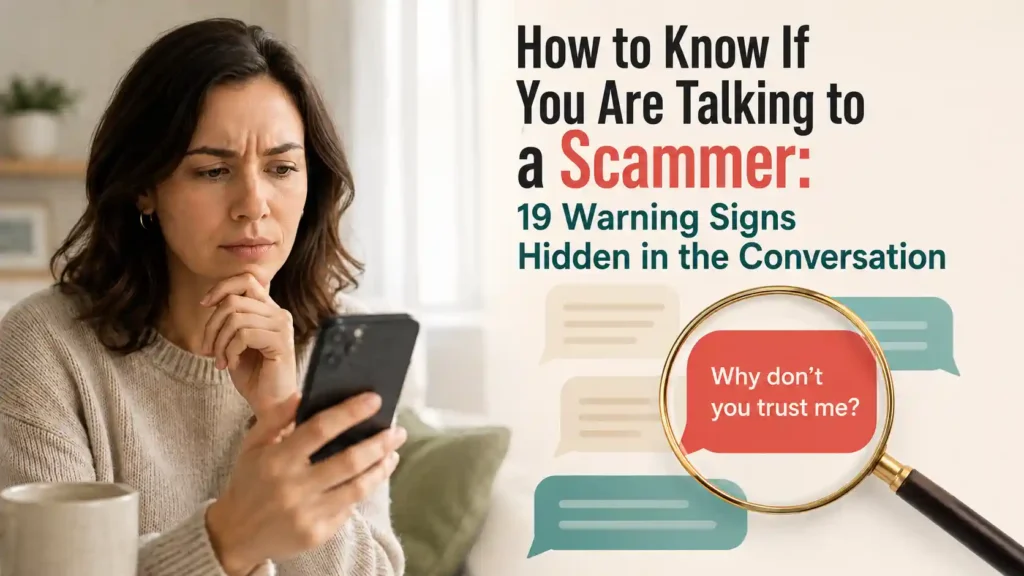
The most dangerous moment in a scam is not when money changes hands. It is the moment a suspicious person still feels believable.
Perhaps the caller knows your name. The text appears to come from a bank. A new online friend remembers small details about your life. The “recruiter” has a convincing profile, while the “support agent” sounds calm and professional. Nothing seems obviously fake—yet something feels wrong.
That uncertainty is exactly where scammers want you. Modern fraud rarely begins with an immediate demand for money. It often starts with ordinary conversation, manufactured trust and a small request that does not feel dangerous. Only later does the pressure rise.
This guide explains how to know if you are talking to a scammer by examining what the person says, what they avoid, how the story changes and what happens when you try to verify it. You will also find safe questions to ask, realistic scammer message examples and the steps to take if information or money has already been shared. Read to the end before replying again; the next message may be designed to push the conversation past the point where clear thinking becomes difficult.
First, do not expect every scammer to sound suspicious.
Can You Tell a Scammer by the Way They Talk?
Sometimes, but language alone is weak evidence. Poor grammar, strange phrasing and an unfamiliar accent can occur in scams, but legitimate people can communicate the same way. Meanwhile, scammers can use polished scripts, translation tools and artificial intelligence to produce professional messages.
The stronger clues are behavioral. A scammer tries to control four things:
- Emotion: fear, excitement, sympathy, romantic attachment or greed
- Time: urgency that prevents independent checking
- Information: requests for secrets while avoiding verifiable details
- Action: a payment, click, download, transfer or account change
One unusual sentence may mean nothing. A pattern that moves from unexpected contact to trust, pressure, secrecy and an irreversible action is far more revealing.
With that in mind, examine the conversation itself.
19 Signs You Are Talking to a Scammer Online or by Phone
1. They Contact You Unexpectedly
The conversation begins with a bank alert, delivery problem, job offer, prize, investment tip or wrong-number text you did not expect. Unexpected contact does not prove fraud, but it means the sender—not you—controls the starting story.
Do not verify an unsolicited claim using a link or number inside the message. Find the organization’s official contact information independently.
2. They Create Urgency Before Providing Proof
The account will close today. The offer expires in minutes. A loved one needs money immediately. Police are supposedly on the way. Urgency keeps you reacting instead of checking.
A genuine problem remains genuine after you pause and verify it. Refuse to make a financial or security decision while someone is counting down the time.
3. They Ask You to Keep the Conversation Secret
A scammer may say bank employees cannot be trusted, family members will interfere or an investigation is confidential. A romance scammer may call secrecy proof of loyalty.
Isolation removes the people most likely to notice contradictions. Anyone instructing you to lie to a bank, relative, employer or authority is giving a decisive warning sign.
4. They Request Money in a Hard-to-Reverse Form
Gift cards, cryptocurrency, cash, wire transfers and payment apps give victims fewer recovery options. The story may involve a fee, emergency, investment, fine or account protection, but the payment method reveals the risk.
No legitimate bank, government office or employer needs gift-card numbers or a transfer to a “safe account.”
5. They Ask for Passwords or One-Time Codes
The person claims a code is needed to confirm your identity, cancel fraud or secure an account. In reality, the code may approve a login, password reset or transaction.
One-time codes are digital keys. A genuine representative does not need you to read one aloud or send a screenshot of it.
6. They Know Personal Details but Their Identity Cannot Be Verified
A caller may know your address, workplace, relatives or recent purchase. Much of this information can come from public profiles, leaked databases or earlier phishing attempts. They may send an ID image, certificate, website, testimonial or screenshot as additional “proof,” but all of it could be stolen, edited or created for the scam.
Knowledge about you is not proof of identity. Evidence matters only when it can be confirmed independently. Verification must work in the other direction: can the person be reached through an official channel the stranger does not control?
7. Their Story Changes or They Avoid Direct Questions
The job title, location, employer, travel date or family story shifts. When questioned, the person changes the subject, repeats reassurance or becomes offended. A fake recruiter cannot clearly explain the role. A fake investor cannot explain withdrawals. A romance scammer gives vague answers about daily life.
Write down important claims rather than relying on memory. Honest people may protect their privacy, but repeated contradictions and evasion around facts essential to the claim are different.
8. They Move You Off the Original Platform Quickly
A new contact wants to leave a dating site, marketplace or job platform for private messaging. The excuse may be convenience, privacy or a poor connection.
Moving the conversation can reduce platform monitoring and make reporting harder. Stay on the original service until identity and purpose are verified.
9. They Manufacture Intimacy Too Fast
A stranger quickly describes you as a soulmate, trusted partner or closest friend. Constant attention, affectionate names and future plans create emotional investment before real-world trust exists.
Fast affection is not proof of a romance scam, but affection followed by an emergency, loan or investment opportunity is a powerful pattern.
10. Every Attempt to Meet or Video Call Fails
The camera is broken. Work prevents a meeting. Security rules supposedly ban video. Travel plans repeatedly collapse at the last moment.
A video call is useful but not definitive: prerecorded clips, filters and AI-generated media can mislead. Treat repeated avoidance as a warning, and verify identity through several independent methods.
11. They Send Links Instead of Letting You Navigate Independently
The message directs you to a bank login, delivery page, investment dashboard, document or payment portal. The address may differ from the genuine domain by one character.
Do not use the link. Open the official app or type the known website address yourself. A professional-looking page can still be a credential trap.
12. They Want Remote Access to Your Device
A supposed technician, bank investigator or refund agent asks you to install screen-sharing or remote-control software. Once connected, the person can view codes, move money or alter what appears on screen.
End unsolicited technical-support calls. Contact the company through its official support channel before installing anything.
13. They Tell You to Move Money to Protect It
The caller claims your account is compromised and funds must be transferred to a secure wallet or protected account. The destination actually belongs to the scammer.
Banks protect funds internally. They do not instruct customers to defeat fraud by sending money elsewhere.
14. They Promise a Reward That Requires Payment First
A prize, inheritance, refund, loan or investment profit is waiting, but a tax, processing charge or release fee must be paid. After the first payment, another obstacle appears.
Paying money to receive a larger promised sum is a classic advance-fee pattern, regardless of how impressive the documents look.
15. They Send Money and Ask You to Return Part of It
The person sends a check or payment, then claims an overpayment or asks you to buy equipment, gift cards or supplies. The original payment later disappears or proves fraudulent, while the money you sent is real.
Never forward money from an unfamiliar payment. Contact the financial institution and wait for a verified resolution.
16. They Coach You on What to Tell Other People
The scammer supplies a cover story for the bank teller, payment service or family. They may warn that revealing the “real reason” will cancel the transaction.
Legitimate transactions do not require deception. Stop immediately if anyone instructs you to misrepresent why money is being withdrawn or transferred.
17. They Use Threats That Depend on Immediate Payment
The person threatens arrest, deportation, disconnection, public embarrassment or legal action unless payment is made now. The threat is designed to make verification feel dangerous.
Real legal and government processes provide formal notices and ways to challenge claims. They are not settled through gift cards, cryptocurrency or a secret phone call.
18. They Become Aggressive When You Verify
A scammer may accuse you of disrespect, threaten consequences or insist that calling the official organization will make the situation worse. The emotional reaction is intended to regain control.
Reasonable verification does not harm a legitimate transaction. Resistance to checking is itself valuable information.
19. The Conversation Gradually Turns Toward Money or Access
Many scams begin without an obvious demand. A wrong-number text becomes friendship. Friendship becomes an investment discussion. A romance becomes an emergency. A support call becomes remote device access.
Judge the direction of the conversation, not only the latest message. If every step increases trust while moving closer to money, information or account access, stop and reassess.
For a wider breakdown of manipulation methods, read How Scammers Gain Your Trust Before Asking for Money.
Next, test the claim without giving the stranger more information.
What Questions Should You Ask a Suspected Scammer?
Questions are useful only when answers can be checked. Do not ask for more photographs or documents and assume they prove anything; both can be stolen or fabricated.
“What is your full name, department and official extension?”
Then end the call and contact the organization through its verified website, card or app. Do not use the number the caller gives you.
“Where can I find this notice in my official account?”
A genuine bank, delivery company or service may display the issue inside its real app or website. Navigate there independently.
“What is the case or reference number?”
Record it, but verify it through an official channel. A reference number supplied by a scammer is not proof by itself.
“Can I call back through the publicly listed number?”
A legitimate representative should accept this. A scammer often invents reasons why the call cannot end.
“Why must this payment use gift cards, cryptocurrency or a personal account?”
There is rarely a legitimate answer. Do not let a complicated explanation hide an unsafe payment method.
“Can I discuss this with my bank, family or lawyer first?”
Watch the reaction. Pressure, anger or demands for secrecy reveal more than rehearsed reassurance.
Do not turn the exchange into a confrontation. Once the warning signs are strong, ending contact is safer than trying to expose or outsmart the scammer.
Now compare several common scripts.
Examples of What Scammers Say in Texts, Chats and Calls
The Bank Impersonator
“We detected fraud. For your protection, transfer the balance to this secure account while I stay on the line.”
The contradiction is the clue: moving money to an unfamiliar account does not protect it. Hang up and call the number on the back of the bank card.
The Wrong-Number Scammer
“Sorry, I thought this was Daniel. You seem kind, though. Where are you from?”
An innocent mistake becomes persistent personal conversation. The eventual objective may be romance, investment fraud or information gathering. There is no benefit in continuing with an unknown sender.
The Romance Scammer
“I have never trusted anyone like this. My account is temporarily frozen, and I only need a short loan for my flight.”
Rapid intimacy, an obstacle to meeting and a financial emergency form a familiar progression. Do not send money to someone who cannot be independently verified and met safely.
The Fake Recruiter
“You are hired. We will email a check so you can purchase equipment from our approved vendor today.”
The check will likely be reversed after real money reaches the fake vendor. Verify the vacancy and recruiter through the company’s official careers page.
The Government Impersonator
“A warrant has been issued in your name. Stay on the line and pay the penalty at a Bitcoin ATM to avoid arrest.”
The threat, forced continuous call and cryptocurrency payment are decisive warning signs. End the call and verify the claim through the agency’s published number.
These scripts work because they target emotion before logic.
How Scammers Manipulate You During a Conversation
Scammers do not need to fool you about everything. They only need to control one important decision.
They may begin with small agreements, harmless personal questions or a minor payment. Once someone has invested time, emotion or money, walking away becomes harder. The scammer then uses sunk-cost thinking: “One final fee will release everything.”
Other tactics include love bombing, authority, fear, scarcity, reciprocity and shame. A small initial payment may make an investment platform seem real. A friendly conversation may make refusing an emergency request feel cruel. A threatening caller may make independent verification feel risky.
Recognizing the emotional state is therefore part of recognizing the scam. If a conversation makes you unusually afraid, excited, guilty or rushed, pause before acting.
Use these practical red flags to spot a phishing message when the suspicious contact arrives by email or text.
However, technology has made visual and audio “proof” less reliable.
Can a Video Call or Familiar Voice Prove Someone Is Real?
No. A live conversation can increase confidence, but it cannot establish that every claim is true. Scammers can impersonate genuine people, use stolen accounts, replay media or manipulate voices and images.
If a relative or colleague makes an unusual request, end the call and contact that person using a number already saved. Families can agree on a private emergency phrase, but it should not be based on information visible online.
For an online stranger, combine several checks: consistent live interaction, independent profile history, reverse-image searching, verifiable workplace or social connections and a safe in-person meeting where appropriate. No single test should carry the entire decision.
Most importantly, never send money merely because a face or voice appears convincing.
If the evidence points to fraud, act cleanly.
What to Do When You Realize You Are Talking to a Scammer
Stop Responding
Do not announce an investigation or explain what exposed the scam. Further conversation gives the person more information and another chance to manipulate you.
Save Evidence
Capture the profile, messages, phone number, email address, payment instructions, website and transaction details. Save evidence before blocking the account because some platforms may hide the conversation afterward.
Block and Report the Contact
Use the platform’s reporting tools. If an organization was impersonated, notify it through an independently verified channel.
Secure Exposed Accounts
Change compromised passwords from a trusted device, enable multifactor authentication and sign out unfamiliar sessions. Check whether recovery addresses, forwarding rules or phone numbers were changed.
Contact the Payment Provider Immediately
If money was sent, ask the bank, card company or payment service whether the transaction can be stopped, recalled or disputed. Speed matters. Ignore anyone promising guaranteed recovery for another upfront fee.
Protect Your Identity
If identity documents, tax numbers or banking information were shared, monitor financial accounts and credit records. Use fraud alerts, credit freezes and document replacement procedures where available.
Follow What to Do After Being Scammed: The First 24 Hours for a complete recovery sequence.
Finally, remember the test that exposes most conversational fraud.
The Fastest Way to Know If You Are Talking to a Scammer
Pause the conversation and verify the claim somewhere the other person does not control.
Call the bank using the number on the card. Open the official app without clicking the message. Contact the relative through a saved number. Find the employer’s real careers page. Ask a trusted person to review the situation before money or information moves.
A scammer needs the conversation to remain a closed system in which they supply the problem, the proof and the solution. Independent verification breaks that system.
Do not rely on confidence, caller ID, professional grammar, a familiar voice or an official-looking document. None of those proves identity. Trust should follow verification—not replace it.
Frequently Asked Questions
How do you know if someone texting you is a scammer?
Be cautious when an unexpected sender creates urgency, asks personal questions, sends a link or gradually introduces money. Verify any claimed identity through a separate, official channel and stop responding if the story cannot be confirmed.
What is the biggest red flag when talking to a scammer?
Pressure to take an irreversible action before independent verification is one of the strongest signs. This may involve sending money, revealing a code, clicking a link, installing software or moving funds.
Will a scammer video call you?
Some will. A video call does not prove the person’s name, intentions or story. Stolen accounts, prerecorded media and manipulated video can all create false confidence.
What information should you never give a stranger?
Never share passwords, one-time codes, card PINs, full banking credentials or remote access to a device. Identity and financial documents should be provided only through a verified, legitimate process.
Should you tell a scammer you know it is a scam?
Usually, no. Save the evidence, stop responding, block the contact and report it. Continuing the conversation can expose more information and create another opportunity for manipulation.
Can caller ID be trusted?
No. Caller ID information can be falsified. End an unexpected call and dial the organization using a number obtained independently.
What should you do if you sent a scammer money?
Contact the payment provider immediately, ask about reversal or dispute options, secure affected accounts and preserve evidence. Report the fraud to the appropriate platform and local authority.
Why do scammers want to keep you on the phone?
Continuous contact prevents you from checking the claim, contacting family or hearing warnings from a bank employee. Hanging up restores the time and independence needed to verify the story.
Disclosure: This article may contain affiliate links. If you choose to use a provider through one of these links, we may earn a commission at no additional cost to you. These commissions help support the ongoing maintenance and operation of our website so we can continue providing helpful, up-to-date content.
Pingback: AI Grandparent Scam: The One Question That Could Stop a Costly Mistake - SafeGuard Press
Pingback: AI Family Emergency Scam: How Criminals Clone a Loved One’s Voice and Make the Lie Feel Real - SafeGuard Press