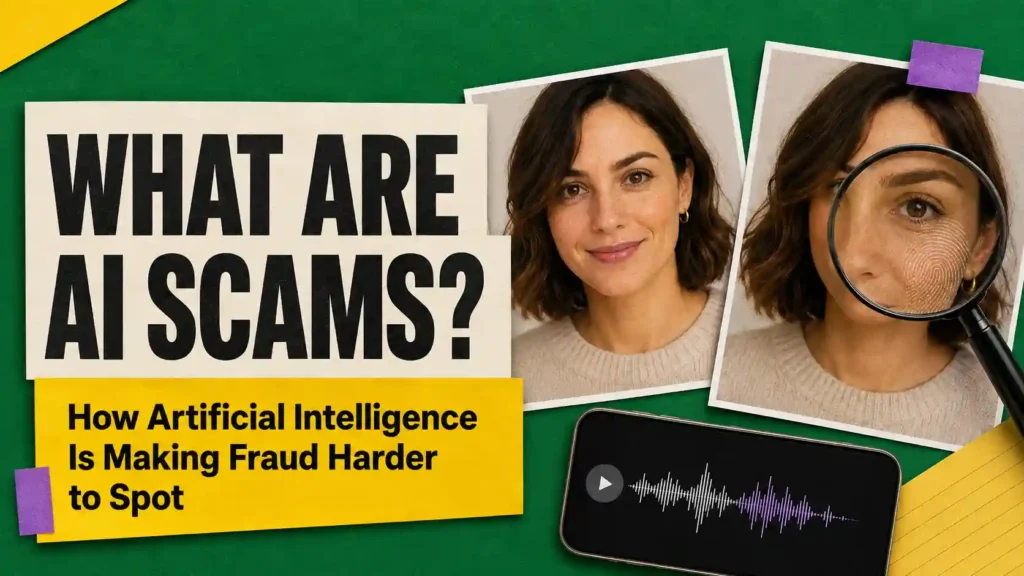
The frightened voice on the phone sounds exactly like someone you love. The face in the video looks familiar. The message mentions personal details that seem impossible for a stranger to know.
Then comes the request: send money, reveal a security code, open a link or act before something terrible happens.
This is what makes AI scams so dangerous. Artificial intelligence allows criminals to imitate voices, manufacture convincing images, write flawless messages and create believable identities at a speed that was once impossible. You may no longer receive an obviously suspicious email filled with spelling mistakes. Instead, you could face a polished deception designed around your fears, relationships and daily life.
So, what are AI scams, how do they work and why can they fool even careful people? This guide will help you understand the meaning of AI scams, recognize realistic examples and identify the emotional manipulation hiding beneath the technology. Most importantly, you will learn one simple truth that can protect you when your eyes and ears are no longer enough: authenticity must be verified, not assumed.
What Are AI Scams?
AI scams are fraudulent schemes in which criminals use artificial intelligence to create, improve, personalize or automate a deception.
The technology itself does not steal your money. A scammer uses it to make an old lie appear more believable, reach more people or adapt the story specifically to you.
For example, a criminal may use AI to:
- Clone the voice of someone you trust
- Create a fake video of a public figure
- Write a highly personalized phishing email
- Build a realistic-looking website
- Generate photos for a fake dating profile
- Translate messages into natural-sounding English
- Operate a chatbot that responds like a real person
- Create counterfeit identification documents
- Produce fake reviews and testimonials
- Research your life from publicly available information
- Maintain hundreds of fraudulent conversations at once
This means an AI scam may reach you through a phone call, text message, email, video, social-media advertisement, dating app, job platform or investment website. You may even encounter one during a live video conversation.
The easiest way to understand AI fraud is to separate the technology from the objective. The AI creates the convincing voice, face, message or identity. The scammer uses that content to pressure you into surrendering money, account access or personal information.
What Does an AI Scam Look Like?
An AI scam does not have one recognizable appearance. It may look like a family emergency, an investment opportunity, a romantic relationship or a message from your employer.
The story changes, but the goal usually falls into one of four categories.
The scammer wants your money
You may be told to send a bank transfer, buy gift cards, deposit cryptocurrency or pay an urgent fee. The AI-generated content creates the illusion that the request comes from a person or organization you trust.
The scammer wants your personal information
You may be asked for your Social Security number, date of birth, address, banking details or a photograph of your identification. The criminal can use this information to commit identity theft, open accounts or build a more detailed profile for another scam.
The scammer wants access to an account
A message may ask you to reveal a one-time security code, reset your password or approve a login request. Once you comply, the scammer may take over your email, bank or social-media account.
The scammer wants control of your device
You may be instructed to install an application, open an attachment or allow remote access. The criminal can then monitor your activity, steal saved passwords or manipulate what appears on your screen.
Although AI makes these schemes more convincing, the desired result remains familiar: the scammer wants you to act before you verify the story.
How Artificial Intelligence Makes Scams More Convincing
Scammers have always copied trusted organizations and invented false identities. Artificial intelligence changes how quickly, cheaply and convincingly they can do it.
Here is where the danger becomes more personal.
AI removes many traditional warning signs
You may have learned to watch for spelling mistakes, strange grammar and awkward sentences. Those clues still matter, but they are no longer reliable on their own.
A scammer can use generative AI to produce an email that sounds professional, friendly or authoritative. The criminal can request a specific tone and make the message resemble something written by a bank employee, recruiter, government official or company executive.
If English is not the scammer’s first language, AI can translate the message and remove the errors that might once have exposed the deception.
A perfectly written message can still be fraudulent.
AI allows scammers to personalize the lie
Imagine that you receive a generic message claiming that a family member needs help. You may question it immediately.
Now imagine the message includes that person’s name, workplace, recent holiday destination and the nickname used within your family. The request suddenly feels much more credible.
A criminal can collect fragments of information from your social-media profiles, public records, business pages, data breaches and previous messages. AI can then organize those details and create a personalized approach.
The information proves that someone researched you. It does not prove that the person contacting you is genuine.
AI creates realistic voices
A voice clone can imitate a person’s pitch, rhythm, accent and speaking style. The original audio may come from a social-media video, podcast, voicemail, online presentation or public interview.
You might receive a call from someone who sounds like your child, partner, manager or close friend. The voice may say there has been an accident, an arrest or another emergency. Crying, background noise and a poor connection can make inconsistencies harder to notice.
If you hear a familiar voice requesting money, do not rely on recognition alone. End the call and contact the person through a number you already trust.
AI produces fake images and videos
AI-generated images can create people who do not exist. Image-editing tools can also place a real person in a fabricated location or situation.
Video deepfakes go further by making someone appear to say or do something that never happened. A scammer may create a fake celebrity endorsement, an investment presentation or a video call featuring an impersonated executive.
Older deepfakes often contained obvious visual mistakes. In 2026, some of those imperfections may still appear, but clear eyes, natural blinking and synchronized lips no longer guarantee authenticity.
If money or sensitive information is involved, verify the claim outside the video.
AI can keep conversations going
Some scams depend on weeks or months of communication. Romance scams, fake investment schemes and fraudulent job offers often require the criminal to maintain a consistent personality.
AI can help a scammer remember details, generate affectionate responses and adapt messages to your interests. Chatbots can also respond immediately, allowing one criminal operation to communicate with many targets at the same time.
Fast replies do not prove that a person is attentive. Detailed replies do not prove that a person is real.
AI helps scammers create an entire false world
One fake message is easier to question than a complete digital presence.
AI can help criminals create:
- A professional website
- Employee biographies
- Product descriptions
- Customer reviews
- Social-media profiles
- Photographs of supposed team members
- Promotional videos
- Customer-service conversations
- Legal-looking documents
- Fake news articles
- Fabricated account dashboards
You may search for the company and find what appears to be supporting evidence. The website, reviews and profiles may all agree because the same criminals created all of them.
AI-Generated Scams vs. AI-Enhanced Scams
Not every AI scam is created entirely by a machine. Understanding the difference can help you recognize how the technology fits into the deception.
An AI-generated scam uses fabricated content
In an AI-generated scam, artificial intelligence creates a major part of what you see or hear.
Examples include:
- A cloned emergency phone call
- A deepfake investment video
- A nonexistent person’s profile photograph
- A fake identification document
- An automated chatbot pretending to be a romantic partner
The generated content becomes the scammer’s disguise.
An AI-enhanced scam improves a traditional scheme
In an AI-enhanced scam, the basic fraud already exists, but AI makes it faster, cleaner or more personalized.
For example, a criminal may use AI to rewrite a phishing email, analyze your online activity or translate a fraudulent job offer. A real scammer may still speak to you and control every major decision.
The difference matters less than the result. Whether AI generated the entire approach or polished one part of it, you still need to independently verify unexpected requests.
Why AI Scams Are So Hard to Spot
You may assume that careful, intelligent people can always recognize fraud. AI scams expose the weakness in that belief.
These schemes do not succeed simply because the technology looks realistic. They succeed because the technology is combined with emotional pressure.
You naturally trust familiar voices and faces
When you recognize someone, your brain begins processing the message as if the person’s identity has already been confirmed. A cloned voice or deepfake video exploits that automatic trust.
The scammer wants familiarity to replace verification.
Urgency prevents careful thinking
An emergency call may tell you that someone is injured. A bank message may warn that your account is being emptied. A work request may claim that an important payment must be completed immediately.
The faster you react, the less likely you are to notice contradictions or contact the real person.
Fear makes the request feel more important than the evidence
A scammer may threaten arrest, financial loss, public embarrassment or harm to someone you love. Once fear takes control, sending money can feel like the safest way to end the danger.
Before acting, ask: “What evidence can I verify independently?”
Authority discourages questions
If a message appears to come from your manager, a police officer, a bank representative or a government agency, you may worry that questioning it will appear disrespectful or irresponsible.
A legitimate authority will not object to reasonable verification. A scammer often will.
Personal information creates false credibility
A caller who knows your address, employer or relative’s name may seem trustworthy. However, those details may have come from a data breach, public profile or AI-assisted search.
Knowledge about you is not proof of identity.
What Is an Example of an AI Scam?
Suppose you receive a late-night call from a number you do not recognize.
When you answer, you hear your daughter crying. She says she caused an accident and has been arrested. A supposed lawyer takes the phone and tells you that bail must be paid immediately. He warns that calling anyone else could make the situation worse.
The voice sounds real because it may have been cloned from a short video. The lawyer creates authority. The accident creates fear. The demand for secrecy prevents verification, while the deadline pressures you to pay.
The safest response is not to analyze the voice for tiny imperfections. Hang up and call your daughter directly. If she does not answer, contact someone who is physically close to her. Use independently verified contact information to call the relevant police department.
The power of this approach is that it works even when the voice clone is flawless.
That same verification principle applies to AI investment scams, fake job interviews, executive impersonation and fraudulent romantic relationships. Do not ask only, “Does this look real?” Ask, “Can I confirm this through a separate, trusted channel?”
Are AI Scams Completely New?
Most AI scams are not entirely new. Criminals have impersonated relatives, created fake investments and sent phishing messages for decades.
AI changes the scale and quality of the deception.
A scam that once required a skilled writer, designer, actor and website developer can now be assembled by a much smaller operation. The criminal can produce several versions, test different emotional approaches and personalize messages for different targets.
Artificial intelligence also gives old schemes a new layer of evidence. Instead of merely claiming that a relative needs help, the criminal can reproduce the relative’s voice. Instead of describing a celebrity-backed investment, the scammer can manufacture a video endorsement.
The lie is old. The delivery system is faster, cheaper and more believable.
The Most Important Truth About AI Fraud
You do not need to become a deepfake expert to protect yourself.
Trying to identify every visual glitch, unnatural pause or strangely written sentence can help, but those clues will continue to change as the technology improves. A more durable defense is to examine what the sender wants you to do.
Be especially cautious if anyone asks you to:
- Act immediately
- Keep the situation secret
- Send an irreversible payment
- Reveal a security code
- Move money to “protect” it
- Install unfamiliar software
- Ignore standard procedures
- Trust a new phone number or email address
- Accept a surprising opportunity without verification
A convincing voice can be fabricated. A polished website can be manufactured. A familiar face can be digitally recreated.
But the pressure to bypass verification remains one of the clearest warning signs.
How to Spot an AI Scam
You may not always detect the technology behind a scam. Fortunately, you do not need to prove that a message, image or voice was generated by artificial intelligence before protecting yourself.
Instead, examine the behavior, request and circumstances surrounding the contact.
You receive an unexpected request
Be cautious when someone contacts you without warning and immediately introduces a financial problem, emergency or opportunity.
The message may claim to come from:
- A family member who has lost a phone
- Your bank’s fraud department
- A company executive
- A recruiter
- A government employee
- A police officer
- A celebrity or financial expert
- A customer or supplier
- Someone you recently met online
Even when the person’s voice or appearance seems genuine, an unexpected request deserves independent verification.
You are pressured to act immediately
Urgency is one of the strongest warning signs because it prevents you from investigating the story.
You may hear:
- “You need to pay within the next hour.”
- “Do not hang up.”
- “Your account will be closed today.”
- “This opportunity is available to only a few people.”
- “You must keep this confidential.”
- “If you contact anyone, the situation will get worse.”
A legitimate emergency may require quick action, but it should still survive a basic identity check. If the person becomes angry or threatening when you try to verify the claim, stop communicating.
The payment method is difficult to reverse
Scammers prefer payment methods that allow them to disappear quickly.
Be extremely cautious if you are told to pay through:
- Cryptocurrency
- Gift cards
- Wire transfers
- Cash couriers
- Payment applications
- Prepaid cards
- Unfamiliar digital wallets
- Cash deposits into cryptocurrency machines
A bank, police department, employer or government agency will not require gift cards to resolve an emergency. A genuine investment professional will not pressure you to transfer cryptocurrency to a private wallet.
You are told to move money for “protection”
A caller may claim that someone has compromised your account. The person then instructs you to transfer your money to a “safe account,” “secure wallet” or “government-protected account.”
There is no special account that a stranger must help you access during an unsolicited call.
End the conversation and contact your financial institution using the number printed on your card or listed inside its official application. Do not use a phone number or link supplied by the caller.
The person discourages independent verification
A scammer may give you a reason not to contact the real person, company or authority.
You may be told that:
- A court order requires secrecy
- Your relative’s safety depends on silence
- The transaction is confidential
- Your manager does not want anyone else involved
- The bank’s normal telephone number has been compromised
- An investigation will fail if you speak to someone
- You will lose the opportunity if you ask questions
Secrecy protects the scammer, not you.
The message contains personal information
Personal details can make an AI scam frighteningly believable. However, your full name, address, relatives, employer and recent activities may be publicly available or exposed in a data breach.
Treat personal information as part of the scammer’s performance—not proof of identity.
Ask a question whose answer is not available online. Better still, contact the person through a separate channel you already trust.
The voice or video behaves strangely
AI-generated content is improving, but you may still notice inconsistencies.
During a call, listen for:
- Unnatural pauses
- Repeated phrases
- Changes in speaking speed
- Flat or misplaced emotion
- Unusual pronunciation
- A refusal to answer unexpected questions
- Background sounds that repeat
- A voice that sounds familiar but lacks normal speech habits
During a video, watch for:
- Lip movements that do not perfectly match the words
- Facial features that shift briefly
- Unnatural blinking
- Strange lighting around the face
- Blurred teeth, ears, hands or eyeglasses
- A face that looks unusually smooth
- Sudden changes in skin tone
- Poor movement around the edge of the head
- A refusal to turn sideways or move naturally
These clues can strengthen your suspicion, but their absence does not prove the content is genuine. A sophisticated deepfake may look cleaner than you expect.
The story changes when you ask questions
A genuine person should be able to explain basic details consistently.
Ask:
- What happened?
- Where are you now?
- Who else is present?
- Why are you contacting me from this number?
- What organization do you represent?
- How can I verify your identity?
- Can I call you back through the official number?
A scammer may repeat the original demand, avoid the question or add more pressure. An AI chatbot may also provide vague responses when the conversation moves beyond its prepared story.
The opportunity appears unusually perfect
AI can help scammers study your interests and create an offer that matches exactly what you want.
You may receive:
- A remote job with exceptional pay
- An investment with guaranteed returns
- A romantic message from an attractive stranger
- A prize you do not remember entering
- A business deal with no apparent risk
- A loan requiring no meaningful checks
- An offer to recover money previously lost to fraud
Do not let an appealing outcome lower your standards. The more an opportunity promises, the more carefully you should verify it.
How to Verify a Suspicious Voice, Image or Video
When artificial intelligence can imitate what you see and hear, verification must happen outside the suspicious communication.
Here is how to do it safely.
End the original conversation
Do not remain on the phone while attempting to investigate. A scammer can keep talking, answer objections and pressure you to ignore what you discover.
Hang up.
If the contact came through text, email or social media, stop responding temporarily. Do not open additional links or download files.
Contact the person through a trusted channel
Call the person using a number already saved in your phone. If the supposed request came from your employer, use your company’s established communication system.
If you cannot reach the person, contact another trusted individual who is likely to know where they are.
Do not call a number supplied in the suspicious message. That may reconnect you to the same criminal operation.
Create a family safe word
Choose a private word or short phrase that family members can use during a genuine emergency. Avoid birthdays, pet names or information visible on social media.
If a caller claims to be someone you love, ask for the safe word.
Your family should also agree that no one will feel insulted when asked to verify an unexpected request. That simple agreement removes the emotional hesitation scammers exploit.
Verify organizations independently
If someone claims to represent a business, bank or government department, find the official contact information yourself.
You can:
- Type the organization’s known address directly into your browser
- Use the telephone number printed on your bank card
- Open the official mobile application
- Visit a local branch
- Check a government licensing database
- Contact a company’s publicly listed office
Avoid sponsored search results when looking for sensitive financial or account services. Fraudulent advertisements can lead to cloned websites.
Search the exact wording
Place an unusual sentence from the message inside quotation marks and search for it. You may discover that other people received the same script.
You can also search the person’s name, company, phone number or email address alongside words such as “scam,” “fraud,” “complaint” or “review.”
A lack of complaints does not prove legitimacy. Newly created scams may not have been reported yet.
Reverse-search suspicious images
A reverse-image search may reveal that a profile photograph was stolen from another person or appears under several names.
However, an image with no matches could have been generated entirely by AI. Treat reverse-image searching as one verification step, not a final answer.
Ask for a fresh action
During a suspicious video call, ask the person to perform an unplanned action, such as turning their head, raising a specific number of fingers or describing something nearby.
This may expose a basic deepfake or prerecorded video. It will not defeat every real-time impersonation, so you should still verify the person through another channel.
How to Protect Yourself From AI Scams
You cannot prevent criminals from generating fake content, but you can make yourself a harder target.
The strongest protection comes from changing how you respond to unexpected requests.
Pause before you click, pay or reply
Give yourself enough time to separate the emotional story from the requested action.
Ask three questions:
- Why am I being contacted unexpectedly?
- What does this person want me to do?
- How can I verify the claim without using anything they provided?
A short pause can prevent a rushed payment, stolen password or compromised account.
Limit the personal information you share publicly
Review the information visible on your social-media profiles.
Consider hiding or removing:
- Your telephone number
- Home address
- Email address
- Full date of birth
- Travel plans
- Children’s schools
- Workplace details
- Names of close relatives
- Photographs of identification documents
- Posts revealing security-question answers
You do not need to disappear from the internet. You need to avoid giving strangers an easy collection of details they can turn into a convincing script.
Be careful with public audio and video
A short recording may provide material for a voice clone. This does not mean you should never publish videos, especially if your work requires them.
Instead, assume that public content can be copied. Do not use voice recognition as your only method of verifying a financial request.
Parents should also review how much information they share about their children, including names, schools, routines and locations.
Strengthen your account security
AI may improve the message that leads you to a fake login page, but good account security can reduce the damage.
You should:
- Use a different password for every important account
- Store passwords in a reputable password manager
- Enable multifactor authentication
- Prefer an authentication application or security key when available
- Protect your email account with the strongest security
- Review active login sessions regularly
- Remove devices you no longer recognize
- Turn on financial transaction alerts
- Update your phone and computer
- Keep reliable security software active
Your email account deserves special attention because a criminal may use it to reset passwords for your other services.
Never share a one-time security code
A security code is often the final barrier between a criminal and your account.
A caller may claim to be confirming your identity, stopping fraud or reversing a transaction. If the caller asks you to read a code sent to your device, end the conversation.
Your bank or account provider does not need you to reveal a code during an unsolicited call.
Use strict payment rules
Create personal rules before an emergency occurs.
For example:
- Never send money based only on a phone call
- Never buy gift cards to pay a bill or fee
- Never transfer funds while someone remains on the line
- Never send cryptocurrency to an unverified person
- Never change supplier payment details without verbal confirmation
- Never approve an urgent executive request outside company procedure
Rules protect you when fear or excitement makes clear thinking difficult.
Discuss AI scams with your family
Children, parents and grandparents may face different versions of the same deception.
Explain that a familiar voice can be cloned and a realistic video can be fabricated. Make it clear that nobody will be punished for ending a suspicious call or delaying a payment.
Practice what each person should do during a supposed emergency.
A useful family response is:
“I will call you back through the number I already have.”
Protect your workplace
Businesses should never depend on voice or email recognition for sensitive requests.
If you handle money, employee data or account access, insist on a second method of approval for:
- Changes to bank details
- Wire transfers
- Payroll updates
- Password resets
- Confidential document requests
- Large purchases
- Requests from senior executives
- New supplier payments
Employees should know that a deepfake video meeting does not override company payment procedures.
If you want a better prevention system can check out how to protect yourself from AI scams before a convincing request reaches them.
What to Do If You Responded to an AI Scam
If you clicked, paid or shared information, do not let embarrassment delay your response. Scammers depend on silence because every hour may give them more time to move money or access additional accounts.
Take action based on what happened.
If you sent money
Contact your bank, card provider or payment service immediately. Explain that the transaction resulted from fraud and ask whether it can be stopped, reversed or recalled.
If you paid by gift card, contact the issuing company and keep the card and receipt.
If you sent cryptocurrency, contact the platform used for the transfer. Cryptocurrency transactions are difficult to reverse, but reporting the destination wallet may help an investigation.
Do not pay anyone who promises guaranteed recovery. Criminals often target victims again through scam recovery services that demand upfront fees.
If you shared a password
Change the password immediately from a device you trust.
If you used the same password elsewhere, change it on every affected account. Begin with your email, banking and social-media accounts.
Sign out of unfamiliar sessions and review recovery email addresses, telephone numbers and forwarding rules.
If you revealed a security code
Contact the account provider immediately and explain what happened. Change your password and check whether a new device, payment method or recovery option was added.
Review recent transactions and login activity.
If you shared identity information
Monitor your financial accounts and credit reports. Consider placing a fraud alert or security freeze where available.
Keep records of the information you disclosed. This will help you determine which accounts require extra protection.
For a detailed response plan, follow what to do after being scammed to limit the damage before criminals can misuse more of your information.
If you installed an application
Disconnect the affected device from the internet if you believe someone has remote access.
Use a different trusted device to change important passwords. Remove unfamiliar applications and run an updated security scan.
If financial or highly sensitive information was exposed, professional technical assistance may be necessary. Do not continue following instructions from the person who told you to install the application.
Save the evidence
Keep:
- Screenshots
- Email addresses
- Phone numbers
- Usernames
- Website addresses
- Payment receipts
- Wallet addresses
- Account statements
- Messages and voicemails
- Dates and times
- A written timeline of what happened
Do not edit the original files if they may be needed for an investigation.
Report the scam
Report the incident to the relevant financial institution, platform and fraud-reporting authority in your country.
Reporting may not guarantee that your money will be returned, but it can help investigators connect related cases, warn other people and disrupt the accounts used by criminals.
Can AI Detect AI Scams?
Artificial intelligence can help identify suspicious messages, manipulated media and unusual account activity. Some tools examine voice patterns, facial movement, metadata, writing behavior and transaction patterns.
However, an AI-detection score should never become your only proof.
Detection tools can produce false results. A genuine image may be flagged as artificial, while a sophisticated deepfake may pass unnoticed. Content may also lose identifying details when it is compressed, edited, recorded from another screen or shared through social media.
Use detection tools as supporting evidence. Your strongest protection remains independent verification and refusal to bypass normal safety procedures.
What AI Scams Teach You About Online Trust
The internet once encouraged you to believe what you could see and hear. AI has weakened that assumption.
A video is no longer proof that an event happened. A familiar voice is no longer proof that a relative is calling. A professional message is no longer proof that a company sent it.
This does not mean you must distrust everyone. It means trust should come from verification, consistent behavior and established procedures—not from digital appearance alone.
When a request involves money, passwords, security codes or sensitive information, slow down. Contact the person through a trusted channel. Check the claim independently. Refuse payment methods that offer little protection.
Artificial intelligence can make a lie appear real, but it cannot force you to act before you verify it.
Frequently Asked Questions About AI Scams
These answers address the practical questions you may have after encountering suspicious AI-generated content.
What is the simple definition of an AI scam?
An AI scam is a fraudulent scheme in which a criminal uses artificial intelligence to create or improve a deceptive voice, image, video, message, identity or website.
How do AI scams work?
Scammers use AI to make a false story more believable, personalize it with information about you and pressure you into sending money or revealing sensitive information.
What are the most common AI scams?
Common examples include voice-cloning emergencies, deepfake investment promotions, personalized phishing messages, fake dating profiles, job scams and business impersonation.
For a broader breakdown, see AI scams in 2026 and the different forms these schemes can take.
Can scammers clone a person’s voice?
Yes. A scammer may use available recordings to imitate a person’s voice. You should independently contact the person instead of trusting the voice alone.
Can an AI scam happen during a live video call?
Yes. Criminals may use face-swapping tools, prerecorded video or real-time deepfake technology during a video conversation.
Can AI create a completely fake person?
Yes. AI can generate a realistic face, biography, voice and online personality for someone who does not exist.
Are AI-generated images always easy to identify?
No. Some contain obvious mistakes, but others can look highly realistic. Do not treat visual quality as proof that an image is genuine.
Can perfect grammar still indicate a scam?
Yes. AI writing tools can produce polished messages without spelling or grammatical errors.
How can you verify an emergency phone call?
End the call and contact the supposed caller using a trusted number. You can also contact another person who can confirm their safety.
What should you do if a caller sounds like someone you know?
Do not send money based on voice recognition. Ask a private question, request the family safe word and call the person back independently.
Should you trust an AI-detection tool?
Use it as one clue, not final proof. Detection tools can make mistakes, particularly when content has been edited or compressed.
Why do scammers demand secrecy?
Secrecy prevents you from contacting someone who could expose the lie.
Why do AI scammers create urgency?
Urgency reduces the time you have to investigate, think clearly or ask another person for advice.
Can a scammer use information from social media?
Yes. Public posts may reveal names, relationships, locations, workplaces and events that can make a scam more personal.
Can AI scammers target businesses?
Yes. They may impersonate executives, suppliers or employees to request payments, payroll changes or confidential information.
Is a video endorsement proof that an investment is legitimate?
No. A celebrity, executive or financial expert may be impersonated through a deepfake video.
Can AI be used in romance scams?
Yes. Scammers can create photographs, affectionate messages, voices and video content to maintain a false romantic identity.
What payment methods should make you suspicious?
Be cautious when someone demands cryptocurrency, gift cards, a wire transfer, cash or another payment that is difficult to reverse.
Can you recover money sent to an AI scammer?
Recovery depends on the payment method and how quickly you act. Contact the payment provider immediately, but avoid anyone promising guaranteed recovery for an upfront fee.
What is the best defense against an AI scam?
Pause and verify the request through a separate channel you already trust. Do not depend solely on the voice, image, message or video presented to you.
Final Thoughts
AI scams are dangerous because they attack the shortcuts you normally use to decide whom to trust. A familiar voice, recognizable face, polished website or personalized message can create a powerful illusion of authenticity.
Your protection begins when you stop treating digital realism as proof.
If a request is unexpected, emotional, secretive or urgent, pause. Verify the person independently. Refuse unusual payments. Protect your security codes and passwords. Ask someone you trust to examine the situation before you act.
A scammer can use artificial intelligence to copy a voice, manufacture a face and polish a lie. What the scammer cannot easily defeat is your decision to stop, question and verify.

Pingback: Real vs. AI-Generated: A Practical Test for Suspicious Voices, Images and Videos - SafeGuard Press
Pingback: AI Family Emergency Scam: How Criminals Clone a Loved One’s Voice and Make the Lie Feel Real - SafeGuard Press
Pingback: AI Grandparent Scam: The One Question That Could Stop a Costly Mistake - SafeGuard Press
Pingback: Can a Scammer Access My Bank Account With My Phone Number? What to Check Now - SafeGuard Press
Pingback: Online Scams: Common Types, How to Spot Them, and What to Do Next - SafeGuard Press
Pingback: Gift Card Scams: How to Spot Them and What to Do If You Sent a Code - SafeGuard Press
Pingback: How to Protect Your Child From Identity Theft Before the Damage Starts - SafeGuard Press
Pingback: Voice Cloning Scams: 11 Red Flags That the Caller Is Not Who You Think - SafeGuard Press
Pingback: What Is CEO Fraud? 17 Warning Signs, Real Examples and Prevention Steps - SafeGuard Press