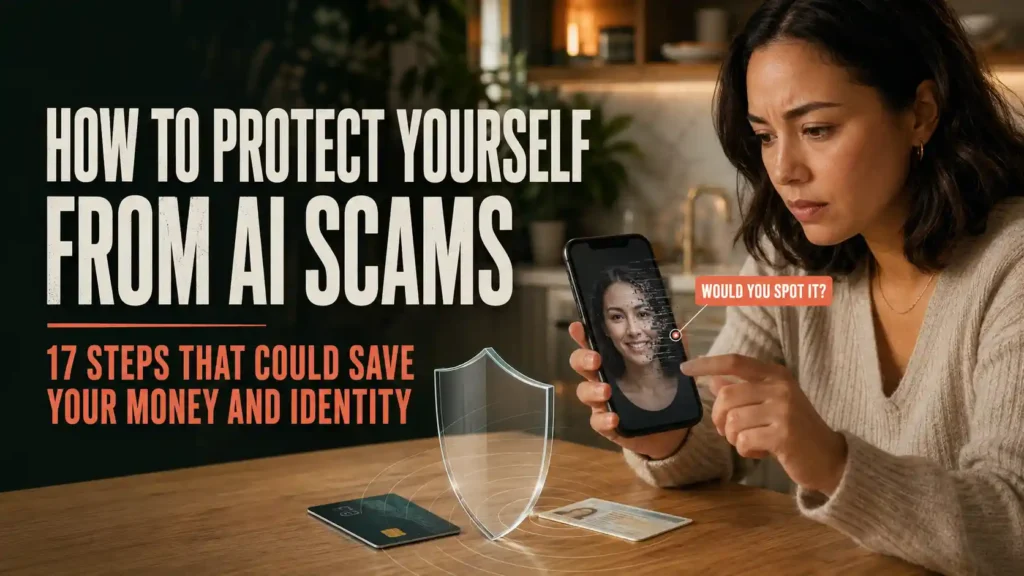
The voice on the phone sounds exactly like your son.
He is breathing heavily. He says he has been arrested after an accident and needs money before anyone else finds out. Then another person takes the phone, introduces himself as a lawyer and tells you where to send the payment.
Everything feels real because the fear in the voice is real to you.
But your son may be completely safe. The frightened voice could have been created from a short recording found online. The lawyer may be a scammer waiting for panic to overpower your judgment.
Artificial intelligence has given criminals more convincing ways to impersonate relatives, employers, banks, celebrities and government officials. It can create realistic voices, manipulate videos, write personalized phishing messages and build entire online identities around a lie.
Fortunately, protecting yourself does not require advanced technical knowledge.
The strongest defense is a set of habits that still work when a voice clone sounds perfect or a deepfake video shows no obvious glitches. These 17 practical steps will help you verify unexpected requests, reduce the information criminals can use against you and respond safely when something does not feel right.
Why Protecting Yourself From AI Scams Requires a New Approach
You may have been taught to spot scams by looking for spelling mistakes, robotic voices and poorly designed websites.
Those warning signs still exist, but they are no longer enough.
Artificial intelligence can help a criminal create a polished email, natural-sounding conversation or convincing video within minutes. A message may include your name, employer and relatives because the scammer collected those details from public posts, stolen databases or compromised accounts.
That means you should stop treating digital realism as proof of identity.
The question is no longer simply, “Does this look or sound genuine?”
You must also ask, “Can I verify the person, story and request through a separate channel I already trust?”
That shift—from recognition to verification—is the foundation of AI scam protection.
First, begin with the habits that can stop a scam during its most dangerous moment.
17 Steps to Protect Yourself From AI Scams
Each step creates another barrier between the scammer’s convincing story and the action that could cost you money or expose your identity.
1. Pause Before You Click, Pay or Reply
Your first defense against an AI scam is not software. It is a pause.
Scammers use urgency because they know careful thinking is dangerous to their story. They want you to respond while you are frightened, excited, embarrassed or emotionally attached.
Before taking action, ask:
- Did I expect this contact?
- What does this person want from me?
- Why must I act immediately?
- Why am I being discouraged from checking?
- What happens if I wait ten minutes?
- Can I confirm the story independently?
Do not allow the person to remain on the phone while you think. End the call so you can evaluate the situation without continued pressure.
If you receive a message, do not click its links while investigating. Open the relevant organization’s official application or type its known website address into your browser.
A short pause can prevent:
- An irreversible payment
- A stolen password
- An exposed security code
- A malicious download
- An account takeover
- The release of personal information
If the request is genuine, it should survive reasonable verification. If it collapses when you slow down, it was never safe.
2. Verify Every Unexpected Request Through Another Channel
You should never verify a suspicious communication using the contact information inside that communication.
If someone calls claiming to be your child, hang up and call your child through the number already saved in your phone.
If an email supposedly comes from your manager, contact the manager through your company’s internal system or known telephone number.
If a caller claims to represent your bank, use the number printed on your card or inside the official banking application.
Do not:
- Press redial
- Call a number supplied in the message
- Click a verification link sent by the caller
- Trust the displayed caller name
- Assume an email signature proves identity
- Continue communicating through a newly created account
Caller identification can be manipulated. Email addresses can be imitated. Social-media accounts can be copied or compromised.
Independent verification breaks the scammer’s control because you leave the communication environment the criminal created.
Readers can use how to spot an AI scam when they need a complete checklist for examining suspicious voices, videos and messages.
3. Create a Private Family Safe Word
A family safe word gives you a fast way to challenge someone who claims to be a relative during an emergency.
Choose a word or short phrase that:
- Every trusted family member can remember
- Has never been posted online
- Is unrelated to birthdays or addresses
- Cannot be found in family photographs
- Is not a common pet name
- Would be difficult for a stranger to guess
Explain that anyone requesting emergency money must provide the safe word.
Do not send the word through an unprotected family group or post it in a shared online document. Discuss it privately and change it if you suspect it has been exposed.
A safe word is particularly valuable when a caller sounds frightened or the connection is poor. Background noise, crying and urgency can hide defects in an artificial voice.
However, the safe word should not be your only defense. A compromised email or messaging account may expose private conversations. After asking for the word, call the relative through a trusted number.
4. Establish a Family Callback Rule
A safe word tests the caller, while a callback rule tests the communication itself.
Agree that nobody in your family will send money or reveal sensitive information based solely on an incoming call.
The rule should be simple:
- End the unexpected call.
- Call the person through a saved number.
- Contact another relative if the person does not answer.
- Verify the situation before sending anything.
Everyone should understand that ending the call is not rude or uncaring. It is the agreed safety procedure.
This rule can protect older relatives who may receive fake grandchild emergencies. It can also protect parents from cloned calls supposedly coming from their children.
Practice the response before it is needed:
“I want to help, but I must verify this call. I will contact you through the number I already have.”
A scammer may object, threaten or insist that you remain on the line. That resistance gives you another reason to end the conversation.
5. Stop Treating Voices and Videos as Proof
Hearing a familiar voice or seeing a recognizable face can create immediate trust. AI impersonation exploits that instinct.
A voice clone may copy someone’s:
- Accent
- Pitch
- Speaking rhythm
- Emotional tone
- Common expressions
A deepfake video may reproduce someone’s:
- Face
- Mouth movements
- Expressions
- Gestures
- Apparent surroundings
You should still watch for unnatural pauses, mismatched lips, strange lighting and facial distortions. However, do not make your safety depend on spotting a technical mistake.
The content may look and sound completely believable.
Verify the request based on context and procedure:
- Is the person using the normal contact method?
- Does the request fit their usual behavior?
- Why are normal procedures being bypassed?
- Why must the payment happen immediately?
- Can the supposed person confirm through another channel?
A polished deepfake does not make an unreasonable request reasonable.
Understanding what AI scams are will help your family recognize why sight and sound can no longer provide sufficient proof on their own.
6. Ask Unexpected Questions
If someone claims to be a person you know, interrupt the prepared story with an unexpected question.
Ask about a private detail that has never appeared online, such as:
- A shared experience
- An inside joke
- A recent private conversation
- A family safe word
- A detail from the last time you met
Avoid questions based on publicly available information. A scammer may know:
- Birthdays
- Schools
- Employers
- Pet names
- Travel destinations
- Relatives’ names
- Home addresses
Artificial intelligence can organize those details and help the scammer answer predictable questions.
Listen carefully to the response. A scammer may:
- Ignore the question
- Give a vague answer
- Repeat the urgent demand
- Become angry
- Claim there is no time
- Redirect the conversation
- End the call
A correct answer does not prove the person is genuine, especially if private accounts have been compromised. Use the question as one layer of verification, then call the person independently.
7. Never Share One-Time Codes or Recovery Information
A one-time security code can give a criminal access to your account even when the scammer does not know your complete password.
The criminal may attempt to sign in or reset your password. The real service sends a code to your phone. The scammer then contacts you while pretending to represent the company.
You may hear:
- “Read the code so I can secure your account.”
- “I need it to cancel the unauthorized transaction.”
- “The number confirms your identity.”
- “This will stop the password change.”
- “The code is required to process your refund.”
Do not share it.
You should never reveal:
- One-time passwords
- Login verification codes
- Password-reset links
- Backup codes
- Authentication approvals
- Account recovery codes
- Personal identification numbers
- Answers to security questions
If an unexpected caller requests any of these, end the conversation.
Open the official application and inspect your account. Change your password if you suspect someone attempted to access it.
Your email account deserves special protection because a criminal may use it to reset passwords for your banking, shopping and social-media accounts.
8. Strengthen Your Important Accounts With Multifactor Authentication
A password alone may not be enough to protect you after a data breach or phishing attack.
Multifactor authentication adds another requirement before someone can enter your account. Depending on the service, you may confirm a login with:
- An authentication application
- A physical security key
- A biometric check
- A code sent to your device
- An approval notification
Use the strongest method available. An authentication application or physical security key generally gives you better protection than relying only on text-message codes.
Start with accounts that can unlock the rest of your digital life:
- Primary email
- Banking and payment accounts
- Password manager
- Cloud storage
- Social-media accounts
- Mobile-phone provider
- Workplace systems
Save recovery codes in a secure offline location. Do not leave them inside an unprotected note or email.
Multifactor authentication cannot prevent every AI scam. It will not help if you voluntarily approve a fraudulent login or reveal the code. That is why account security and careful verification must work together.
Strong account security can limit the damage after a password is stolen, but you also need to reduce the information and opportunities scammers can use against you.
9. Use a Different Password for Every Important Account
Reusing one password across several accounts creates a dangerous chain reaction.
If criminals obtain the password from one website, they can use automated tools to test it against your email, banking, shopping and social-media accounts.
Protect yourself by creating a unique password for every important account.
A strong password should be:
- Long
- Difficult to guess
- Unrelated to personal information
- Used for only one account
- Stored securely
Avoid passwords based on:
- Your name
- Birth date
- Phone number
- Child’s name
- Pet’s name
- Favorite sports team
- Repeated characters
- Predictable number sequences
A reputable password manager can generate and store unique passwords for you. This means you need to remember only the strong master password protecting the manager.
Never share your master password with anyone who contacts you unexpectedly. A legitimate company representative does not need it to fix your account.
You should also change any password that has been exposed, reused or entered on a suspicious website. Begin with your email because access to it may allow a criminal to reset other passwords.
10. Reduce the Personal Information Available Online
AI scams become more convincing when criminals can personalize them with accurate details about your life.
Review what a stranger can discover through your social-media profiles, professional pages and public posts.
Consider hiding or removing:
- Your complete date of birth
- Phone number
- Home address
- Personal email address
- Children’s schools
- Workplace location
- Daily schedule
- Travel plans
- Family relationships
- Photographs of identity documents
- Vehicle registration details
- Financial information
Pay attention to what appears in the background of photographs and videos. A school uniform, house number, employee badge, boarding pass or certificate may reveal more than you intended.
Review your privacy settings, but do not assume they create complete protection. Followers can save, copy or redistribute your content. Accounts can also be compromised.
Ask family members not to publish sensitive details about you without permission. A private profile belonging to you cannot protect information posted publicly by someone else.
You do not need to disappear from the internet. You need to stop giving strangers all the pieces required to construct a convincing impersonation.
11. Be Careful With Public Voice and Video Recordings
Voice cloning can use audio taken from social-media videos, podcasts, interviews, presentations, voicemail greetings and other public recordings.
This does not mean you must stop speaking online, especially if creating content is part of your work. It means you should assume that any public recording can be copied.
Protect yourself by:
- Avoiding unnecessary personal details in public videos
- Limiting who can view family recordings
- Reviewing old public content
- Removing recordings that reveal sensitive information
- Warning relatives that your voice could be imitated
- Using a family safe word for emergency verification
- Refusing to use voice recognition as your only proof of identity
Parents should think carefully before sharing children’s names, voices, schools, locations and routines together. That combination can give a criminal enough information to create a frightening emergency story.
The goal is not to eliminate every recording. It is to ensure that a voice sample alone cannot authorize a payment or reveal sensitive information.
12. Inspect Messages Without Trusting Good Grammar
You may have learned that scams contain spelling mistakes and awkward sentences. AI can now help criminals write messages that sound polished, professional and personal.
A well-written email is not automatically safe.
Examine:
- The complete sender address
- The domain name
- The destination of every link
- The reason for the contact
- The requested action
- Any unexpected attachment
- Changes to normal payment instructions
- Pressure to communicate through another platform
Look for subtle changes such as:
- A replaced letter
- An added hyphen
- An unfamiliar domain ending
- A slightly misspelled brand
- Extra words inside the address
- A display name hiding an unrelated email
Do not click a link merely to investigate it. Type the organization’s known website address into your browser or open its official application.
If the message concerns an account problem, check the account directly. A real warning should normally appear there as well.
AI may improve the wording, but how AI scams work still depends on pushing you from a convincing message into an unsafe action.
13. Refuse High-Risk Payment Methods
Create strict payment rules before someone places you under pressure.
Never send money to an unexpected caller through:
- Gift cards
- Cryptocurrency
- Cash couriers
- Wire transfers
- Prepaid cards
- Cryptocurrency machines
- Unfamiliar payment applications
- Accounts belonging to unrelated individuals
Be especially cautious if someone tells you to:
- Visit several shops
- Buy cards in smaller amounts
- Read gift-card numbers over the phone
- Send a photograph of a receipt
- Convert your savings into cryptocurrency
- Hide the reason for the payment
- Lie to your bank or cashier
- Remain on the phone during the transaction
A person asking you to mislead your bank is not protecting you. The person is trying to bypass the employee or system most likely to stop the payment.
No legitimate police department, government agency or bank requires gift cards to resolve a problem. A genuine organization should provide verifiable payment details and enough time to check them.
Your safest rule is simple: no unexpected payment until independent verification is complete.
14. Do Not Move Money to a Supposed “Safe Account”
A scammer may call and claim that criminals have accessed your bank account. The solution sounds urgent but reassuring: transfer your money to a protected account before it is stolen.
The destination may be called:
- A safe account
- A government holding account
- A protected wallet
- A temporary security account
- A safeguarding account
These names are part of the deception.
Your bank does not need you to move your money into an unfamiliar account during an unsolicited call. It can freeze suspicious transactions, restrict access or replace compromised credentials.
If you receive this instruction:
- End the call.
- Do not transfer anything.
- Call the number printed on your bank card.
- Explain exactly what happened.
- Review recent account activity.
- Change exposed login information.
Do not call a number supplied by the person. Do not trust caller identification, even if your bank’s name appears on the screen.
Never install an application that a supposed bank employee tells you to use. It may give the scammer remote access to your device.
15. Verify Investments, Jobs and Romantic Identities Independently
AI scams do not always begin with a frightening emergency. Some develop slowly through trust, hope or affection.
You may receive:
- A highly paid remote job offer
- A guaranteed investment opportunity
- A romantic message from an attractive stranger
- A celebrity-backed cryptocurrency promotion
- A business proposal matching your experience
- An offer to recover money lost to another scam
The scammer may use AI-generated photographs, polished messages, fake documents and video calls to support the story.
Before accepting a job
Verify the company through its official website. Contact its human-resources department using independently obtained information.
Never pay for equipment, background checks, training or software through an unfamiliar supplier chosen by the recruiter.
Be cautious when an interview happens only through text or an encrypted messaging application.
Before investing
Confirm that the company and individual are properly registered or licensed where required.
Do not rely on:
- Celebrity videos
- Testimonials
- Screenshots of profits
- Online dashboards
- Social-media comments
- Articles supplied by the promoter
- Withdrawal claims from supposed investors
Scammers can generate or coordinate all of them.
Never assume that a website balance represents real money. Fraudulent platforms may display invented profits to encourage larger deposits.
Before trusting an online romantic partner
Take your time. Reverse-search profile photographs and verify details independently.
Be cautious if the person:
- Avoids meeting
- Repeatedly cancels video calls
- Declares love unusually quickly
- Introduces financial emergencies
- Recommends an investment
- Requests cryptocurrency
- Claims that another person controls their accounts
A convincing photograph, voice or video does not prove that the identity and story are genuine.
16. Create Financial Safeguards for Your Family and Workplace
You should not rely on one person making a perfect decision during a stressful moment. Build procedures that make unsafe actions harder.
For your family, consider:
- A safe word
- A callback rule
- A second person approving large transfers
- Transaction alerts
- Withdrawal limits
- Regular conversations about new scams
- A trusted contact for vulnerable relatives
For your workplace, require secondary approval for:
- Wire transfers
- Payroll changes
- New supplier accounts
- Changes to banking details
- Large purchases
- Password resets
- Confidential data requests
- Unusual executive instructions
Voice recognition, video meetings and writing style should never replace established financial controls.
Employees need permission to question authority without fearing punishment. A useful workplace response is:
“I will verify this request through our normal approval process before taking action.”
A genuine executive should support that procedure. A scammer will often try to prevent it.
Review financial processes regularly and update them as threats change. Studying AI scams in 2026 can help your family or workplace prepare for current impersonation tactics without relying on outdated assumptions.
17. Prepare a Response Plan Before You Need It
Even careful people can click a fraudulent link, reveal information or send money under pressure. A written response plan helps you act quickly instead of losing more time to panic or embarrassment.
Your plan should include:
- Your bank’s official fraud number
- Contact information for card issuers
- Instructions for freezing payment cards
- Steps for changing important passwords
- Contact details for your mobile provider
- Instructions for freezing or monitoring credit
- Relevant fraud-reporting channels
- A trusted person you can call
- A safe location for account-recovery information
If you suspect an AI scam:
- Stop communicating with the person.
- Do not send additional money.
- Contact the payment provider immediately.
- Change any exposed passwords.
- Secure your email account first.
- Sign out of unfamiliar devices.
- Preserve messages, receipts and account details.
- Report the fraudulent account or content.
- Warn anyone whose identity was impersonated.
- Monitor your financial and online accounts.
Do not pay a person or company promising guaranteed recovery. Criminals often contact victims again while pretending to be investigators, lawyers or recovery specialists.
The faster you respond, the greater your chance of limiting the damage.
Can AI-Detection Tools Protect You From AI Scams?
AI-detection tools can examine suspicious text, photographs, audio and video. They may identify patterns that are difficult for you to notice.
However, no detector should become your only protection.
A genuine file may be incorrectly flagged as artificial. A sophisticated deepfake may avoid detection. Results may also become less reliable after content has been compressed, edited, filtered or recorded from another screen.
Scammers can combine genuine and artificial material. For example, they may attach fake audio to a real video or place a real photograph inside a fabricated advertisement.
Use detection tools as supporting evidence, not final proof.
A more reliable process is to:
- Examine the content.
- Evaluate the request.
- Verify the person separately.
- Confirm the claim independently.
- Refuse to act if verification fails.
Readers who regularly encounter suspicious media can learn how to detect AI-generated content without assuming that one visual defect or detector score settles the question.
What to Do If an AI Scammer Already Contacted You
Your response depends on whether you only received the contact or actually shared money or information.
If you did not respond
Block the account or number and report it through the platform. Warn the person or organization being impersonated.
Keep a screenshot or record in case the scammer contacts you again through another account.
If you clicked a link
Close the page and do not download anything.
If you entered login information, change the password immediately using the official website or application. Change it anywhere else you reused it.
Review login sessions and enable multifactor authentication.
If you installed an application
Disconnect the device from the internet if you suspect remote access.
Use another trusted device to change important passwords. Remove unfamiliar software and run an updated security scan.
Contact your bank if financial information may have been visible.
🚨 Don’t wait until identity theft costs you—discover 11 practical steps to protect yourself and your family →
If you shared personal information
Document exactly what you revealed.
Monitor financial accounts and credit information. Consider a fraud alert or security freeze where available.
Be prepared for additional scams because criminals may reuse or sell your information.
If you sent money
Contact the bank, card issuer or payment service immediately. Ask whether the payment can be stopped, recalled or disputed.
Keep receipts, messages, account numbers and cryptocurrency wallet addresses.
Do not let embarrassment delay you. The scammer is responsible for the deception, but you are responsible for acting quickly to limit further damage.
Frequently Asked Questions About Protecting Yourself From AI Scams
These answers cover the practical questions you may have while building your defenses.
What is the best way to protect yourself from AI scams?
Verify every unexpected request through a separate contact method before sending money, clicking a link or sharing sensitive information.
How can you protect yourself from AI voice scams?
Create a family safe word, establish a callback rule and never trust a familiar voice without independent verification.
Can AI clone your voice from social media?
Public audio may provide material for a voice imitation. Treat voice recognition as one clue rather than proof of identity.
Should you delete all your online videos?
Not necessarily. Limit sensitive information, review privacy settings and ensure that your voice alone cannot authorize payments or account changes.
🚨 Don’t wait until identity theft costs you—discover 11 practical steps to protect yourself and your family →
How do you verify a suspicious call from a relative?
Hang up and call the relative using a trusted number already saved in your phone. Contact another family member if necessary.
Can caller identification be trusted?
No. A displayed name or telephone number does not reliably prove who is calling.
Should you trust a live video call?
Not automatically. Verify unusual financial or information requests through another channel, even if the person appears during a live video conversation.
What should you do if someone asks for a security code?
Do not share it. End the conversation and contact the organization through its official application or verified telephone number.
Are AI-written phishing messages easy to recognize?
Not always. AI can produce polished, personalized messages. Inspect the sender, links, request and surrounding pressure.
Can an AI detector confirm that a video is fake?
It may provide a useful clue, but it cannot guarantee an accurate result. Independent verification remains essential.
How can you protect older relatives?
Explain voice cloning, establish a safe word, create a callback rule and encourage them to contact a trusted person before making unusual payments.
How can a business prevent deepfake payment fraud?
Require secondary approval and independent verification for transfers, supplier changes and sensitive requests.
What payment methods commonly appear in AI scams?
Gift cards, cryptocurrency, wire transfers, cash couriers and other difficult-to-reverse payments deserve particular caution.
What should you do after sending money to an AI scammer?
Contact the payment provider immediately, preserve the evidence, secure affected accounts and report the fraud.
Can you recover money lost to an AI scam?
Recovery depends on the payment method and how quickly you act. Nobody can honestly guarantee recovery, particularly in exchange for an upfront fee.
Final Thoughts
Protecting yourself from AI scams does not require you to identify every artificial voice, image or video with perfect accuracy.
You need habits that remain effective when the deception looks real.
Pause before acting. Verify through a trusted channel. Protect your security codes. Use strong, unique passwords. Establish family and workplace procedures. Refuse unusual payment methods and prepare a response plan before an emergency occurs.
Artificial intelligence can help a scammer copy a voice, manufacture a face and personalize a story. It cannot make an unverified request safe.
When money, account access or sensitive information is involved, trust should never be assumed. It should be confirmed.
🚨 Don’t wait until identity theft costs you—discover 11 practical steps to protect yourself and your family →

Pingback: 5 Small Habits That Make You a Hard Target - SafeGuard Press
Pingback: What Are AI Scams? How Artificial Intelligence Is Making Fraud Harder to Spot - SafeGuard Press
Pingback: AI Family Emergency Scam: How Criminals Clone a Loved One’s Voice and Make the Lie Feel Real - SafeGuard Press
Pingback: AI Kidnapping Scam: How to Verify the Terrifying “Mom, I’m in Trouble” Call - SafeGuard Press