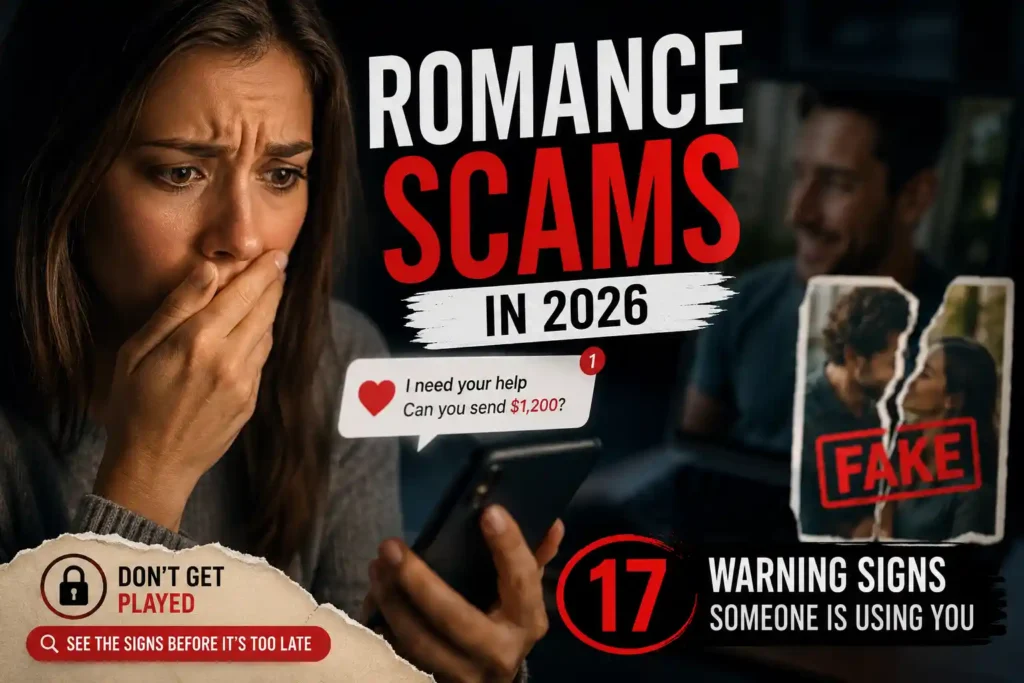
Romance Scams in 2026: 17 Warning Signs Someone Is Using You

The most dangerous romance scam does not begin with a request for money.

It begins with a good-morning message.

Someone remembers the small details you shared yesterday. They ask whether you slept well, listen when you feel lonely and make you believe you have finally met a person who truly understands you.

Soon, the messages become the best part of your day.

Then something goes wrong.

They cannot access their money. A medical emergency appears. A business deal is about to collapse. They need help buying a ticket so they can finally meet you.

By the time money enters the conversation, sending it may no longer feel like paying a stranger. It feels like helping someone you love.

That emotional shift is exactly what makes romance scams so destructive.

In 2026, a romance scammer can use artificial intelligence to write natural messages, generate realistic photographs, clone voices and manipulate video calls. Some criminals spend weeks or months building trust before making their first financial request.

This guide reveals 17 warning signs that someone may be using you. You will learn how romance scams develop, which stories scammers repeat and how to protect your heart, identity and savings without becoming afraid of genuine relationships.

❤️ A romance scammer does not steal your money first—they carefully earn the trust that protects it. Never Get Scammed Again by Daniel Mercer helps you recognise manipulation before affection turns into financial pressure. 👉 Use the 11 practical steps to protect your finances, identity, family and future before a convincing stranger becomes difficult to question.

What Is a Romance Scam?

A romance scam happens when someone creates a false identity or relationship to gain your affection, trust and money.

The scammer may contact you through:

  • A dating application
  • Social media
  • A messaging platform
  • An online game
  • A professional networking site
  • A wrong-number text
  • An email
  • A fan or community group

They may pretend to be looking for love, friendship or marriage. However, the relationship is designed to achieve another goal.

That goal may involve:

  • Stealing your money
  • Collecting identity information
  • Leading you into a fake investment
  • Obtaining intimate photographs
  • Using your bank account
  • Persuading you to receive packages
  • Taking over your online accounts
  • Recruiting you into money laundering
  • Blackmailing you

Not every person who lies online is running a financial scam. However, when false identity, emotional manipulation and financial requests appear together, you are no longer dealing with an ordinary dating problem.

How Romance Scams Work

Romance scams often follow a predictable emotional sequence.

Recognising that sequence can help you see the manipulation before the financial request arrives.

The Scammer Chooses a Believable Identity

The criminal creates a personality likely to attract trust or sympathy.

They may pose as:

  • A military officer
  • A doctor working overseas
  • An engineer on a remote project
  • A widowed business owner
  • A celebrity
  • A wealthy investor
  • An aid worker
  • An offshore worker
  • A single parent
  • A contractor travelling abroad

These identities explain why they cannot meet you immediately. They also create future excuses involving travel, money and emergencies.

They Study What You Need Emotionally

A romance scammer listens carefully.

They may ask about:

  • Previous relationships
  • Family difficulties
  • Financial worries
  • Loneliness
  • Retirement
  • Future plans
  • Religious beliefs
  • Personal disappointments

This can feel like emotional intimacy. However, the scammer may be identifying your hopes, fears and boundaries.

They use what you reveal to construct a partner who appears perfectly matched to you.

The Relationship Moves Quickly

The person may call you their soulmate, discuss marriage or say they have never felt this way before.

Rapid affection creates emotional commitment before you have enough evidence to verify who they are.

They Isolate the Relationship

The scammer may persuade you to leave the dating platform and communicate privately.

Later, they could discourage you from discussing the relationship with friends or relatives.

Isolation protects the story from people who might recognise the warning signs.

A Financial Opportunity or Crisis Appears

Once the relationship feels secure, the scammer introduces money.

They may claim to need help with:

  • Medical treatment
  • Travel costs
  • Customs fees
  • Legal expenses
  • A frozen bank account
  • A family emergency
  • Military leave
  • A business problem
  • Cryptocurrency investment
  • A package containing valuables

The first request may be small. If you pay, the emergencies usually grow.

The Scammer Uses Your Emotions to Keep You Paying

When you question the request, they may accuse you of not trusting them.

They might withdraw affection, become angry or remind you of the future you planned together.

The relationship becomes a lever. Love is offered when you cooperate and threatened when you resist.

Why Romance Scams Are Harder to Spot in 2026

Traditional warning signs are becoming less reliable.

A person who refused every video call once looked suspicious. Today, a scammer may appear during a manipulated call using face-changing technology, prerecorded footage or an artificial voice.

You might see a face and hear a voice without speaking to the real person in the photographs.

Artificial intelligence can also help criminals:

  • Maintain several conversations
  • Remember personal details
  • Write romantic messages
  • Translate conversations naturally
  • Generate photographs
  • Create identity documents
  • Produce voice notes
  • Answer questions consistently
  • Personalise investment pitches

This does not mean every polished message or awkward video call is fraudulent. It means you cannot use one piece of digital evidence as complete proof.

A photograph proves that an image exists. It does not prove who sent it.

A video call shows you a moving face. It does not automatically confirm the person’s identity, location or intentions.

Your strongest protection is independent verification combined with clear financial boundaries.

Romance Scams vs. Catfishing: What Is the Difference?

Catfishing happens when someone uses a false online identity to deceive another person.

Their motive might involve attention, insecurity, entertainment, revenge or emotional control. They may not ask for money.

A romance scam has a clearer criminal objective. The false relationship is used to obtain money, financial access, private information or another benefit.

The two can overlap.

A person may begin by catfishing for attention and later request money. A professional scammer may use catfishing from the first message as part of a planned financial crime.

You do not need to determine the person’s exact label before protecting yourself. If their identity cannot be verified and financial pressure begins, stop sending money.

17 Romance Scam Warning Signs You Should Never Ignore

A single unusual behaviour may have an innocent explanation. Several warning signs forming a pattern deserve your full attention.

1. They Fall in Love Unusually Fast

You have known each other for only a few days or weeks, but the person already calls you their soulmate.

They may say:

  • “I have never connected with anyone like this.”
  • “You are the person I have been waiting for.”
  • “I know we are meant to be together.”
  • “I want to spend my life with you.”
  • “God brought you into my life.”

The affection feels intense because it is designed to be.

This behaviour is often called love bombing. The person overwhelms you with compliments, attention and promises before a genuine relationship has had time to develop.

Rapid affection can create a sense of obligation. When the first financial request arrives, you may feel that refusing would betray the relationship.

Healthy attraction can develop quickly, but trust still requires time, consistency and shared reality.

Someone who genuinely cares about you should respect a slower pace.

2. Their Profile Looks Almost Too Perfect

The person appears unusually attractive, successful and emotionally available.

Their profile may show:

  • Professional photographs
  • Luxury travel
  • A prestigious career
  • Expensive vehicles
  • A beautiful home
  • A carefully written biography
  • Very little ordinary daily life

A perfect-looking profile does not automatically prove fraud. However, examine whether the photographs and story feel authentic together.

Warning signs include:

  • Recently created accounts
  • Few genuine interactions
  • Followers from unrelated locations
  • Comments that do not match the person
  • Inconsistent ages
  • Different names attached to the same photograph
  • A profile history that begins suddenly

Use a reverse-image search on several photographs. One image appearing elsewhere does not always prove deception, but finding it under different names is a strong warning.

Remember that artificial images may not appear in any previous search. A clean result does not guarantee that the photograph belongs to the person contacting you.

3. Their Story Makes Meeting Difficult

The person lives, works or travels somewhere that prevents an immediate meeting.

They may claim to be:

  • Deployed with the military
  • Working on an offshore platform
  • Completing a construction project abroad
  • Providing medical care in a conflict area
  • Managing an international business
  • Travelling under a confidential contract
  • Caring for a sick relative overseas

These situations solve a practical problem for the scammer: they explain why the relationship must remain entirely online.

A long-distance relationship can be genuine. The warning appears when distance is combined with repeated excuses, identity inconsistencies and requests for money.

Ask specific questions about their work and location. Then verify the details independently.

Do not rely on uniforms, identification cards, contracts or travel documents they send you. Those materials can be copied or fabricated.

4. They Want to Leave the Dating Platform Quickly

After a brief conversation, the person asks to move to text, email or a private messaging application.

They may say:

  • The dating platform is inconvenient
  • Their subscription is expiring
  • They want more privacy
  • They rarely check the application
  • They feel a special connection with you

Moving to another platform is normal in many genuine relationships. However, scammers have additional reasons for doing it.

A private channel may:

  • Reduce the dating platform’s ability to detect them
  • Prevent their account from being linked to the conversation
  • Make reporting more difficult
  • Allow them to send dangerous links
  • Give them your telephone number
  • Create greater emotional intimacy

Stay on the original platform until you have built reasonable confidence in the person’s identity.

If you move elsewhere, preserve the original profile and conversation. A scammer may delete the account once they have secured another way to contact you.

5. They Avoid Live, Unscripted Video Calls

Every attempt to video call ends with an excuse.

Their camera is broken. The internet connection is poor. Their employer forbids video. Their location is too dangerous.

Eventually, they may send a short video or appear briefly on camera.

That still may not prove their identity.

A prerecorded clip can be presented as live, while artificial tools can alter a person’s face or voice. Focus on whether the conversation is natural and interactive.

During a video call, ask the person to respond to an unexpected but harmless request, such as discussing a specific detail from your current conversation.

Be cautious if:

  • Their mouth and voice do not align
  • Their face distorts when they move
  • They avoid turning their head
  • The call always lasts a few seconds
  • They refuse spontaneous questions
  • The screen repeatedly freezes at convenient moments
  • Their appearance differs from their photographs

Do not treat a video call as complete verification. Confirm their employer, location and personal story through independent information too.

6. Their Personal Details Keep Changing

Small inconsistencies begin appearing in their story.

They might forget:

  • Their child’s age
  • The city where they grew up
  • Their military rank
  • The name of their employer
  • Their birthday
  • Their time zone
  • The year their spouse died
  • Details they previously shared

One forgotten detail does not prove fraud. People make mistakes, and honest conversations can contain misunderstandings.

But repeated contradictions matter.

Professional romance scams may involve several criminals sharing the same profile. One person handles morning messages, another takes evening calls and someone else introduces the financial request.

Differences in vocabulary, tone and memory may reveal that more than one person controls the account.

Save important conversations if you feel uncertain. Reviewing the messages side by side can make inconsistencies easier to see.

7. They Always Have a Reason They Cannot Meet You

You make plans to meet, but something repeatedly happens at the last moment.

Their flight is cancelled. A work emergency appears. A relative becomes ill. Their passport is held. Their employer extends the assignment.

The excuses may be accompanied by emotional messages about how disappointed they feel.

Then money enters the story.

They need help with:

  • A new airline ticket
  • Visa fees
  • Medical expenses
  • Customs charges
  • Transportation
  • Emergency accommodation
  • Travel insurance

Do not pay for a stranger to meet you.

If the person genuinely intended to travel, they should be able to manage their own arrangements or find a solution that does not require your money.

Repeatedly cancelled meetings reveal something important even when no money is requested: the relationship is not moving from promises into reality.

✈️ The promise of finally meeting can make one more payment feel reasonable—even after several broken plans. Never Get Scammed Again by Daniel Mercer shows you how scammers use hope, urgency and emotional commitment to weaken financial boundaries. 👉 Learn the 11 protective steps before another excuse turns your affection into an expensive obligation.

8. They Ask for Money During an Emergency

The first financial request usually comes with a crisis.

The person may claim that:

  • They need urgent medical treatment
  • A relative is in hospital
  • Their bank account has been frozen
  • Their wallet was stolen
  • Their business equipment is trapped at customs
  • They cannot afford food or accommodation
  • A legal problem prevents them from accessing money
  • They need to repair a vehicle
  • Their child requires urgent care

The emergency is designed to make verification feel cruel.

You may be told there is no one else they can trust. Refusing to help can feel like abandoning someone during their worst moment.

But ask yourself a simple question: how did this person handle emergencies before meeting you?

A financially successful business owner, military professional or international contractor should have access to colleagues, relatives, insurance, employers or emergency services.

Do not send money because the deadline makes you afraid.

Ask for verifiable information about the hospital, lawyer, employer or service involved. Contact that organisation independently—not through a number supplied by the person.

If the story collapses when you try to verify it, the emergency was probably manufactured.

9. They Tell You How to Send the Money

The person does not simply ask for help. They control the payment method.

They may instruct you to use:

  • Cryptocurrency
  • Gift cards
  • A wire transfer
  • A payment application
  • Cash
  • A money-transfer service
  • A cryptocurrency ATM
  • An unfamiliar bank account

They may claim these methods are faster, safer or necessary because they are overseas.

The recipient’s name may not match the person you believe you are dating. They explain that the account belongs to a friend, colleague, lawyer, agent or relative.

That explanation should not comfort you. It makes the payment harder to connect to the person who requested it.

Be especially cautious if they remain on the telephone while you:

  • Visit your bank
  • Purchase gift cards
  • Withdraw cash
  • Open a cryptocurrency account
  • Use a cryptocurrency ATM
  • Complete a transfer

They may tell you what to say if a bank employee asks questions.

Never lie to your bank about why you are sending money. If someone instructs you to hide the relationship or payment purpose, stop immediately.

💸 Romance scammers do not only decide why you should pay—they often control when, where and how the money leaves your hands. Never Get Scammed Again by Daniel Mercer helps you recognise these pressure patterns before affection overrides your judgment. 👉 Use the 11 practical steps to protect your finances, identity, family and future before an emotional request becomes an irreversible payment.

10. They Introduce a “Guaranteed” Investment

The person appears financially successful and offers to help you build a better future.

They may say they earn impressive returns through:

  • Cryptocurrency
  • Foreign-exchange trading
  • Gold
  • Artificial-intelligence trading
  • Stock tips
  • Digital assets
  • A private investment group
  • A family trading strategy

At first, they do not ask you to send money directly to them. Instead, they introduce you to a trading platform that appears professional.

Your first deposit may show a profit. You might even be allowed to withdraw a small amount.

That early success is designed to make the platform feel legitimate.

The person encourages you to invest more, perhaps linking the decision to your shared future. They may talk about buying a home, travelling together or retiring early.

Your account balance grows rapidly on the screen. However, the figures may be completely controlled by the scammers.

When you try to withdraw a larger amount, the platform demands:

  • Taxes
  • Insurance
  • A verification deposit
  • A liquidity fee
  • An account upgrade
  • A security payment

Paying the fee does not release your money. It creates another demand.

Do not invest through a platform introduced by someone you met online, regardless of how long you have communicated.

Verify the company and investment independently. Do not rely on licences, reviews, account statements or customer-support contacts supplied by the same person.

A genuine investment carries risk. Anyone promising guaranteed profits is hiding the truth.

11. They Pressure You to Keep the Relationship Secret

The person says other people will not understand your connection.

They may warn you that:

  • Your children are jealous
  • Your friends want you to remain lonely
  • Your bank does not understand the investment
  • Your relatives are too controlling
  • Their work requires secrecy
  • Public attention could endanger them
  • Discussing the relationship will ruin your future together

This separates you from the people most likely to challenge the story.

The scammer may also become angry when you mention that a friend expressed concern. They frame verification as betrayal and obedience as love.

A healthy relationship should not require you to hide financial decisions from everyone you trust.

You are allowed to discuss the relationship with a friend, relative, counsellor or financial professional. Someone with genuine intentions should understand that online relationships require reasonable caution.

If the person repeatedly creates conflict between you and your support network, the isolation may be deliberate.

12. They Ask for Intimate Photographs or Videos

The conversation becomes sexual, and the person asks you to share private images.

They may send an intimate photograph first to make the exchange feel mutual. That image may be stolen, artificial or unrelated to the person messaging you.

Once you respond, the tone changes.

The scammer threatens to send your content to:

  • Your family
  • Your employer
  • Friends
  • Colleagues
  • Social-media contacts
  • Members of your religious community

They demand money to keep the material private.

Paying rarely ends the threat. It proves that fear can be used to collect more money.

Do not send additional photographs or payments.

Preserve the evidence and stop negotiating. Secure your social-media accounts, reduce public access to your contacts and report the profile.

If the threat involves a child or young person, involve a trusted adult and the appropriate authorities immediately. Do not let shame prevent urgent action.

You did not give the scammer permission to threaten or distribute your private content. The wrongdoing belongs to the person using it for blackmail.

13. They Want to Use Your Bank Account

The person claims they cannot receive money because of a banking, business or travel problem.

They ask you to accept a payment and forward it elsewhere.

You may be told to:

  • Receive a business payment
  • Transfer money to an associate
  • Convert funds into cryptocurrency
  • Withdraw cash
  • Purchase gift cards
  • Pay a supplier
  • Open a new bank account
  • Create a cryptocurrency wallet

The money may come from another scam victim, a hacked account or stolen payment information.

By moving it, you could become part of a money-laundering operation.

The person may allow you to keep a percentage, making the arrangement feel like a favour that benefits both of you.

Do not receive or transfer money for someone you have only met online.

If suspicious funds have already entered your account, do not spend or forward them. Contact your bank’s fraud department and explain the complete situation.

Hiding the relationship or inventing a false explanation can make the situation worse.

14. They Ask You to Receive or Forward Packages

The person sends products to your address and asks you to forward them to another location.

They may describe the arrangement as:

  • Helping with their business
  • Receiving a romantic gift
  • Testing a shipping service
  • Avoiding international delivery problems
  • Assisting a deployed service member
  • Collecting supplies for a project

The packages may contain goods purchased using stolen cards or compromised accounts.

Your name and address appear in the delivery record while the person directing the operation remains hidden.

You could be asked to:

  • Remove invoices
  • Replace labels
  • Photograph the contents
  • Combine several packages
  • Send expensive electronics overseas
  • Use prepaid shipping labels

Do not reship products for an online romantic partner.

If a suspicious package has already arrived, preserve the shipping label and messages. Do not forward it until you have spoken with the delivery provider and appropriate reporting service.

A genuine partner does not need to turn your home into an anonymous shipping address.

📦 A request that looks like a simple favour can quietly connect your identity and address to stolen property. Never Get Scammed Again by Daniel Mercer shows you how emotional trust can be exploited for financial and criminal schemes. 👉 Learn the 11 protective steps before saying yes to a favour that could put your money, identity or freedom at risk.

15. They Claim to Be in the Military, Royalty or a Public Figure

The person claims to have a position that creates instant credibility, admiration or sympathy.

They may pretend to be:

  • A deployed military officer
  • A celebrity
  • A wealthy royal
  • A senior doctor
  • A famous entrepreneur
  • A diplomat
  • A high-ranking government official
  • A public figure’s representative

Their identity helps explain why the relationship must remain private and why meeting is difficult.

A supposed military member may claim they need money for:

  • Leave
  • Flights home
  • Medical treatment
  • Secure communication
  • Early retirement
  • Replacing lost equipment
  • Shipping personal belongings
  • Accessing money while deployed

A fake celebrity or royal might say they need you to pay for:

  • A fan membership card
  • A private meeting
  • A marriage certificate
  • Security clearance
  • A charitable project
  • Confidential travel arrangements
  • A special communication account

Do not assume a uniform, passport, membership card or video proves the story. Photographs and documents can be copied, altered or artificially generated.

A genuine service member should not need an online romantic partner to pay for leave, food, medical treatment or secure communication.

A real celebrity or royal figure will not secretly begin a relationship with you and then demand gift cards or cryptocurrency.

Verify the identity independently. Do not use the website, assistant or telephone number supplied by the person making the claim.

16. They Become Angry When You Ask Reasonable Questions

The person was affectionate while you accepted their story. Once you begin asking questions, their behaviour changes.

They may accuse you of:

  • Not trusting them
  • Ruining the relationship
  • Listening to jealous relatives
  • Caring more about money than love
  • Breaking a promise
  • Embarrassing them
  • Abandoning them during a crisis

They might stop messaging for several hours or days, then return with an emotional apology or another emergency.

This cycle trains you to avoid questions because questioning threatens the relationship.

A healthy partner may feel hurt or frustrated occasionally, but they should still respect your need for safety—especially when you have never met in person.

You are entitled to ask:

  • Why can you not meet?
  • Why does the payment go to someone else?
  • Why can I not confirm your employer?
  • Why do your details keep changing?
  • Why must the relationship remain secret?
  • Why do you need money from me?
  • Why can you not solve this through your family, employer or bank?

A person who responds with manipulation instead of clear answers is giving you important information.

Do not send money to restore affection after an argument. If warmth returns only when you agree to pay, the relationship has become transactional.

🧠 A romance scammer may punish your questions because uncertainty protects their story. Never Get Scammed Again by Daniel Mercer helps you recognise guilt, urgency and emotional withdrawal before they control your decisions. 👉 Use the 11 practical steps to protect your finances, identity, family and future without apologising for reasonable caution.

17. Every Problem Requires More Money

You already helped once, but the crisis did not end.

The medical bill was only the first payment. The flight requires another fee. The package is still trapped at customs. The investment withdrawal needs one final tax.

There is always a believable reason the previous payment was not enough.

You may be told:

  • The transfer failed
  • Currency conversion increased the cost
  • A new document is required
  • The deadline created a penalty
  • A lawyer discovered another problem
  • Customs added an inspection fee
  • The bank demands a deposit
  • The trading platform requires insurance

The scammer may show you receipts, invoices and official-looking correspondence. Those documents can be fabricated.

After investing significant money and emotion, stopping becomes difficult. You want the final payment to rescue everything you already sent.

This is the sunk-cost trap.

The money you have already lost cannot prove that the next payment is sensible. In fact, repeated demands make recovery less likely.

There is no final payment in a romance scam. There is only the final payment you refuse to send.

Stop paying, preserve the evidence and contact every financial provider involved.

Common Types of Romance Scams in 2026

Romance scams share the same emotional foundation, but the financial scheme attached to the relationship can vary.

Online Dating Scams

A fake profile matches with you on a dating application.

The person quickly builds intimacy, moves the conversation elsewhere and invents a financial emergency.

They may delete their dating profile after gaining your telephone number, making it harder to review or report.

Social-Media Romance Scams

A stranger follows you, reacts to several posts and begins a private conversation.

They may claim your profile appeared in their suggestions or that one of your comments caught their attention.

Because they can examine your posts first, they already know your interests, family situation and emotional concerns.

Wrong-Number Romance Scams

An apparently innocent message arrives for someone else.

After you explain that they have the wrong number, the sender continues the conversation.

They appear friendly, successful and interested in you. Over time, the conversation becomes romantic or leads to an investment opportunity.

The original mistake may have been completely intentional.

Military Romance Scams

The person claims to be deployed or stationed overseas.

Distance, security restrictions and dangerous conditions explain why they cannot meet or communicate normally.

Eventually, they request money for leave, travel, medical treatment or shipping valuable property.

Celebrity and Royal Impersonation Scams

A famous person supposedly notices your comment or profile and sends you a private message.

You are asked to keep the relationship secret because of public attention.

Payments may be described as fan verification, membership, travel, security or marriage expenses.

Cryptocurrency Romance Scams

The relationship leads to an investment platform.

The person appears knowledgeable and financially successful. They guide you through buying cryptocurrency and transferring it to a fake investment account.

Your balance grows on the screen, but withdrawals eventually require additional payments.

Inheritance and Valuable Package Scams

The person claims to have gold, cash, business profits, military valuables or an inheritance trapped in another country.

They need your help paying customs, legal or delivery fees.

The promised package or fortune never arrives.

Medical Emergency Romance Scams

A sudden illness or accident creates an urgent financial request.

The scammer may introduce a fake doctor, relative or hospital representative who confirms the story.

One criminal can control all those identities.

Sextortion Romance Scams

A flirtatious conversation leads to private photographs or video.

The person threatens to distribute the material unless you pay.

Payment often leads to larger demands rather than ending the threat.

Money Mule Romance Scams

The person uses the relationship to persuade you to receive and transfer money.

You may believe you are helping their business, family or legal situation. In reality, you could be moving stolen funds.

How to Verify Someone You Met Online

Verification should happen before the relationship involves money, travel, intimate content or sensitive documents.

Search Their Photographs

Use reverse-image searches on several profile pictures.

Look for:

  • Different names
  • Unrelated social-media profiles
  • Stock photographs
  • Dating-scam warnings
  • Public figures
  • Old advertisements

A matching result can expose stolen photographs. However, no result does not prove the image is genuine because it may be newly created or artificially generated.

Search Their Name, Job and Story

Look for information that supports or contradicts their claims.

If they say they own a company, examine its registration, website history, address and employees.

If they claim to hold a professional position, verify whether the organisation recognises them.

Do not use links or documents they send as your only evidence.

Examine Their Social-Media History

A genuine account often contains years of ordinary interactions.

Look for:

  • Conversations with friends
  • Tagged photographs
  • Consistent locations
  • Normal changes over time
  • Family interactions
  • Comments that match the person’s story

Be suspicious if the account was created recently, contains only polished photographs or has followers who appear unrelated.

Request a Meaningful Live Video Conversation

A spontaneous video conversation can provide useful information, although it is no longer complete proof.

Ask questions connected to your current conversation and watch whether the responses feel natural.

A person who repeatedly avoids every live call deserves closer examination.

Verify Their Workplace Independently

Contact the organisation through information you find yourself.

Do not call the supervisor, assistant or human-resources number supplied by the person. The scammer may control those contacts.

Check the Time Zone and Daily Routine

Someone claiming to live in a particular country should normally follow a compatible schedule.

Consistent messages at strange hours, incorrect local knowledge and repeated confusion about time can reveal an invented location.

This evidence is not conclusive by itself. Some people work unusual hours or travel. Look for a pattern.

Protect Your Own Information During Verification

Do not send a passport, identification card, bank statement or proof of address to persuade the person that you trust them.

A genuine partner does not need enough information to steal your identity.

How to Protect Yourself From Romance Scams

You can remain open to genuine relationships while keeping boundaries that make scams harder to complete.

Keep Early Conversations on the Dating Platform

Established platforms may detect suspicious behaviour and preserve reporting options.

Do not move immediately because the person claims their subscription is ending.

Move at a Realistic Emotional Pace

Affection may develop quickly, but trust should be supported by consistent behaviour over time.

Do not make financial commitments based on promises of marriage or a future you have not begun building in person.

Never Send Money to Someone You Have Not Met

Treat this as a firm rule.

Do not create exceptions for:

  • Emergencies
  • Travel
  • Medical treatment
  • Legal fees
  • Investments
  • Customs charges
  • Business expenses
  • Military leave

The story may be unique, but the payment risk remains the same.

Do Not Share Security Information

Never share:

  • Passwords
  • Security codes
  • Card PINs
  • Cryptocurrency recovery phrases
  • Online banking credentials
  • Answers to security questions

Love does not require unrestricted access to your accounts.

Avoid Sending Intimate Content

Once shared, digital content may be copied and used outside your control.

If someone pressures you, questions your affection or threatens to leave because you refuse, that pressure is itself a warning.

Do Not Invest Through an Online Partner

Verify every investment independently.

Do not accept screenshots, platform balances or small withdrawals as proof that the opportunity is legitimate.

Discuss the Relationship With Someone You Trust

Scammers benefit from secrecy.

Tell a friend or relative how you met, what the person claims and whether money has been discussed.

Ask them to challenge the story honestly.

Protect Your Social-Media Accounts

Limit public access to your:

  • Birthday
  • Family relationships
  • Workplace
  • Travel plans
  • Home address
  • Telephone number
  • Friends list

These details help scammers personalise their approach and threaten your reputation.

Create a Financial Pause Rule

Decide that you will never send money during the same conversation in which it was requested.

Wait, verify and speak with someone independent.

The person’s reaction to that pause may reveal more than the original request.

🛡️ Genuine love should make you feel safe enough to verify—not afraid that one question will destroy everything. Never Get Scammed Again by Daniel Mercer gives you a practical system for recognising deception while your emotions are involved. 👉 Keep the 11 protective steps close so affection never forces you to choose between your heart and your safety.

What to Do If You Sent Money to a Romance Scammer

Realising that a relationship was constructed to deceive you can be emotionally devastating. You may feel ashamed, angry or unable to accept that the person was not who they claimed to be.

Those feelings are understandable, but your first priority is limiting further damage.

Stop Sending Money Immediately

Do not make one final payment.

The scammer may promise that it will:

  • Release your investment
  • Pay the final customs fee
  • Solve the medical emergency
  • Purchase the flight
  • Unlock a frozen account
  • Return everything you sent
  • Prove your commitment

There is no final fee.

Once you stop paying, the scammer may become angry, loving, desperate or threatening. Every reaction is intended to reopen the payment channel.

Do not negotiate. Preserve the evidence and stop all further transfers.

Contact Your Bank or Payment Provider

Report the transaction immediately.

Explain that you sent money because someone created a fraudulent romantic relationship.

Provide:

  • The payment amount
  • The date
  • The recipient
  • The receiving account
  • The payment method
  • Relevant messages
  • The story used to obtain the money

Ask whether the transfer can be stopped, recalled, disputed or traced.

Recovery is not guaranteed, but acting quickly gives you the best available chance.

Respond Based on the Payment Method

Bank Transfer

Contact your bank’s fraud department and request an urgent recall. Ask it to notify the receiving institution.

Credit or Debit Card

Report the fraudulent payment and ask whether a dispute is available. Replace the card if you shared its details.

Payment Application

Report the user and transaction through the official application. Contact the connected bank or card provider too.

Wire Transfer

Contact the transfer service immediately. Provide the transaction reference and request a freeze or recall.

Gift Card

Contact the card issuer and report the scam. Keep the physical card and receipt.

Cryptocurrency

Contact the exchange or wallet provider you used. Provide the wallet address and transaction identifier.

Cryptocurrency transfers can be difficult to reverse, but reporting the destination may help identify funds when they reach a cooperating platform.

Do not pay a supposed hacker who promises to reverse the transaction.

Secure Your Financial Accounts

If you shared banking information, contact your financial provider and explain what was exposed.

Change your:

  • Banking password
  • Email password
  • Payment-app passwords
  • Cryptocurrency account credentials
  • Card PIN where appropriate

Remove unfamiliar devices and review recent activity.

If you gave the scammer remote access to your device, disconnect it from the internet and use another trusted device for password changes.

Protect Your Identity

A romance scammer may collect personal information gradually during ordinary conversations.

They may know your:

  • Full name
  • Address
  • Birthday
  • Employer
  • Family members
  • Banking details
  • Identification number
  • Passport information
  • Security answers

Monitor your credit and financial records. Consider placing stronger restrictions on new credit if sensitive information was exposed.

Watch for unfamiliar accounts, password-reset messages and changes to your contact information.

Preserve the Evidence

Do not delete the conversation immediately.

Save:

  • Profile photographs
  • Usernames
  • Profile links
  • Email addresses
  • Telephone numbers
  • Chat histories
  • Voice messages
  • Video recordings
  • Website addresses
  • Bank account details
  • Cryptocurrency wallets
  • Payment receipts
  • Contracts and identity documents

Create a timeline from the first contact to the final payment.

The evidence may help connect your case to other reports involving the same criminal network.

Report Every Account Involved

Report the scammer to the dating application, social-media platform, messaging service and payment provider.

A report may help remove the profile before it targets someone else.

Take screenshots before reporting because the account or conversation may disappear.

Tell Someone You Trust

Isolation helped the scam continue. Connection can help you recover.

Choose someone who can listen without insulting or blaming you.

You need practical and emotional support—not a lecture about what you should have noticed.

❤️ Discovering the truth can hurt more than losing the money because the relationship felt real to you. Never Get Scammed Again by Daniel Mercer provides an 11-step system for protecting your identity, finances and family while rebuilding confidence after deception. 👉 Use a clear recovery plan so shame never stops you from securing what the scammer has not taken.

Beware of Romance Scam Recovery Scams

Your information may be shared or sold after the original fraud.

A new person contacts you and claims your money has been located. They may introduce themselves as:

  • An investigator
  • A lawyer
  • A government official
  • A cryptocurrency recovery expert
  • A hacker
  • A financial specialist
  • Another victim

They already know how much you lost, who you paid and which platform was used.

That knowledge does not prove they are legitimate. The original criminals may have provided it.

The supposed recovery professional demands:

  • An investigation fee
  • Legal costs
  • A tracing payment
  • A tax
  • A wallet activation charge
  • A security deposit
  • A percentage paid in advance

Do not send more money.

No genuine professional can guarantee that stolen funds will be returned. Verify any recovery service independently and reject requests for gift cards, cryptocurrency or secret payments.

How to End Contact With a Romance Scammer Safely

Ending the relationship may feel more difficult than recognising the fraud.

The person has become part of your routine, and your emotions do not disappear immediately after the evidence changes.

Save the Evidence First

Capture the profile and conversations before blocking the account.

Do not warn the scammer that you are collecting evidence.

Stop Explaining Yourself

You do not need to persuade the scammer that you discovered the truth.

A long confrontation gives them another opportunity to manipulate you.

Block Every Contact Method

Block the person on:

  • Dating applications
  • Social media
  • Messaging platforms
  • Email
  • Your telephone
  • Payment applications

They may return through a new account and claim that someone else impersonated them.

Do not restart the relationship simply because the new explanation addresses your doubts.

Strengthen Your Privacy Settings

Limit who can view your posts, friends and contact information.

Warn close contacts if the scammer might impersonate you or distribute private content.

Prepare for Emotional Withdrawal

You may miss the daily messages even while knowing the relationship was fraudulent.

That does not mean you should return. Your emotional attachment was real, even if the identity behind it was not.

Speak with someone you trust or seek professional support if the loss affects your sleep, mood or ability to function.

What to Do If a Romance Scammer Is Blackmailing You

Blackmail creates intense fear, but paying usually increases the demands.

Do Not Send Money

The scammer may promise to delete the content after payment.

You cannot verify that they deleted every copy. Paying shows that the threat works.

Preserve the Threats

Save messages, usernames, payment instructions and screenshots.

Do not edit the evidence.

Secure Your Accounts

Change passwords and enable stronger login verification.

Review which information is public and restrict access to your friends list.

Report the Account

Report the profile and threats to the platform and the appropriate authorities.

If the scammer threatens immediate physical harm or knows your location, contact local emergency services.

Warn Trusted Contacts When Appropriate

A short warning can reduce the scammer’s power.

You do not need to describe every private detail. You can say that someone is attempting to impersonate or harass you and that suspicious messages should be ignored.

How to Help Someone Caught in a Romance Scam

Telling someone, “You are obviously being scammed,” may push them closer to the scammer.

The relationship may feel real, and attacking it can feel like attacking their judgment.

Begin With Concern, Not Ridicule

Say:

“I am worried because some parts of this situation match patterns used in online relationship scams.”

This is more effective than calling the person foolish.

Ask Questions

Encourage them to explain:

  • How the relationship began
  • Whether they have met
  • Which payments were requested
  • Why the person cannot access their own money
  • Whether the identity has been verified
  • Why the relationship must remain secret

Questions help them examine the story without forcing an immediate confession.

Focus on the Payment Pattern

Avoid arguing about whether the feelings are real.

Ask why every crisis requires money and why the recipient’s identity changes.

Verify the Story Together

Search photographs, contact the supposed employer and examine the investment platform.

Let the evidence lead the conversation.

Avoid Taking Control Without Permission

Unless there is an immediate legal or safety concern, involve the person in every protective action.

Taking over may reinforce the scammer’s claim that family members are controlling.

Continue Offering Support

Someone may return to the scammer several times before ending contact.

Keep communication open. Shame and isolation make the scammer stronger.

Romance Scam Prevention Checklist

Before trusting an online relationship with money or sensitive information, ask:

  • Did this person contact me unexpectedly?
  • Did the relationship become serious unusually quickly?
  • Have we met in person?
  • Do they repeatedly avoid live video calls?
  • Can I verify their work and location independently?
  • Do their photographs appear under other names?
  • Does their story contain contradictions?
  • Have they asked me to keep the relationship secret?
  • Have they created conflict between me and my family?
  • Have they requested money?
  • Does the payment go to someone else?
  • Do they prefer cryptocurrency, gift cards or wire transfers?
  • Have they introduced an investment platform?
  • Do they become angry when I ask questions?
  • Have several emergencies appeared?
  • Am I being asked to receive money or packages?
  • Would I make this financial decision without the relationship?

If several answers concern you, stop sending money and ask someone independent to review the situation.

Frequently Asked Questions About Romance Scams

These answers address the questions you may have when an online relationship begins to feel suspicious.

1. What Is the Biggest Warning Sign of a Romance Scam?

A person you have not met asks for money, investment funds or access to your financial accounts.

Rapid affection and repeated excuses add to the risk.

2. How Quickly Do Romance Scammers Ask for Money?

Some ask within days, while more patient scammers may wait weeks or months.

Waiting longer does not make the request safer. It may mean the scammer invested more time in building trust.

3. Do Romance Scammers Video Call?

Some do.

Artificial intelligence, face-changing tools and prerecorded footage can make video calls less reliable. Use video as one part of verification, not complete proof.

4. Can a Romance Scammer Talk to You Every Day?

Yes.

Frequent communication builds emotional dependence and makes the relationship feel genuine.

The consistency of the messages does not prove the identity behind them.

5. Why Do Romance Scammers Fall in Love So Fast?

Rapid affection creates commitment before you have time to verify them.

Once you feel emotionally invested, questioning a financial request becomes harder.

6. What Questions Can Expose a Romance Scammer?

Ask specific questions about their location, employer, daily routine and previous statements.

Request independent verification. The strongest evidence is not one clever question but whether their story remains consistent and verifiable.

7. How Can You Check a Romance Scammer’s Photograph?

Use multiple reverse-image search tools and examine several pictures.

Look for the same face under different names. Remember that newly generated images may produce no matches.

8. Can a Romance Scammer Use a Real Person’s Identity?

Yes.

The criminal may copy photographs, employment details and social-media posts from a real person.

Verifying that the person in the photographs exists does not prove you are communicating with them.

9. Are Military Romance Scams Common?

Military identities are frequently impersonated because deployment creates a believable explanation for distance and secrecy.

A genuine service member should not need you to pay for leave, food, communication or travel home.

10. Can a Celebrity Secretly Contact a Fan?

A public figure could technically communicate with a fan, but an account requesting money, gift cards, membership payments or secrecy is highly suspicious.

Verify the account independently.

11. Why Do Romance Scammers Ask for Gift Cards?

Gift card balances can be transferred quickly and may be difficult to recover.

No legitimate romantic emergency requires you to reveal gift card numbers.

12. Why Do Romance Scammers Prefer Cryptocurrency?

Cryptocurrency can move quickly across borders and transactions may be difficult to reverse.

A romantic partner who teaches you to invest through an unfamiliar platform may be leading you into fraud.

13. What Is a Cryptocurrency Romance Scam?

A scammer builds an emotional relationship before introducing a fraudulent investment platform.

Your displayed profits are manipulated, and withdrawals require additional payments.

14. What Is a Wrong-Number Romance Scam?

An apparently accidental text begins a friendly conversation.

The sender gradually develops a relationship and may later introduce cryptocurrency or another financial opportunity.

15. What Is the Difference Between Catfishing and a Romance Scam?

Catfishing involves using a false identity. The motive may be emotional rather than financial.

A romance scam uses the relationship to obtain money, information or another benefit.

16. Can a Romance Scammer Have Genuine Feelings?

A scammer may display convincing emotion, but you cannot build a safe relationship around deception and financial exploitation.

Their claimed feelings do not make the payment requests legitimate.

17. Will a Romance Scammer Ever Meet You?

Most avoid meeting because their identity is false.

Some in-person scammers do exist, so meeting once does not automatically prove the relationship is financially safe.

18. Why Does the Scammer Send Money to You?

The money may come from another victim or a compromised account.

You could be asked to forward it, making you part of a money-laundering operation.

19. Should You Send Money for an Online Partner’s Emergency?

No.

Do not send money to someone you have not independently verified and met. Emotional urgency does not prove the crisis is real.

20. Can You Recover Money Lost to a Romance Scam?

Recovery depends on the payment method, destination and speed of your response.

Contact the payment provider immediately, but reject anyone who guarantees recovery for an upfront fee.

21. Should You Tell the Scammer You Know?

Preserve the evidence first.

A confrontation can give the scammer time to delete accounts or create a new explanation. Blocking and reporting are usually safer.

22. What Should You Do If You Shared Identity Documents?

Secure your accounts, monitor your credit and report the information as exposed.

Watch for new accounts, password resets and unfamiliar financial activity.

23. What Should You Do If You Shared Intimate Photographs?

Do not pay blackmail demands.

Preserve the threats, secure your accounts, report the profile and seek support. If you are a minor, involve a trusted adult immediately.

24. Can Romance Scammers Target Married People?

Yes.

Scammers may use secrecy, emotional dissatisfaction or the threat of exposure as leverage.

Anyone seeking connection online can be targeted.

25. Do Romance Scammers Target Men?

Yes.

People of every gender, age and income level can be targeted. The scammer adapts the identity and emotional approach to the individual.

26. Why Do Intelligent People Fall for Romance Scams?

The scam targets emotion, trust and human connection—not intelligence.

A patient criminal creates a believable relationship before introducing money.

27. How Can You Convince Someone They Are Being Scammed?

Avoid ridicule.

Ask questions, verify the story together and focus on the repeated financial requests. Continue offering support even if they initially reject your concern.

28. What Is the Best Way to Avoid Romance Scams?

Keep firm boundaries: verify identities independently, discuss the relationship with someone you trust and never send money to an online partner you have not met.

📘 The safest relationship boundary is one you decide before emotion is involved. Never Get Scammed Again by Daniel Mercer gives you 11 clear steps for recognising manipulation, verifying suspicious requests and protecting the people you love. 👉 Build your defence before affection, urgency or secrecy makes a dangerous request feel reasonable.

Final Thoughts on Romance Scams in 2026

A romance scammer may never begin with money.

They begin by becoming familiar. They listen, remember and slowly place themselves inside your daily life.

That is why the financial request can feel like an act of love rather than a warning.

Do not judge an online relationship by the intensity of its messages. Judge it by whether the person’s identity, actions and promises survive independent verification.

Genuine affection does not require secrecy, repeated emergencies or payments to strangers. It does not punish you for asking questions or pressure you to risk your financial security.

If you already sent money, act quickly and refuse to let shame isolate you. Contact your financial provider, preserve the evidence, secure your identity and tell someone you trust.

The relationship may have been manufactured, but your feelings were real. Protecting yourself now is not an admission of weakness. It is the moment you take your trust, money and future back.

Disclosure: This article may contain affiliate links. If you choose to use a provider through one of these links, we may earn a commission at no additional cost to you. These commissions help support the ongoing maintenance and operation of our website so we can continue providing helpful, up-to-date content.

Leave a Comment

Your email address will not be published. Required fields are marked *

Scroll to Top