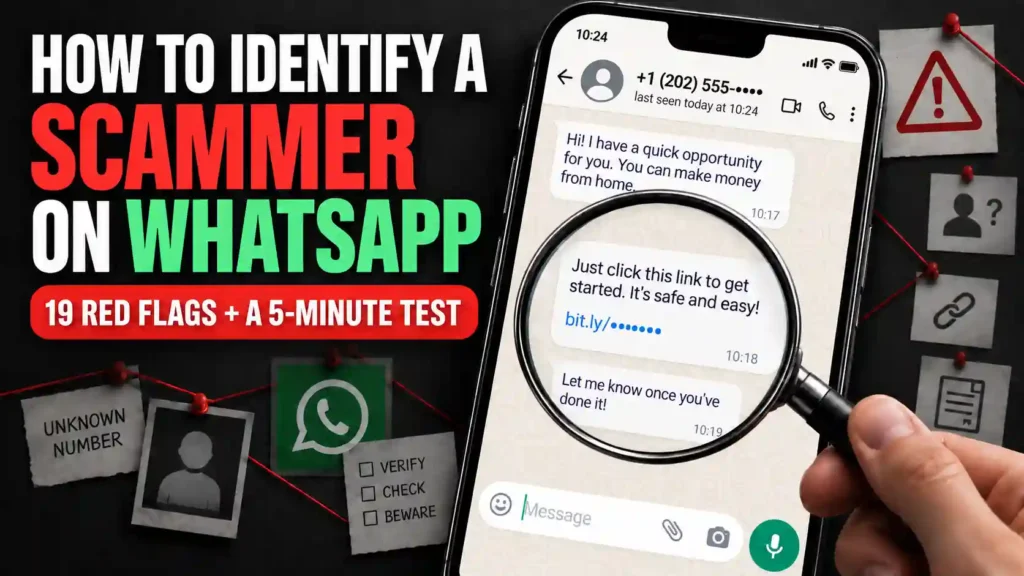
The message arrives without warning:
“Hi Mum, this is my new number. My phone is broken.”
The profile photograph is your child’s. The sender knows your name and sounds convincing. Then, after a few ordinary messages, an emergency appears. A bill must be paid immediately—but their banking app is supposedly not working.
You want to help. You may even feel guilty for hesitating.
But the person behind the messages is not your child.
That is what makes WhatsApp scams so dangerous. Fraudsters no longer rely only on badly written messages or unbelievable promises. They copy real photographs, collect personal details from social media, hijack genuine accounts and follow carefully prepared scripts. Some spend days or even weeks building trust before requesting money, passwords or verification codes.
Fortunately, even a convincing scam usually leaves clues.
Learning how to identify a scammer on WhatsApp means looking beyond the profile picture and examining how the person behaves. Do they create urgency? Avoid a live call? Ask for secrecy? Refuse to answer a private question? Pressure you to send money through a difficult-to-reverse payment method?
This guide reveals 19 red flags, shows you real scam-message examples and gives you a five-minute verification test you can use before replying, clicking a link or sending money.
For now, remember this rule: never allow someone else’s urgency to control your decision. Slow down, verify independently and do not send anything until you know exactly who is on the other side of the conversation.
How to Identify a Scammer on WhatsApp Quickly
A WhatsApp contact may be a scammer if the person:
- Messages you unexpectedly
- Claims to be someone you know using a new number
- Creates an emergency
- Requests money or confidential information
- Asks for a verification code
- Sends an unfamiliar link or attachment
- Offers guaranteed profits
- Refuses independent identity checks
- Wants the conversation kept secret
- Becomes aggressive when you hesitate
- Changes important parts of the story
One unusual detail does not automatically prove fraud. A relative can change their number. A genuine business can contact a customer. Someone can make an honest spelling mistake.
The danger becomes much greater when several suspicious details appear together—especially when the conversation ends with a demand for money, information, account access or immediate action.
Legitimate WhatsApp Message vs Scam Message
The quickest way to evaluate a conversation is to examine how the sender behaves when you slow things down.
| What to examine | More likely legitimate | More likely fraudulent |
|---|---|---|
| Identity | Accepts independent verification | Avoids calls and personal questions |
| Urgency | Gives you time to investigate | Demands immediate action |
| Payment | Uses a recognizable business process | Requests crypto, gift cards or a personal account |
| Verification codes | Never asks for your private code | Requests a six-digit code |
| Links | Directs you to an official app or known website | Pressures you to open an unfamiliar link |
| Questions | Answers clearly and consistently | Changes the subject or becomes hostile |
| Privacy | Allows you to consult other people | Demands secrecy |
| Offer | Makes a realistic proposal | Promises guaranteed profit or easy money |
| Mistakes | Corrects errors with evidence | Changes important parts of the story |
| Support | Uses official support channels | Claims to be support inside an ordinary chat |
This comparison is not a substitute for verification. It simply helps you decide when a message deserves closer examination.
19 Red Flags That Can Reveal a WhatsApp Scammer
Scam scripts change constantly, but the emotional tools behind them are remarkably repetitive. Fraudsters rely on surprise, trust, fear, greed, sympathy and time pressure.
These 19 clues can help you recognize those tactics before you reply, click or pay.
1. The Message Arrives Unexpectedly
An unknown number sends:
“Hello.”
“Is this Sarah?”
“Are you available?”
“Do you remember me?”
A message from an unfamiliar person is not automatically criminal. Nevertheless, vague openings are frequently used to discover which phone numbers are active.
When you reply, you confirm that a real person monitors the number. The sender may then introduce a business opportunity, friendship, romance or investment.
If the message contains no clear identity or legitimate reason for contacting you, you are not required to respond.
2. A Familiar Person Suddenly Has a New Number
The sender claims to be your child, friend, colleague or relative whose phone has been lost, damaged or stolen.
At first, the story may sound reasonable. Then the person needs money.
The photograph and name are not proof. Both can be copied from social media or another WhatsApp account.
Contact the person through their original number. If that fails, call a close relative, workplace or mutual friend. Do not use another contact method supplied by the suspicious sender because the scammer may control it too.
3. The Sender Manufactures an Emergency
Scammers create urgent situations because frightened people make faster decisions.
The sender may claim to be:
- Stranded
- Hospitalized
- Under arrest
- Locked out of an account
- Facing a penalty
- About to lose a job
- Unable to pay an emergency bill
- Helping a relative after an accident
A genuine emergency is possible. However, real urgency does not make verification unnecessary.
Pause and confirm the story independently. If the person refuses to give you a few minutes, that pressure becomes evidence against them.
4. They Ask for Your Six-Digit Verification Code
Never share a WhatsApp registration code with anyone.
A scammer may say:
“I accidentally sent my code to your phone.”
“Send me the six digits so I can recover my account.”
“I’m from support. We need the code to verify you.”
The code may allow that person to register your WhatsApp number on another device. If the takeover succeeds, the criminal can message your contacts while impersonating you.
A verification code sent to your phone is intended for you. Do not forward it, photograph it or read it aloud.
5. The Profile and Story Do Not Match
Look beyond the profile photograph.
Does the account name match the person’s introduction? Does a supposed company representative use an unrelated personal profile? Is the business description vague or filled with exaggerated claims? Does the country code conflict with the story?
Any one of these details may have an innocent explanation. Several inconsistencies together require investigation.
A polished profile can still be fake. Scammers can copy corporate logos, employee photographs and business descriptions in minutes.
6. Their Communication Style Feels Wrong
If someone claims to be a person you know, compare the messages with that person’s normal writing.
Pay attention to:
- Unusual greetings
- Different spelling
- Missing nicknames
- Strange expressions
- Excessive formality
- Unexpected language choices
- Repeated scripted sentences
Grammar alone is not a reliable test. Skilled criminals can write perfectly, while genuine people make mistakes.
The stronger clue is inconsistency. If your daughter always calls you “Daddy” but the sender suddenly uses “Dear Father,” stop and verify.
7. They Repeatedly Avoid Live Calls
Someone using a stolen identity may refuse a voice or video call.
Typical excuses include:
- “My microphone is damaged.”
- “My camera is not working.”
- “The network is too poor.”
- “I’m in a meeting.”
- “I cannot speak because it is an emergency.”
- “My phone can only send messages.”
One failed call proves nothing. Repeated excuses become suspicious when the person also requests money.
A voice note is not conclusive evidence. Audio can be copied, edited or generated artificially. Call the person using a number you trusted before the suspicious conversation began.
8. They Cannot Answer a Private Question
Ask something the real person should know but a stranger could not easily discover online.
For example:
“What did we order the last time we ate together?”
“Where did we meet on Tuesday?”
“What nickname did you give my old car?”
Do not ask about information visible on social media, such as birthdays, schools, workplaces or relatives’ names.
Also, do not include the answer inside your question. “Did we eat pizza?” gives the scammer a 50-percent chance of guessing correctly.
A fraudster may ignore the question, provide a vague reply or become angry. That reaction can be more revealing than the answer.
9. They Demand Secrecy
Secrecy separates victims from people who might recognize the deception.
Be cautious when someone says:
- “Do not tell your husband.”
- “Keep this opportunity between us.”
- “Do not call the bank.”
- “The police cannot help.”
- “You will lose everything if other people find out.”
- “This information is confidential.”
Before sending money, describe the situation situation to someone you trust. An outside person is not experiencing the same emotional pressure and may notice problems you missed.
Honest people may value privacy, but they do not normally forbid you from verifying a financial request.
10. The Payment Method Is Difficult to Reverse
Fraudsters often request:
- Cryptocurrency
- Gift-card codes
- Wire transfers
- Instant bank transfers
- Prepaid cards
- Transfers to personal accounts
- Payments divided among several recipients
These methods allow money to be moved or redeemed quickly.
Be especially suspicious if a supposed company instructs you to pay an individual, lie about the purpose of the transfer or ignore a fraud alert from your bank.
A request to deceive your bank is not a clever payment technique. It is a major indicator that the transaction is unsafe.
11. The Offer Is Unrealistically Good
A stranger promises:
- Guaranteed investment returns
- A high-paying job requiring little work
- A valuable prize you never entered to win
- Discounted luxury products
- Free cryptocurrency
- An instant loan without checks
- An exclusive opportunity available only today
The offer is designed to make caution feel expensive.
Ask yourself: why would this stranger select me for an extraordinary opportunity?
If the answer depends on luck, secrecy or vague claims about your “potential,” assume nothing until you verify everything.
12. You Must Pay Before Receiving Money
You are told that you have won, inherited or earned money. However, you must first pay a fee.
The charge may be described as:
- Tax
- Processing
- Clearance
- Registration
- Insurance
- Account activation
- Withdrawal authorization
- Security verification
After you pay, another obstacle appears. The scammer may even display a fake dashboard showing money waiting for withdrawal.
Do not send additional funds to recover your original payment. That is how a manageable loss becomes a devastating one.
13. A Recruiter Wants Money From You
A fake recruiter may contact you with an attractive remote job and approve you without a meaningful application or interview.
The sender eventually requests payment for:
- Training
- Equipment
- Registration
- Background checks
- Software
- Account activation
- Access to higher-paying tasks
Some task scams initially pay a small amount. That payment is bait. Once you believe the system works, you are pressured to deposit considerably more.
A genuine employer pays employees. It does not require new workers to send cryptocurrency or fund an unknown personal account.
14. A Romantic Contact Quickly Introduces Money
Romance scams may develop slowly. The scammer creates an emotional relationship before producing a financial crisis.
Common patterns include:
- Declaring love unusually quickly
- Avoiding in-person meetings
- Cancelling video calls
- Claiming to work overseas
- Describing repeated emergencies
- Promising a future together
- Asking for loans, gifts or investments
The person may pose as a soldier, doctor, engineer, contractor or business owner trapped in another country.
Affection is not identity verification. Never send money or intimate images to someone whose identity you have not confirmed independently.
15. They Send an Unfamiliar Link or Attachment
A message may imitate a bank, delivery service, government agency, giveaway, retailer or WhatsApp security notice.
The link leads to a page requesting your:
- Password
- Card number
- Banking details
- Identification information
- Email login
- Verification code
Examine the address carefully. Added words, misspellings, unusual endings, hyphens and shortened URLs can hide fraudulent destinations.
However, visual inspection is not enough. A dangerous address can look convincing.
Instead of opening the link, access the organization through its official application or manually enter the website address you already know. This detailed guide to recognizing phishing scams explains how fake messages and login pages steal information.
16. They Ask You to Install Software or Share Your Screen
A supposed bank employee, investment adviser or technical-support agent offers to help by controlling your device remotely.
The software may allow the person to see your screen, operate your phone or watch you enter financial information.
A scammer may also ask you to share your screen during a call. Verification codes and sensitive notifications could become visible.
Never install a remote-access application because an unsolicited WhatsApp contact instructed you to do so. Contact the organization using its verified website, application or phone number.
17. They Pretend to Be WhatsApp Support
An account uses the WhatsApp logo and a name such as:
- WhatsApp Support
- Security Department
- Account Verification
- WhatsApp Technical Team
- Help Centre
The sender claims that your account has violated a policy, experienced an attack or requires immediate verification.
Then they request a code, password, payment or link click.
Do not treat an official-looking logo as proof. If you have an account problem, use the help controls inside WhatsApp rather than following instructions from an unexpected chat.
18. They Become Aggressive When You Hesitate
An honest person should understand why you want to verify an unexpected request involving money or personal data.
A fraudster may:
- Insult you
- Threaten you
- Make you feel guilty
- Accuse you of being disloyal
- Repeat a deadline
- Refuse direct questions
- Warn that verification will ruin the opportunity
This pressure is designed to disable your judgment.
Do not debate the sender. Save the evidence, end the conversation and report the account.
19. The Story Changes or the Demands Keep Growing
Contradictions often reveal a fabricated story.
The person initially says they are in a hospital but later claims they cannot call because they are at work. The payment is supposedly for a relative, yet the receiving account belongs to an unrelated person.
Fraudsters may also begin with a small request. Once you comply, the am ount increases.
Review the complete conversation from the beginning. Inconsistencies are easier to see when the messages are read together.
For a wider examination of the patterns shared by different fraud schemes, review these scam warning signs that can expose a fraudster before you lose money.
The Five-Minute WhatsApp Scammer Test
When a message feels suspicious, do not improvise. Use the following process before taking any further action.
Step 1: Stop the Conversation
Do not click, download, pay or reveal more information.
Silence creates room to think and prevents the sender from learning additional details about you.
Step 2: State the Claim Clearly
Write down what the person wants you to believe.
For example:
“This person claims to be my son using a new number and wants me to transfer money to someone I do not know.”
The story often looks less convincing when reduced to one factual sentence.
Step 3: Verify Through a Separate Channel
Call the claimed person using a previously saved number. Contact a mutual friend or close relative. Open your bank’s official application instead of calling a number provided in the message.
The verification channel must be independent of the suspicious sender.
Step 4: Ask a Private Question
If the person claims to know you, ask for information that is not publicly available.
Do not reveal clues, and do not accept vague answers.
Step 5: Refuse Urgency
Tell the sender that you will not act until verification is complete.
A genuine person may feel frustrated, but they should understand. A fraudster is more likely to increase the threats, guilt or pressure.
How to Investigate an Unknown WhatsApp Number
No website, application or profile detail can instantly prove that a number belongs to a scammer. Criminals use local numbers, foreign numbers, virtual numbers and accounts stolen from genuine users.
Instead, combine several checks.
Check the Country Code
An unfamiliar country code deserves attention when the person claims to be local. However, people travel and retain foreign numbers, so the code is only a clue.
Search the Complete Number
Search the number with its country code. You may find scam complaints, business listings or public profiles.
A lack of results does not prove safety. The number may be new or recently compromised.
Examine the Account Information
Check the name, photograph, business category and description. Look for conflicts between the profile and the story.
Reverse-Search the Photograph
A reverse-image search may reveal that the photograph belongs to a public figure, model, doctor, soldier or unrelated social media user.
Finding the same photograph under a different identity is strong evidence of deception. Not finding it is not proof of legitimacy.
Check the Payment Recipient
If a sender asks for money, compare the recipient’s name with the claimed identity or organization.
Do not accept a complicated explanation for why a company, relative or recruiter needs money sent to an unrelated individual.
Verify the Business Independently
Search for the company’s official website and contact information. Do not use an address, number or review page sent by the stranger.
Scammers can create fake websites and publish fabricated reviews, so examine the business beyond its first search result.
Common WhatsApp Scam Messages and What Exposes Them
Real examples help you recognize manipulation faster.
The “New Number” Family Scam
“Hi Dad, this is my temporary number. My phone fell into water. I need to pay an urgent bill, but I cannot access my banking app.”
What exposes it: a new number, sudden emergency, inability to call and request for payment.
The Verification-Code Trick
“I accidentally sent a six-digit code to your phone. Please send it back immediately.”
What exposes it: no one needs a private authentication code delivered to your device.
The Fake Recruitment Message
“We reviewed your profile and selected you for remote work. Earn $300 daily by rating products. Pay $50 to activate your employee account.”
What exposes it: no proper application, unrealistic earnings and a demand for advance payment.
The Investment Group
“Our experts generate guaranteed daily returns. Deposit today before this opportunity closes.”
What exposes it: guaranteed profit, artificial urgency and payment arranged through a chat.
The Fake Delivery Message
“Your parcel could not be delivered. Pay a $2 redelivery charge using this link.”
What exposes it: an unexpected parcel, unfamiliar link and request for card information.
The Romance Emergency
“My business funds are temporarily frozen. I only need a short-term loan. I will repay you when I travel to meet you.”
What exposes it: avoidance of real-world verification, emotional pressure and a financial crisis.
The Account-Suspension Threat
“Your WhatsApp account will be deleted today. Send the code you received to complete security verification.”
What exposes it: an ordinary account impersonating support and asking for a private code.
How to Report and Block a Scammer on WhatsApp
Save relevant evidence before deleting the conversation. Capture the number, profile, messages, payment instructions, links, dates and transaction details.
The precise labels may vary slightly depending on your phone and application version.
How to Report a WhatsApp Scammer on Android
Open the suspicious chat. Tap the person’s name or number at the top of the screen, scroll down and select Report.
On some Android versions, you can also open the chat, tap the three-dot menu, choose More and then select Report.
Choose the available option to block the account and delete the chat only after saving the evidence you need.
How to Report a WhatsApp Scammer on iPhone
Open the conversation and tap the contact’s name or number at the top. Scroll down, select Report Contact and confirm your choice.
You can block the person from the same contact-information screen.
Why You Should Report Instead of Only Blocking
Blocking prevents that account from contacting you directly. Reporting also provides WhatsApp with information that may help it review the account.
A scammer can return with another number, so treat future messages referring to the original conversation cautiously.
How to Check for Unknown Linked Devices
A criminal who gains account access may link another computer, browser or device. Checking this list can reveal access you do not recognize.
On Android
Open WhatsApp, tap the three-dot menu and select Linked devices. Review every session.
On iPhone
Open WhatsApp, tap Settings and select Linked Devices. Examine the devices listed.
If you do not recognize a device, tap it and log it out. Then secure your account, email and mobile number.
WhatsApp Security Settings to Activate Today
Security features cannot replace judgment, but they can make account theft and unwanted contact more difficult.
Enable Two-Step Verification
Open WhatsApp and go to Settings, Account and Two-step verification. Create a PIN that cannot be easily guessed.
Add a recovery email address you control, and secure that email account with a strong, unique password.
Do not use your birthday, phone-number ending or a repeated sequence as the PIN.
Run Privacy Checkup
Open Settings, select Privacy and look for Start Checkup or Privacy Checkup.
Review:
- Who can contact you
- Who can see your personal information
- Additional chat privacy
- Account protection options
The exact selections should reflect how you use WhatsApp. Someone who receives public customer inquiries may need different settings from someone who uses the application only with family.
Silence Calls From Unknown Numbers
Go to Settings, Privacy and Calls. Activate Silence Unknown Callers if available.
Unknown calls may still appear in your call list, but silencing them reduces surprise and pressure from unsolicited callers.
Control Who Can Add You to Groups
Open Settings, Privacy and Groups. Restrict group invitations if strangers frequently add you to investment, cryptocurrency or employment groups.
Restrict Profile Information
Under Privacy, review who can see your profile photograph, About information, status, last-seen activity and online presence.
Reducing public personal information gives impersonators less material to copy.
Use Device and Chat Locks
Protect your phone with a strong passcode, fingerprint or facial lock. Where suitable, activate WhatsApp’s application or chat-lock options for additional privacy.
What to Do if a Scammer Takes Over Your WhatsApp Account
Account takeover requires immediate action, but panic will not help.
Re-register Your Phone Number
Open WhatsApp and register your phone number again using the six-digit code sent by SMS or phone call.
Entering that code should remove another person who registered the account using your number.
If the attacker activated two-step verification, you may be asked for a PIN you do not know. Follow the recovery instructions displayed by WhatsApp. In some situations, access without that PIN may require a waiting period.
Check Linked Devices
After recovering access, open Linked Devices and remove every session you do not recognize.
Secure Your Email and Mobile Account
Change the password of any connected email account. Contact your mobile provider immediately if your phone suddenly loses service or you suspect unauthorized SIM activity.
Warn Your Contacts
Tell relatives, friends and colleagues not to trust recent requests from your account. Use another communication method if you cannot access WhatsApp.
State clearly that they should not send money, share codes or open links.
Review Financial Accounts
If banking information, cards or passwords were exposed, contact the relevant institutions and change compromised credentials.
Never reuse a password that the attacker may know.
What to Do if You Sent Money or Information
Do not wait for the scammer to promise a refund. Speed can affect whether a payment can be interrupted.
Contact your bank, card issuer, cryptocurrency platform or payment provider immediately. Explain that the transaction resulted from fraud and ask whether it can be frozen, recalled or disputed.
Then:
- Save the complete conversation.
- Record the recipient’s payment details.
- Change exposed passwords.
- Secure your email account.
- Review banking activity.
- Contact your mobile provider if necessary.
- Report the incident to the appropriate authorities.
- Warn anyone else who may be targeted.
- Monitor your accounts for additional activity.
Recovery is not guaranteed, but delaying makes it easier for the criminal to move the money.
Be cautious of anyone who contacts you afterward promising to recover your funds for an advance payment. Recovery scammers specifically search for people who have already been defrauded.
Follow this detailed response plan if you have been scammed and need to act quickly.
How to Protect Your Family From WhatsApp Impersonation
Individual security is useful, but a shared family plan is stronger.
Create a Family Verification Word
Choose a private word or phrase that relatives can use during unexpected emergencies.
Do not post it online, use it as a public password hint or send it through an account you believe has been compromised.
Establish a Payment Rule
Agree that no family member will send money based only on a message.
Every unusual request must be confirmed through a call to a previously saved number or through another trusted relative.
Discuss Current Scam Methods
Older adults are not the only targets. Students, job seekers, investors, business owners and technically confident people can all be manipulated through different stories.
Discussing scams removes shame and makes it easier for relatives to ask for help before paying.
Limit Public Family Information
Photographs, birthdays, school names, travel plans and family relationships can help criminals produce believable messages.
You do not need to disappear from social media, but you should understand what a stranger can learn from your public profile.
Frequently Asked Questions About WhatsApp Scammers
These answers cover the practical questions people commonly ask after receiving a suspicious WhatsApp message.
How can you tell if someone is scamming you on WhatsApp?
Look for several clues together: unexpected contact, urgency, requests for money or codes, suspicious links, secrecy, inconsistent information and refusal to verify an identity independently.
What is the biggest indication of a WhatsApp scam?
A request for money, private information, remote access or a verification code combined with urgency is one of the strongest indicators.
Can a WhatsApp profile photograph prove someone’s identity?
No. Photographs, names, logos and descriptions can be copied from websites or social media accounts.
Why do scammers ask whether I am a particular person?
The “wrong number” opening can confirm that your number is active and create an opportunity to begin a longer investment, friendship or romance scam.
Should I reply to an unknown WhatsApp message?
If you do not recognize the sender and have no legitimate reason to expect the message, the safest option is usually not to respond.
Can replying to a message hack my WhatsApp?
A normal text reply does not usually give someone control of your account. However, it confirms that your number is active and allows the sender to continue manipulating you.
Can opening a WhatsApp message infect my phone?
Simply viewing an ordinary message is different from opening a link, attachment or downloaded file. Avoid unfamiliar links and files, and keep your application and operating system updated.
Can a scammer use a local phone number?
Yes. Criminals can use locally registered numbers, virtual numbers or accounts taken from genuine users.
Does an international number mean the person is a scammer?
No. An unexpected country code is a reason to investigate, not proof by itself.
Can scammers impersonate someone already in my contacts?
Yes. They can copy profile information or hijack the person’s genuine account.
Why does someone want my six-digit WhatsApp code?
The code may allow the person to register your WhatsApp number on another device. Never share it.
Can WhatsApp support ask for my verification code in a chat?
Treat any chat requesting a verification code as fraudulent. Keep authentication codes private and use the help options inside the application when you need assistance.
Is a voice note enough to verify someone?
No. Audio can be copied, edited or artificially generated. Call the person through a previously trusted number.
Can a video call prove the person is genuine?
A live video call provides useful evidence but should not be your only check when significant money or sensitive information is involved.
How can I verify a family emergency?
Call the relative’s usual number, contact another family member and ask a private question that cannot easily be answered from social media.
What should I do with a suspicious WhatsApp link?
Do not open it. Visit the organization through its official application or type its known website address directly.
Can searching a phone number reveal a scammer?
It may uncover complaints or conflicting identities. However, no search results do not prove that the number is safe.
Why do scammers request gift cards?
Gift-card codes can be transferred and redeemed quickly, while recovery is difficult. Legitimate organizations do not demand gift cards for debts, taxes or account fees.
Are WhatsApp investment groups legitimate?
Some discussion groups may be genuine, but guaranteed returns, staged testimonials, artificial urgency and cryptocurrency deposits are serious red flags.
How do I recognize a fake WhatsApp recruiter?
Look for unrealistic pay, immediate acceptance, text-only interviews and requests to pay for training, equipment or account access.
Should I confront a suspected scammer?
No. Preserve evidence, stop communicating, report the account and block it. Confrontation gives the person another opportunity to manipulate or threaten you.
What happens when I report someone on WhatsApp?
Reporting sends relevant account and recent-message information for review. You can generally report and block the contact from the chat information screen.
Can a scammer return after I block them?
Yes. The person may use another number. Be careful if a new contact refers to the earlier conversation.
Can money lost through a WhatsApp scam be recovered?
Recovery depends on the payment method, location and speed of your response. Contact the payment provider immediately, but do not assume the money can always be returned.
How can I protect older relatives from WhatsApp scams?
Establish a family verification word, discuss impersonation methods and require every unexpected financial request to be confirmed through a separate phone call.
Final Thoughts: Trust the Verification, Not the Profile
Knowing how to identify a scammer on WhatsApp is not about distrusting every stranger or panicking over every unfamiliar number.
It is about refusing to let appearances replace evidence.
A copied photograph can look genuine. A hijacked account can belong to someone you know. A professional message can still contain a fraudulent link. Even a familiar voice may no longer provide absolute certainty.
Therefore, when an unexpected contact asks for money, sensitive information, a verification code, software installation or secrecy, stop.
Read the conversation again. Check the identity through another channel. Ask a private question. Contact the organization independently.
Most importantly, never allow the sender to set the speed of your decision.
Five minutes of verification can prevent months—or years—of financial and emotional damage.
Pingback: 21 Job Scam Examples That Look Real—Until They Steal Your Money or Identity - SafeGuard Press
Pingback: Romance Scams: 17 Romance Scammer Red Flags Before You Trust the Wrong Person - SafeGuard Press
Pingback: 21 Scam Warning Signs That Can Expose A Fraudster Before You Lose Money - SafeGuard Press
Pingback: Signs of a Scammer on Facebook: 18 Red Flags Before You Trust the Profile - SafeGuard Press
Pingback: Fake WhatsApp Screenshot: 15 Signs the Conversation Was Edited or Fabricated - SafeGuard Press
Pingback: WhatsApp Scammer List: Check a Suspicious Number, Profile or Message - SafeGuard Press
Pingback: +44 Country Code on WhatsApp: Is It a Scam or a Real UK Number? - SafeGuard Press
Pingback: +92 Country Code on WhatsApp: Is It a Scam or a Real Pakistani Number? - SafeGuard Press
Pingback: +212 Country Code on WhatsApp: Is It a Scam or a Real Moroccan Number? - SafeGuard Press
Pingback: +852 Country Code on WhatsApp: Is It a Scam or a Real Hong Kong Number? - SafeGuard Press
Pingback: 786 Area Code on WhatsApp: Is It a Scam or a Real Florida Number? - SafeGuard Press
Pingback: Romance Scammer Messages: 12 Examples and What the Warning Signs Mean - SafeGuard Press
Pingback: Celebrity Romance Scam: Is That Famous Person Really in Love With You? How to Check Before You Pay - SafeGuard Press
Pingback: How to Tell If a Text Message Is From a Scammer: Check It Before You Click or Reply - SafeGuard Press
Pingback: What to Say to a Scammer: Short Responses, When to Stay Silent, and What to Do Next - SafeGuard Press
Pingback: How to Catch a Scammer: What to Check Before They Disappear - SafeGuard Press
Pingback: 13-Digit +234 WhatsApp Number: Is It a Scam or a Real Nigerian Number? - SafeGuard Press
Pingback: Is It Safe to Open a WhatsApp Message From an Unknown Number? What Actually Happens - SafeGuard Press